Four documents tell you what to install, where, to what standard and when. Between them they answer nearly every question you will have before you start.
The short answer
Four documents: manufacturer’s instructions, specification, drawings, work schedule. They tell you, in order, how to install it, to what standard, where it goes, and when.
The manufacturer’s instructions take priority. First fix is everything buried before the walls and floors close up; second fix is everything you can see afterwards.
Why the instructions beat the specification
It feels backwards — the specification is the document the client paid an engineer to write, and the instructions came free in the box. But three separate things make the instructions win.
Building Regulations approve appliances on the basis of how the manufacturer says they must be installed, so fitting one differently can put the whole installation outside the approval. The warranty is void the moment you depart from them, and a boiler out of warranty in year two is somebody's very expensive problem. And for gas work, Gas Safe registration is judged against the manufacturer's instructions — an installation that ignores them is not merely poor work, it is an unsafe installation on the record.
So the practical rule is: read the instructions before you unpack the appliance, and if the spec and the instructions disagree, you stop and ask rather than choosing.
What first fix actually decides
First fix is pipework, tanks and cisterns in the roof, and anything that will be buried — clipped, routed, tested and capped. Second fix is boilers, radiators, sanitaryware, taps and the connections you make once the plasterer and the decorator have gone.
The reason the split matters is that first fix is the only chance you get. Every decision you make with a wall open — where the pipe runs, how many bends, whether that branch is 15 mm or 22 mm, whether an isolation valve goes in — becomes permanent the moment the plasterboard goes on. Getting a run wrong at first fix costs a day; discovering it at second fix costs a wall.
And cap and test before you leave. Pressure test the pipework, cap the ends, and find the leak now while you can still see the joint. Once the floor is down and the plaster is on, the same leak is found by the customer, through a ceiling.
The work schedule is not somebody else’s problem
The schedule — the programme, on a bigger job a Gantt chart — is what puts your first fix after the carpenter and before the plasterer. Miss your slot and you are either drilling through finished work or holding up four other trades, and the second one gets remembered.
It also tells you what to ask for in advance. If you know at the programme stage that a radiator lands on a stud wall, you can ask the carpenter for a noggin while the wall is still open. That is a thirty second conversation that replaces a plasterboard fixing that would have failed.
Existing buildings lie to you
New build comes with drawings that describe the building. An existing dwelling comes with drawings that describe what somebody intended in 1974, plus fifty years of alterations nobody recorded.
So you survey it. What is the pipe material, and is it all the same material? Where does the main come in, and what is the pressure and flow? Is there a stopcock that actually turns? What is buried in the walls, and is any of it asbestos? Is the existing system open vented or sealed?
Every one of those changes the quote, and finding one of them out on day two rather than at survey is how a job stops being profitable.
What comes next
Level 2 adds the documents you produce rather than read — commissioning records, benchmark certificates, handover packs. Same principle: the paperwork is what proves the work was done properly, long after nobody can see the pipe.
🔢 The numbers worth memorising
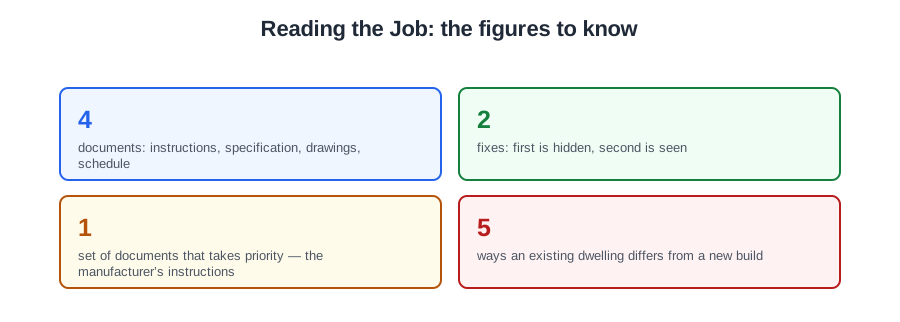
- 4
- documents: instructions, specification, drawings, schedule
- 2
- fixes: first is hidden, second is seen
- 1
- set of documents that takes priority — the manufacturer’s instructions
- 5
- ways an existing dwelling differs from a new build
⚠️ Where people go wrong
- Ranking the specification above the manufacturer’s instructions. The instructions take priority.
- Putting radiators and sanitaryware in first fix. They are second fix.
- Forgetting to cap and test at first fix. It is the last cheap chance to find a leak.
- Treating the work schedule as somebody else’s problem. It is what puts your first fix before the plasterer.
- Assuming an existing property matches its drawings. Survey it first.
📝 8-Question Self-Test
Straight from the Level 1 course question bank. Click an option to see whether you got it right — the explanation appears instantly, and there is nothing to submit.
The manufacturer's instructions take priority — fitting an appliance against them voids the warranty and can breach the regulations.
Manufacturer's instructions take priority — fitting a boiler against them voids the warranty and can breach the regulations.
The work schedule says when each part happens and who is on site when — it is how your first fix lands before the plasterer arrives rather than after.
The manufacturer’s instructions are the one document specific to the thing in the box, and the one that overrides your habits. The other three describe the job; only this describes the appliance.
The work schedule. It is the order and the timing — what happens when, and who is waiting on you.
The scale drawing. It is drawn to a ratio, so a measurement on the paper converts to a real measurement on the wall. This is the one you work from.
The schematic. Not where anything is and not what size — how it connects. Pipe runs are straightened out to make it readable.
The site plan. Where the site is, how you get in, and where things sit on the ground — not what is inside the building.
Going deeper: the same ground at Level 2
Level 1 gives you the shape of this. The Level 2 guides below take it considerably further — the regulations, the calculations and the detail you will need next. Free to read, same as these.
- Start here: Site Preparation for Level 1 Plumbers — the whole unit in one piece
- All 72 Level 1 guides — one per lesson, across all ten units
- The Level 1 glossary — 620 terms in plain English