Using the wrong bit does not just fail. A masonry bit tears timber, and an HSS bit is ruined in seconds in brick — so this is a lesson that pays for itself in bits.
The short answer
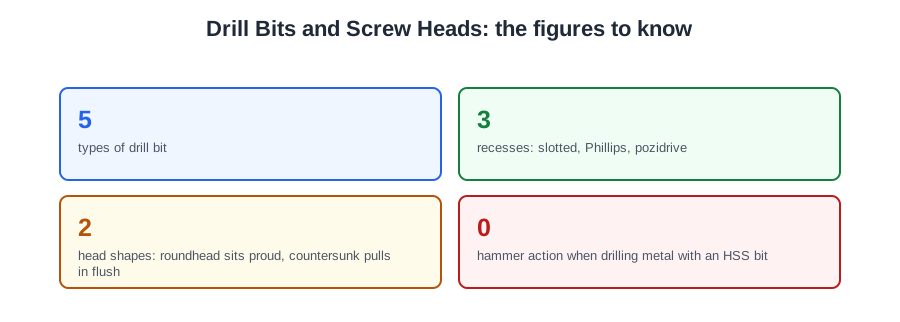
Five bits: twist (HSS) for metal, masonry for brick and block, wood (flat or auger) for timber, tile for tile and glass, core for large holes. Three recesses: slotted, Phillips, pozidrive. Two head shapes: roundhead sits proud, countersunk pulls in flush.
No hammer action with an HSS bit, and no hammer action in a tile.
Why a bit works in one material and dies in another
The difference is not the shape of the flutes — it is the tip. A masonry bit carries a brazed tungsten carbide tip, ground blunt on purpose. It does not cut; it hammers the material into dust and the flutes sweep the dust out. Put that blunt tip into timber and it tears rather than cuts, leaving a ragged hole.
An HSS bit is hardened steel, ground sharp, and it shears a curl of metal off the bottom of the hole. Put it into brick and the cutting edge meets aggregate harder than the steel, and it is gone within seconds — genuinely seconds, not a figure of speech.
The heat point matters too. Steel is hard because it has been heat treated, and heat undoes heat treatment. Run an HSS bit fast in mild steel with no lubricant and it goes blue, and blue means the temper has come out of the tip and the bit will never cut again. Slow speed, steady pressure, a drop of cutting oil.
Phillips and pozidrive, and why the difference exists
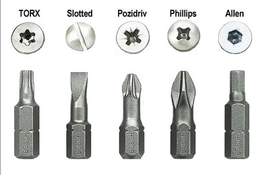
They look almost identical and the extra four lines radiating from the centre mark the pozidrive. The history explains the trap.
Phillips was designed to cam out — to ride up out of the screw at a certain torque, which on a 1930s production line protected the assembly from over-tightening. Pozidrive was designed afterwards to do the opposite: to grip and keep gripping, with parallel flanks that resist riding out.
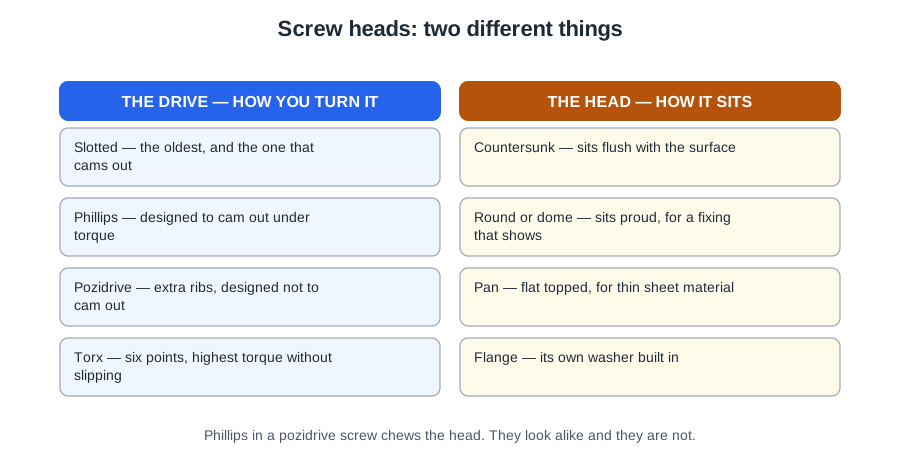
So a Phillips driver in a pozidrive screw does not just slip occasionally. It slips by design, chews the recess into a round hole, and leaves you with a screw that cannot be driven or removed. Look for the four lines before you pick up the driver.
You will also meet Torx on site, especially in boiler casings and appliance panels. Star shaped, six lobed, and it does not cam out at all — which is precisely why manufacturers use it on things they would rather you did not open casually.
Round or countersunk, and what the surface tells you
A screw has one recess and one head shape and these are separate answers. Countersunk pulls itself flush into a tapered seat — right for anything you will cover, and right for a hinge or a plate with countersunk holes already in it. Roundhead sits on top and clamps down, which is what you want through a pipe clip or a bracket with a plain flat hole.
Put a countersunk screw through a plain flat hole and it pulls the plate up and centres itself badly. Put a roundhead into a countersunk seat and it never seats at all.
Core drills and the plug that comes out
A core drill cuts a ring, not a hole. The material in the middle comes out as a plug, which is what makes it possible to cut a 100 mm hole for a flue or a soil pipe without trying to turn a house brick into dust. It also means the plug has to go somewhere — usually into the room on the far side, which is a thing to think about before you break through into someone's bedroom.
What comes next
Level 2 adds the fixings and hole sizes for specific components — flue terminals, brackets, appliance mountings — and every one of them assumes you already know which bit goes in which material. This is the lesson that quietly pays for itself in bits you do not have to buy twice.
🔢 The numbers worth memorising
- 5
- types of drill bit
- 3
- recesses: slotted, Phillips, pozidrive
- 2
- head shapes: roundhead sits proud, countersunk pulls in flush
- 0
- hammer action when drilling metal with an HSS bit
⚠️ Where people go wrong
- Using a Phillips driver in a pozidrive screw. Look for the four extra lines.
- Using hammer action with an HSS bit. It destroys the cutting edge.
- Confusing the recess with the head shape. A screw has one of each.
- Thinking a core drill removes all the material. It cuts a ring and takes out a plug.
- Running a metal bit fast. Heat takes the temper out of the tip — slow speed, steady pressure.
📝 8-Question Self-Test
Straight from the Level 1 course question bank. Click an option to see whether you got it right — the explanation appears instantly, and there is nothing to submit.
A diamond tipped core drill cuts a large clean circle through masonry.
Pozidrive has the extra lines and grips better than Phillips. Countersunk describes the head shape, not the recess.
A diamond tipped core drill makes large clean holes right through masonry — for a flue or an extractor — by cutting a ring and leaving a core.
HSS — high speed steel — is the bit for metal, used without hammer action and often with a cutting fluid.
Both are crosses, but Pozidrive has extra small lines between the arms. It grips better and is the common one on site. A Phillips driver in a Pozidrive screw will chew the head.
Roundhead and countersunk describe the shape of the head; slotted, Phillips and Pozidrive describe the recess the driver goes into. They are two different lists.
A spear point. It scrapes rather than cuts, so the glaze does not chip. A masonry or SDS bit with hammer action would crack the tile.
An SDS bit. It slides and locks into an SDS chuck rather than being gripped, which is why an SDS bit will not fit an ordinary drill and an ordinary bit will not fit an SDS machine.
Going deeper: the same ground at Level 2
Level 1 gives you the shape of this. The Level 2 guides below take it considerably further — the regulations, the calculations and the detail you will need next. Free to read, same as these.
- Start here: Site Preparation for Level 1 Plumbers — the whole unit in one piece
- All 72 Level 1 guides — one per lesson, across all ten units
- The Level 1 glossary — 620 terms in plain English