There is a phrase that gets used on site as though it settles an argument: it's WRAS approved. It does not settle the argument, and the reason it does not is the most useful thing in this module. Approval and suitability are two different tests, a fitting can pass one and fail the other, and the Regulations require both.
This article covers Module 2 of the PlumbMate Water Regulations course: what Regulation 4 actually demands of a material or fitting, which approval routes survive today, the five things that decide whether something is suitable for a particular position, and the corrosion mechanisms that turn a compliant installation into a failed one three years after handover. There is a 10-question mock test at the end.
Regulation 4: two tests, not one
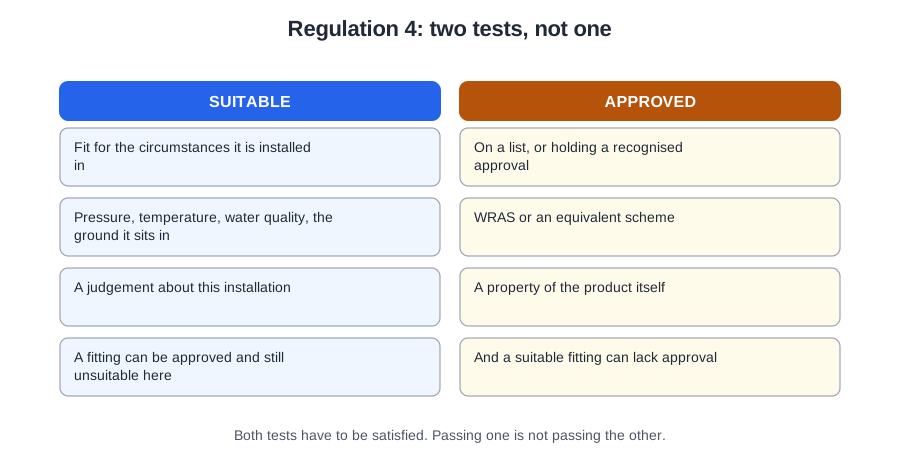
Regulation 4 requires that every water fitting is:
- of an appropriate quality and standard, and
- suitable for the circumstances in which it is used.
Read them as separate hurdles, because that is how they work. The first asks whether the product is a properly made thing that does not spoil water. The second asks whether this properly made thing belongs in this position, in this water, at this temperature, at this pressure. A fitting can sail through the first and fail the second completely.
The standard example is a tap made for gravity supply fitted onto mains pressure. Nothing is wrong with the tap. It is a good tap, made to a standard, entirely appropriate in quality. It is simply not suitable for where it has been put, and it will fail. Approved does not mean suitable, and no certificate on a box can tell you about the circumstances of use, because the manufacturer does not know where you are putting it.
What happened to the approval schemes
This is the part where a lot of older training is out of date. Regulation 4(2)(a) and (b) have been omitted. Those were the paragraphs that made a scheme mark the statutory test. A scheme mark is no longer the legal test of compliance.
What survives are two routes:
- conformity with an appropriate British Standard, or an equivalent national specification of another EEA state; or
- conformity with a specification approved by the regulator.
So where does that leave WRAS, KIWA, NSF and the rest? Exactly where they have always been in practice, and nowhere they were not. They are excellent evidence that a product conforms — a third party has tested it, and a scheme listing is far easier to produce at an inspection than a sheaf of test reports. They are just not, on their own, the statutory test. Use them; do not treat them as the end of the enquiry.
BS 6920 and the materials that touch the water
BS 6920 is the standard for non-metallic materials in contact with water intended for human consumption. It tests whether a material affects the water — taste, odour, appearance, and whether it supports microbial growth or leaches anything it should not.
It is the reason you cannot simply grab any convenient rubber washer, any hose, any sealant. The question is not whether it holds pressure. The question is what it does to the water sitting against it for the next fifteen years.
Two materials are named as unsuitable and worth remembering as named cases rather than inferred ones: lead, and bituminous coatings derived from coal tar. Both were entirely ordinary within living memory, which is precisely why they are called out.
Suitability: the five factors
When you are deciding whether a fitting is suitable for its circumstances, five things are doing the work:
- Temperature. The most common cause of a wrong choice. A fitting rated for cold service on a secondary flow, a plastic pipe rated for one temperature run past an uninsulated flue, a seal that is fine at 20 °C and gone at 80 °C.
- Corrosion. What the water does to the fitting, and what the fitting does to its neighbours.
- Compatibility. Whether the materials in contact can live together — the dissimilar-metals question, and also whether a jointing material attacks a pipe.
- Ageing and fatigue. Whether it survives the number of cycles it will actually see. A fitting on a pumped circuit that starts and stops forty times a day is doing something very different from the same fitting on a cold main.
- Permeability. Whether anything can pass through the material into the water. This is the one people forget, and Module 3 returns to it in earnest, because plastics are permeable to hydrocarbons and that has consequences in contaminated ground.
Workmanship is also a legal requirement
It is easy to read the Regulations as being entirely about products. They are not. Work must be carried out in a workmanlike manner, and that has a definition with content: to an appropriate British Standard, to a specification approved by the regulator, or to a method approved by the water undertaker.
In other words, “workmanlike” is not a vague appeal to craftsmanship. It points at documents. The right fitting installed badly is a contravention just as surely as the wrong fitting installed beautifully.
Corrosion, and the two mechanisms worth separating
More compliant-on-day-one installations are ruined by corrosion than by anything else in this module, and two mechanisms account for most of it. They are frequently confused, and the way to keep them apart is to count how many metals each one needs.
Galvanic corrosion needs two metals
Galvanic corrosion requires two dissimilar metals in electrical contact with an electrolyte — and the water is the electrolyte. A small current flows, and the less noble metal is eaten away to protect the more noble one.
Direction matters enormously. Galvanised steel downstream of copper is the worst arrangement you can make. Copper dissolves into the water in tiny quantities, deposits on the zinc surface downstream, and sets up countless small galvanic cells all over the inside of the steel pipe. The steel does not fail at the joint; it fails everywhere. Reverse the order — galvanised upstream, copper downstream — and the effect largely disappears.
The remedy where you cannot avoid the pairing is to break the electrical path: an insulating connector, or a gunmetal fitting between the two metals. Note what that does and does not do. It stops the current. It does nothing about the copper already in solution, which is why order still matters even with an insulating joint.
Dezincification needs only one metal, and the water
Dezincification is different. It needs no second metal at all. Certain waters selectively leach the zinc out of a brass alloy, leaving behind a porous copper skeleton that keeps its shape and loses its strength. The fitting looks intact right up until it fails, and it often fails at pressure without warning.
That failure mode is why the Regulations are strict about position. Concealed fittings and mechanical backflow prevention devices must be of gunmetal or a dezincification-resistant material. The logic is precisely about consequence: a fitting you can see and reach can be replaced when it weeps; a fitting buried in a wall or a floor cannot, and a backflow device that has quietly turned to sponge is protecting nothing while appearing to protect everything.
DR material has a specification worth knowing rather than gesturing at:
- DRA quality brass;
- a dezincification-resistant depth of not less than 200 microns;
- marked CR or DRA;
- tested to ISO 6509.
If you can read the mark, you can answer the question on site. That is the point of the marking requirement.
The corrosion you cause yourself
One more, and it is the one most within your control. Excessive flux is the usual cause of internal corrosion in new copper installations. Flux is an acid. It is there to clean the joint, and what is left after the joint is made carries on doing what acid does, from the inside, at the point where the pipe is thinnest and hottest.
Two habits deal with it: use the least flux that will make the joint, and flush the system thoroughly before it goes into service. Flushing is not housekeeping. It is the removal of a corrosive residue, and Module 4 treats it as a required step rather than a courtesy.
The standards worth knowing by number
A short list, because these come up in assessment and on site:
- Solder: BS EN 29453 — and it must be lead-free for any pipework carrying water for human consumption.
- Jointing compounds: BS 6956 Part 5.
- PTFE tape: BS 6974.
- Underground stopvalves, 15–50 mm: BS 5433.
- Above-ground stopvalves: BS 1010.
The split between BS 5433 and BS 1010 is not arbitrary. A valve below ground is operated rarely, sits in a chamber that fills with water and silt, and has to work on the day it is needed after a decade of not being touched. That is a different design problem from a valve on a wall, and it gets a different standard.
The loose washer plate rule
One small requirement with a large reason behind it: stopvalves, servicing valves and drain taps must not have a loose washer plate.
A loose plate can detach and sit in the seat, or be carried downstream. Either way the valve no longer closes reliably — and every one of these three fittings exists precisely so that somebody can stop the water in a hurry. A valve that might not shut is worse than no valve, because the system was designed on the assumption that it would.
Putting the module together
Two tests, and the second is the one that needs your judgement. Quality and standard is answered by the product: a British Standard or an approved specification, with a scheme listing as good evidence of it. Suitability is answered by the position: temperature, corrosion, compatibility, ageing and fatigue, permeability.
Then the corrosion mechanisms, which are where compliant work goes wrong later. Two metals and an electrolyte gives you galvanic attack, and the order of the metals decides how bad it is. One brass fitting and the wrong water gives you dezincification, which is why anything concealed or protecting against backflow has to be gunmetal or DR.
📝 10-Question Mock Test
Click an option to see whether you got it right. Explanations appear instantly — no submitting at the end.
Two separate hurdles. The first is about the product; the second is about the position it is being put in. A fitting can pass the first and fail the second completely.
The classic example of the two tests coming apart. Nothing is wrong with the tap; it simply does not belong where it has been put. No certificate can speak to circumstances of use, because the manufacturer does not know where you are fitting it.
Those paragraphs were omitted, so a scheme mark is no longer the legal test. It remains excellent evidence — far easier to produce at an inspection than a sheaf of test reports — but it is not the end of the enquiry.
It tests what a material does to the water — taste, odour, appearance and microbial growth — rather than whether it holds pressure. Lead and bituminous coatings derived from coal tar are separately named as unsuitable.
Count the metals. Two dissimilar metals in contact with an electrolyte gives galvanic attack. Dezincification needs no second metal at all — certain waters leach the zinc out of a brass alloy, leaving a porous copper skeleton that keeps its shape and loses its strength.
Direction matters. Copper dissolves in tiny quantities, deposits on the zinc downstream and creates countless small cells, so the steel fails all along its length rather than at the joint. The remedy where the pairing is unavoidable is to break the electrical path with an insulating or gunmetal connector.
Because of consequence. A visible fitting can be replaced when it weeps; a buried one cannot, and a backflow device that has quietly dezincified is protecting nothing while appearing to protect everything. DR material is DRA quality, not less than 200 microns, marked CR or DRA, tested to ISO 6509.
Flux is an acid. It cleans the joint and then carries on doing what acid does, from the inside. Flushing is not housekeeping — it is the removal of a corrosive residue, which is why it is a required step rather than a courtesy.
BS 5433 underground for 15–50 mm, BS 1010 above ground. The split is not arbitrary: a valve in a chamber that fills with water and silt, operated once a decade, is a different design problem from a valve on a wall.
Every one of these three fittings exists so that somebody can stop the water in a hurry. A valve that might not shut is worse than no valve, because the rest of the system was designed on the assumption that it would.
The habit worth building is to ask the second question every time. The box tells you about quality and standard. Only you can answer whether the fitting is suitable for the temperature, the pressure, the water and the metals it is about to live next to.
The one to carry away: galvanic corrosion needs two dissimilar metals; dezincification needs only one and the water. That is why concealed fittings and mechanical backflow devices must be gunmetal or DR — you cannot inspect what you cannot reach, and a dezincified device fails without ever looking wrong.