Regulation is the part of a renewables syllabus people revise last and get caught by first. It is not difficult material — it is just a lot of separate documents, each with a narrow scope, and the marks go to knowing which one governs what.
This article covers Module 3 of the PlumbMate solar thermal course: which Parts of the Building Regulations apply and which do not, MIS 3001 and the MCS documents, permitted development and the four situations where it does not simply apply, the Water Regulations and legionella, working at height, safe electrical isolation, and handling glycol. There is a 10-question mock test at the end.
The Building Regulations
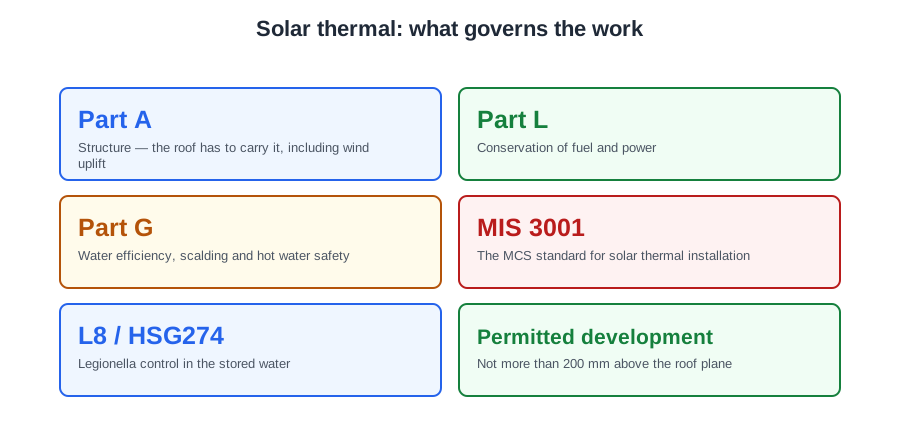
A solar thermal installation touches several Parts at once. The straightforward recall is which is which:
- Part A — Structure. Loading a roof with collectors and frames, and forming openings for pipework without weakening structural elements.
- Part C — Moisture. Weatherproofing and making good every penetration through the external envelope.
- Part G — Sanitation and hot water safety. Unvented storage, discharge arrangements and protection against scalding.
- Part L — Conservation of fuel and power. Insulation, heat-loss limits for cylinders and pipework, efficiency and controls.
- Part P — Electrical safety. The supply and its installation.
Unvented storage
Where the system includes an unvented cylinder — and many do — installing it is notifiable building work. To self-certify you must be in a competent person scheme, which requires the unvented (G3) qualification; otherwise building control must be notified before work starts (Approved Document G 3.40–3.42). Manufacturers require it for servicing. MCS registration covers the microgeneration side and proves nothing at all about unvented competence. Both may be needed on the same job, and they are separate tickets.
Demonstrating compliance
Most domestic work is self-certified through a competent person scheme: the registered installer certifies, the scheme notifies the local authority, and the customer receives a compliance certificate.
Be clear that this is not the same document as an MCS certificate. They prove different things, and conflating them causes real trouble when a grant, a warranty or a house sale depends on the right one being produced.
MCS, MIS 3001 and the standards framework
The Microgeneration Certification Scheme is a quality scheme, not a legal requirement. You can lawfully install a solar thermal system without being registered.
But MCS is the gateway to incentive schemes — the grant and support arrangements that make a renewable installation affordable — and those almost always require both the product and the installer to be certified. An uncertified installation is ineligible, however well it is installed. The schemes themselves change with government policy, so treat the current one as a fact to look up rather than memorise; what does not change is the eligibility rule.
The documents, kept apart
- MIS 3001 — the installation standard: design, sizing, installation, commissioning and handover. The backbone of the whole course.
- MCS 004 or the CEN Solar Keymark — product certification for the solar heating products themselves.
- MCS 012 — mounting and flashing kits, with declared wind uplift resistance and weathertightness, valid only within the limitations of the certificate.
- MCS 024 — the solar domestic hot water energy calculation.
Other standards you will meet
BS EN 12975 / 12976 / 12977 for collectors, factory-made systems and custom-built systems. BS EN 15316-4-3 for the energy performance method. BS EN 12897 and BS 1566-1 for storage vessels. BS EN 1991-1-4 (Eurocode 1) for wind actions. BS 5918 for solar heating practice, BS 8558 for water services design and BS 7671 for the electrical work.
Commissioning is part of the standard
MIS 3001 requires commissioning to follow a documented procedure with a completed checklist, and requires the flow rate to be accurately indicated and recorded. Commissioning failure is one of the commonest non-conformities found at MCS audit — and it is almost always a documentation failure on a system that works perfectly well.
Planning and permitted development
Permitted development is planning permission granted nationally by statutory instrument. Provided every condition is met, no application is needed, and most domestic solar installations qualify. Because it comes from an instrument that gets amended, always confirm the current position rather than working from memory.
The dimensional conditions in England
- Pitched roof: equipment must project no more than 200 mm from the roof slope, and must not sit above the highest part of the roof, excluding the chimney.
- Flat roof: the highest part of the equipment must be no more than 600 mm above the highest part of the roof.
A ballasted frame at a steep tilt breaches the flat-roof figure easily, so check the finished height before committing to a tilt angle.
Where the rights do not simply apply
Four situations, and they are the ones the marks are in:
- Listed buildings and scheduled monuments. Permitted development does not apply within the curtilage; listed building consent is required.
- Conservation areas and World Heritage Sites. Equipment must not be fitted to a wall or roof fronting a highway. A rear or side slope will often still qualify, so establish which elevations front a highway at survey rather than assuming the whole property is barred.
- Article 4 directions. A local authority can withdraw the rights in a specified area, and a planning condition can do the same on an individual property.
- Flat roofs on Article 2(3) land — conservation areas, AONBs, National Parks, the Broads, World Heritage Sites. Solar equipment there requires prior approval from the local planning authority: lighter than a full application, but still a submission that has to be decided.
There is also a standing condition to site equipment so as to minimise its effect on the amenity of the area, and to remove it when it is no longer needed for microgeneration.
Water Regulations, legionella and scalding
Filling the primary
A sealed primary containing inhibitor and glycol is exactly what the Water Supply (Water Fittings) Regulations exist to keep out of the mains. Fill through a temporary connection with suitable backflow protection and physically disconnect it afterwards.
A flexible filling loop left coupled at both ends is one of the commonest contraventions found on domestic systems, and it is trivially avoidable.
Why legionella gets its own lesson
Solar stores are more likely than boiler-fed ones to sit at moderate temperatures for days at a time during low-solar spells. Stagnant or slow-moving water at moderate warmth is precisely what the organism needs, so the control regime matters more here, not less.
The control regime
- Store at 60 °C or above at the cylinder outlet.
- Get hot water to every outlet at 50 °C or more within a minute, and back on any secondary return at 50 °C or more (55 °C in healthcare for both). Both figures are guidance from BS 8558 and HSE (HSG274 Part 2).
- Fit thermostatic mixing valves at outlets, so a store hot enough to disinfect is not hot enough to scald a user.
- Where solar alone cannot reach it, the backup heater must pasteurise the whole volume, daily.
The 1999 Water Regulations guidance (G18.2 and G18.4) is older: it asks for distribution at 55 °C and 50 °C within 30 seconds where practicable. BS 8558 (2015) and HSE’s HSG274 use 50 °C within a minute, which is what you work to.
Daily, not weekly — and the reason is worth carrying, because it is the thing that transfers. The interval follows from how predictable the store temperature is. A heat pump holds 45 to 52 °C every day of the year, so the risk is steady and weekly can be justified. A solar store holds whatever the sun gave it: 65 °C in July, 25 in a dull January week, and nobody knows on any given morning which it was. “It was probably hot yesterday” is not a control measure.
Time the cycle late in the day and the sun has already done most of the lift, so the immersion runs for minutes rather than an hour. The solar contribution reduces what discharging the duty costs; it does not remove the duty.
Design out dead legs and stagnant sections, use approved materials, maintain insulation so the system does not cool into the growth range, and use circulation loops on larger systems. The duty to assess and act on the risk sits under ACOP L8; BS 7592 gives the sampling procedure.
Working at height and roof work
Under the Work at Height Regulations 2005, working at height means any place where a person could be injured by falling from it — even if it is at or below ground level. There is no two-metre threshold, whatever people remember, and that is a favourite exam point.
Ladders
Suitable grade, good condition, and effectively secured against movement. Where used for access, a ladder should extend at least 1 m above the landing point to give a handhold at the moment of stepping off. Formal inspection every three months, plus a check by the user before every use — the pre-use check is what catches damage done since the last formal one.
Harnesses
Inspect before and after every use: abrasions, cuts, tears, burns, mould, fraying, discolouration and chemical damage. Check all stitching for pulling, loosening or cut thread, and buckles for rust, cracks, wear or distortion.
A harness subject to paint overspray must not be used. The paint can hide damage and attack the webbing, and you cannot inspect what you cannot see.
Abrasive wheels
Carry out a ring test before use — tap the wheel with something non-metallic and listen for a clear ring. Fit only manufacturer-recommended parts. Keep the work rest no more than about 3 mm (⅛ in) from the wheel, and move the guard's adjustable tongue in as the wheel wears.
Safe electrical isolation
No electrical work is undertaken until safe isolation has been achieved and maintained for the duration of the task, and only by someone trained and competent.
The sequence
- Identify the correct circuit, board, isolator or equipment. Do not rely on labels alone.
- Inform anyone affected that the supply is going off.
- Switch off the appropriate isolator or protective device.
- Secure it with an approved lock-off device, and attach a warning tag naming the person who applied it.
- Prove the voltage indicator on a known live source.
- Test dead — on single phase, line to earth, line to neutral and neutral to earth, all reading 0 V.
- Re-prove the indicator on a known live source.
Step 4 is the one most often dropped. Step 7 is the one that catches an indicator which failed during the test — without it, a faulty tester reads dead on a live circuit and you have proved nothing at all.
The instrument
Follow HSE GS38: probes with a barrier preventing contact with live terminals, exposed metal tips not exceeding 4 mm with 2 mm strongly recommended, leads carrying high breaking capacity fuses typically not exceeding 500 mA, and coloured to tell them apart. Test equipment to BS EN 61010-2-033.
Never use a neon screwdriver as a voltage indicator.
On completion: remove tools, replace covers, confirm the area is clear, then remove the lock-off and restore — re-testing the indicators at every stage.
Glycol, COSHH and safe handling
Glycol is a hazardous substance, and the primary document is the manufacturer's safety data sheet for that specific product — different products have different hazard profiles. It gives the hazards, the PPE, first aid, the spillage procedure and the disposal route, and a COSHH assessment is built from it.
Ethylene glycol is considerably more toxic if ingested than the propylene glycol usually specified for these circuits. That is why the choice is deliberate, and why decanting into unmarked containers is such a serious failing.
Spillage
Contain, protect, absorb, dispose. Contain first so it cannot spread or reach a drain, put on the PPE the data sheet identifies, absorb with a suitable absorbent, and dispose of the contaminated material through the proper waste route.
Never flush a spill with water. That spreads it and washes it into drains, which is an environmental offence. Glycol is also extremely slippery, so a spill is an immediate slip hazard as well.
Other hazards on this job
Burns from steam and from pipework at stagnation temperature. Cuts from thin aluminium collector fins and pressed sheet edges — wear the right gloves whenever panels come off. Eye protection for resin anchor fixings, where the resin is an irritant dispensed under pressure and drilling throws up debris.
Labelling
Label the installation with the presence and type of heat transfer fluid, the fill pressure, safe isolation points and warnings such as high-temperature pipework — at the pump station, the cylinder connections and any accessible isolation point. It prevents the two commonest maintenance errors: refilling with the wrong fluid, and grabbing pipework far hotter than a heating circuit.
What comes next
Module 4 is the survey and the sizing: what the survey has to establish, roof coverings and their defects, the three structural loads and how wind uplift is assessed, hot water demand, sizing the array and the store, and the MCS calculation the customer is later held to.
📝 10-Question Mock Test
Click an option to see whether you got it right. Explanations appear instantly — no submitting at the end.
Part J covers combustion appliances and flues, and a solar collector burns nothing. It is the standard distractor because it appears in every other heating syllabus.
Installing an unvented cylinder is notifiable building work. A competent person scheme, which requires the G3 qualification, lets you self-certify it; otherwise building control must be notified before work starts. MCS covers the microgeneration side and proves nothing about unvented competence — they are separate tickets and both may be needed on one job.
You can lawfully install without it. But incentive and grant schemes almost always require both the product and the installer to be certified, so an uncertified installation is ineligible however well it is installed.
MIS 3001 covers design, sizing, installation, commissioning and handover. MCS 004 is product certification, MCS 012 covers mounting and flashing kits, and MCS 024 is the energy calculation.
600 mm above the highest part of the roof. The pitched-roof figure is 200 mm projection from the slope. A ballasted frame at a steep tilt breaches the flat-roof figure easily, so check the finished height before fixing a tilt.
A conservation area is Article 2(3) land, and solar equipment on a flat roof there requires prior approval. It is lighter than a full planning application but is still a submission that must be decided.
Temporary, backflow protected, and disconnected once the system is full. A flexible loop left coupled at both ends is one of the commonest contraventions found on domestic systems.
Store hot, deliver safe. 60 °C at the cylinder outlet, 50 °C or more at the outlets within a minute (55 °C in healthcare), and thermostatic mixing valves so a store hot enough to disinfect is not hot enough to scald. Where solar cannot reach it, the backup pasteurises the whole volume.
The Work at Height Regulations 2005 define it by the possibility of injury from a fall, not by a height. The two-metre figure people remember comes from older legislation and is a favourite exam trap.
Without the re-prove, a tester that died between the first proving and the dead test gives you a confident zero on a live circuit. It is the step that turns the procedure into proof rather than a ritual.
None of this material is hard. It is just a lot of separate documents with narrow scopes, and the marks go to knowing which governs what: A for structure, C for weather, G for hot water safety, L for heat loss, P for electrical — and J for nothing at all, because nothing here burns.
The two that catch people out are worth repeating. There is no minimum height for work at height. And a Building Regulations compliance certificate is not an MCS certificate.