Commissioning is confirming and correcting, not recording. The paperwork matters — MCS audits fail on it regularly — but the paperwork is the residue of a process, and a form filled in on a system nobody actually checked is worse than no form at all.
This article covers Module 6 of the PlumbMate solar thermal course: what to check before a drop of fluid goes in, flushing filling and purging, cold fill pressure and proving the freeze protection, setting the controller and verifying flow, and what the customer goes away with. There is a 10-question mock test at the end.
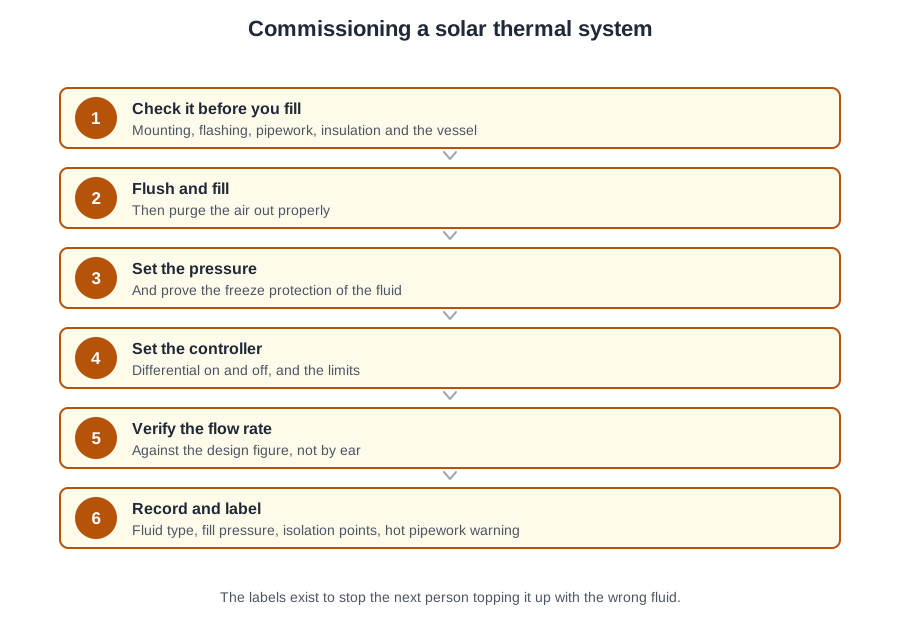
Before you commission
MIS 3001 requires commissioning to follow a documented procedure with a completed checklist. Working to memory is how steps get missed, and missed commissioning steps are among the most common non-conformities found at MCS audit — usually on a system that works perfectly well.
The pre-fill checks
- Mechanical: collectors securely mounted within the mounting kit's limitations; pipework complete, supported and correctly jointed; insulation continuous and UV protected; all penetrations weathered.
- Components: pump station mounted and accessible; expansion vessel correctly sized and fitted on the return with its connecting pipe left bare; pressure relief valve fitted with a safe, visible discharge; non-return valve fitted the right way round; isolation valves present for servicing.
- Sensors: collector sensor in the manufacturer's pocket at the flow outlet; store sensor low, in the zone the solar coil heats; sensor cables routed clear of mains cabling.
- Electrical: supply confirmed adequate and correctly protected; spur correctly rated and labelled; safe isolation available.
- Expansion vessel pre-charge set and verified with the water side depressurised to zero.
Then isolate the pump before filling begins, so it cannot be started dry. And have the fluid safety data sheet on site before opening the drum — it is the document that tells you the PPE and the spillage procedure, and it is no use in the van.
Everything on that list is easy to reach now. After filling, half of it is under pressure and hot.
Flushing, filling and purging
Air is the enemy of a solar primary. It collects at high points, blocks circulation, causes noise, and corrodes. Removing it properly at commissioning avoids most of the callbacks a new system generates in its first season.
Flushing
Flush the circuit to remove flux residues, swarf, jointing compound and debris before the heat transfer fluid goes in. Debris left behind ends up in the pump, the flow meter and the narrow passages of the heat exchanger — all places it is expensive to remove later.
The hydraulic test
Before the system is dressed and insulated, pressure test it and hold the pressure while you inspect every joint. Anything weeping is fixed and then the circuit is retested. A repair is not accepted on the strength of having been made, and a second leak sitting behind the first is common enough that assessments ask for the retest by name.
Only then insulate. Covering a joint before it has held pressure means taking the insulation off again to find the leak.
Filling and purging
Fill through a temporary connection with backflow protection, and disconnect it afterwards — a filling loop left coupled is a Water Regulations contravention. Use a filling and flushing station to circulate at a velocity high enough to sweep air along with the flow to the vents. Purge until the fluid runs clear and free of bubbles and the flow through the meter is steady, not surging.
Fluid
Use the correct pre-mixed concentration, and keep the pump isolated until the circuit is full. Never fill a hot collector: filling in the early morning, in the evening, or under a cover avoids flashing the fluid to steam and being scalded.
Pressure, glycol and freeze protection
Setting the pressure
Fill to the design cold-fill pressure, which comes from the static height of the system plus a margin — roughly a tenth of a bar per metre of height, plus typically half a bar. The margin is what keeps the highest point positively pressurised, so air cannot be drawn in and the fluid cannot boil at low pressure on a hot afternoon.
Record the figure, because every future pressure check is measured against it. A gauge reading means nothing on its own and a great deal against the value the system was left at.
Verify the safety devices
Confirm the pressure relief valve operates and that its discharge terminates safely and visibly. A discharge that runs into a hidden gully means a system can lose pressure and freeze protection all summer with nobody noticing until the first hard frost splits a collector.
Prove the glycol
Test the concentration with a refractometer and record the freezing point achieved. A typical target is protection to around −20 °C, but the real requirement is what the fluid manufacturer specifies for the location. Do not judge by colour or by how much went in — a refractometer reading is a number you can write down; "we put antifreeze in" is not.
Normal pressure variation
A solar circuit's pressure moves by roughly 0.2–0.3 bar between cold and hot. A reading taken on a hot afternoon and compared against a cold fill figure will always differ, and that difference is not a fault. Compare like with like, or allow for the swing.
Check for leaks under pressure
Inspect every joint, connection and component once the circuit is at working pressure and has been through a heat cycle. Joints that are sound cold can weep once thermal movement has worked them, so a leak check before the system has ever been hot is only half a check.
Setting the controller and verifying flow
The differential
Typical settings are a switch-on difference of 6–8 K and a switch-off difference of 2–4 K. The gap between them — the hysteresis — is what prevents the pump short-cycling on and off around a single threshold. Set them too close and the pump hunts; set switch-on too high and useful low-level gain is thrown away.
The maximum store temperature
Set the store limit so the controller stops charging before the cylinder overheats, typically around 60–65 °C. This is a protection setting, not a comfort one, and it must be consistent with the scald protection at the outlets — the store is deliberately hotter than anything that reaches a tap, which is what the mixing valves exist to manage.
Set and record the flow rate
Set the flow rate to the design figure using the flow meter — 0.5 L/min/m² at the low end, 0.6 typical, 0.7 at the high end of collector area — and record it. MIS 3001 requires the flow rate to be accurately indicated and recorded, and it is the value every future performance question is measured against.
Vent again once hot
Dissolved air comes out of solution as the fluid warms, so a system vented cold will have more air in it an hour after it starts running. That second vent is what separates a system that settles down from one that generates a callback in week three.
Observe operation
Let it run and confirm the pump starts and stops at the set differentials, that flow direction is correct, and that the temperature difference across the collector is sensible.
Then set the auxiliary heat source to fire in the late afternoon or evening, so solar has the whole day to contribute first. Getting this backwards is the commonest reason a technically sound installation underperforms — and nothing on it is broken.
Records, handover and the customer
What must be recorded
- The completed commissioning checklist.
- Flow rate set, and the fact it was indicated and recorded.
- Cold fill pressure and expansion vessel pre-charge.
- Glycol concentration and the freezing point measured.
- Controller settings: switch-on and switch-off differentials, maximum store temperature.
- Confirmation that safety devices were verified and the system leak-checked hot.
Documents to hand over
Manufacturer instructions for every component, the system schematic, the commissioning record, warranty documents, the recommended maintenance schedule, the performance estimate produced by the MCS calculation, and — where an unvented cylinder is involved — the Building Regulations compliance certificate. Where MCS applies, the MCS certificate too; it is a different document from the compliance certificate and both may be needed.
The two documents people are asked to name
- Arriving to maintain a system for the first time, the essential documents are the manufacturer's installation and servicing instructions and any previous servicing and maintenance reports. Without them you do not know what was commissioned or what has already been changed.
- After every service visit the customer receives a servicing and maintenance report. BS 5918 puts it plainly: a copy of the inspection record should be left with the client.
Label the plant
Presence and type of heat transfer fluid, fill pressure, safe isolation points, and warnings for high-temperature pipework — at the pump station, the cylinder connections and any accessible isolation point. This prevents the two commonest maintenance errors: topping up with the wrong fluid, and grabbing pipework far hotter than a heating circuit.
The demonstration
Show the customer how to read the controller, where the isolation points are, what normal operation looks like, and what to do if something seems wrong.
Above all, explain seasonal variation: excellent summer output, a useful contribution in spring and autumn, and little in midwinter. A customer who has not been told this reads entirely normal December behaviour as a fault — and that callout is not a technical problem, so it cannot be fixed technically.
What comes next
Module 7 is maintenance and fault finding: routine servicing to BS 5918, stagnation and fluid degradation, and a method for working a fault from the symptom — including the callouts that turn out not to be faults at all.
📝 10-Question Mock Test
Click an option to see whether you got it right. Explanations appear instantly — no submitting at the end.
A circulator run dry damages its bearings and seal in seconds. Isolating it is a two-second step that is easy to forget once filling is under way.
A repair is not accepted on the strength of having been made, and a second leak behind the first is common. Insulating over an untested repair means stripping it off again to find the next one.
Fill in the early morning, in the evening, or under a cover. It is a safety step rather than a technical one, and it is why covering the collectors is the first action when draining as well.
Static head is roughly a tenth of a bar per metre, so 7 m is about 0.69 bar. Add the 0.5 bar margin and you get about 1.2 bar. The margin is what keeps the highest point positively pressurised so air cannot be drawn in.
0.25 bar is squarely within normal. Compare readings taken in comparable conditions, or allow for the swing — otherwise every hot-afternoon reading looks like a fault.
Adding neat glycol to a filled system does not distribute reliably — you get a strong pocket and a weak circuit. Refill with fluid pre-mixed to specification and verify the freezing point again.
More is not better. The circuit carries less heat per litre and the pump works harder to move it, so the system quietly delivers less while appearing entirely healthy. It is why concentration is a measurement, not a judgement.
A system vented cold has more air in it an hour after it starts running. The second vent is what separates a system that settles down from one that generates a callback in week three.
Heat the store in the morning and the collector faces a hot cylinder all day, so it collects little and runs hot doing it. Getting this backwards is the commonest reason a technically sound system underperforms — and nothing on it is broken.
You need to know what the system is and what has already been done to it. The instructions give the commissioning values and service requirements; previous reports tell you what has changed and when the fluid was last tested.
Commissioning is where a solar system either becomes maintainable or does not. Every number written down — cold fill pressure, flow rate, freezing point, the two differentials — is a value some future engineer will measure against. A record that says "commissioned, all OK" gives them nothing.
And the last conversation matters as much as the first. Seasonal variation explained at handover is a customer who understands their system; unexplained, it is a callout in December on a system that is working exactly as designed.