A method beats a hunch. That is the whole of this module, and the reason is that solar faults divide into three groups that look identical from the doorstep: things that are broken, things that are set wrong, and things that are working exactly as designed.
This article covers Module 7 of the PlumbMate solar thermal course: routine servicing to BS 5918, stagnation and fluid degradation, working a fault from the symptom, the faults with one distinctive sign, and what to do after rectification. There is a 10-question mock test at the end.
Routine servicing
A solar primary lives a harder life than a heating circuit: it is outdoors, it swings between ambient and stagnation, and its fluid degrades with heat. Maintenance is what keeps that from turning into failure.
The BS 5918 shape of an inspection
The standard splits the visit in two, which is a useful way to work through it.
Outside the building: the collector glazing is clean; the glazing is sound and free of cracks; there is no evidence of serious corrosion; any paintwork is sound; roof fixings are firm and the covering beneath the collectors is free from cracks and abrasions.
Inside the building: the sensing devices are firmly and properly in place; there are no signs of corrosion; labels are in position and updated at the time of the visit; and the life of the heat transfer fluid has not expired.
Add to those the post-commissioning items: unions and glands free of weeps, glazing seals weathertight, all air expelled, sealed systems at the correct pressure, controls and indicators operating, the pump running without undue noise, insulation firmly attached, and no condensation or damp spots — particularly around pipes and fixings in the roof space, which is where a slow leak shows up first.
The annual checks
- System pressure against the recorded cold fill figure. A slow fall means a leak, a weeping PRV or a failed expansion vessel — and a system running below pressure will draw air in and can boil at the collector.
- Collectors and mountings: glazing condition, fixings, seals, and any movement. Also check nothing new has grown into the array's sunlight.
- Insulation, especially outdoors — UV degradation, weather damage, birds and animals. Gaps at valves and brackets in particular.
- Pump and controller operation, and the settings still as recorded.
- Air — vent if needed, and note if it keeps recurring, because that is a symptom rather than a task.
Longer intervals
- Heat transfer fluid: test every 2–3 years. Check pH and freezing point. Glycol degrades with heat, and when the inhibitor package is exhausted the fluid turns acidic — pH below about 7 means it is attacking the system from the inside and must be replaced, not topped up.
- Sacrificial anode in a glass-lined cylinder: check and replace typically every 2–3 years.
- Expansion vessel pre-charge, checked with the water side depressurised.
The two records a visit produces
- A maintenance record — sometimes called the servicing and maintenance report — listing every check made and the values found. A copy is left with the customer.
- A fault identification record, completed separately whenever a fault is found: the symptom, the diagnostic checks made, the cause identified, the rectification carried out, and confirmation that the system was recommissioned and left in full working order.
They are two documents because they answer two questions. The maintenance record says the system was checked; the fault record says what was wrong and what was done about it — including what you eliminated on the way, which is what tells the next engineer where not to start.
Stagnation and fluid degradation
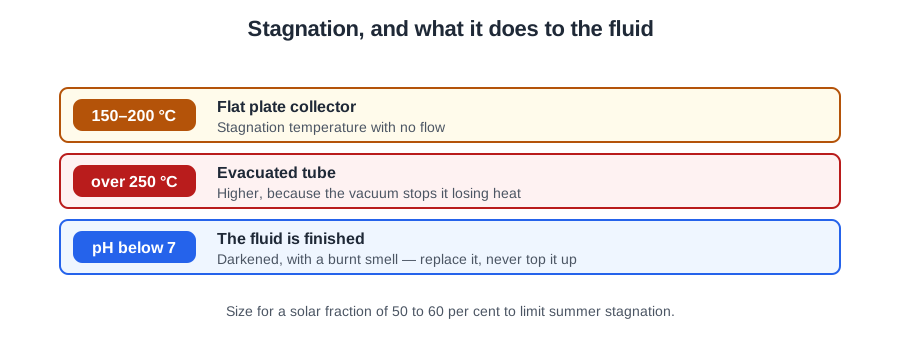
Stagnation occurs when the collector is receiving solar energy but the pump is not running and no heat is being removed — a power cut, a controller or pump failure, a fully charged store on a hot day, or a holiday with no draw-off. The collector simply keeps absorbing until it reaches its stagnation temperature: the point at which losses equal the energy coming in.
That is why flat plate collectors typically reach around 150–200 °C and evacuated tubes can exceed 250 °C, and why the fluid, seals, insulation and jointing must all be rated for it.
What it does to the fluid
Repeated stagnation degrades the glycol and exhausts its inhibitor package. Once the inhibitors are spent, the fluid turns acidic and begins corroding the system from within. The visible signs are darkened or brown fluid, a sharp or burnt smell, and a pH below 7. Any of those means replacement — topping up simply dilutes exhausted fluid with fresh.
Managing it by design
Correct sizing is the first defence: an oversized array spends the summer stagnating for no extra benefit, which is why a 50–60% solar fraction is the target rather than the largest array that will fit. A drain-back design removes the problem entirely, since the collector empties whenever the pump stops.
Changing the fluid
Isolate, allow the system to cool — never drain a hot collector — drain and flush thoroughly, refill with correctly pre-mixed fluid, purge, reset the pressure and verify the freezing point with a refractometer. Dispose of the old fluid through the proper waste route, following the safety data sheet. Glycol is a hazardous substance and does not go down a drain.
Fault finding: no heat and poor performance
Fault finding is a discipline, not a guess: establish the symptom, list the plausible causes, and check them in ascending order of cost and disruption. The cheapest checks are also the commonest faults, which is what makes that order work.
Pump not running
Check in this order: electrical supply — is the spur switched on and the fuse intact; controller settings — is the differential still as recorded; sensors — are they reading plausibly; then the pump itself.
Two more causes belong on that list before you condemn the pump. The cylinder may have reached its maximum temperature — at 65 °C the controller stops charging, and the system is behaving exactly as commissioned. And the rotor may be seized by deposits rather than the motor being dead: many circulators can be freed by switching briefly to maximum speed, or by turning the shaft by hand through the inspection notch.
Short-cycling, or "clocking"
The pump starts, runs briefly, stops, and repeats — typically in the morning and again in the evening. The causes are a switch-on differential set too small, a pump speed set too high, or a collector sensor in the wrong place or left uninsulated, which reads a spike the rest of the circuit cannot sustain. The remedies follow directly: widen the differential, drop the pump speed, and get the sensor into the flow and insulated.
The mirror image is a pump that starts late and stops early, which points to a switch-on differential set too high, or uninsulated collector connection pieces on a tube collector.
Pump runs but no heat reaches the store
Suspect airlock first, then a closed or partly closed isolation valve, then a blocked or fouled heat exchanger, then reverse flow through a failed or wrongly fitted non-return valve. Reading temperatures either side of the exchanger separates a circulation problem from a transfer problem quickly.
If the pump is running hot with flow and return at the same temperature, that is air. Check the system pressure, run the pump intermittently at maximum, and vent at the pump, the cylinder and the non-return valve. If it keeps coming back, the pipework itself is the problem — a dip over a beam or around a bend holds air the vents cannot reach, and the answer is to re-route or add a vent at that high point.
Poor performance with everything apparently working
Check the flow rate against the commissioned figure, the glycol concentration — over-concentrated fluid carries less heat — insulation condition, and new shading, which is easily missed on a system that was fine for three summers and then had a tree grow into it.
The store sensor
A sensor fitted too high reads water the boiler has already heated. The controller sees no useful differential and the pump never runs. Nothing is faulty and every component tests good — which is precisely why it is missed. If a system has never performed since installation, check the sensor position before anything else.
Overheating, pressure loss and air
Pressure loss with nothing discharging
When the gauge falls but there is no wet patch and no sign of the relief valve passing, work through three explanations before assuming a hidden leak:
- The expansion vessel is hiding it. A ruptured diaphragm lets system water pass into the gas side, so the fluid is still inside the system and there is nothing to see. Depressurise the water side and check the charge.
- Normal thermal fluctuation. A solar circuit's pressure moves by roughly 0.2–0.3 bar between cold and hot. A reading taken at a different temperature is not a leak.
- Air still coming out of solution. A fall shortly after filling is usually residual air escaping through the automatic air vent, not a fault at all.
If it keeps falling after all three are excluded, then it is a leak — and the places to look are the screwed connections and glands at valves, then the soldered joints, then the collector array itself, where a tube or a collector may need replacing.
Two faults with a single distinctive symptom
- One loud bang from a sealed system, with the pump and electrics apparently fine, points to the expansion vessel rupturing. Repeated banging or knocking is a different fault — air, or pipework expanding against a clip.
- Sluggish circulation with a healthy pump points to viscosity that is too high: glycol mixed too strong, or a cold circuit on a winter morning. It is the same trade-off met at commissioning — more glycol is not better.
Noise
Gurgling is air. Whistling is usually excessive flow or a restriction. Knocking suggests pipework expanding against a clip or through a wall without a sleeve — a solar primary moves a long way between ambient and stagnation, so clipping that is fine on a heating circuit can be noisy here.
Overheating and PRV discharge
Look at the controller's maximum store temperature setting, at whether the system is oversized for the actual demand, at a failed expansion vessel, and at low draw-off — a holiday period with a full store on a hot day is a perfectly normal cause of stagnation.
After rectification, and when to escalate
After any rectification
- Re-check system pressure against the recorded cold fill figure.
- Vent thoroughly, then run and vent again once hot.
- Verify the flow rate against the commissioned figure.
- Confirm the controller settings are as recorded.
- Verify the glycol with a refractometer if any fluid was lost or added.
- Leak check under pressure after a heat cycle, not before.
- Observe a full cycle: pump starting and stopping at the differentials, correct flow direction, sensible temperature rise across the collector.
Two procedures worth knowing in order
Replacing an expansion vessel. Isolate the electrical supply to the controller and pump → drain down → collect the heat transfer fluid and check its pH and glycol concentration → replace the vessel → refill, reusing the fluid only if the tests passed. Checking the fluid before refilling is the step that gets dropped, and it decides whether you are putting good fluid back or recycling exhausted fluid into a repaired system.
Draining a solar circuit. Cover the collectors first and let the fluid cool — draining a hot collector is how people are scalded. Then isolate the circuit breaker and spur supplying the solar controls, connect a hose to the drain point at the low end of the return, run it to a container set below the lowest part of the system, and drain into a secure container for disposal through the proper waste route.
When to escalate
Refer on rather than improvising where the fault involves structural concerns with the mounting or the roof, electrical work beyond your competence, unvented cylinder components without G3 qualification, or a suspected manufacturing defect under warranty — where an unauthorised repair can void the cover.
And the fault that is not a fault
Low winter output is normal. So is a store that reaches 60 °C by mid-afternoon in July and then stops charging. So is a very hot collector while the family are away and nobody has drawn any hot water for four days.
Before diagnosing anything, establish what the customer expected and what the system was designed to deliver. A good proportion of solar callouts are answered by the performance estimate rather than by a spanner — and the engineer who can explain that clearly, without making the customer feel foolish for calling, is the one they call again.
The series
That completes the seven-module walk through the solar thermal course — principles and collectors, system types and layouts, regulations, survey and sizing, installation, commissioning, and fault finding. The course itself has 44 lessons with quizzes, flashcards, AI-marked short answers and forty-four interactive tasks, including a diagnostic simulator built from the scenarios in this article.
📝 10-Question Mock Test
Click an option to see whether you got it right. Explanations appear instantly — no submitting at the end.
pH tells you whether the inhibitor package is exhausted; freezing point tells you whether the freeze protection is still there. Colour and smell are useful indicators but neither is a measurement.
Once the inhibitors are spent the fluid turns acidic and corrodes the system from within. Topping up simply dilutes exhausted fluid with fresh — it needs draining, flushing and refilling.
It happens on any filled system with a charged store and no demand, and the collector simply heats until losses equal the energy arriving. It is normal — but it is what ages the fluid, which is why an oversized array is a problem rather than a bonus.
Nothing is wrong. The controller holds a maximum store temperature, typically 60–65 °C, and stops charging when it is reached. Establishing the store temperature early avoids condemning a healthy pump.
Often called clocking. The pump moves heat, closes the difference almost at once, and stops. Widen the differential, drop the pump speed, and get the sensor into the flow pocket and insulated.
A sensor in the upper pocket reads water the boiler has already heated, so the controller sees no useful difference and the pump never runs. Nothing is faulty, which is exactly what makes it hard to find.
Cold readings rule out the 0.2–0.3 bar thermal swing, and nothing wet means the fluid has not left the building. Depressurise the water side and test the vessel charge — water at the schrader valve is conclusive.
A single bang points to the vessel. Repeated banging or knocking is a different fault — air in the circuit, or pipework expanding against a clip or through an unsleeved wall.
It is the same trade-off met at commissioning: raising the concentration lowers the specific heat capacity and raises the viscosity, so the pump works harder and moves less heat. More glycol is not better.
Isolate first so nothing can start over an open circuit. Test the fluid while it is out and before you decide to reuse it — that is the step that gets dropped, and it decides whether good fluid goes back or exhausted fluid returns to a repaired system.
The method is the point. Symptom, plausible causes, cheapest checks first — and the commissioning record as the thing that turns a reading into information, because a pressure or a flow rate means nothing on its own and a great deal against the value the system was left at.
And keep the third category in mind. Broken, set wrong, or working as designed — the last is more common than most engineers expect, and recognising it quickly is worth as much as any diagnostic skill.