The last module of the course collects the requirements that do not sit neatly anywhere else: the drinking water tap, plugs in appliances, the consumption figures used in water efficiency calculations, and everything that happens outside the building — troughs, hoses, ponds and pools, where the fluid category jumps to 5 and stays there.
This article covers Module 13 of the PlumbMate Water Regulations course: the drinking water requirement and its permitted sources, plugs and their exemptions, the consumption figures and what they are for, and the agricultural and outside-use requirements that most domestic plumbers meet only occasionally and get wrong when they do. There is a 10-question mock test at the end.
Drinking water
Every premises must have at least one tap conveniently situated for drawing drinking water — normally over the kitchen sink in a house.
Three sources are permitted:
- a supply pipe;
- a pump delivery pipe drawing from a supply pipe; or
- a distributing pipe drawing exclusively from a cistern holding wholesome water.
The word exclusively is the operative one in the third case. A distributing pipe that also draws from anywhere else is not a permitted source for drinking water, whatever the quality of what it happens to be delivering today.
Pumping drinking water direct from the supply pipe is permitted below 0.2 l/s, or above that figure with the undertaker's agreement — the same threshold as Module 4, appearing again.
And on softeners: softened water may only be used for drinking if the treated water remains wholesome. That is a genuine question rather than a formality, because ion exchange softening adds sodium in proportion to the hardness removed, and in a very hard water area a hard-water drinking tap taken off before the softener is the usual answer.
Plugs
Every bath, wash basin, sink or similar appliance needs a watertight and readily accessible plug. Both adjectives matter: watertight, and reachable.
Six exemptions:
- appliances with spray taps only;
- a trough that cannot take a plug, at not more than 0.06 l/s;
- appliances with self-closing taps;
- a shower bath or tray;
- a drinking fountain;
- a medical, dental or veterinary appliance designed for unplugged use.
The shape of that list tells you the reasoning: a plug is exempted where filling the appliance is not what it is for, or where the flow is controlled by other means. And the point behind it is explicit in the Regulations — omitting self-closing taps or waste plugs is expressly given as an example of waste under Regulation 3. Not an inference from the general principle; a named example.
Water efficiency figures
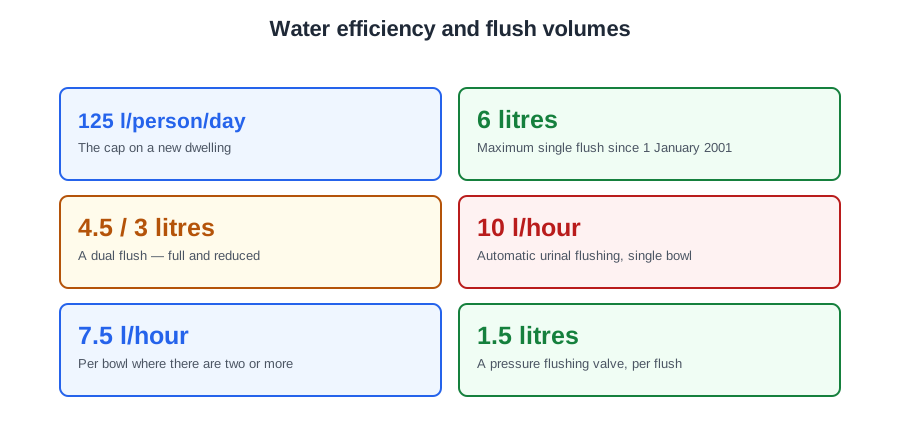
Three consumption figures used in calculations:
- Washing machine: 27 litres per kilogram of load.
- Washer-drier: 48 litres per kilogram.
- Dishwasher: 4.5 litres per place setting.
Watch the unit. Laundry appliances are measured per kilogram of load; dishwashers per place setting. Mixing the two units is the standard error, and it produces answers that are wrong by a large factor rather than a small one.
The near-doubling from washing machine to washer-drier is also worth noticing: the drying cycle on a condenser machine uses water to condense the moisture it removes.
Fixed volume against proportional consumption
A distinction that decides whether a proposed water-saving measure will do anything at all. Some fittings consume a fixed volume regardless of flow rate; others consume in proportion to flow. Flow limiting only helps the second.
A WC uses 6 litres whether you fill the cistern quickly or slowly — fixed volume, so a flow restrictor on the inlet saves nothing at all. A shower runs until the user turns it off, so its consumption is flow multiplied by time — proportional, and a restrictor saves real water. Applying restrictors indiscriminately across a building wastes money on the fixed-volume fittings and irritates users for no benefit.
Animal drinking troughs
Every pipe to an animal drinking vessel needs:
- an inflow control device, protected from damage and from contamination; and
- a stop valve or servicing valve.
The supply must have fluid category 5 protection — normally a type AA air gap at the appliance. Where multiple troughs share one distributing pipe, the protection is a break tank via a type AA, AB or AD air gap.
The installation details that make it work
- The inlet must be rigidly fixed and protected against animal damage. A raised service box is acceptable, provided it does not compromise the air gap — which is exactly what a badly designed enclosure does, by putting a lid close over the inlet.
- Troughs must be installed level, so that the inlet cannot become submerged. A trough out of level fills to the low end, and the air gap at the high end is measured from a water surface that is no longer where you think it is.
- Linked troughs: the supplied troughs have higher spillover levels, so any overflow occurs at the inlet trough. They fill to a common level anyway, so nothing is lost by the arrangement, and the overflow happens where somebody will see it rather than in a distant field.
- Field troughs should have secondary protection — a double check valve in an accessible chamber near the main. A second line of defence for a long run of pipe that nobody inspects.
- A servicing valve adjacent to every drinking appliance, and label which troughs each stop valve controls. On a farm with a dozen troughs across several fields, an unlabelled valve is a valve nobody will use.
Pipework and standards
- Pipework under 750 mm deep must be protected.
- Above ground it must be ducted, insulated and sealed — and the sealing is to keep rodents out, not only weather.
- Agricultural troughs: BS 3445. Pig buildings: BS 5502 Part 42.
Farm hose union taps are category 5, and the acceptable arrangements are a DC arrangement, a break tank via type AA or AB, or an AUK3 tap gap maintained at all times. That last phrase carries the difficulty: a tap gap on a farm is only protection while nothing is standing under it, and a bucket left below the tap removes it.
Ponds, pools and fountains
- Every pond, fountain or pool needs an impervious lining or membrane. This is a waste requirement — an unlined pond that seeps loses water continuously and is replenished continuously.
- No permanent or direct connection to a pond, pool or fountain. Any temporary connection must comply with paragraph 15 — which means appropriate backflow protection for the category, and Module 6's rule applies: a temporary connection is still a connection.
- From Module 1: a pool of more than 10,000 litres, designed to be automatically replenished, is notifiable.
Putting the module together, and the course
Module 13 is where the Regulations deal with the ordinary business of using water — drinking it, filling a basin, running a washing machine, watering a field — and the pattern is the same one that started in Module 1. Waste, misuse, undue consumption, contamination, erroneous measurement. A missing plug is waste. An unlined pond is waste. A submerged trough inlet is contamination. A hose union tap on a farm is a category 5 route into the main.
That is the thread through all thirteen modules. The Regulations are not a list of arrangements to memorise; they are five harms with a great deal of detailed guidance about how to avoid them. Learn the five, and the detail becomes something you can reconstruct rather than something you have to recall.
📝 10-Question Mock Test
Click an option to see whether you got it right. Explanations appear instantly — no submitting at the end.
“Exclusively” is the operative word. The three permitted sources are a supply pipe, a pump delivery pipe drawing from one, or a distributing pipe drawing exclusively from a wholesome cistern.
A genuine question rather than a formality: ion exchange adds sodium in proportion to the hardness removed, so in a very hard area the treated water may not remain wholesome.
The exemptions are spray taps only, a trough that cannot take a plug at not more than 0.06 l/s, self-closing taps, a shower bath or tray, a drinking fountain, and a medical, dental or veterinary appliance designed for unplugged use. Omitting plugs or self-closing taps is expressly named as an example of waste under Regulation 3.
Watch the unit — laundry appliances are per kilogram of load, dishwashers per place setting. Mixing the two is the standard error and produces answers wrong by a large factor. The near-doubling for a washer-drier is the drying cycle using water to condense the moisture it removes.
A WC uses 6 litres whether you fill the cistern quickly or slowly. A shower runs until the user turns it off, so its consumption is flow times time — that is where a restrictor saves real water.
Category 5, so an air gap and nothing mechanical. Where multiple troughs share one distributing pipe the protection is a break tank via a type AA, AB or AD air gap. The pipe also needs an inflow control device, protected from damage and contamination, and a stop or servicing valve.
The same reasoning applies to a raised service box protecting the inlet from animal damage: it is acceptable provided it does not compromise the air gap, which is exactly what a badly designed enclosure does.
Nothing is lost by the arrangement, and the overflow happens where somebody will see it rather than in a distant field. Field troughs should also have secondary protection — a double check valve in an accessible chamber near the main.
Farm hose union taps are category 5. Note the difficulty in that last option: a tap gap is only protection while nothing is standing under it, and a bucket left below the tap removes it. HA and HUK1 are for existing hose union taps in house installations only.
Waste, straight from Regulation 3. There must also be no permanent or direct connection to a pond, pool or fountain, and any temporary connection must comply with paragraph 15 — a temporary connection is still a connection. A pool over 10,000 litres designed to be automatically replenished is notifiable.
That is the course. Thirteen modules from Regulation 3 to an animal drinking trough, and the same five harms underneath every one of them.
The one to carry away from this module: flow limiting only helps fittings that consume in proportion to flow. A WC uses its 6 litres however slowly you fill it — knowing which fittings are which is the difference between a water efficiency measure and an expensive irritation.