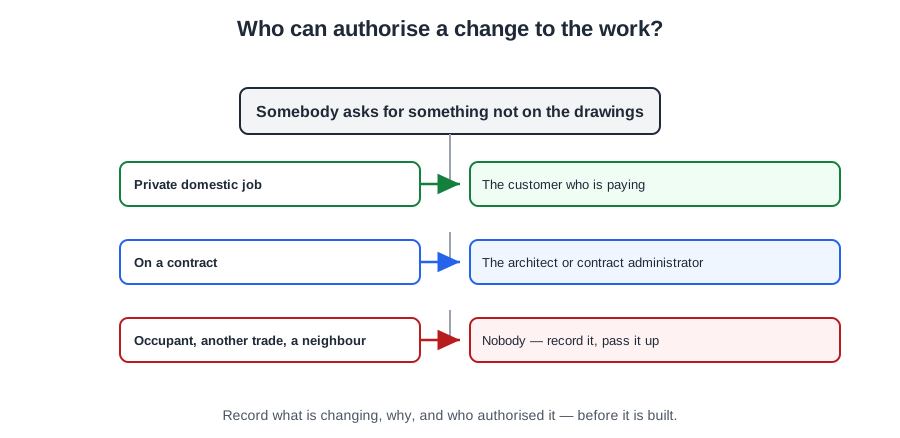
Halfway through a fit-out the client’s representative asks for two extra basin positions that are not on the drawings. He is pleasant, he is clearly senior, and he says just get them in, we will sort it out later.
The short answer
If you get them in, you will be sorting it out for months. A variation order records an agreement with the client to alter the work, and it must be agreed and approved in writing before the work is carried out.
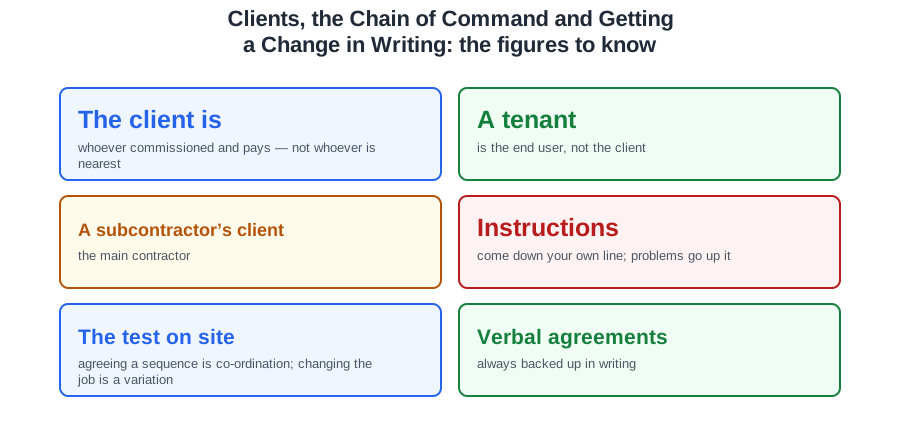
Behind that sits a question that answers most site arguments: who is actually allowed to tell me that? The client is whoever commissioned and pays for the work, not whoever is standing nearest.
Three kinds of client
In one week you might work for three completely different people and never notice the difference until something goes wrong.
A private customer engages you directly — a homeowner, a landlord, someone having a bathroom done. The relationship rests on trust, because they cannot judge the pipework themselves. They may work through a representative or managing agent, who instructs, approves and pays on the owner's behalf. And if the property is let, the tenant is the end user: you liaise with them for access and keep them informed, but they did not commission the work and cannot approve the price or vary the job.
A contracting customer is another business that engages your firm under a contract. On a school where your firm is a subcontractor, the main contractor is your contracting customer — not the county council that owns the building, and not a council officer who happens to be visiting. They expect an organised workforce, usually a method statement before you start, and normally a CSCS card for everyone on site.
An internal customer is a department of your own organisation. A housing association with its own maintenance plumbers is the classic case: the housing office logs the repair, so your client is the housing office, even though a tenant lives in the flat and will be the one you meet.
| Type of client | Who approves and pays | What they expect of you |
|---|---|---|
| Private customer | The owner, or a managing agent acting for them | Direct communication, a quotation, tidy work, a proper handover |
| Contracting customer | The company that holds your contract, usually the main contractor | Cards, risk assessments and method statements; work to programme |
| Internal customer | The department in your own organisation that raised the job | Work to the company’s own procedures and reporting; records kept |
Naming the client is not paperwork for its own sake. It answers the only question that matters when somebody asks for something extra. On the school, the answer for the council officer is no. On the let house, the answer for the tenant is no. On the housing association job, the answer for the tenant is again no — but you still keep them informed, because you are standing in their kitchen.
The chain of command
An apprentice notices the electricians fixing a cable tray exactly where the drawings show the 54 mm heating flow and return. The temptation is to ask them to move it, or to drop the pipes under and redraw it later. Both are wrong, and for the same reason: neither the apprentice nor the electrician has the authority to change the design or to instruct another trade.
A chain of command is the formal reporting line that says who instructs whom. Instructions travel down it and problems travel up it. On a site two chains meet: the contractual one — client, main contractor, subcontractor — and your own company's.
The rule that follows is short: take instructions only from your own line, and pass everything else up it. The apprentice reports the clash to the plumbing supervisor. The supervisor speaks to the electrical supervisor and site management, and if the design has to change, that comes back down as a proper instruction. Nobody wins an argument in a riser.
The same rule catches the visitor with a clipboard. A council officer, a facilities manager or an architect may all ask for something perfectly reasonable. If they are not in your contractual chain, you refer the request rather than carry it out.
Building services work is never done alone, so one authority — normally the principal contractor — controls the overall programme, and each trade is expected to be aware of its dependencies and, where it can, to make direct contact to co-ordinate. Two supervisors agreeing on Monday who gets the riser on Tuesday saves a week.
What it is not is a licence to renegotiate the drawings between two operatives. The test is simple: am I agreeing a sequence, or am I changing the job? Agreeing a sequence is co-ordination; changing the job is a variation. If you are unsure which, treat it as a variation and ask.
- A technical problem — a clash, a route that will not work, materials off specification: your trade supervisor.
- A safety problem — a damaged ladder, an unguarded opening, a suspected asbestos board: stop, then tell the supervisor.
- A request for extra work: your supervisor or contracts manager, so it can be priced and confirmed in writing.
Spoken, written and drawn
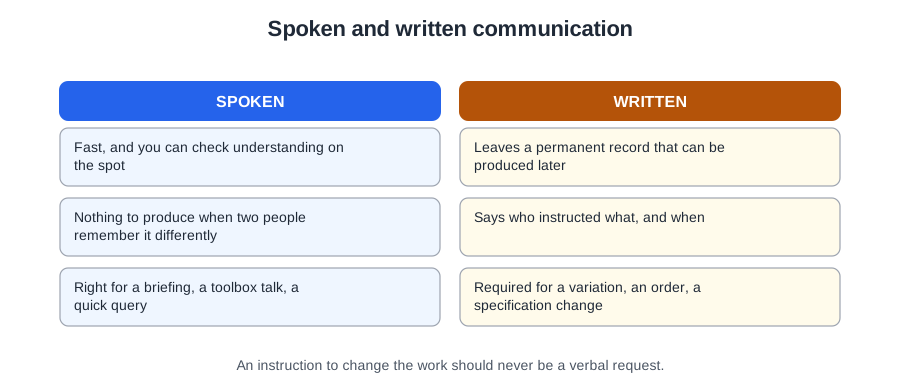
A customer catches you at the van and asks for the towel rail to be moved and a bigger basin fitted. You say that should be fine. Six weeks later she is refusing to pay for the basin because, she says, you never told her it would cost extra. You did tell her. Neither of you can prove anything.
Speech is fast, personal and good for anything that needs a reaction: agreeing access times, a toolbox talk, a call to say you are running late. It is also how you find out that you have not been understood, because you can ask a question and check. Its weakness is that it leaves no record.
So the rule is fixed: verbal communication is always backed up with written confirmation. Anything about your job, however casual it sounded, counts as formal communication.
The written trail runs from first contact to final payment:
- The quotation or estimate — the first written communication to a customer. A quotation is a fixed price; an estimate can move if the work turns out differently.
- The job specification, describing what is to be installed, in what materials, to what standard.
- Letters and emails confirming what was said.
- The variation order when the work changes.
- Test and commissioning certificates, which for a private customer are normally the last written item about the work itself, before the invoice.
Some information cannot be said at all. Working drawings carry the plans, elevations and details, scaled and dimensioned, that let a contractor price and then build the job. A sketch on a scrap of plasterboard settles an argument about a pipe route in ten seconds where a paragraph would fail.
| Message | Best method | Because |
|---|---|---|
| Running twenty minutes late | Phone call | Immediate, and the customer can respond |
| Agreement to extra time and cost | Written confirmation | It is a change to money and to the programme |
| Where the pipe run goes | Drawing or marked-up plan | Position and size cannot be described reliably in words |
| A hazard everyone must know about | Safety memo, backed by a briefing | Same message to everybody, and a record that it was issued |
Adjust the method to the person. For a customer with a hearing impairment, use written notes or drawings to reinforce what you say. For someone with a visual impairment, give more verbal detail and describe any diagram. Where English is not the person's first language, use short sentences and plain words, avoid slang and trade nicknames, back it up with a diagram, and ask a question to check you have been understood.
Ordering and checking materials
Second fix starts on Monday. On Friday somebody signs for a pallet without looking at it. On Monday the pallet turns out to hold fifteen basin traps and no basins, the merchant says the delivery note was signed as correct, and four plumbers stand about being paid to do nothing. That is not bad luck. It is two ordering mistakes and one signature.
On a larger contract there is a buyer, whose job is to source and purchase — obtaining quotes for the quantities required, together with delivery times and quality assurances. The route runs: requisition → purchase order → delivery → delivery note and invoice. Ordering outside that route — the phone call to the merchant that nobody records — is how a job ends up with materials it did not price and cannot charge for.
Materials are ordered against the work programme, so they arrive when the gang arrives. On larger sites, just-in-time delivery puts materials at the exact location at a time coinciding with the plumbers starting.
Get it wrong in either direction and it costs. Late materials mean idle labour, and if material is not available, labour costs increase. Too early, and you are storing expensive goods where theft is a real risk — which is why deliveries are best arranged early in the morning when operatives are there to receive them.
A delivery note should be checked against what is physically on the pallet and signed only if the two agree.
- Count and identify what has arrived — sizes and specification, not just item names.
- Compare it with the note and with what was ordered.
- Inspect for damage before the driver leaves.
- Note any shortage or damage on the note before signing, or refuse the item.
- Tell the supervisor immediately if anything affects the programme.
Signing an inaccurate note is the expensive mistake, because you have just recorded in writing that everything was correct. And even where a delivery arrives on time, the wrong goods have the same effect on the job as no goods at all.
If the merchant substitutes a different make or material, that is not a decision for the operative. The specification is part of the contract, and changes are made only after agreement with management. A substitution may affect cost, jointing, compatibility or compliance. The same applies to quantity: taking four fewer radiator valves because that is what turned up is a change to the job made by nobody in particular.
Plant deserves the same care. Hire runs whether the item is used or not, so off-hire it the day you finish, check it is complete before you sign, and report at once anything that arrives with a missing guard, a torn label or an out-of-date inspection tag — that item cannot be used until it is put right.
Variation orders
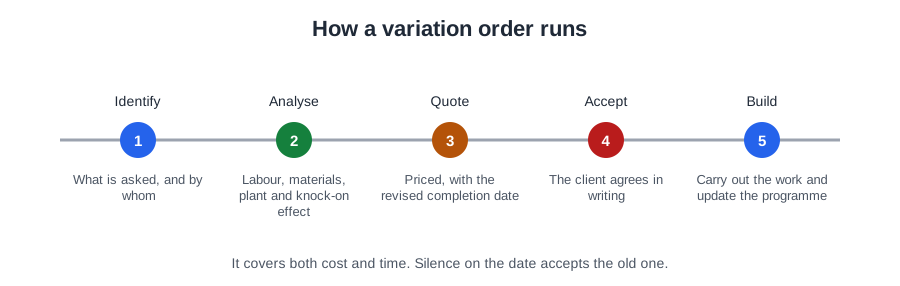
Nearly every construction project changes during design and construction, so most contracts contain a variation clause. A variation is a change, modification, alteration or amendment to the original contract and to how the works are to be carried out.
The order of events is fixed, and doing it in this order is the whole point:
- The change is identified and its effect analysed — on the other trades, on the programme, on cost.
- The change, including any change to the agreed contract price, is agreed and approved in writing by the client.
- A variation order is issued, including details of both cost and time.
- Only then is the work carried out.
So the answer on the fit-out floor is: obtain a written variation order through the contracts manager. A verbal request from someone who may not hold contractual authority is not a basis for extra work, and a price agreed verbally is not a price at all.
The single most important item in the written confirmation is the client's agreement to the extra time and the extra cost. Around that sit the description, who asked for it, the date, the drawing reference it alters, and any effect on other trades. Getting agreement early saves money, because the slow part of a variation is reaching agreement at all.
| Cause of variation | Example | Who normally bears the cost |
|---|---|---|
| Client related | Change of plans, scope or specification after signing | The client |
| Design team related | Errors or omissions in design; a change by the consultant | Dealt with through the design team |
| Contractor related | Defective workmanship; unavailability of skills or equipment | The contractor |
| Other | Weather, differing site conditions, changes in regulations | As the contract provides |
A variation may also be raised against you. If the clerk of works finds a run of exposed pipework unacceptable and it alters the agreed design, that too has to be discussed with the contractor, and the reasons and the effect on time and cost put to the customer.
Site procedures
A gang arrives at half past seven to start first-fix soil stacks. The temptation is to unload and get on. What actually has to happen first is a short list, and every item on it exists because somebody was hurt when it was skipped.
Everyone entering a construction site must sign in, wear the identification issued, and sign out again on leaving. Everyone must also have had a site induction: that site's hazards, rules, traffic routes, welfare facilities, alarm and emergency arrangements, and who is in charge of what. Site-specific PPE is stated at induction and worn from the gate.
Starting is a formal step, not just the moment you pick up a saw. The working space, the continuity and the flow of work are assessed, checked against the overall method statement and accepted; only then may work commence. Operatives must be trained, skilled and where required certified, and clear instructions given on the methods to be used. Some work needs more: a permit to work for hot works, confined spaces, live services and roof work.
A toolbox talk is a short, informal meeting — usually ten minutes, usually before the day's work — dealing with one matter of health and safety. Ten minutes on a new press-fit tool and its jaw-change procedure is a toolbox talk; so is a briefing before connecting to a live sewer.
The talk is not decoration. It is one of the ways an employer meets its legal duty to provide such information, instruction, training and supervision as is necessary, and it is normally recorded with the names of those present.
A safety memo is a short written notice to everyone affected, used where the same message must reach a lot of people accurately and be on record. Where the message is urgent or complicated it is backed by a spoken briefing, because a notice on a board is not proof that anybody read it.
| Method | Who it reaches | Typical use |
|---|---|---|
| Site induction | Every person before they first work on the site | Site rules, hazards, welfare, emergency arrangements |
| Toolbox talk | One gang, from their own supervisor | One task or hazard, briefly, before the work |
| Safety memo | Everyone affected, in writing | A change or a newly found hazard, on record |
| Site meeting | Supervisors and managers of each trade | Progress, sequence, co-ordination, problems |
Sites also run work quality management systems: agreed checks at agreed stages, recorded as they are done. The point is the same as with safety paperwork. If the check was not recorded, then as far as the job is concerned it did not happen.
🔢 The numbers worth memorising
- The client is
- whoever commissioned and pays — not whoever is nearest
- A tenant
- is the end user, not the client
- A subcontractor’s client
- the main contractor
- Instructions
- come down your own line; problems go up it
- The test on site
- agreeing a sequence is co-ordination; changing the job is a variation
- Verbal agreements
- always backed up in writing
- Quotation against estimate
- a quotation is fixed; an estimate can move
- Ordering route
- requisition → purchase order → delivery → note and invoice
- Delivery note
- checked against the goods and signed only if they agree
- Variation order
- agreed in writing before the work, stating cost and time
- Before work commences
- space and sequence checked against the method statement and accepted
- Toolbox talk
- about ten minutes, one hazard, recorded with names
⚠️ Where people go wrong
- Taking an instruction from whoever is standing nearest.
- Letting a tenant approve or vary the work.
- Instructing another trade, or moving a pipe run to avoid an argument.
- Carrying out a request from someone outside your contractual chain.
- Agreeing extra work verbally and pricing it later.
- Ordering off-programme, or by an unrecorded phone call.
- Signing a delivery note that does not match the pallet.
- Accepting a merchant’s substitution without going up the chain.
- Starting a variation before the written order exists.
- Leaving the effect on time out of a variation order.
- Unloading and starting before induction and sign-in.
- Starting a task before the area and sequence are accepted.
- Treating a toolbox talk as decoration rather than a legal duty.
- Relying on a notice board without a briefing.
📝 10-Question Self-Test
Straight from the Level 3 course question bank. Click an option to see whether you got it right — the explanation appears instantly, and there is nothing to submit.
A private customer has the work done in their own home and pays for it themselves, so they are the client, they authorise any changes and they hold statutory cancellation rights. A commercial customer is tempting, but that is another business engaging your firm under a contract, such as a main contractor, not someone paying for work in their own house.
Changing the equipment alters what was contracted for, so the instruction needs a record of what changed and who authorised it, and a letter, a signed variation order or a site instruction form all give you that. A verbal request leaves no evidence, so when the change costs time or money there is nothing to price it against.
A variation order has to record the client’s agreement to the change in both cost and time, in writing, before the extra work starts. Without that you have built something with no agreed basis for charging it. The date the original quotation was issued is useful reference, but it settles nothing about what the addition will cost.
On a job for a private customer the first item of written communication is the quotation and the last is the invoice. The survey report comes before the quotation, and the commissioning certificate is handed over at completion, but the invoice follows it and is what closes the job.
Protecting the fabric means stopping the damage before it happens, so the shared carpet is covered and fixed plastic covers go on the stairs before anyone carries tools, materials or debris through. Vacuuming the hallway and stairs at the end of each day is tempting because it looks conscientious, but by then the dust and grit are already ground in.
Left running and set as commissioned. Leaving it isolated or in an override means the customer's first experience is a system they have to configure themselves — which is exactly where misconfiguration starts, and it undoes the settings you just recorded.
An internal customer is a department or section of the same company that raises the work, so the plumber's client is the housing office, not the tenant. The tenant is the end user and needs liaison for access, but they did not commission the job and are not the client. A contracting customer would be another company that has engaged the plumbing firm under a contract.
A variation order is the formal written record of a change to the contracted scope of work, agreed and priced before the work is carried out so that the quantity surveyor can value it and both parties are protected. A verbal request from someone who may not hold contractual authority is not a basis for extra work. BS 8000-0 requires operatives to respond to clear and formal reporting lines for authority and instruction.
A toolbox talk is a short, focused briefing on one task or hazard given to the gang by their supervisor. Section 2(2)(c) of the Health and Safety at Work etc. Act 1974 requires the employer to provide such information, instruction, training and supervision as is necessary, so far as is reasonably practicable, and PUWER 1998 regulation 9 requires adequate training for everyone who uses work equipment. BS 4163 restates both duties and adds that training should be given on induction and whenever a new or increased risk is introduced.
An apprentice works under supervision and has no authority to instruct another trade or to vary the design, so the clash goes to the trade supervisor, who co-ordinates with the electrical supervisor and the site management team. BS 8000-0 says each specialist should be aware of dependencies with other operations, that one authority (typically the principal contractor) controls the overall programme and must be kept informed, and that all operatives should respond to clear and formal reporting lines.
Going further: the lessons behind this article
This article is the public answer. Unit 336 of the Level 3 course takes the same ground to the depth the exam and the synoptic assignment ask for, in 6 lessons:
- Types of client: private, contracting and internal
- The chain of command: who can give you an instruction
- Spoken, written and drawn: choosing the right method
- Ordering plant and materials, and checking what arrives
- Variation orders: pricing a change the client asks for
- Site procedures: inductions, toolbox talks and safety memos
- Site procedures: the Unit 336 guide — every article on this unit in one place
- All PlumbMate articles — Level 1, 2 and 3
- The Level 3 course — the whole 8202-35 Diploma