Unit 336 is the unit people assume is the easy one because there is no arithmetic in it. It is the unit that decides whether the business you eventually work for makes money.
The short answer
Unit 336 — Site procedures and planning — is the management unit. It covers who the client is and how you communicate with them, who does what on site, the law you work under and the supervision it requires, how work is risk assessed and written up, how a job is programmed and monitored, and how it is priced so that it returns a profit.
It is not the soft option. It is the unit that most closely resembles what a Level 3 qualified person is actually employed to do, and it is assessed on applying a procedure to a scenario rather than on recall.
How the unit is shaped
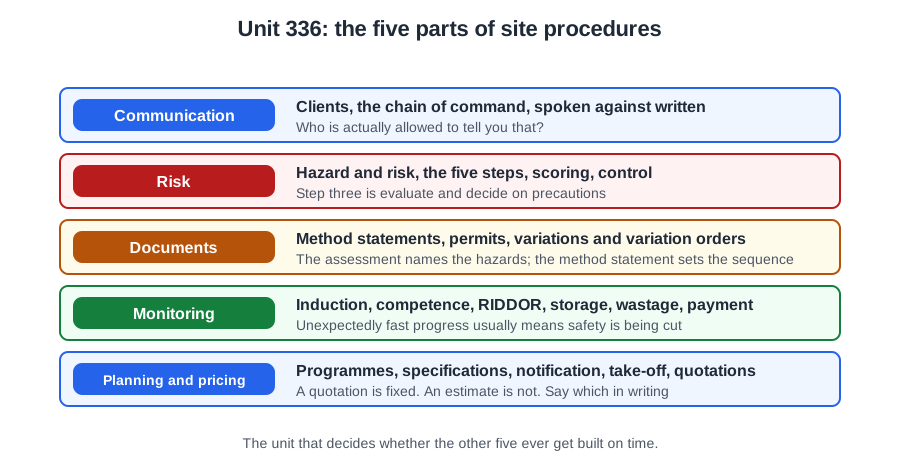
Clients and communication. Who the client actually is on a given job, the different client types, and the methods and records of communication with each.
Roles on site. The construction team, who instructs whom, and what an operative may and may not decide.
The law and supervision. The legislation governing the work, the levels of supervision a task attracts, and who carries the duty.
Risk assessments and method statements. Six lessons on risk assessment alone: the five steps, the hierarchy of control, the hazards you will actually be assessing, and how the assessment becomes a method statement that somebody can follow.
Variations, monitoring and progress. What happens when the job changes, how safety and cost are monitored while it runs, and how progress, quality and people are managed.
Programmes and planning. The types of work programme, what each is for, and how a programme is built from the work rather than the other way round.
Pricing. Estimating, the documents involved, mark-up against margin, and presenting a price to a client.
What actually makes it hard
The five steps of risk assessment are a sequence and the exam checks the order. Identify the hazards; decide who might be harmed and how; evaluate the risks and decide on precautions; record your findings and implement them; review and update. Naming them is worth less than applying them to the scenario given.
The hierarchy of control is a hierarchy, not a menu. Eliminate, substitute, engineering controls, administrative controls, PPE — in that order, and PPE is last for a reason. A candidate who answers "wear gloves" to a question that could be answered by eliminating the hazard is answering the wrong question.
A variation that is not recorded did not happen. The whole variations section comes down to that. Extra work agreed verbally on a Tuesday is unpaid work by the time the invoice is questioned.
Mark-up and margin are different numbers. This is the arithmetic people did not expect in this unit, and it is examined. A 25% mark-up on cost is a 20% margin on price, and confusing the two is how firms price themselves out of business.
Where it connects to the rest of the course
Every other unit's work happens inside this one. The notification in Unit 331 is a programme item here. The commissioning records in Units 332 and 334 are the handover documentation here. And the synoptic assignment is largely a Unit 336 exercise wrapped around a technical problem from one of the others.
Every article on Unit 336
One article per section of the unit. Each is a complete answer on its own, and each ends with a self-test drawn from the course question bank.
🔢 The numbers worth memorising
- The five steps of risk assessment
- identify hazards → who might be harmed → evaluate and decide precautions → record and implement → review
- The hierarchy of control
- eliminate → substitute → engineering → administrative → PPE, in that order
- PPE
- last in the hierarchy, always — it protects one person and only if worn correctly
- Variations
- in writing, before the work is done — a verbal agreement is unpaid work
- Mark-up vs margin
- 25% mark-up on cost is a 20% margin on price — they are different numbers
- Work programmes
- built from the work, not the other way round
⚠️ Where people go wrong
- Naming the five steps of risk assessment without applying them to the scenario. The application is the mark.
- Reaching for PPE when the hazard could have been eliminated. The hierarchy is an order, not a list.
- Confusing mark-up with margin. They are different calculations on different bases.
- Treating a verbal variation as agreed work. If it is not recorded, it is not chargeable.
- Assuming the client is whoever is standing in the room. On a contract job the client is the party who holds the contract — which decides who may instruct a change.
📝 10-Question Self-Test
Straight from the Level 3 course question bank. Click an option to see whether you got it right — the explanation appears instantly, and there is nothing to submit.
A private customer has the work done in their own home and pays for it themselves, so they are the client, they authorise any changes and they hold statutory cancellation rights. A commercial customer is tempting, but that is another business engaging your firm under a contract, such as a main contractor, not someone paying for work in their own house.
Changing the equipment alters what was contracted for, so the instruction needs a record of what changed and who authorised it, and a letter, a signed variation order or a site instruction form all give you that. A verbal request leaves no evidence, so when the change costs time or money there is nothing to price it against.
A variation order has to record the client’s agreement to the change in both cost and time, in writing, before the extra work starts. Without that you have built something with no agreed basis for charging it. The date the original quotation was issued is useful reference, but it settles nothing about what the addition will cost.
On a job for a private customer the first item of written communication is the quotation and the last is the invoice. The survey report comes before the quotation, and the commissioning certificate is handed over at completion, but the invoice follows it and is what closes the job.
Protecting the fabric means stopping the damage before it happens, so the shared carpet is covered and fixed plastic covers go on the stairs before anyone carries tools, materials or debris through. Vacuuming the hallway and stairs at the end of each day is tempting because it looks conscientious, but by then the dust and grit are already ground in.
Left running and set as commissioned. Leaving it isolated or in an override means the customer's first experience is a system they have to configure themselves — which is exactly where misconfiguration starts, and it undoes the settings you just recorded.
An apprentice has very little responsibility for the installation itself: constant supervision from the plumber they work with at first, and simple installations and maintenance tasks only as experience is gained. That is why the others are wrong. Supervising others or signing off work needs a Level 3 qualification, and induction tells you the site rules, it does not make you competent to work alone.
The estimator prices work for the contractor, breaking the bill of quantities into labour, materials and plant and applying rates, so the cost effect of swapping one material for another is their calculation. Once the change is instructed it is the quantity surveyor who measures and values it for payment. The site foreman runs the work on the ground and holds no pricing information.
The quantity surveyor measures and values what has actually been installed, and those measurements feed the interim payments and the final account, so quantities are their business. The clerk of works also walks the job with a notebook, but they are checking the quality of the workmanship and materials for the client, not the amounts.
Wiring and earthing a fixed appliance such as a circulating pump is electrical installation work within the scope of BS 7671.
Going further: the Unit 336 lessons
These articles are the public answer. Unit 336 of the Level 3 course takes the same ground to the depth the exam and the synoptic assignment ask for, in 53 lessons across 12 sections, each with its own quizzes, flashcards, key facts, an AI-marked short answer and interactive tasks.
- Clients and communication
- Roles on site
- Legislation and supervision
- Risk assessments
- Hazards you will assess
- Method statements
- Variations to the work
- Monitoring safety and cost
- Progress, quality and people
- Types of work programme
- Planning the work
- Pricing and presenting the work
- All PlumbMate articles — Level 1, 2 and 3
- The Level 3 course — the whole 8202-35 Diploma