If progress against the programme is unexpectedly fast, the likeliest explanation is that safety standards are being cut.
The short answer
A supervisor monitors two things every week: whether the work is being done safely and whether it is being done economically. Safety monitoring runs on induction, competence, supervision, permits and reporting. Cost monitoring runs on storage, wastage and an accurate monthly record of what has actually been built. The two meet in one exam-favourite fact: unexpectedly fast progress usually means corners are being cut.
Induction and who is responsible
Two new operatives arrive on a housing site at half seven, find the gang and start pulling pipe out of the van. Nobody has inducted them. That is a failure in the safety management system — the arrangement of duties, procedures, records and checks by which a site actually keeps people safe rather than merely intending to.
Under the Construction (Design and Management) Regulations 2015 (CDM 2015), the duty to ensure that a suitable site induction is provided sits with the principal contractor. Not the client, not the principal designer, and certainly not the operatives reading the notices at the gate.
That does not let the plumbing firm off. A contractor has its own CDM duty to plan, manage and monitor its work and to give its workers appropriate supervision, instruction and information. So a supervisor checks that the induction has actually happened before allocating work.
Competence and training
An apprentice has never used the site's powered pipe-threading machine and offers to work it out from the manual. The Provision and Use of Work Equipment Regulations 1998 (PUWER) require that all persons who use work equipment have received adequate training. Workmanship standards say the same from the other side: untrained people should not operate plant or equipment.
Each wrong answer sounds reasonable. Learning from the manual is not training. A second apprentice who has used the machine once is not a competent instructor. And PPE is not a substitute for training — gloves and goggles do not make an untrained operator safe.
The same principle drives allocation: delegation is based on the competence of the person, not on how fast they work or how little they charge. Supervision scales with experience — close, hands-on at Level 1; more autonomy and less strict supervision at Level 2; largely working alone at Level 3, depending on the work.
A good work programme tells a supervisor exactly when a job will happen, so the briefing happens before it starts. A toolbox talk is a short, informal meeting on site, normally before the day's work, dealing with a specific health and safety matter — before a connection to an existing sewer, that means contact with foul matter: gloves on, and nobody with an open wound doing that work.
The warning sign nobody expects
If progress against the work programme is extremely fast and unexpected, the most likely explanation is poor safety standards being applied. Corners get cut in the places that do not show: guards left off, edge protection not moved, isolation skipped, ladders used where a tower was planned. Very slow progress tells you something too — it drives up labour costs — but a gang suddenly a week ahead of a carefully built programme deserves a walk round, not a bonus.
Permits to work
A subcontractor has to cut into a live steam-heated calorifier pipe in a hospital plant room, close to energised switchgear. The risks cannot be eliminated and the precautions are complex. A verbal briefing will not do; neither will a note in the site diary; and putting one person in there alone so fewer people are exposed is worse still.
Where risks remain high, cannot be eliminated, or the precautions are complex, a permit-to-work system should be employed — flowing from the duties in the Management of Health and Safety at Work Regulations 1999 to assess risks and keep records. A permit is a formal document that isolates the plant and controls who may start and finish the job: it names the work, the isolations made, the precautions required, the people authorised, and the time window it covers. Nobody starts without it and nobody signs it back until the plant is safe to return to service. On live plant, two-person working is normally required alongside it.
Reporting under RIDDOR
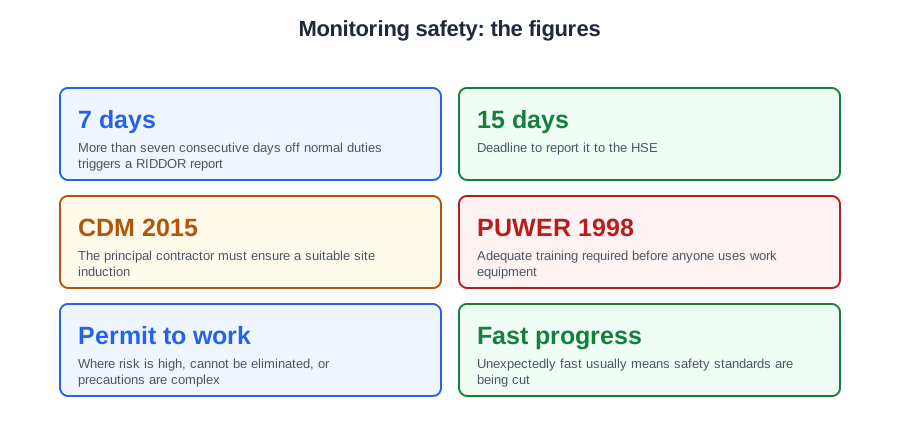
An operative strains their back lifting a cylinder and is signed off for eight days. Under the Reporting of Injuries, Diseases and Dangerous Occurrences Regulations 2013 (RIDDOR), an injury leaving a worker unable to do their normal duties for more than seven consecutive days — not counting the day of the accident — must be reported to the HSE within 15 days of the accident.
Three traps sit around that figure. An accident book entry is still needed, but on its own it does not satisfy RIDDOR. The trigger is not a broken bone or an ambulance — it is the days off normal duties. And the report goes to the HSE, not to environmental health, on construction work of this kind.
The people your work affects
Monitoring safety is not only about your own gang. Compare four jobs: pressure testing pipework in an empty new house; reading a water meter at an unoccupied property; labelling stop valves in a new dwelling before handover; and commissioning an extension to an industrial toilet block. The first three happen in buildings nobody is using. The fourth happens in a working building, needs water off and appliances out of use, and is the one most likely to disrupt the work of other people. Work like that is planned around the occupants — often out of hours — and they are told in advance.
In winter, a central heating repair in an elderly person's flat will leave the system out of use for up to two days. The first thing the supervisor should do is find out whether another form of heating is available to the occupant. Not postpone until the weather improves — that leaves a broken system in a cold flat. Not start straight away to keep downtime short — that is two days of no heat for someone who may not tolerate it. Not report it to the office and wait — that passes the decision upwards while the flat gets colder. Establish the welfare position first, provide temporary heating if there is none, then get on with the job.
Storage
A Friday delivery of copper tube, fittings and coils of blue MDPE gets stacked on the ground outside the plot and left by the gate in the sun. By Monday the copper ends are dented and full of grit and two coils have walked. That is a cost problem.
Materials and components should be stored:
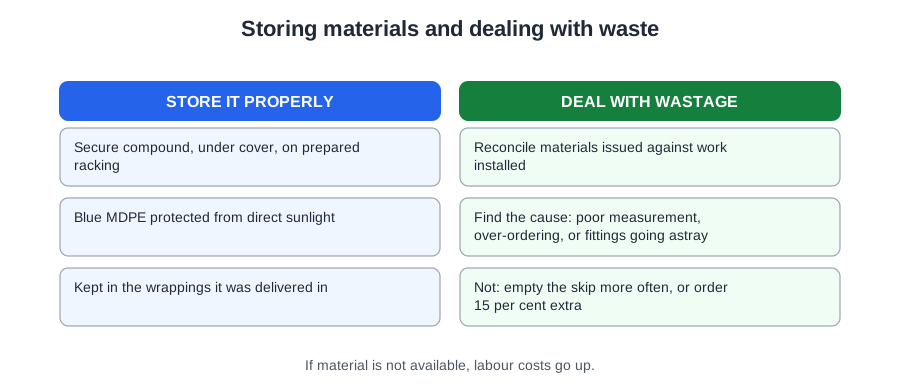
- In a secure hut or compound, under cover, on bases or racking prepared in advance of deliveries.
- In accordance with the manufacturer's site work instructions — in particular, blue MDPE tube and pipe must be protected from direct sunlight.
- In the protective wrappings or cartons they were delivered in.
A locked gate alone is not storage, and neither is an old dust sheet. Materials in store are kept dry where required, safe from damage and pilfering, and arranged with an awareness of storage lives, so stock rotates and nothing is fitted past its shelf life.
Wastage
On a weekly walk round the skip holds a lot of long copper offcuts and several unopened packs of fittings. The right response is to reconcile materials issued against work installed, find the cause, and correct the practice. Waste from packaging, protective materials and offcuts should be avoided or minimised, and good supervision reduces waste and cost in its own right — not least by reducing re-work.
The wrong responses are instructive. Emptying the skip more often hides the evidence without changing anything. Ordering 15 per cent more copper builds the waste into the price of every future job. Weighing offcuts in for scrap recovers pennies on pounds and quietly makes waste acceptable. Reconciliation asks the only useful question: was this poor measurement, over-ordering, or fittings going astray?
The monthly payment
Most contracts pay in stages. Each month the contractor makes an application for payment, and the contractor's quantity surveyor — the person who measures the work and manages the money — asks the site supervisor for the supporting information.
What the supervisor provides is a record of work completed and materials on site at the valuation date, including agreed variations. Interim payments are based on the value of work properly executed and materials on site at the valuation date, the fixed date each month at which the job is measured. Where checked work has been accepted, that acceptance formally indicates completion or stage completion — exactly what a valuation needs.
The tempting alternatives measure the wrong thing. Timesheet hours and merchant statements show cost incurred, not value earned — you can burn a fortnight of hours and have nothing installed. The original tender shows the total contract value, not what was built this month.
Cost effectiveness, then, is three habits at once: materials that survive until they are fitted, waste that is measured rather than tolerated, and a monthly record accurate enough for someone else to be paid on.
🔢 The numbers worth memorising
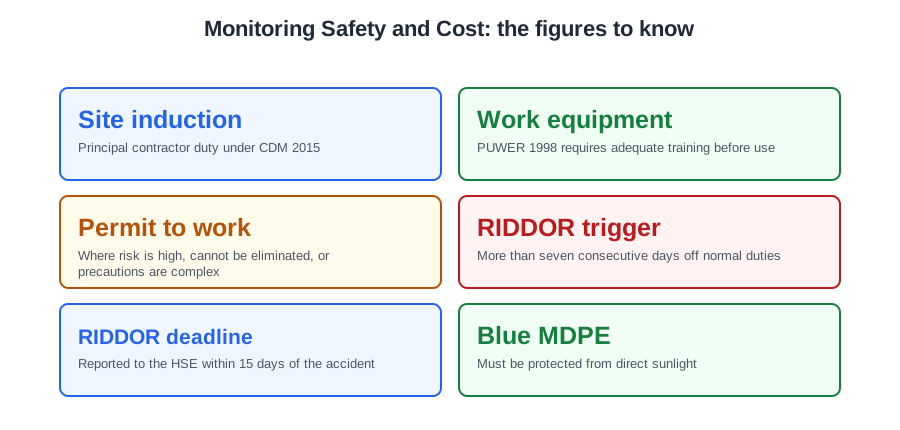
- Site induction
- Principal contractor duty under CDM 2015
- Work equipment
- PUWER 1998 requires adequate training before use
- Permit to work
- Where risk is high, cannot be eliminated, or precautions are complex
- RIDDOR trigger
- More than seven consecutive days off normal duties
- RIDDOR deadline
- Reported to the HSE within 15 days of the accident
- Blue MDPE
- Must be protected from direct sunlight
- Interim payment
- Value of work properly executed plus materials on site at the valuation date
⚠️ Where people go wrong
- Thinking the operative arranges their own induction,The principal contractor must ensure a suitable site induction is provided.
- Treating a manual as training,PUWER requires adequate training, and PPE is no substitute for it.
- Reading fast progress as good news,Unexpectedly fast progress usually means safety standards are being cut.
- Assuming the accident book satisfies RIDDOR,The book entry is still needed, but an over-seven-day injury is reported to the HSE within 15 days.
- Waiting for an ambulance-level injury,The RIDDOR trigger is days off normal duties, not the type of injury.
- Ordering extra to cover wastage,Reconcile issued against installed and correct the cause — extra ordering prices waste into every job.
- Supporting a payment application with timesheets,Hours are cost incurred; the valuation needs work completed and materials on site.
📝 9-Question Self-Test
Straight from the Level 3 course question bank. Click an option to see whether you got it right — the explanation appears instantly, and there is nothing to submit.
A communal hallway is a shared escape route and other residents are using it while you work, so cuttings, old pipe and packaging have to be cleared as you go rather than left until the end of the day. Locking the communal door is tempting as a way of keeping people out, but it blocks the escape route for every other flat and is not yours to lock.
Work running far ahead of a realistic programme normally means steps are being missed — guardrails not fitted, isolations not proved, checks skipped — because that is the only way that much time gets saved. Strict adherence to the specification is tempting, but following a specification adds checks and takes longer, it does not speed work up.
People are motivated by being listened to, so discussing work problems with staff gets you the reason for the problem and their agreement to fix it. Threatening dismissal for poor timekeeping may change behaviour for a week, but it works on fear, damages trust and does nothing about the cause.
CIBSE guidance on the Management of Health and Safety at Work Regulations 1999 says that where risks remain high, cannot be eliminated or the precautions are complex, a permit-to-work system should be employed. Commissioning Code B likewise lists use of a permit-to-work system and two-person working where live plant is involved.
Interim payments are based on the value of work properly executed and materials on site at the valuation date, so the supervisor's record of stage completion is what the application rests on. BS 8000-0 says acceptance of checked work should formally indicate completion or stage completion, and that performance to cost and programme should be fed back into the project organisation. Hours worked and merchant invoices show cost incurred, not value earned.
BS 8000-15 clause 2.1.2.2 says materials should be stored in a secure hut or compound under cover on bases or racking prepared in advance, in accordance with the manufacturer's instructions, and specifically that blue MDPE tube and pipe should be protected from direct sunlight. Poor storage causes damage, contamination and theft, all of which are avoidable cost.
BS 8000-0 clause 6.3 says that prior to offering for completion all work should be checked by the operative and, where appropriate, by a supervisor, and clause 6.1 says inspection of work in progress should be undertaken and recorded where critical aspects will become covered. Offering unchecked work wastes the client's inspection and insulating first hides the joints the inspection is meant to see.
BS 8000-0 clause 5.1 says all operatives should understand and respond to clear and formal reporting lines for authority and instruction, and topic 3.2 of this unit names responsibility allocation of work to areas as a way of checking quality. Allocating defined areas gives each operative ownership of the quality of their work and lets the supervisor trace, correct and learn from any defect.
BS EN 14336 clause 9.4 says handover documentation shall include records of pressure and functional testing, the balancing report and operation and maintenance instructions, and Annex A requires a record of each water tightness test giving the date, test pressure and duration. A supervisor who accepts work without these records has no evidence the quality checks were ever performed.
Going further: the lessons behind this article
This article is the public answer. Unit 336 of the Level 3 course takes the same ground to the depth the exam and the synoptic assignment ask for, in 3 lessons:
- Safety management on site: induction, competence and training
- Permits, reporting and the people your work affects
- Cost monitoring: storage, wastage and the monthly payment
- Site procedures: the Unit 336 guide — every article on this unit in one place
- All PlumbMate articles — Level 1, 2 and 3
- The Level 3 course — the whole 8202-35 Diploma