The risk assessment identifies the hazards. The method statement sets the sequence. You cannot write the second without the first.
The short answer
A method statement is the record of how management wants the job done. Its principal purpose is to describe, stage by stage, how the work will be carried out, so that accidents and dangerous situations are prevented. It gathers the control measures from every risk assessment that applies to the job into one document and turns them into an order of work somebody can follow. It is not a materials list, not a price, not a timesheet and not the payment terms.
How it differs from a risk assessment
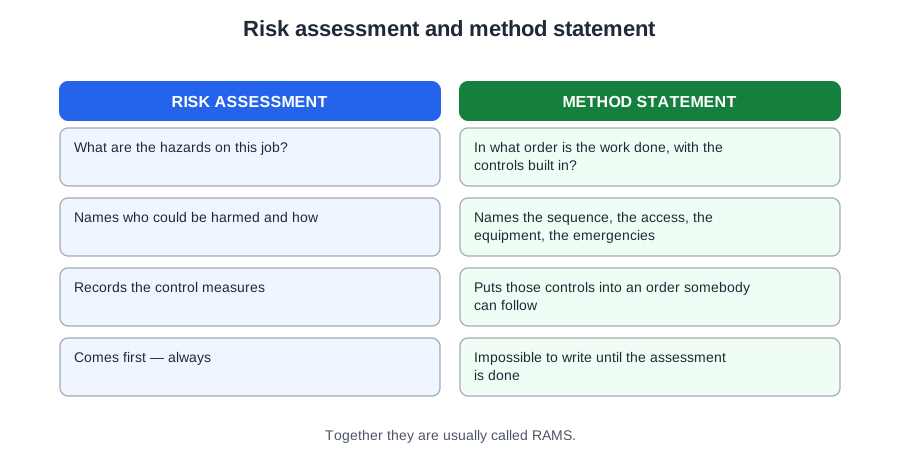
The two are partners and they are constantly confused:
| Document | Question it answers |
|---|---|
| Risk assessment | What are the hazards, who could be harmed, and what controls apply? |
| Method statement | In what order is the work done, with those controls built in? |
You cannot write a safe sequence until you know what you are working around — which is why the assessment always comes first. Together they are usually called RAMS.
Take a leaking domestic septic tank: raw sewage, low-level pipework to lift and repair, an excavation, a specialist contractor bringing the tank, and neighbours twenty metres away. There are risk assessments for the sewage and for the excavation. What nobody has yet is a single document telling the team the order in which to do it safely.
What goes in it
A method statement must be clear and precise, or it will be considered unsuitable or insufficient for the task. It should be practical and readable enough for the team to follow easily, and detailed enough that anyone inspecting it — the HSE, the client, the principal contractor — can judge whether the plan actually works. Typical content:
- The sequence of work, stage by stage, and the methods used to keep the area safe and tidy.
- Access arrangements — how you get onto a roof or into an excavation is exactly the sort of thing that belongs here.
- The risk assessments drawn on, and the control measures from them.
- Drawings, plans, specifications and schedules the work depends on.
- Manufacturers' information, current regulations and official guidance.
- Site inspection reports and anything already known about the site.
- The equipment, materials and controls to be used.
- Emergency arrangements, and any other significant risks with how they will be controlled.
On the septic tank job that means: how the area is fenced and signed, how the excavation is supported and accessed, what protective equipment is worn for the sewage, what happens to the arisings, how the specialist contractor and the plumbers are sequenced so they are never in the same hole, who talks to the neighbours and the local authority, and what happens if somebody is injured in the excavation.
Presenting it: the standard headings
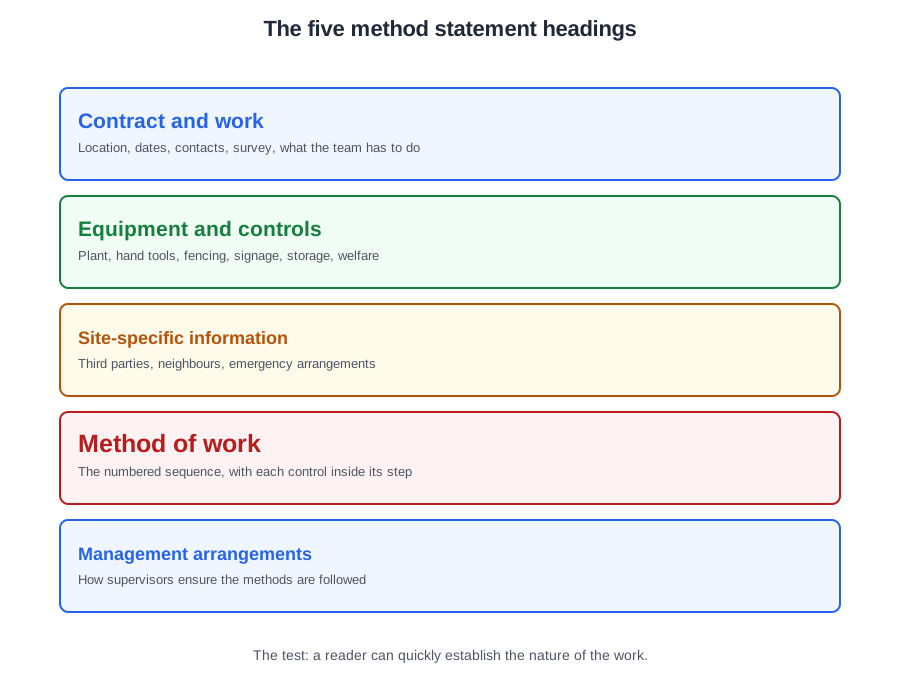
Companies and clients have their own templates, so it is difficult to be entirely prescriptive about the form. But there is one test: anyone reading the document should quickly be able to establish the nature of the work. If a reader has to hunt for what the job is, where it is and who is doing it, the format has failed — and a rejected method statement on a Friday means the gang does not start on Monday.
| Heading | What goes under it |
|---|---|
| Details of the contract and the work | Work location, attendance times and dates; contacts for the supervisor, client, principal contractor or co-ordinator, senior manager and local authority; survey details; what the team has to do and the site constraints |
| Equipment, materials and controls | Lifting, drilling and excavation equipment; hand tools, sprays and gels; fencing, barriers and signage; location and access for water and power supplies; storage and transport; welfare facilities |
| Other site-specific information | Responsibilities and lines of communication with third parties; pre-planning so neighbours are not affected; emergency arrangements; other significant risks and their controls |
| Method of work | The site-specific sequence and the methods used to keep areas safe and tidy — including work at height, excavations, confined spaces and live electrical installations |
| Management arrangements | How supervisors and managers ensure the methods are followed, and regular team meetings covering variations to the specification or working methods |
Writing the sequence
The method of work is the part people write badly. Three habits fix it:
- Number the stages in the order they happen, from arriving on site to leaving it clean. A reader should be able to follow it with a finger.
- Put the control inside the step, not in a list at the end. Not "work at height — use suitable equipment", but "Stage 4: erect the mobile tower on the level slab, fit the guardrails and toe boards, and lock the castors before anyone climbs."
- Write what the operative will do, in plain sentences and short paragraphs. A method statement that reads like a policy will be signed and not read.
Be specific about people too: name the supervisor, say how many operatives and what training or certification each stage requires, and state who is authorised to stop the work.
The document is doing two jobs at once. It is a guide for the site team, so it has to be practical, ordered and readable. And it is a management tool, because senior management use it to control the job — it verifies that the significant risks have been considered and that specific instructions were given for dealing with them. That second audience is why it is signed and dated, and why the version on site has to be the current one.
Using it on site
It is written by the employer or contractor carrying out the work — in practice a supervisor, contracts manager or competent person who knows both the job and the assessments behind it. On a site, the client or principal contractor normally has to accept it before work commences: the workplace, work continuity and work flow are assessed, checked against the overall method statement and accepted, and only then may work start.
It is then briefed to everybody who will work under it, and each of them signs to say they have received and understood the briefing. The signature is not a formality — it is the record that the instruction was given, and it is also the moment somebody can say the sequence will not work in that riser.
A method statement is a live document that must always be available on site: the current version, where the work is, not an email on somebody's phone in a van. It is followed precisely. When the job changes, the document changes with it — a supervisor who has to adjust schedules because a health and safety problem delayed the work produces a revised method statement and involves the team in carrying it out, so the obstruction is worked around safely rather than pressed through. Variations to the specification or the working methods are exactly what the regular team meetings are for.
The rule for the operative is unchanged from the risk assessment: if the job in front of you is not the job in the method statement, stop and tell the supervisor. Nobody improvises around a written sequence on their own authority.
Leaving it safe
The last stages are the ones people forget: making good, clearing the area, removing barriers only once they are no longer needed, and handing over — including telling the next person what you left behind. On some systems that means labelling.
A completed solar thermal installation is the standard example. The labels carry the presence and type of heat transfer fluid, the fill pressure, the safe isolation points, and key operational warnings such as high-temperature pipework. They go at the pump station, at the cylinder connections and at any accessible isolation point, and they exist to prevent the two commonest maintenance errors: topping up with the wrong fluid, and touching pipework far hotter than a heating circuit would be. What the label is not is the installer's advertising, a certificate number on its own, or a warning not to touch the collectors.
That is the whole logic of this outcome in one place. You assessed the hazards, chose the controls, wrote the sequence, briefed it, followed it and revised it when the job moved — then left behind the information the next person needs to work safely on what you built.
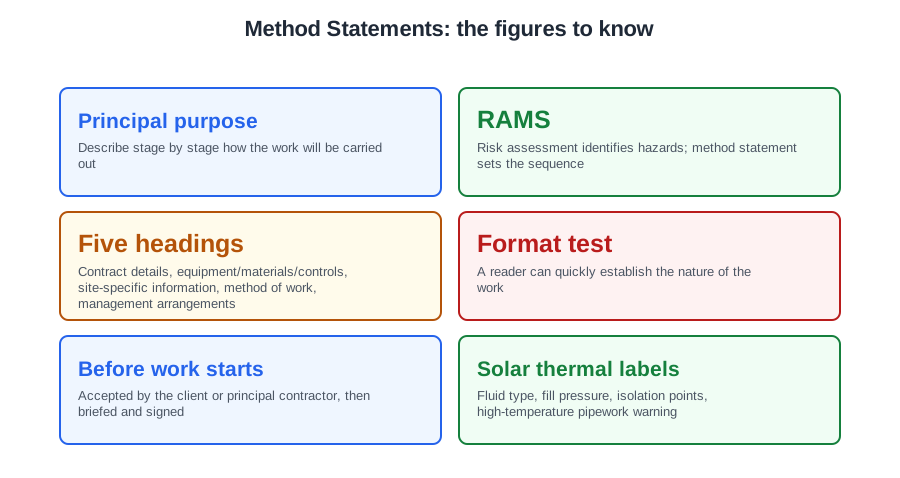
🔢 The numbers worth memorising
- Principal purpose
- Describe stage by stage how the work will be carried out
- RAMS
- Risk assessment identifies hazards; method statement sets the sequence
- Five headings
- Contract details, equipment/materials/controls, site-specific information, method of work, management arrangements
- Format test
- A reader can quickly establish the nature of the work
- Before work starts
- Accepted by the client or principal contractor, then briefed and signed
- Solar thermal labels
- Fluid type, fill pressure, isolation points, high-temperature pipework warning
⚠️ Where people go wrong
- Confusing it with a risk assessment,The assessment names hazards and controls; the method statement orders the work.
- Treating it as a materials list or price,It is a safety sequence, not a quotation, a schedule of rates or a timesheet.
- Listing controls at the end,Each control belongs inside the numbered stage it applies to.
- Leaving it in the site cabin unsigned,It is briefed, signed by everyone working under it, and kept current on site.
- Improvising when the job changes,Stop, tell the supervisor, and have the method statement revised and re-briefed.
- Putting the installer name on a solar label,The label carries fluid type, fill pressure, isolation points and hot surface warnings.
📝 10-Question Self-Test
Straight from the Level 3 course question bank. Click an option to see whether you got it right — the explanation appears instantly, and there is nothing to submit.
A method statement describes, stage by stage, how the work will be carried out, with the control measures from the risk assessments built into each step, so the job gets done without an accident. Listing the materials and their cost is the work of the specification and the price; the method statement answers how, not how much.
A method statement gives the site-specific sequence and safe working practice for the task, so the procedure for getting onto a roof — the equipment, the edge protection, the order of steps — is exactly what it contains. Hire rates for mobile access equipment are tempting because access equipment is involved, but prices belong in the quotation.
A method statement carries the control measures for the task, and how you keep people away from a harmful substance — ventilation, protective equipment, the order of the steps — is one of them. The telephone number of the tool hire company is tempting because it looks like site information, but the method statement covers how the work is done safely.
Four things somebody attending later needs to know before touching anything. The list is BPEC training and trade practice rather than a standard; BS 5918 clause 10.6 adds a durable label for any additive in the heat transfer liquid and a separate label giving the installer and the date.
A method statement is usually completed after the risk assessment, and its purpose is to bring the control measures and findings of the risk assessments for the job together into one document that says how the work will be done safely. Writing the method statement first means planning a sequence before you know what the hazards are.
A method statement may also be known as a safe system of work, and a client may ask for one as part of a tender process so that it can see how the company will operate. The permit to work is a separate document that authorises named people to do specified work in a set time frame; it does not set out the whole method.
A method statement should carry enough detail that anyone inspecting it, whether the HSE or the client, can assess how effective the plan is, and clients ask for one at tender stage to see how the company operates. It settles method, not price, and it never moves the contractor’s own legal duties onto the client.
The method of work heading carries the site specific sequence of work and the actual methods used to keep the work area safe and tidy, including safe practice for working at height, in excavations, in confined spaces and on live services. The scope heading says what the team has to do; the method heading says in what order and how.
Emergency arrangements and procedures are one of the site specific items a method statement must carry, alongside clear lines of communication with third parties and any other significant risks and how they are controlled. The risk rating belongs in the risk assessment, and rates for extra work are a commercial matter, not part of the safe system of work.
A method statement must be clear and precise, or it will be considered unsuitable or insufficient for the task, and it has to give specific instructions on how significant risks will be dealt with. Saying a competent person will do it leaves the reader no way of telling whether the right people, with the right training and certification, are being used.
Going further: the lessons behind this article
This article is the public answer. Unit 336 of the Level 3 course takes the same ground to the depth the exam and the synoptic assignment ask for, in 3 lessons:
- Method statements: what they are and contain
- Presenting a method statement: headings and format
- Using a method statement on site
- Site procedures: the Unit 336 guide — every article on this unit in one place
- All PlumbMate articles — Level 1, 2 and 3
- The Level 3 course — the whole 8202-35 Diploma