Float belongs to the programme, not to the trade holding it — spend it casually and you have removed the only protection the job has.
The short answer
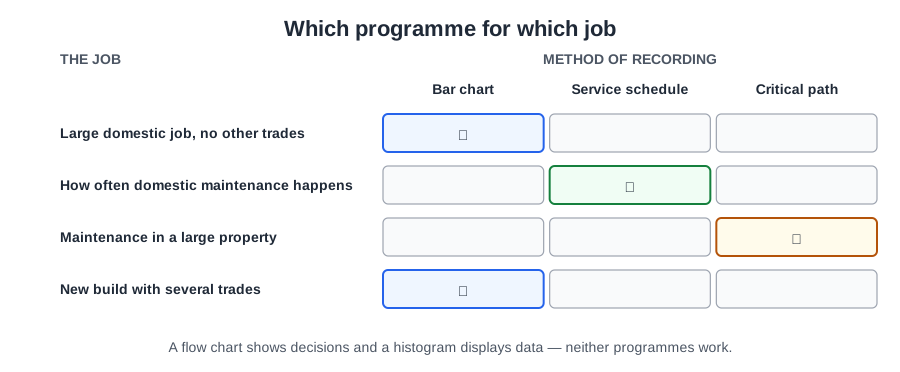
A work programme plans work activity against the time frame of a job or contract so it is finished to the agreed schedule. Another name for it is a Gantt chart, and on site you will hear it called the bar chart or progress chart. Which type you use depends on the job: a simple bar chart for a single-trade domestic install, a service schedule to set how often domestic maintenance happens, and the critical path method for building services maintenance in large properties.
What a work programme shows
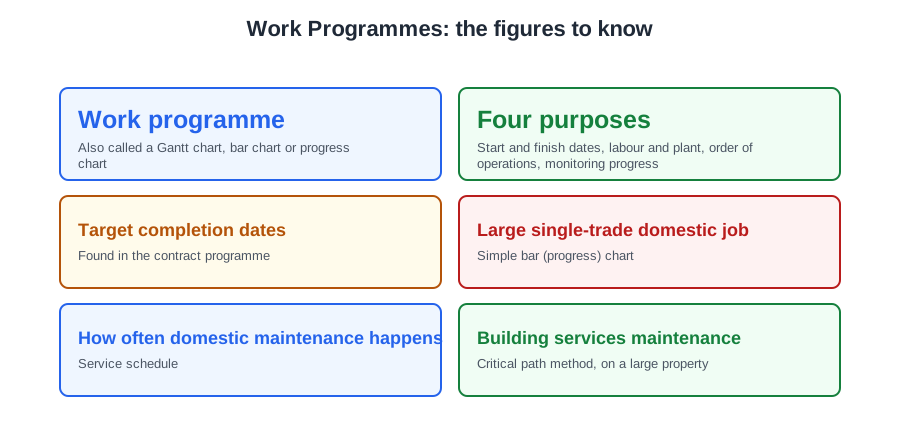
Activities down the left, time across the top, a bar showing when each activity runs. Its purpose is fourfold:
- Establish dates for work to start and finish.
- Illustrate the labour and plant required for the duration of the contract.
- Show the order of operations.
- Provide information for monitoring work progress.
That third purpose is the one people underrate. A programme is not only a calendar — it is a statement of sequence, of what has to be finished before your work can sensibly begin.
Because one of its jobs is to illustrate the labour required, you would expect a space for recording labour inputs on it. What you would not expect to find is a tool hire price list, the customer's contact details or a copy of the site risk assessment — those live elsewhere. A programme answers when and who, not how or how safely.
On a large job the version everybody works to is the contract programme, and that is where target completion dates come from — not the bill of quantities (what and how much), not the method statement (how), not the site diary (what happened).
Using it once work starts
Problems happen anyway, which is why contingency plans are put in place to keep the project on time and within budget. Precise monitoring, timely intervention and good communication with other trades are what make that work. Monitoring against the programme means watching four things at once:
- Cost effectiveness — tracking and managing costs so the job stays within budget.
- Progress against the schedule — so the programme is completed on time.
- Quality — keeping the standard up as the pace rises.
- Staff management — whether staffing levels match what the programme assumed.
Subcontractors need to take this seriously: fail to finish inside the allocated time without the main contractor's agreement and you can lose out to competitors or face penalties. On big projects there is often a separate plan for each trade built into a larger overall programme, with the main contractor holding the overall version. Your trade programme is a page of somebody else's book, and the two have to agree.
Private installation work
A private customer is someone who has work done in their own home and pays for it themselves — not a commercial customer, not a public sector client. That distinction changes who you negotiate with, who authorises changes, and whose daily life you are disrupting.
Programmes are used for private installation work such as removing a bathroom and installing a wet room, where there can be a great deal of disruption to the people living there. A discussion with the customers at the outset customises the work plan and organises the different trades. On a construction site there are fewer restrictions than in someone's house: when a property is occupied, the customer's needs, requirements and lifestyle have to be considered. There will be compromises on both sides, but the initial discussion identifies where rapid progress can be made and where the restrictions are — no noise before eight, the WC back in use every night, the dog kept out of the hall.
For a large property where the job involves no other trades, the method of recording the programme is a simple bar (progress) chart, because the only sequence to manage is your own. A flow chart shows decisions rather than time; a histogram and a scatter diagram display data, they do not programme work.
A domestic programme can be very short. Day one, strip out; day two, first fix; day three, tanking and screed. That is a work programme, and it does everything the big ones do.
Private service and maintenance work
Servicing and repair is planned differently because it repeats. Where you need to set how often maintenance is carried out in a domestic dwelling, the method of recording the programme is a service schedule — a list of tasks with the interval at which each is due. A risk assessment records hazards, a critical path network suits complex interdependent work, and a job sheet records one visit. Only the service schedule answers how often.
Some checks are a legal requirement for landlords, and good record keeping is what lets a plumber work efficiently and prove the work was done. A heating system service means testing the safety controls on a sealed system and inspecting the float-operated valve in a feed and expansion cistern in a loft — which needs safe access and good lighting arranged in advance, not discovered on the day. Records of past events and risk assessments make the next programme accurate: the second year of a maintenance round is always easier to plan than the first.
Contract work: new build and maintenance
The programme for a large new-build project can be very detailed, with a separate plan for each trade built into a larger overall programme, generally overseen by the main contractor. What makes a new-build programme distinctive is dependency: groundworks before the incoming main, joists and studwork before first fix, plaster before second fix. Your dates are hostage to other trades, which is why slippage anywhere upstream lands on you.
A maintenance contract programme exists to keep appliances and components functional, safe and in good working order — monitoring chlorination of water supplies, testing, checking flow rates and temperatures of outlets to show compliance with the Water Regulations and current British Standards, servicing a commercial gas boiler to the manufacturer's instructions, checking radiator circuits for operation and leaks, inspecting sanitary appliances, replacing air admittance valves and WC siphons, and performance testing trap seals after complaints of foul smells.
| Type of maintenance | What it means |
|---|---|
| Planned preventive | Systematic tasks at set intervals to stop failures happening |
| Corrective | Putting right a fault that has been found |
| Breakdown | Responding once something has failed |
| Condition-based | Acting on what measurements show, rather than on the calendar |
For building services maintenance in large properties, the method most likely used is the critical path method. With many systems, plant shutdowns and access windows, the useful question is not simply when each task happens but which chain of tasks decides the total time. Simple listing cannot cope with the interlocking, a flow chart shows decisions, and a histogram displays quantities.
Two practical points: some tasks such as chlorination may have to be done after hours, so communication with the customer is essential; and accurate records make next year's programme realistic. There is a commercial difference too — a new-build contract is priced once for a fixed scope and ends, while a maintenance contract is priced as a rate for a period, so the profit depends on how accurately the visits were estimated. A firm that allowed two hours for a boiler service that really takes three will lose money every month for three years.
Reading a bar chart
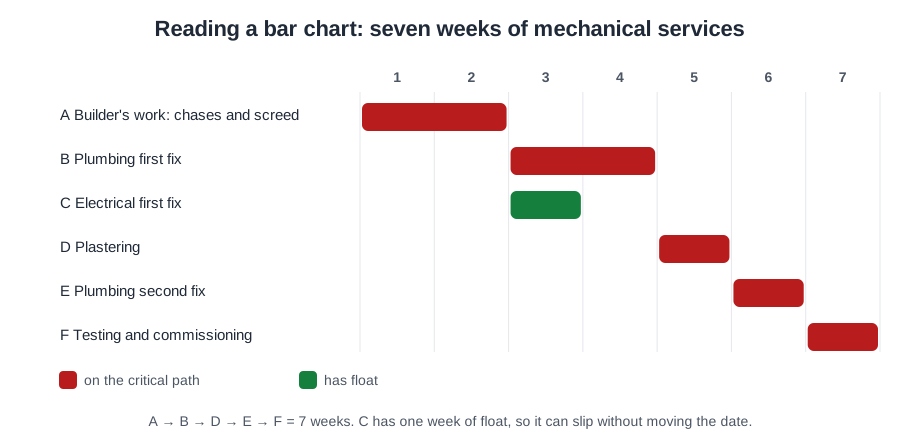
A seven-week programme for the mechanical services in a small extension:
| Activity | 1 | 2 | 3 | 4 | 5 | 6 | 7 |
|---|---|---|---|---|---|---|---|
| A Builder's work: chases and screed | ■ | ■ | |||||
| B Plumbing first fix | ■ | ■ | |||||
| C Electrical first fix | ■ | ||||||
| D Plastering | ■ | ||||||
| E Plumbing second fix | ■ | ||||||
| F Testing and commissioning | ■ |
Pass one — dates and durations. Plumbing first fix starts at the beginning of week 3 and finishes at the end of week 4, a duration of two weeks. Second fix is a single week, week 6. The whole job runs seven weeks.
Pass two — dependencies. First fix cannot start until the chases are cut and the screed is down, so B depends on A. Plastering needs both first fixes in, so D depends on B and C. Second fix follows the wall finishes (E depends on D), and testing follows second fix (F depends on E).
Pass three — the critical path. Follow the longest chain of linked activities: A → B → D → E → F, durations 2 + 2 + 1 + 1 + 1 = 7 weeks, the whole job. That chain is the critical path: the sequence that decides the total duration, where any delay to any one activity delays completion of the whole project.
Now look at C. One week long, it cannot start before week 3 and must finish before plastering begins in week 5 — a two-week window for one week of work, so it has one week of float. Float is the spare time in an activity: how much it can slip without pushing the finish date.
One caution: float belongs to the programme, not to the trade holding it. If the electrician uses the whole week and then hits a problem, there is nothing left and C becomes critical too.
Test the chart with two questions. Plumbing first fix runs a week late? B is on the critical path, so plastering moves to week 6, second fix to week 7, commissioning to week 8 — the job finishes a week late, and that is reported to the programme holder immediately. The electrician starts a week late? C has a week of float, so it runs in week 4 and still finishes before plastering — the completion date does not move.
That is why a supervisor reads the chart before promising anything. Protect the activities on the critical path — materials on site early, preceding trade finished, gang kept on them — and be flexible with the ones carrying float. The same reading works on a domestic job with three activities and on a tower block with three hundred; only the number of rows changes.
🔢 The numbers worth memorising
- Work programme
- Also called a Gantt chart, bar chart or progress chart
- Four purposes
- Start and finish dates, labour and plant, order of operations, monitoring progress
- Target completion dates
- Found in the contract programme
- Large single-trade domestic job
- Simple bar (progress) chart
- How often domestic maintenance happens
- Service schedule
- Building services maintenance
- Critical path method, on a large property
- Critical path
- The chain that sets total duration — delay on it delays completion
- Float
- Spare time in an activity that can slip without moving the finish date
⚠️ Where people go wrong
- Expecting risk assessments on a programme,A programme answers when and who; hazards live in the risk assessment.
- Looking up completion dates in the bill of quantities,Target completion dates come from the contract programme.
- Choosing a flow chart or histogram to programme work,Flow charts show decisions and histograms display data — neither plans against time.
- Using a job sheet to set service intervals,A service schedule sets how often; a job sheet records one visit.
- Spending float because it is "yours",Float protects the project. Use it up and that activity becomes critical too.
- Treating any delay as a delay to completion,Only delay on the critical path moves the finish date.
📝 10-Question Self-Test
Straight from the Level 3 course question bank. Click an option to see whether you got it right — the explanation appears instantly, and there is nothing to submit.
One of the four purposes of a work programme is to show the labour and plant needed across the contract, so a bar chart carries a space for recording labour inputs against each activity. A copy of the site risk assessment is tempting because it is another live site document, but the programme answers when and who, not how safely.
With no other trades there is only your own sequence to manage, so a simple bar chart — activities down the side, days across the top — sets the start and finish dates and gives you something to check progress against. A flow chart is tempting, but it maps decisions and routes through a process and has no time axis at all.
A service schedule lists the maintenance tasks with the interval at which each falls due, so it is the only one of these that answers how often. A job sheet is tempting because it does record maintenance work, but it records a single visit that has already happened and sets no interval for the next one.
New-build walls are plasterboard on studs or dot-and-dab on blockwork, so fixings need to reach the studs or the block behind; lath and plaster and solid stone with plaster belong to older buildings.
The contract programme is the schedule of when each part of the work must be done; the material schedule lists what, not when.
Gantt chart is another name for the work programme, and on site it is also called the bar chart or the progress chart: activities down the left, time across the top, a bar showing when each activity happens. The bill of quantities is tempting because it is also a large contract document, but it says what and how much, not when.
The bar covers the whole of week 3 and the whole of week 4, so the allowance is two weeks. Reading it as one week is the common slip of counting only the week the bar starts in.
In a large building with many systems, plant shutdowns and access windows, the useful question is not just when each task happens but which chain of tasks decides the total time, and that is what a critical path shows. Simple listing is tempting because a maintenance round looks like a list, but a list cannot show which jobs depend on which.
An activity on the critical path has no spare time in it, so a week lost there pushes every following activity and the completion date with it. Following trades absorb a delay only if they have float, and activities on the critical path by definition have none.
The spare time in an activity's window is its float, and a delay smaller than the float is absorbed without moving the finish date. The date would move only if the delay used up all the float and pushed the plastering start.
Going further: the lessons behind this article
This article is the public answer. Unit 336 of the Level 3 course takes the same ground to the depth the exam and the synoptic assignment ask for, in 4 lessons:
- Work programmes: what they are and what they show
- Programmes for private work: installations and service jobs
- Programmes for contract work: new build and maintenance
- Reading a bar chart: a worked example
- Site procedures: the Unit 336 guide — every article on this unit in one place
- All PlumbMate articles — Level 1, 2 and 3
- The Level 3 course — the whole 8202-35 Diploma