A firm with twelve operatives has never written a health and safety policy and has never trained anybody on the threading machine. One operative has taken the guard off because it slows him down, and will not wear the goggles he was issued.
The short answer
Everybody in that story is breaking the same Act, in four different places.
The Health and Safety at Work etc. Act 1974 applies to everyone at work — employers, employees and the self-employed — and it protects members of the public who may be put at risk by work activities. It is enforced by the Health and Safety Executive.
Most of its duties are qualified by so far as is reasonably practicable: the employer weighs the size of the risk against the time, trouble and cost of removing it, and acts unless the two are grossly disproportionate. It does not mean whatever is convenient.
The four sections

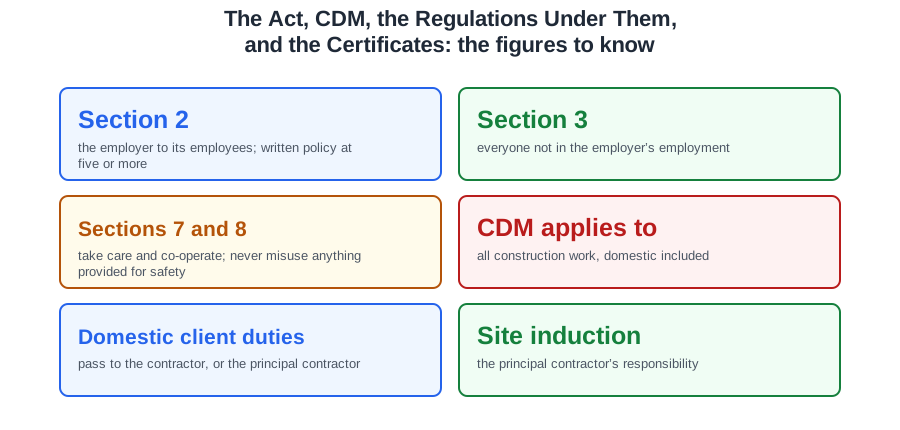
Section 2 — the employer must ensure the health, safety and welfare of its employees: safe plant and systems of work; safe use, handling, storage and transport of articles and substances; a safe workplace with safe access and egress; adequate welfare facilities; and such information, instruction, training and supervision as is necessary. It also requires a health and safety policy, written down where the employer has five or more employees, kept up to date and made known.
Section 3 — employers and the self-employed must ensure that people not in their employment are not exposed to risks: the customer, the neighbours, the other trades, the public on the pavement.
Section 7 — every employee must take reasonable care for themselves and others affected by what they do or fail to do, and co-operate with their employer.
Section 8 — no person shall intentionally or recklessly interfere with or misuse anything provided in the interests of health, safety or welfare. Removing the guard and refusing the issued eye protection breaches both 7 and 8.
What that means in practice is a short list an employer must actually do: carry out risk assessments; identify and put in place adequate control measures; inform employees of the assessments and controls; review the assessments at regular intervals; and record them where five or more people are employed.
That is where duty of care comes from in practice: not a slogan, but a chain of specific things that must be done, written down and kept current. A supervisor carries it downwards — you cannot delegate a task to someone you have not trained and then treat the outcome as their fault.
CDM 2015
A homeowner builds a kitchen extension, engaging a builder and, separately, a plumbing firm. She has made no appointments, signed no forms and never heard of CDM. She still has a construction project, and somebody is carrying the client duties.
The aim of CDM is to build health and safety into the way projects are managed: hazards identified early and designed out where possible, remaining risks managed through the job, and effort put where it does most good rather than into paperwork for its own sake. CDM applies to all construction work, including domestic work — there is no minimum size and no scaffolding test.
- The client makes suitable arrangements: appointing competent people early, allowing enough time and resources, ensuring welfare facilities, and providing pre-construction information.
- The principal designer plans, manages and monitors the pre-construction phase, and advises and assists the client and the team with their duties.
- The principal contractor plans, manages and monitors the construction phase where there is more than one contractor: the construction phase plan and site rules, welfare facilities, securing the site, and ensuring that a suitable site induction is provided.
- Each contractor plans, manages and monitors its own work, checks competence, and gives each worker appropriate supervision, instructions and information.
- Workers co-operate, co-ordinate with others and report obvious risks.
Two things catch people out. The site induction is the principal contractor's responsibility, not the subcontractor's — but the subcontractor still briefs and supervises its own gang. And the health and safety file, containing what is needed to clean, maintain and alter the building safely, is prepared and handed to the client at the end.
A domestic client is someone having work done on their own home, not in connection with a business. Their client duties pass to somebody else: to the contractor where there is only one; to the principal contractor where there is more than one; unless the client has agreed in writing that the principal designer will take them on. Where no principal contractor has been appointed, the contractor in control of the construction phase is treated as the principal contractor.
So on the kitchen extension, the client duties sit with the builder controlling the work — not with the homeowner and certainly not with building control, which has no role under CDM at all.
The practical effect is that on domestic work the planning, co-ordination and information duties land on the installer. Nobody else is going to write the construction phase plan.
A project is notifiable to the HSE where the work will last longer than 30 working days with more than 20 workers at the same time, or exceed 500 person days; the client gives that notice, and on a domestic project the duty travels with the client duties.
And CDM sits alongside the rest of health and safety law rather than replacing it: a duty to plan, manage and monitor is not discharged by a folder of paperwork nobody has read.
The regulations underneath
The Management of Health and Safety at Work Regulations 1999 require a suitable and sufficient assessment of the risks of all work activities. They also deal with young persons: before employing anyone under 18, the employer must make or review a risk assessment paying particular attention to their inexperience, lack of awareness of risk and immaturity. In practice a 16-year-old apprentice is assessed for and supervised closely, not simply inducted and left.
COSHH protects people from illness caused by exposure to hazardous substances — chemicals, dusts, fumes, biological agents, asphyxiants and carcinogens. The employer must assess the risk, decide the precautions, prevent exposure or adequately control it, make sure controls are used and maintained, monitor exposure, carry out health surveillance where needed, and inform, train and supervise.
PUWER sets minimum standards for all work tools and equipment: equipment fit for purpose, used only for its intended purpose, maintained in good working order, with appropriate safety devices, adequate instruction, training and supervision, and regular inspection. That is the regulation the missing guard and the untrained operator both fall foul of.
The Electricity at Work Regulations 1989 require systems maintained safe, work carried out safely by competent people, effective isolation available, and live work not attempted unless it is unreasonable to work dead. They also require verifiable evidence, which is why calibration and certification of test instruments matters. An operative can null leads, sanity-check an ohmmeter against a known resistor and prove a tester on a known live source — but calibration and certification are not done by operatives; the instrument goes away to be calibrated against traceable standards.
RIDDOR places a duty on the employer to report certain work-related events — for construction, to the HSE. Deaths and specified injuries are reported without delay. An injury leaving a worker incapacitated for more than seven consecutive days, not counting the day of the accident, must be reported within 15 days, and a record kept of any injury causing more than three days' incapacity. Certain diseases and dangerous occurrences — near misses that could have caused serious harm — are also reportable.
The Work at Height Regulations 2005 require work at height to be avoided where it can be, properly planned, done by competent people, with equipment inspected and maintained. The Manual Handling Operations Regulations require hazardous handling to be avoided, then assessed, then reduced.
And of the ordinary tasks a building services operative meets, working in excavations carries the greatest risk — sides collapse without warning and bury people.
An Approved Code of Practice gives practical advice and has a special legal status: follow it and you are doing enough on the matters it covers; depart from it, and if you are prosecuted you must show you complied some other way or a court will find you at fault. The legionella code names a duty holder — the employer, the self-employed person, or the person in control of the premises — who must ensure a suitable and sufficient risk assessment is carried out by someone competent to do it.
Notification and certificates
Two jobs, two Fridays: an unvented cylinder in an existing house, and a bidet with an ascending spray. Neither needs anybody from the council to visit, and both produce a certificate.
Installing an unvented hot water storage system is notifiable building work, which must normally be notified before work starts. But where the installer is registered with a competent person self-certification scheme, it is not necessary to notify in advance — the installer self-certifies.
What follows is not optional. The occupier must be given a certificate of compliance within 30 days of completion, and the building control body must be given notice, also within 30 days. So the unvented cylinder needs no advance notice and no inspection visit — but the householder gets a certificate within 30 days, and building control is told.
The Water Supply (Water Fittings) Regulations 1999 protect the public supply from waste, misuse, undue consumption, contamination and erroneous measurement. Notifiable work includes a bath over 230 litres, a bidet with an ascending spray or flexible hose, certain showers, pumps drawing more than 12 litres per minute, reverse osmosis units, and devices protecting against fluid category 4 or 5.
Where notice is required, the person must not begin without the undertaker's consent. The undertaker has ten working days; if it says nothing, consent is deemed to have been granted unconditionally.
An approved contractor changes this. Where an approved contractor installs a fitting in certain of those categories, the notification requirement does not apply — but the contractor must, on completion, furnish a signed certificate to the person who commissioned the work stating whether the fitting complies, and send a copy to the undertaker where notice was required. That certificate is what gives the owner a defence if compliance is later questioned.
Regulations set the requirement; British Standards and Approved Documents show a way of meeting it. Neither is the first document you reach for when installing an appliance. Manufacturers' installation, servicing and user instructions must be followed: ignore them and the warranty is void, the installation may be dangerous, and you may inadvertently breach the regulations.
🔢 The numbers worth memorising
- Section 2
- the employer to its employees; written policy at five or more
- Section 3
- everyone not in the employer’s employment
- Sections 7 and 8
- take care and co-operate; never misuse anything provided for safety
- CDM applies to
- all construction work, domestic included
- Domestic client duties
- pass to the contractor, or the principal contractor
- Site induction
- the principal contractor’s responsibility
- Notifiable to HSE
- over 30 days and 20 workers, or 500 person days
- Young persons
- assessed for inexperience, lack of awareness and immaturity
- RIDDOR
- over seven days incapacity reported within 15 days
- Greatest ordinary risk
- working in excavations
- Competent person scheme
- certificate to the occupier within 30 days
- Water undertaker
- ten working days, then consent is deemed granted
⚠️ Where people go wrong
- Reading “reasonably practicable” as “whatever is convenient”.
- Forgetting Section 3 — the public and the other trades.
- Delegating a task to someone you have not trained, then blaming them.
- Assuming CDM does not apply to domestic work.
- Leaving the client duties with a homeowner.
- Expecting building control to have a CDM role. It has none.
- Treating a folder of paperwork as compliance with a duty to plan, manage and monitor.
- Inducting a 16-year-old and leaving them to it.
- Calibrating your own test instrument.
- Missing the RIDDOR clock: seven days incapacity, 15 days to report.
- Departing from an Approved Code of Practice with nothing to show instead.
- Starting notifiable water work before consent.
- Reaching for the standard before the manufacturer’s instructions.
📝 10-Question Self-Test
Straight from the Level 3 course question bank. Click an option to see whether you got it right — the explanation appears instantly, and there is nothing to submit.
Work is allocated on competence: whether that person has the skill, training and experience for the particular task and can be supervised appropriately while doing it. How long they have been with the company is tempting because it sounds like experience, but time served is not the same as being trained and assessed for the job in hand.
Suspected substance abuse involves health, capability and usually the disciplinary procedure, so it goes to people qualified to handle it — a manager, HR or occupational health. An employee repeatedly leaving the work area untidy is the tempting answer, but that is ordinary day-to-day supervision and you deal with it yourself, on the spot.
Calibration is done by a calibration house against traceable references, normally annually and to the manufacturer’s recommendations, and it produces a certificate, so it is not something done on site. What operatives do is verify accuracy between calibrations, and nulling the leads or reading a resistor of known value are exactly those in-house checks.
Safe isolation means the supply cannot be restored while you are working, so on a fuse board you take the protective device out, keep it with you and fix a warning notice to the consumer unit saying why. Turning off the main switch and asking the customer to keep people away relies on somebody else remembering, and isolation must never depend on that.
Without registration on a competent person self-certification scheme you cannot certify your own work, so it has to be notified in advance to a building control body: Local Authority Building Control, or an approved inspector under an initial notice. The local water undertaker is tempting because certain water fittings work is notified to them, but sanitary pipework compliance is a Building Regulations matter.
CDM applies to all construction work, domestic included. What differs is that a domestic client's duties normally transfer to the contractor — or to the principal contractor where more than one contractor is involved. The practical effect is that the installer carries the planning, coordination and information duties.
The Electricity at Work Regulations impose the duty to work safely on or near electrical systems: regulation 13 requires adequate precautions to stop equipment that has been made dead becoming charged again while the work goes on. HSE guidance HSR25 paragraph 196 adds that the conductors must be proved dead at the point of work before the task starts, using a voltage indicator that is itself proved immediately before and after. Part P and BS 7671 govern the standard of the installation; this is about the safety of the person working on it.
Follow the instruction. The order is straightforward: statute first, then the more demanding of the instruction and the standard. Where an instruction conflicts with statute, statute wins and the appliance is not fitted that way.
Section 7 places a duty on every employee to take reasonable care for the health and safety of themselves and of others affected by their acts or omissions, and to co-operate with the employer so far as is necessary for the employer to meet its own duties. Section 8 states that no person shall intentionally or recklessly interfere with or misuse anything provided in the interests of health, safety or welfare. Removing the guard and refusing issued PPE breaches both sections.
Regulation 13(4) of CDM 2015 requires the principal contractor to ensure that a suitable site induction is provided, that steps are taken to prevent unauthorised access, and that welfare facilities complying with Schedule 2 are provided throughout the construction phase. The subcontractor still has its own regulation 15 duty to give each of its workers appropriate supervision, instructions and information for the tasks they will do, but the site induction itself is the principal contractor's responsibility.
Going further: the lessons behind this article
This article is the public answer. Unit 336 of the Level 3 course takes the same ground to the depth the exam and the synoptic assignment ask for, in 4 lessons:
- The Health and Safety at Work Act: duties on everyone
- CDM 2015: duty holders, domestic clients and induction
- The regulations that sit under the Act
- Building and Water Regulations: notification and certificates
- Site procedures: the Unit 336 guide — every article on this unit in one place
- All PlumbMate articles — Level 1, 2 and 3
- The Level 3 course — the whole 8202-35 Diploma