Three questions come at a supervisor in the same morning. Can we run the heating in a different pipe material? Will the roof timbers carry a 300 litre cylinder? Where exactly is the oil storage tank going?
The short answer
Each has an obvious person to ask, and asking the wrong one wastes a day. Architect, structural engineer, surveyor — in that order.
And one distinction runs through the whole subject: the design team question is who knows; the chain of command decides who tells you. None of these people give you an instruction directly.
The design team
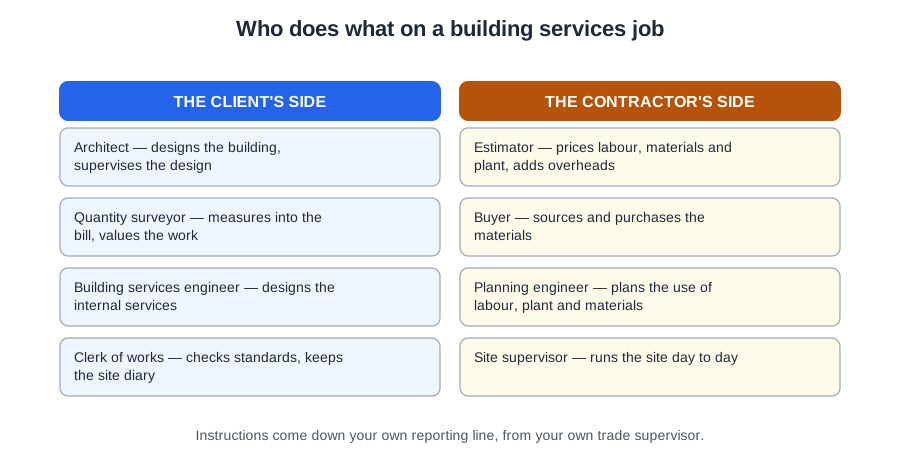
The architect is normally the leader of the design team, turning the client's requirements into a building design and working drawings, and generally overseeing the construction work until handover. Because the architect owns the design, anything that changes what the building is goes to them.
So a change of pipework material is an architect's question, because it affects the specification, the appearance and possibly the contract. So is the layout of the fire compartments — which walls and floors are compartment lines, and therefore where you may not pass a pipe without a proper fire seal.
- The structural engineer deals with loads and the structure. Any question about load-bearing capacity is theirs: whether roof timbers will take a cylinder, whether a joist may be notched, whether a plant base is adequate.
- The civil engineer designs roads, bridges and the drainage and water requirements to the building.
- The building services engineer designs the services inside the building — heating and ventilation, hot and cold water, and the heat loss and heat gain calculations. This is the designer of the systems you install.
- The site engineer is site based and deals with setting out and levels.
- The building surveyor advises on building and property matters and carries out surveys. Questions about where something goes on a property, such as the position of an oil storage tank, are surveyor questions, because they turn on separation distances, ground conditions, access and regulations.
| Question | Ask |
|---|---|
| Can we change the pipework material? | Architect |
| Where are the fire compartments? | Architect |
| Will these roof timbers take the load? | Structural engineer |
| Where should the oil storage tank go? | Surveyor |
| What was the design flow temperature for this circuit? | Building services engineer |
| Is this setting-out line correct? | Site engineer |
Knowing the difference saves you from a common and expensive error. If a joist is in the way of a pipe run, notching it is not a plumbing decision, because a notch in the wrong place weakens the member. In the same way, a pipe passing through a compartment wall is not simply a hole; it is a penetration in a fire barrier. Both are cases where the person holding the tool is not the person who decides.
Cost and quantities
Two money questions on one contract: what does a change of press-fit system do to the price, and can the firm be paid for the 800 metres of pipework installed? These sound like the same question. They go to two different people.
The estimator prices work before it happens. They break the bill of quantities into labour, materials and plant, apply a rate to each, then add a percentage for overheads — site offices, site and administration salaries — and a percentage for profit. That total is what the company tenders.
So a question about the cost of a change of materials is an estimator's question: they hold the build-up — the rate assumed for that fitting, the labour allowed for the joint, the plant assumed.
The quantity surveyor is the cost professional for the project. Before the work they measure from the architect's drawings and produce the bill of quantities that contractors price. During the work they measure what has actually been installed and value it, so the contractor can receive interim payments. At the end they prepare the final account. And the QS values variations.
Estimator first, quantity surveyor after: the estimator says what it should cost, the QS says what it did.
Between the two sits the buyer, who turns the priced allowance into actual goods at actual prices. If the buyer cannot get the specified item at the rate the estimator allowed, that difference is a real cost and has to be raised, not absorbed quietly on site.
Both roles depend on your records. Interim payments, variations and the final account are all built from measured quantities and dated records. A gang that does not record what it installed is a gang whose company gets paid late, or less.
It also explains why an estimator's allowance is not a target you should quietly beat by cutting corners. The rate assumes the joint is made properly, in the material specified, with the fixings named. Work that is faster because it is not the work that was priced is not a saving; it is a defect waiting for the clerk of works.
Running the job
On a large development the gang deals with perhaps five people in a week and could not reliably say who any of them works for. That matters, because two of them represent the client and three represent contractors, and they want different things from you.
The clerk of works is appointed to represent the client on quality. They check and verify work as it is completed — workmanship and materials — against the drawings and specification, keeping written records of the sample checks they make, and keep a diary against future disputes. If somebody independent is inspecting your pipework section by section and writing down what they find, that is the clerk of works.
The project manager is responsible for the overall co-ordination and delivery of the project. On smaller schemes there may be no separate appointment, and the duties are shared between the architect and the quantity surveyor.
| Role | Works for | Cares most about |
|---|---|---|
| Clerk of works | The client | Quality of workmanship and materials |
| Project manager | The client or the project | Co-ordination and delivery of the whole project |
| Contracts manager | The contractor | The contract, variations, commercial matters |
| Construction manager or site agent | The contractor | Day-to-day running of the site and the programme |
| Health and safety manager | The contractor | Inspections, records, investigations, training |
| Trade supervisor | The trade contractor | That trade’s operatives, work and quality |
Two confusions cost marks and cause arguments. The first: the clerk of works checks quality, the quantity surveyor checks cost, and neither does the other's job. The second: the principal designer advises and assists the client and the team with their duties under health and safety legislation, while the designer prepares the detailed design — neither of them runs the site.
There are also visitors who work for nobody on the job: the building control officer from the local authority, checking compliance with the Building Regulations; the water inspector employed by the water undertaker; and the health and safety inspector, who can arrive unannounced.
Craft levels and allocating work
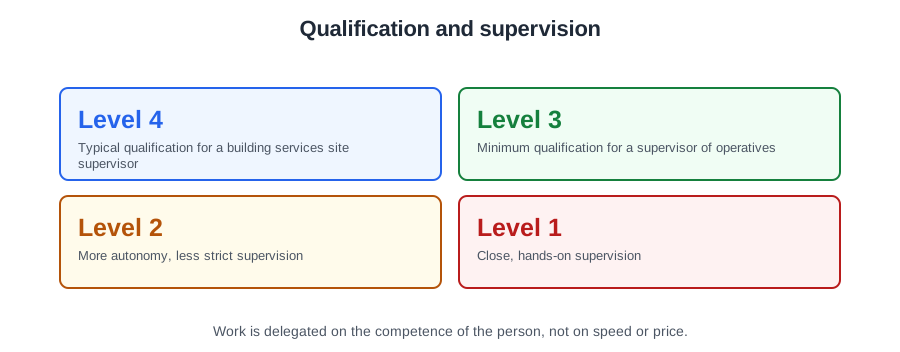
A vented cylinder needs replacing on Thursday. You have a first-year apprentice, a Level 2 plumber and a Level 3 plumber. Somebody has to be in charge, and the answer is not whoever is free.
| Level | What they may do | Supervision |
|---|---|---|
| Apprentice or trainee | Learn the trade; simple tasks as experience grows | Full supervision at all times |
| Level 2 qualified | Non-complex hot and cold water, sanitation and basic heating pipework | Regular supervision; passes problems up |
| Level 3 qualified | Run their own jobs, including unvented; deal with client enquiries and complaints | Supervises themselves and other staff |
| Supervisor | Design and installation across systems; overall responsibility for operatives | Holds at least Level 3, normally with years of experience |
So the cylinder job goes to the Level 3 plumber, who can supervise themselves and the apprentice. A Level 2 plumber has limited self-responsibility and is not there to carry an apprentice; an apprentice is never left in charge, even of work that is on their syllabus.
The single test when deciding who gets a task is competence: whether that person can do that job safely and correctly. Not how long they have been with the firm, not how fast they are, not how much they charge.
Direct supervision means somebody competent present and watching. It is required where the task is new to the person, where the risk is high, where the work is on a system that cannot be made safe, or where an operative is young or newly arrived. As experience is demonstrated, supervision loosens — but it is loosened deliberately, not by default.
Competence is checked, not assumed: confirm qualifications and cards, confirm any specific certification, watch the person work, and record the result. A supervisor is expected to identify the competence levels needed and assess the training requirements of each team member.
Supervision is not only allocation. Where somebody has made a mistake, the effective approach is to talk it through privately, agree where it went wrong and agree an action plan. Discussing work problems with staff motivates them; threats, deducting pay, cutting breaks and public criticism demoralise them and produce a subdued, silent workforce that stops telling you things.
Some problems are not yours to solve. A grievance about pay, a safeguarding concern, a health condition, or an employee showing signs of possible substance abuse must be passed to suitably qualified staff — the employer, occupational health or HR. Untidiness, an unsigned toolbox talk record and a request to change hours are ordinary supervisory matters; suspected substance abuse is not.
🔢 The numbers worth memorising
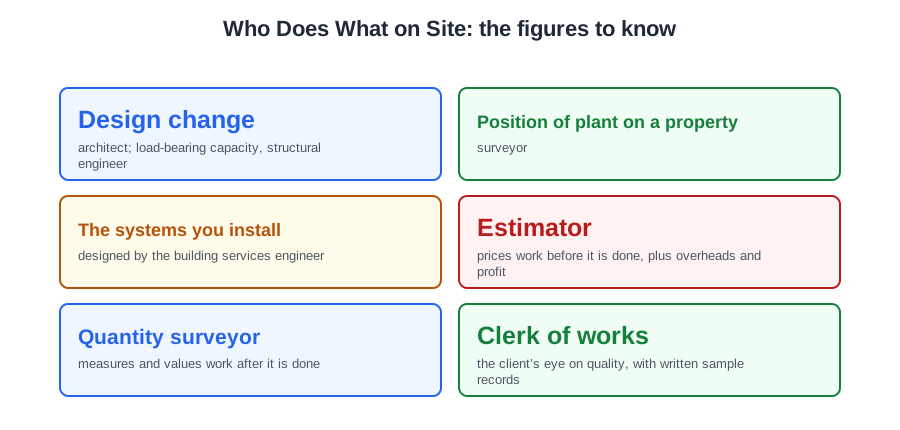
- Design change
- architect; load-bearing capacity, structural engineer
- Position of plant on a property
- surveyor
- The systems you install
- designed by the building services engineer
- Estimator
- prices work before it is done, plus overheads and profit
- Quantity surveyor
- measures and values work after it is done
- Clerk of works
- the client’s eye on quality, with written sample records
- Apprentice
- full supervision at all times
- Level 3
- supervises themselves and others
- Allocating work
- on competence, checked and recorded
⚠️ Where people go wrong
- Asking the architect about loads, or the engineer about the specification.
- Notching a joist because it is in the way.
- Treating a compartment wall as just a hole to drill.
- Sending a quantities question to the estimator, or a pricing question to the QS.
- Beating an estimator’s allowance by not doing the work that was priced.
- Confusing the clerk of works with the quantity surveyor.
- Expecting the principal designer or the designer to run the site.
- Putting a Level 2 plumber in charge of an apprentice.
- Allocating on availability rather than competence.
- Loosening supervision by default rather than deliberately.
- Criticising an operative publicly instead of agreeing an action plan privately.
- Handling a suspected substance abuse concern on site yourself.
📝 10-Question Self-Test
Straight from the Level 3 course question bank. Click an option to see whether you got it right — the explanation appears instantly, and there is nothing to submit.
An apprentice has very little responsibility for the installation itself: constant supervision from the plumber they work with at first, and simple installations and maintenance tasks only as experience is gained. That is why the others are wrong. Supervising others or signing off work needs a Level 3 qualification, and induction tells you the site rules, it does not make you competent to work alone.
The estimator prices work for the contractor, breaking the bill of quantities into labour, materials and plant and applying rates, so the cost effect of swapping one material for another is their calculation. Once the change is instructed it is the quantity surveyor who measures and values it for payment. The site foreman runs the work on the ground and holds no pricing information.
The quantity surveyor measures and values what has actually been installed, and those measurements feed the interim payments and the final account, so quantities are their business. The clerk of works also walks the job with a notebook, but they are checking the quality of the workmanship and materials for the client, not the amounts.
Wiring and earthing a fixed appliance such as a circulating pump is electrical installation work within the scope of BS 7671.
Anything to do with loads belongs to the structural engineer, so whether the roof timbers will carry a cistern or a cylinder is their calculation. The quantity surveyor is tempting because they also deal with the building on paper, but they deal in measurement and cost and never say what a timber will carry.
A firm taken on by a managing construction company to carry out part of the work for it is a sub-contractor; the managing firm is the main contractor and holds the contract with the client. Main contractors is tempting because the words look alike, but there is only one main contractor and it is the firm doing the taking on.
The architect leads the design team and holds the drawings and specification, so a change to what is installed goes through them and is taken up with the building services engineer, who is the designer of the internal services. The structural engineer is tempting because pipework runs through the building, but they deal with loads and structure.
The building surveyor is the person who sees that the Building Regulations are followed on the job, and where an oil storage tank may sit is a Building Regulations question: Approved Document J Table 10 calls for fire protection where a tank is less than 1800 mm from any part of a building or less than 760 mm from a boundary. The estimator is tempting because a tank costs money to install, but they price the work once its position is settled; they do not decide where it goes.
A site supervisor on a building services contract typically holds a Level 3 qualification: the craft qualification with the supervisory and technical knowledge above it. Level 2 is the craft operative standard and Level 1 an introduction, so neither carries supervisory responsibility on its own, and a Level 6 degree belongs to the design and management side rather than to site supervision.
CIBSE's Code of Practice recommends employing an independent clerk of works, in line with the duties described by the Institute of Clerks of Works and Construction Inspectorate, to check and verify works as they are completed, with written records of sample checks. The clerk of works represents the client on quality of workmanship; the quantity surveyor deals with cost, the contracts manager works for the contractor, and the site engineer sets out and controls levels.
Going further: the lessons behind this article
This article is the public answer. Unit 336 of the Level 3 course takes the same ground to the depth the exam and the synoptic assignment ask for, in 4 lessons:
- The design team: architect, engineers and surveyor
- Cost and quantities: estimator and quantity surveyor
- Running the job: managers, clerk of works and supervisors
- Craft levels and allocating work: who supervises whom
- Site procedures: the Unit 336 guide — every article on this unit in one place
- All PlumbMate articles — Level 1, 2 and 3
- The Level 3 course — the whole 8202-35 Diploma