A final test after the floor is boarded will still find the leak — but only once the finish is in the way.
The short answer
Three supervisory jobs sit together here. Progress means checking the work could actually be started, then telling the programme holder the moment it slips. Quality means testing concealed work before it disappears and checking it operative-first, supervisor-second. People means dealing with a first drop in standard privately and informally, and only going formal once that has been tried and recorded.
Accept the workplace before you start
Monday morning, the programme says bathroom pipework starts today, and the gang arrives to find the screed not laid and the chases not cut. Monitoring progress is not just checking whether plumbers turned up on the programmed day — it is checking whether the work they were sent to do could actually be started.
For all operations the working space, conditions, substrate and continuity of work should be formally accepted before commencement. There is a matching duty on the plumbing side: liaise to agree the positions of pipework and fittings in relation to other services, the building fabric and appliances, and ensure the necessary builder's work is, or will be, sufficiently complete not to delay continuity. In plain terms, somebody should have walked that bathroom on Thursday.
Three wrong answers people really do reach for: laying the screed and cutting the chases yourself (unpaid work outside your scope and probably your competence); booking the lost day as a variation (there is no instruction and no agreement); and quietly moving the start to Wednesday without telling the programme holder (which hides two days of slippage from the person who has to plan around it).
Reporting slippage
Plumbing first fix is three days behind because the plasterers were moved into the flats early, and second fix starts next week. The supervisor's first move is to tell the main contractor's programme holder about the slippage and agree a re-sequence.
The reason is a rule about authority: one authority, typically the principal contractor, controls the overall programme, and should be kept informed and consulted. Each specialist should be aware of the dependencies with other operations and, where possible, make direct contact to co-ordinate.
A plumbing supervisor cannot instruct the plasterers to stop — they are not his to instruct. Moving the gang onto external drainage may be sensible, but that is the programme holder's decision. And working the weekend to recover three days quietly is the worst of the four: it hides the true cause, absorbs someone else's cost, and teaches the site that early plastering has no consequences.
A clear work programme lets a supervisor see the work activity, week numbers, expected completion dates and week commencing dates, and compare them against the drawings and the specification. From it you can check progress against agreed timescales, anticipate changes to cost, and confirm delivery dates for fittings — because if material is not available, labour costs go up. When second fix is delayed, the building services supervisor informs the construction manager rather than trying to absorb it.
So progress monitoring is three questions every week: Is the work in front of us ready to start? Are we where the programme says we should be? And who needs to know if we are not?
Test before it disappears
An apprentice finishes hot and cold pipework in a floor void and asks the joiner to board over it. Helpful instinct, wrong one.
Interim tests are carried out as soon as practicable after completion of a particular section, with particular attention to all work that will be concealed. Anything that fails must be corrected immediately and retested before further work proceeds. So the check required before that void is boarded is an interim pressure test of the section.
A visual check on clip centres proves nothing about a joint. A note in the site diary is a record of an opinion. And a final test after boarding and plastering is worse than useless as a substitute. A final test still happens, on completion of all the water services and before handover — satisfactory completion of an interim test does not constitute a final test — and records of all tests required by the specification are kept.
Who checks, and in what order
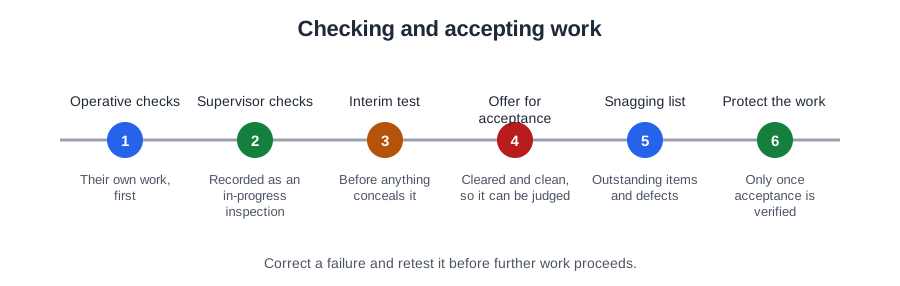
Where the installation is offered to the client's representative floor by floor: the operative checks the work, then the supervisor checks it, and in-progress inspections are recorded. Prior to offering for completion, all work should be checked by the operative and, where appropriate, by a supervisor for that work — particularly where critical aspects will become permanently covered before the whole operation is finished.
Offering unchecked work wastes the client's inspection and damages your standing. Signing floors off from the site office using worksheets is checking paperwork, not pipework. And insulating first so the client sees a tidy finish hides the very joints the inspection exists to look at.
Allocating work by area
One operative per floor of a three-storey building, and weeks later a leak shows on the second floor. The quality benefit of allocating by area is that responsibility is clear, so the defect can be traced and corrected through a defined reporting line. It should be made clear to all concerned where responsibility lies for each part of the work, and all operatives should understand clear and formal reporting lines for authority and instruction.
Note what the benefit is not. It is not so the client can be pointed at an individual, and not so a fault can be fixed early one morning before anyone notices. Ownership of an area means an operative takes care over work nobody else will be blamed for — and it lets the supervisor trace a defect, correct it, and feed what went wrong into how the next floor is done.
Quality control checks are carried out during installation, against the agreed standards, with system tests undertaken as the work proceeds. Checking is not an event at the end of a job — it happens on the same day the work does, which is the only time putting it right is cheap.
Accepting finished work
A subcontractor says the heating system is all done and tested and asks for sign-off. No paperwork is offered; the foreman is confident and says it held pressure overnight. Confidence is not evidence.
Before the work is accepted for handover the supervisor should require written records of the pressure and functional tests, the balancing report, and the operation and maintenance instructions. A record of a water tightness test gives the date, the test pressure and the duration. A verbal assurance, a photograph of a gauge, or a promise that paperwork will follow once the money is settled are the same thing wearing different clothes.
Work is offered for acceptance clean and clear: the worksite is cleared and the presented work left clean so it can be inspected and judged. Acceptance is obtained and verified before the finished work is protected — cover it up afterwards, not before. The inspection produces a snagging list of outstanding items and defects.
Acceptance at the end of a project is often called practical completion. Most contracts then hold back a release of final payment until the building has been in use for a period, at the end of which any agreed defects — those already obvious and those that emerge — are put right, to the same standard as specified in the original contract. Sometimes you return not because of your own failure but to reinstate damage caused when somebody else's defect was rectified. Where the building is in use, areas are cordoned off and sometimes fully screened so the work, including materials storage, can be done safely.
There is a practical reason to be firm about the records. An engineer arriving in three years needs the balancing figures to know whether a circuit has drifted, and the test records to know what pressure it was proved at. A measured value tells you what someone found; a tick only tells you that someone looked.
The last duty of a completed job is feedback: the outcome of the work including any safety issues, the process (design, general construction, specialist construction and your own team), and performance to cost and programme — the one that turns this year's overrun into next year's accurate price. As-built information is provided as the contract requires. Handover to the customer is an active process, not a pack left on a worktop: the controls are demonstrated, the way the system runs is explained, and the documentation is issued and talked through.
Dealing with poor work
An experienced operative who normally produces good work has left several joints unsoldered and missed two pipe clips over a fortnight. Nothing like it has happened before.
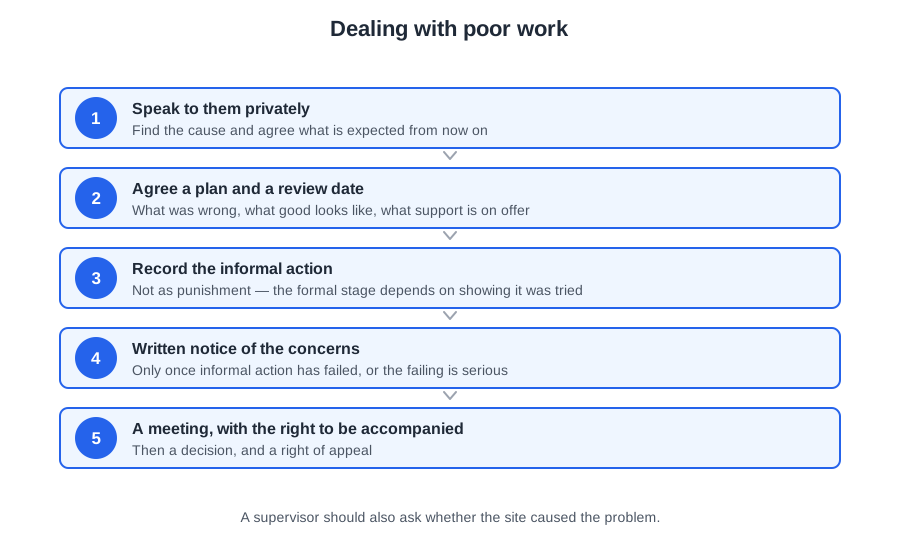
The first action is to speak to the operative privately, find out the cause, and agree what is expected from now on. Private, because a dressing-down in front of the gang humiliates rather than corrects. Find the cause, because a first isolated drop usually has one — something at home, a gap in training, a change in the work, poor light or access on that floor. Agree the standard, and set a date to look again.
An immediate written warning skips a stage. Moving a skilled operative onto labouring is a punishment, not a correction. Reporting them to the client's representative is worse — the client is not the operative's employer and has no business in the matter. Where you do intervene, the useful shape is a plan of how to improve: what was wrong, what good looks like, what support is on offer, and when it will be reviewed. Records of improvement priorities and critical activities are kept for future reference. Motivating people works better than punishing them; deducting pay or making negative comments does nothing for the standard of the next joint.
When informal action has not worked
After two informal conversations and a recorded improvement plan the work is still failing inspection. The correct next step is the formal procedure, which runs in a set order:
- The employee is told in writing what the problem is.
- They are invited to a meeting where they may be accompanied.
- They are given a decision.
- They are given a right of appeal.
Formal action is reserved for cases where informal action has not worked, or where the failing is serious. Another informal chat at that point is avoidance dressed as kindness. Dismissal on the spot would be unfair — no written notice, no meeting, no appeal. Withholding pay until defects are corrected at the operative's expense is not a step the procedure allows at all.
Two details worth holding on to. Informal action still gets recorded — not as a punishment, but because the formal stage later depends on showing that informal action was genuinely tried. And a supervisor should also ask whether the site caused the problem: bad light, poor access, an impossible programme or missing materials produce defective work in perfectly capable hands.
🔢 The numbers worth memorising
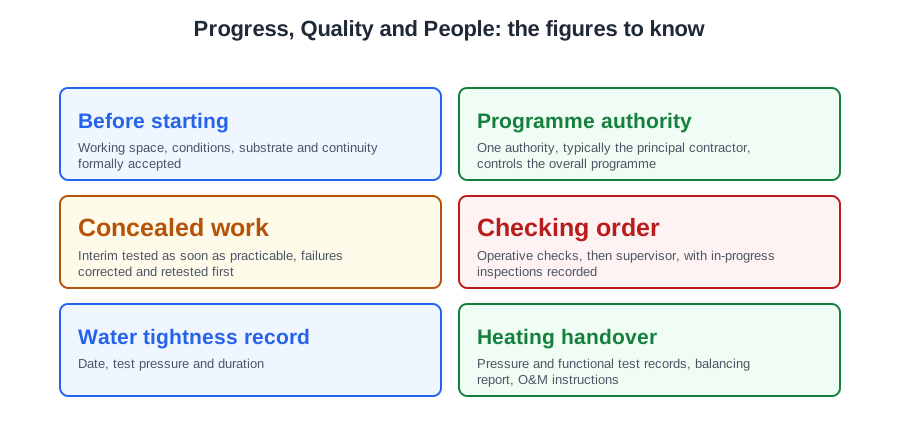
- Before starting
- Working space, conditions, substrate and continuity formally accepted
- Programme authority
- One authority, typically the principal contractor, controls the overall programme
- Concealed work
- Interim tested as soon as practicable, failures corrected and retested first
- Checking order
- Operative checks, then supervisor, with in-progress inspections recorded
- Water tightness record
- Date, test pressure and duration
- Heating handover
- Pressure and functional test records, balancing report, O&M instructions
- Formal procedure
- Written notice, meeting with the right to be accompanied, decision, appeal
⚠️ Where people go wrong
- Doing the missing builder work yourself,It is outside your scope and probably your competence — report it and agree a re-sequence.
- Absorbing a delay in silence,The programme holder must be told; hidden slippage surprises everyone downstream.
- Instructing another trade,You cannot instruct people who are not yours — that is the programme holder job.
- Boarding over untested pipework,Concealed work is interim tested and any failure retested before anything covers it.
- Treating an interim test as the final test,A final test on all water services still happens before handover.
- Signing off work with no records,Require the test records, balancing report and O&M instructions before accepting.
- Protecting the finish before acceptance,Acceptance is obtained and verified first, then the work is protected.
- Going straight to a written warning,A first isolated drop is handled privately and informally, with a review date.
📝 10-Question Self-Test
Straight from the Level 3 course question bank. Click an option to see whether you got it right — the explanation appears instantly, and there is nothing to submit.
BS 8000-0 says that where operatives work with client-supplied materials the same inspection and acceptance or rejection should be applied as for the contractor's own, and that where any non-compliance or deficiency is evident the supplier should be referred to immediately. Fitting damaged appliances would make the contractor responsible for them; replacing from stock without agreement is an unauthorised variation.
Regulation 13(4) of the Construction (Design and Management) Regulations 2015 places the duty on the principal contractor to ensure that a suitable site induction is provided. The plumbing contractor still has its own duty under regulation 15 to plan, manage and monitor its work and give its workers appropriate supervision, instruction and information, so a supervisor should check the induction has actually happened before allocating work.
Regulation 9 of the Provision and Use of Work Equipment Regulations 1998 requires that all persons who use work equipment have received adequate training, and BS 8000-0 states that untrained people should not operate plant or equipment. A second apprentice is not a competent instructor, and PPE does not substitute for training.
RIDDOR 2013 has two thresholds. More than three consecutive days of incapacity must be recorded; more than seven must also be reported to the HSE within fifteen days. Four days clears the first and not the second, so the injury goes in the accident book and no report is made. A strain that stops somebody doing their normal work is certainly covered, and the answer would change at eight days.
BS 8000-0 says waste from offcuts and packaging should be avoided or minimised and that good supervision reduces waste and cost, for example by reducing re-work. Wastage is monitored by reconciling what was drawn from stores against what is in the building; the supervisor then deals with the cause, whether that is poor measurement, over-ordering or unopened fittings going astray.
BS 8000-0 clause 5.4 says one authority, typically the principal contractor, controls the overall programme and should be kept informed and consulted, and each specialist should be aware of dependencies and make direct contact to coordinate. The supervisor cannot instruct another trade and should not silently absorb the delay, which hides the true cause and the associated cost.
BS 8000-0 clause 4.6 says the working space, conditions, substrate and continuity of work should be formally accepted before commencement, and BS 8000-15 clause 2.2.1 requires liaison to ensure builder's work is or will be sufficiently complete not to delay continuity. Monitoring progress against the schedule includes checking preceding trades are ready, not just that plumbers turn up on the programmed day.
BS 8000-15 clause 4.1.2 requires interim tests as soon as practicable after completion of a section, with particular attention to work that will be concealed, and clause 4.1.3 says failing items must be corrected immediately and retested before further work proceeds. A final test still follows on completion of all water services, but it does not replace the interim test of concealed work.
A first, isolated drop in performance is dealt with informally: a private conversation to identify the cause (which may be a personal, training or site problem), clear restatement of the standard required and a date to review. Formal disciplinary action is reserved for cases where informal action has not worked or the failing is serious, and the client is not the operative's employer.
Once informal action has been tried and recorded without success, the employer's formal capability or disciplinary procedure applies: the operative is told in writing what the problem is, invited to a meeting where they can be accompanied, and given a decision with a right of appeal. Instant dismissal or withholding pay for a first formal step would be unfair and is not what the procedure allows.
Going further: the lessons behind this article
This article is the public answer. Unit 336 of the Level 3 course takes the same ground to the depth the exam and the synoptic assignment ask for, in 4 lessons:
- Monitoring progress: readiness, slippage and who to tell
- Quality checks: allocating areas, inspecting and testing
- Accepting finished work: snagging, records and handover
- Dealing with poor work: informal action and the formal procedure
- Site procedures: the Unit 336 guide — every article on this unit in one place
- All PlumbMate articles — Level 1, 2 and 3
- The Level 3 course — the whole 8202-35 Diploma