A quotation is a fixed price. An estimate can move. Say in writing which one the customer is holding.
The short answer
Pricing runs in four moves. Choose the contract type that matches how well the scope is known. Turn the job into a measured list — a take-off, a bill of quantities or a schedule of rates. Build the price up line by line to a direct cost, then add overheads and profit. Then present it as a quotation (fixed) or an estimate (can move), saying clearly in writing which it is.
Contract types
Two jobs come in on the same morning: a bathroom in a new house, fully drawn and specified, and "something is leaking somewhere under the floor of a Victorian terrace". Pricing those two the same way would be a mistake.
Fixed cost sets the price in advance. The contractor states a sum, the customer accepts, and it does not move unless the work moves — which is what the variation procedure handles. The customer gets certainty. The contractor carries the risk: three days instead of two is the contractor's money. So a fixed price is only safe where the scope is genuinely known, and it is always written with a clear list of exclusions.
Variable cost sets rates and a basis, but the final sum depends on what is actually done — measured as it proceeds or on completion. This is what an estimate is on a small job: an estimate is not a fixed price, and can go up or down if it was not accurate or the work finished ahead of schedule. Most contractors prefer estimates for that flexibility. The customer's protection is being told honestly what the price depends on, with changes agreed as they arise rather than announced at the end.
Cost plus pays the actual cost of labour, materials and plant, plus an agreed fee or percentage. It suits work whose extent cannot be known in advance — emergency repair, opening up a floor, refurbishment where nobody knows what is behind the plaster. The risk sits with the client, because the more it costs, the more is paid. That is why cost plus depends entirely on record keeping: signed daywork sheets, timesheets and supplier invoices, produced as the work goes along and not reconstructed afterwards.
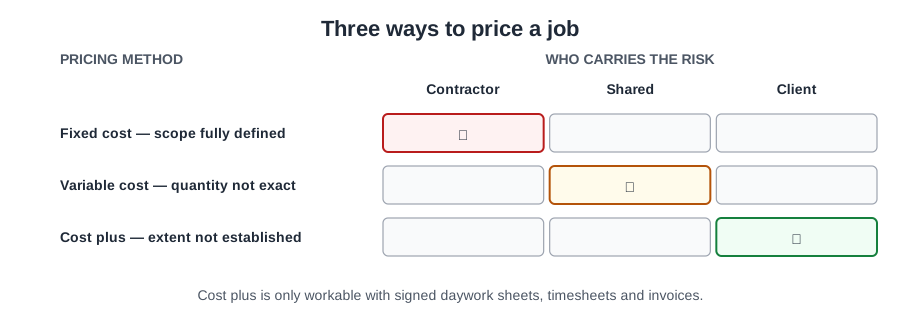
| Method | Use it when | Who carries the risk |
|---|---|---|
| Fixed cost | The scope is fully defined and drawn | The contractor |
| Variable cost | The type of work is known but the quantity is not exact | Shared |
| Cost plus | The extent of the work cannot be established in advance | The client |
Two habits keep any of the three honest. Record the actual hours and materials whichever method is used, because next year's fixed price is only as good as this year's record of what the same job really took. And price the risk, not just the work: a fixed price for a job with unknowns behind a wall should carry a realistic allowance, or should not be a fixed price at all.
Keep one distinction straight: the contract type decides how the money is worked out; the variation procedure decides what happens when the work changes. Even a cost plus job has a scope, and going outside it still needs an instruction from someone with authority.
Turning the job into a measured list
Materials take-off
A take-off is exactly what it sounds like: you take the quantities off the drawing, working to the scale and dimensions shown, measuring each pipe run and counting each component, then listing them by type and size. A domestic heating take-off might read: 42 m of 15 mm copper tube; 8 m of 22 mm; 26 elbows; 14 tees; 9 radiators with valves and brackets; 60 clips.
Do it in a fixed order — room by room, or circuit by circuit — so nothing is counted twice or missed. Add an allowance for wastage, and check the take-off against the specification so nothing specified but not drawn gets left out. The take-off is what the buyer orders from, so its accuracy decides whether the gang has what it needs on the day.
Bill of quantities
On a large contract the measuring is done once, for everybody. The quantity surveyor measures the labour and materials needed from the architect's drawings into a bill of quantities — every item of work with its measured quantity. Its purpose is fairness and comparability: every contractor bidding prices the same list, so returns can be compared item by item rather than as four different guesses. The estimator breaks it into labour, materials and plant to produce an estimate.
Remember what it does not do: it tells you what and how much, not when — the dates are in the contract programme. And it is measured by someone else, from someone else's drawings, so if an item looks wrong — a quantity that cannot be right, a description that does not match the specification — raise it before you price it, not after you have won the work on it.
Schedule of rates
Sometimes nobody can say how much work there will be, only what kind. A schedule of rates is a list of agreed unit prices for common operations — so much per metre of 15 mm copper installed, per radiator fitted, per hour for a plumber and an apprentice. Work is carried out as it arises, measured, and paid at the scheduled rates. It is the normal basis for maintenance and term contracts, and for repair work on a housing stock where the landlord knows the kinds of job but not the quantity.
Whichever route produced the list, the price is not finished when the costs are added. A percentage goes on for overheads — the site offices and the site and administration salaries the business carries whether or not this job exists — and a further percentage for profit. A price that covers only the direct costs is a price at which the company slowly closes.
A worked price
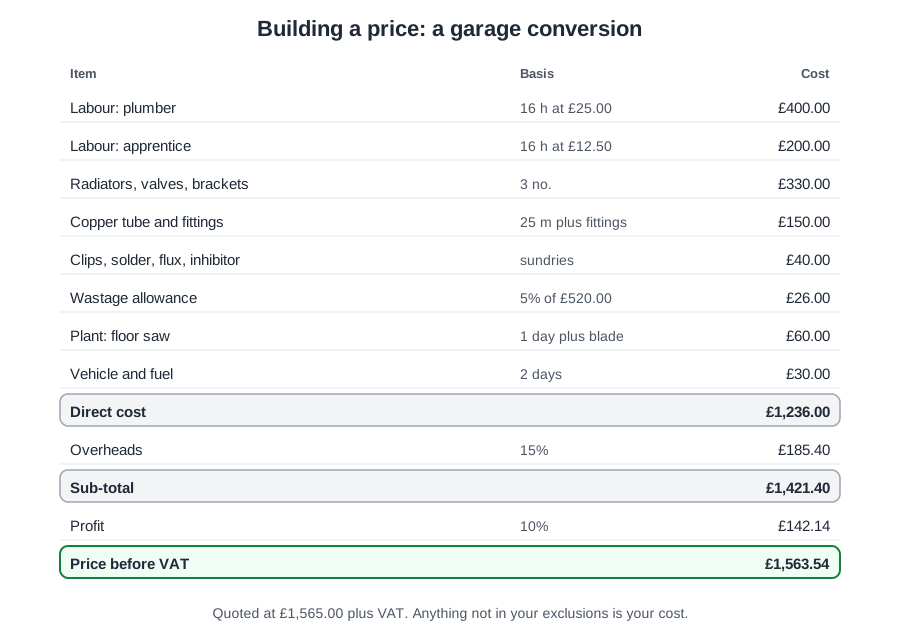
A customer wants a garage conversion heated from the existing boiler: three radiators, about 25 m of new pipework, one floor run to cut. A plumber and an apprentice, two days.
| Item | Basis | Cost |
|---|---|---|
| Labour: plumber | 16 h at £25.00 | £400.00 |
| Labour: apprentice | 16 h at £12.50 | £200.00 |
| Materials: radiators, valves, brackets | 3 no. | £330.00 |
| Materials: copper tube and fittings | 25 m plus fittings | £150.00 |
| Materials: clips, solder, flux, inhibitor | sundries | £40.00 |
| Wastage allowance | 5% of £520.00 | £26.00 |
| Plant: floor saw | 1 day hire plus blade | £60.00 |
| Vehicle and fuel | 2 days | £30.00 |
| Direct cost | £1,236.00 | |
| Overheads | 15% of £1,236.00 | £185.40 |
| Sub-total | £1,421.40 | |
| Profit | 10% of £1,421.40 | £142.14 |
| Price before VAT | £1,563.54 |
The job would be quoted at £1,565.00 plus VAT at the rate in force.
Labour is the hours the work will take at the company's charge-out rate for each grade — the apprentice is charged at a lower rate but still charged, because their time is a real cost. The hours come from the programme, not from optimism. Materials come from the take-off, priced from the merchant's quotation. The wastage allowance covers offcuts and breakages — here 5 per cent, a company figure based on what the company actually wastes. Plant is the hire cost for the days the activity occupies, plus consumables. Vehicle covers travel and fuel. Those five lines are the direct cost.
Then the two additions the estimator makes: overheads (here 15 per cent) covering the offices and administration salaries that exist whether or not this job happens, and profit (here 10 per cent). Both are worth thinking about rather than copying. Overheads have to be set so all the year's jobs together cover the year's office, vehicle and administration costs — set them too low and the company loses money on a full order book. Profit pays for growth, for the vans that need replacing and for the jobs that go wrong. Cutting it to win work is how firms end up busy and broke.
Three checks before it goes out. Does the time match the programme you would actually work to? Have you priced everything the specification asks for, including flushing, inhibitor and the commissioning record? And what is excluded — making good decoration, electrical work, lifting a fitted floor covering — with each exclusion written down? Anything the job turns out to need that is not in your exclusions is your cost.
One sanity check: divide the price by the hours. Here £1,565 over 32 operative-hours is a little under £49 an hour for a two-person gang, materials and plant included. If that number looks wrong for your area and trade, the arithmetic below it is wrong somewhere. And keep the working — a price built line by line can be defended, adjusted and reused; a round number in someone's head cannot.
Quotation, estimate and tender
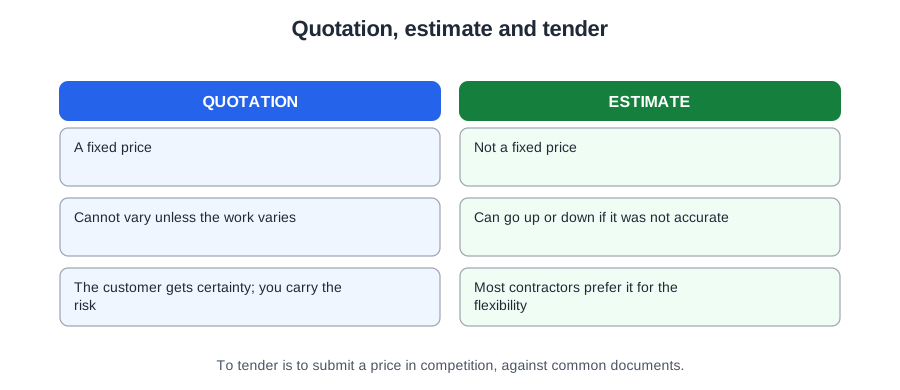
All three are written prices, and they are not the same thing:
- A quotation is a fixed price and cannot vary.
- An estimate is not a fixed price and can go up or down if it was not accurate or the work finished ahead of schedule.
- To tender is to submit a price or quotation for a job or contract, usually in competition, against a common set of documents and by a stated deadline.
Tendering has its own discipline: price the bill of quantities as issued, return it in the form and by the time asked for, and list your exclusions and qualifications clearly, because the client compares your figure against others item by item.
Presenting the price
The first point of written communication with a customer is usually the quotation, and it is the first thing they judge the company by. A professional quotation contains:
- The company's name, address and contact details, on headed paper.
- The customer's name and the address of the work.
- A clear description of the work, matching the specification, item by item.
- The price, with VAT shown separately, and whether it is a quotation or an estimate.
- What is excluded, and any assumptions the price rests on.
- The time: when work can start, how long it will take, and how long the price stays open.
- Payment terms, and the customer's cancellation rights.
On cancellation: a number of laws give a customer the legal right to cancel a contract after signing, usually with no penalty if confirmed in writing within a specific time frame. The period normally starts when the customer receives notice of that right, which should be given before work commences.
A quotation goes out with a short cover letter or email. Official company business is in written form, normally on headed paper, with a clear layout, formal English, correct grammar and logical paragraphs. An email is judged the same way — it conveys professionalism whether it goes to a client, a customer or a colleague. Keep the letter to four short paragraphs: thank them for the enquiry; say what is attached and what it covers; state the price, the time and how long the offer stands; invite them to ring with questions.
Written communication does not stop there. Invoices and statements are the demand for payment, usually with a stated period to pay. At the end, the customer's best assurance that the work meets the required standard is a copy of the commissioning certificate and the test results. Where customer details are held, they are protected as data protection law requires.
And keep a copy of everything that goes out. The quotation, the cover letter, the exclusions and the date sent are the record you will need if the customer later remembers the conversation differently from you.
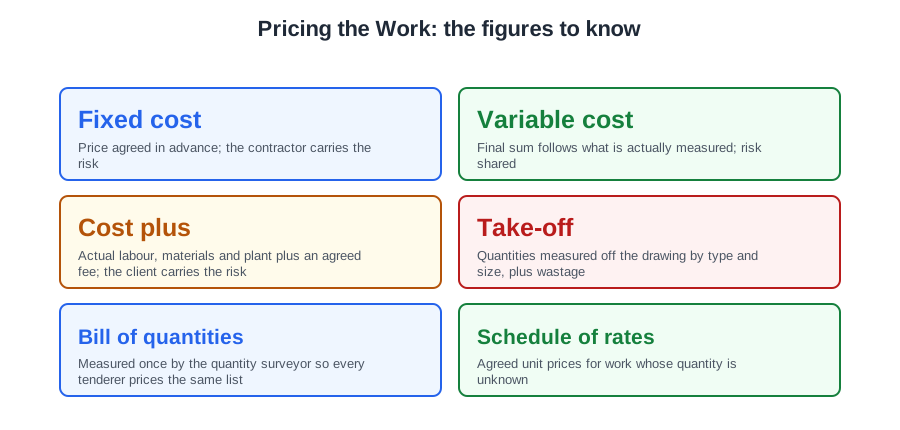
🔢 The numbers worth memorising
- Fixed cost
- Price agreed in advance; the contractor carries the risk
- Variable cost
- Final sum follows what is actually measured; risk shared
- Cost plus
- Actual labour, materials and plant plus an agreed fee; the client carries the risk
- Take-off
- Quantities measured off the drawing by type and size, plus wastage
- Bill of quantities
- Measured once by the quantity surveyor so every tenderer prices the same list
- Schedule of rates
- Agreed unit prices for work whose quantity is unknown
- Price build-up
- Labour, materials plus wastage, plant, vehicle = direct cost; then overheads, then profit
- Quotation
- A fixed price that cannot vary
- Estimate
- Not fixed — it can move up or down
⚠️ Where people go wrong
- Fixed pricing an unknown scope,Where the extent cannot be established, use cost plus with signed records.
- Working cost plus without daywork sheets,No records means no way to be paid and no way to prove you were reasonable.
- Pricing a bill of quantities item that looks wrong,Raise the discrepancy before you price it, not after you have won on it.
- Expecting dates from a bill of quantities,It gives what and how much; the timing is in the contract programme.
- Stopping at the direct cost,Overheads and profit still have to go on, or the company loses money on a full order book.
- Leaving an exclusion unwritten,Anything the job needs that is not excluded becomes your cost.
- Calling an estimate a quotation,A quotation is fixed. Say in writing which one the customer is holding.
📝 10-Question Self-Test
Straight from the Level 3 course question bank. Click an option to see whether you got it right — the explanation appears instantly, and there is nothing to submit.
A quotation is an offer of a fixed price for the work described: this specification, this money. It binds you, which is why what is included, excluded and assumed has to be written on it. An estimate is the thing that “may be revised on completion”, and it must be labelled as an estimate; call a price a quotation and you cannot then put it up.
A quotation is a fixed price and cannot vary, so the risk of an underestimate falls on the contractor; only work the customer adds afterwards can be charged on top. An estimate is the price that is allowed to go up or down, and an estimate is not what was given here.
An estimate is a projected price that can go up or down, and it should say what factors could change it, which is exactly right where the extent of the work is unknown. A quotation would fix a price for work nobody has yet seen, leaving the plumber carrying the whole risk.
Paying the recorded cost of labour, materials and plant with an agreed percentage added on top is the cost plus method, and it suits work whose extent cannot be measured in advance. A provisional sum is an allowance inside an otherwise priced contract, not a way of running the whole job.
A tender is an offer to carry out the work for a stated sum in accordance with a particular contract, and inviting several contractors to tender is the normal route for large or long-term work. A schedule of rates is one of the documents that helps build the price up; it is not the offer itself.
A schedule of rates lists what it costs in labour to fix and connect each item, so a price can be built up item by item and the work remeasured at those rates if the quantities turn out different. The quantities themselves come from the take-off sheet or the bill of quantities.
A take-off sheet is a list of the number and scope of the items needed for each area of the installation, counted from the drawing symbols and checked against the specification for any named manufacturer or finish. It is useful again if the job is won, because the quantities per area show what to order at each stage.
A bill of quantities is a ready-made measured list of the work, normally prepared by the quantity surveyor, and it replaces the take-off sheet the estimator would otherwise produce. Labour, plant, overheads and profit all still have to be priced against those quantities.
Three operatives for four days of eight hours is 96 hours, and 96 hours at £30 is £2,880. £960 is the cost of one plumber for the four days, which is the usual slip.
More material always leaves the van than the drawing measures, because runs are cut from standard lengths and some tube is damaged or set wrong, so a percentage waste allowance is added to the measured quantity. Profit is added openly at the end of the build-up, not buried in the quantities.
Going further: the lessons behind this article
This article is the public answer. Unit 336 of the Level 3 course takes the same ground to the depth the exam and the synoptic assignment ask for, in 4 lessons:
- Contract types: fixed cost, variable cost and cost plus
- Pricing methods: take-off, bills of quantities and rates
- Building a price: a worked example
- Quotation, estimate and tender: presenting the price
- Site procedures: the Unit 336 guide — every article on this unit in one place
- All PlumbMate articles — Level 1, 2 and 3
- The Level 3 course — the whole 8202-35 Diploma