Work at height has no minimum height — it includes standing beside an open inspection chamber at ground level.
The short answer
Four hazard families come up again and again on a Level 3 site paper, and each has one control that follows from naming the harm correctly. Substances are assessed from the manufacturer's safety data sheet for that specific product, before work begins. Manual handling follows avoid, assess, reduce — technique comes last. Work at height means anywhere a fall could injure you, with no minimum height. And energy — electrical, mechanical, refrigerant — is controlled by isolating or recovering it, not by protective equipment.
Substances: data sheets, glycol and spills
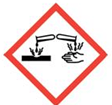
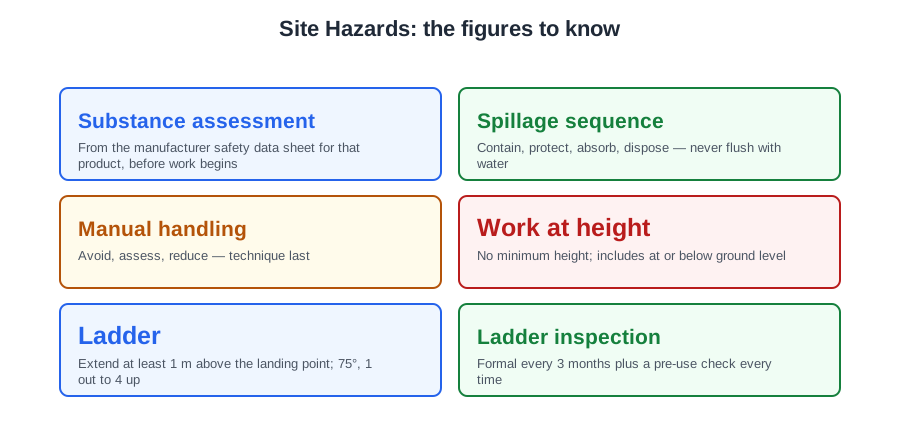
Before a hazardous substance is handled, the assessment is made from the manufacturer's safety data sheet for that specific product — not a generic glycol sheet, not the product label, not the commissioning checklist. The sheet gives the hazards, the protective equipment required, first aid measures, the spillage procedure and the disposal route. The assessment is made before work begins, not annually and not after the first spillage. And substances are never decanted into unmarked containers — a container that could be mistaken for a drink is the worst case there is.
Heat transfer fluids are normally one of two glycols and they are not equivalent. Ethylene glycol is considerably more toxic if swallowed than propylene glycol, which is why propylene is normally specified for systems anywhere near a domestic water supply. Glycol is also extremely slippery, so any escape is a slip hazard as well as an environmental one. Wear what the sheet names, handle it where there is ventilation, keep containers closed and labelled, and keep it clear of drains.
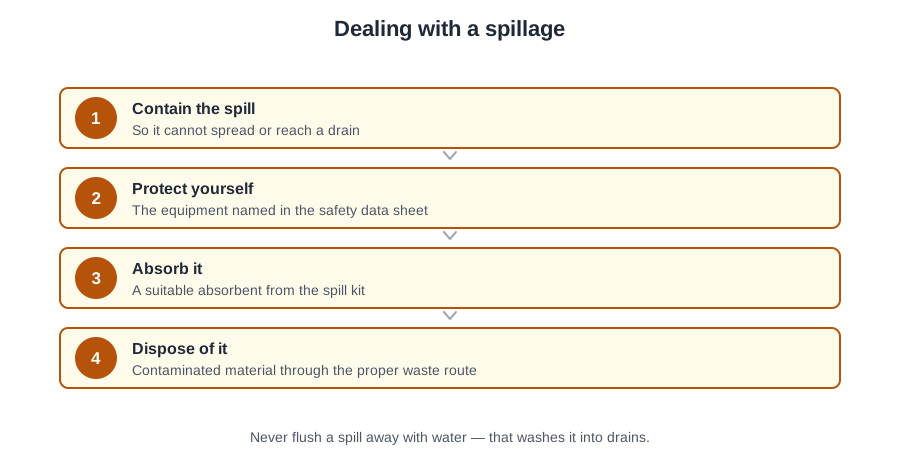
The spillage sequence is contain, protect, absorb, dispose:
- Contain the spill first, so it cannot spread or reach a drain.
- Put on the protective equipment identified in the safety data sheet.
- Absorb it with a suitable absorbent from the spill kit.
- Dispose of the contaminated material through the proper waste route.
What must never happen is flushing a spill away with water. Flushing spreads it and washes it into drains, which is an environmental offence. Nor is it acceptable to leave it to evaporate, sweep it into a general skip, or vacuum it into household waste.
The same method applies to everything carrying a hazard pictogram: fluxes, solvent cements, jointing compounds, cleaning chemicals, boiler treatment and the chlorine used for disinfecting a cistern. Where chlorination happens alongside other work, those data sheets go into the assessment too, because people are now in the same space as a chemical they did not bring. Two further categories catch people out: dusts from cutting, grinding and chasing are hazardous substances in their own right, with asbestos the extreme case; and biological hazards count — working on sanitary pipework means contact with foul water, so gloves are worn, hands washed before eating, and nobody with an open wound does that work.
Manual handling: avoid, assess, reduce
The Manual Handling Operations Regulations set out three steps in order: avoid hazardous manual handling so far as is reasonably practicable; assess any operation that cannot be avoided; reduce the risk of injury so far as is reasonably practicable, including mechanising the lift as far as possible.
Good lifting technique is not the first step and it is not a substitute for the other three. Technique is applied last, once you have decided the lift is happening. Teaching people to lift instead of removing the lift is the classic error, and it is exactly what the exam question tests.
When a drum of glycol, an outdoor unit or a cast iron boiler section has to move, the first step is to assess the load before deciding how it will be handled. Assessment covers the task, the individual, the load and the environment:
- Load — weight, size, shape, stability, whether there is anywhere to grip, whether the contents can shift.
- Task — how far, how high, how often, whether it involves twisting, reaching or carrying down stairs.
- Individual — capability, training and health, and whether they are young or inexperienced.
- Environment — the route, the surface, obstructions, headroom, lighting and where it is set down.
Only then can you decide sensibly whether to use a mechanical aid, split the load, use two people, or handle it at all. Deciding the method before assessing the load is how injuries happen. Note too that a sack truck does not remove the risk — it changes it, into pushing, pulling and controlling a load on a slope.
On a heat pump installation the two things that hurt people are manoeuvring the outdoor unit, which is heavy and awkward, and handling thin sheet metal casings, whose edges cut. Those are the classic pair throughout building services: back injury from weight and awkwardness, lacerations from thin sharp panels. Filling a circuit, setting an expansion vessel, programming a controller and recording commissioning values carry neither.
Cast iron guttering is a whole assessment in one job: heavy, so manual handling; fixed at height, so work at height; done outside, so wind and rain matter. The type of connection bolt is a fitting detail, not a health and safety consideration.
Reduce by mechanising first — delivery to the position, a tail lift, sack truck, skates, a genie lift, a pipe trolley. Then organise: two people with one calling the lift, a route cleared and lit in advance, doors wedged, a set-down point prepared. Then equip: gloves rated for the edges, safety footwear, knee pads. Then, and only then, technique.
Work at height
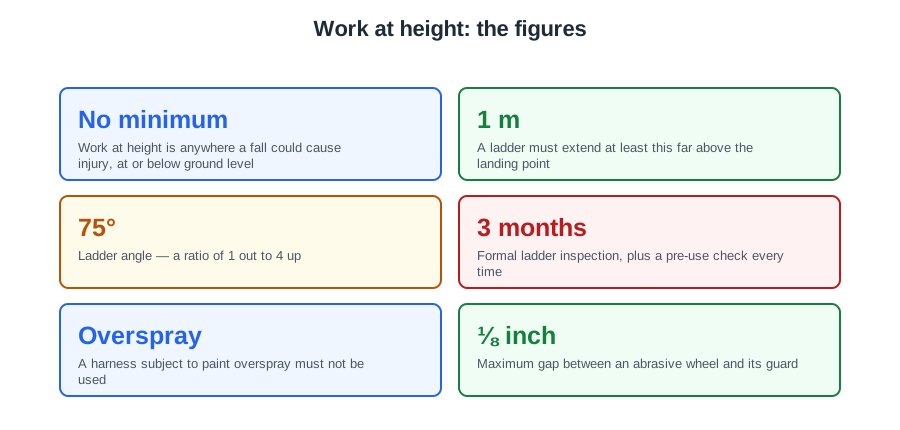
Work at height means any place where a person could be injured by falling from it, even if it is at or below ground level. There is no minimum height. That is why the regulations catch work beside an excavation, over a fragile surface, or at the edge of a floor opening. The two metre figure people still quote has not applied for many years, and there is no special rule for step ladders or roofs either.
The duties follow the hierarchy: avoid working at height where reasonably practicable; where it cannot be avoided, use equipment to prevent a fall; where the risk cannot be eliminated, use equipment to reduce the distance and consequences of one. It must be properly planned and organised, done by competent people, with the right equipment selected, inspected regularly and properly maintained.
Ladders
A ladder is access equipment, not a workplace, and the figures are worth knowing exactly:
- Used for access, it must extend at least 1 m above the landing point, so there is a secure handhold at the moment of stepping on and off — when the user is least stable.
- It must stand at 75°, a ratio of 1 out to 4 up.
- Firm level base, and secured — tied at the top, or at the bottom if that is not possible, or footed by a person holding both stiles.
- Suitable grade and good condition for the work.
Inspection has two layers: a formal inspection every three months, and a pre-use check by the user before every use. The pre-use check catches the damage that happened since the last formal inspection, which is most of it.
Harnesses
Personal fall protection — harnesses, restraints, lanyards and nets — is a last resort where the risk cannot be removed by other means, used only by people trained in it, and inspected and tested at regular intervals. A harness is checked before and after every use for abrasions, cuts, tears, burns, mould, fraying, discolouration and chemical damage, with all stitching examined for pulled or cut thread.
One answer to know cold: a harness subject to paint overspray must not be used. Overspray hides the damage you are supposed to be looking for and can chemically attack the webbing — you cannot inspect what you cannot see. It is not cleaned with solvent, not downgraded to restraint use, and not kept in service until the next formal inspection.
Towers and platforms beat ladders wherever the work takes more than a few minutes or needs two hands. A MEWP must be on stable, flat, structurally sound ground, with the area marked off where vehicles move and nothing loose on the platform floor. Excavations belong in the same conversation: they are the greatest everyday risk a building services operative faces, and an unfenced trench is a fall hazard as well as a collapse hazard.
Equipment and energy
Abrasive wheels
A wheel that fails at speed throws fragments faster than anyone can move. Two requirements: the wheel gets a ring test before use — tap it with something non-metallic and listen, a sound wheel rings clearly and a cracked one sounds dull; and the work rest is kept no more than about 3 mm (⅛ in) from the wheel, so the work cannot be dragged into the gap, with the guard's adjustable tongue moved in as the wheel wears. Only manufacturer-recommended parts may be fitted, and eye protection is worn regardless.
Safe isolation
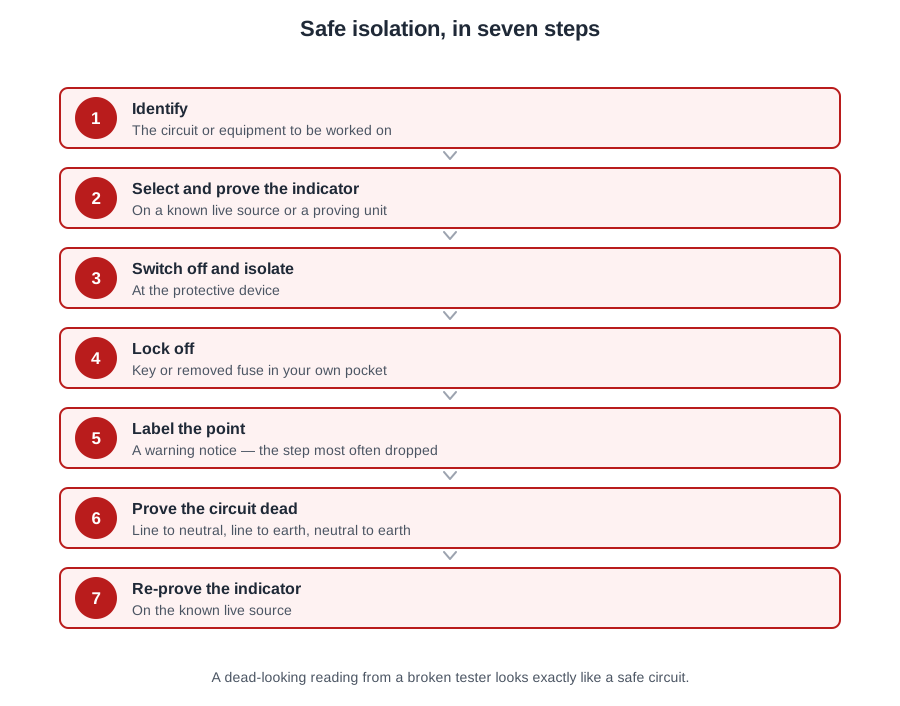
Electrical work is governed by the Electricity at Work Regulations, which require systems to be made dead and proved dead before work is carried out on them. This is about the safety of the person working — the standard of the finished installation is the wiring regulations' job. The seven steps:
- Identify the circuit or equipment to be worked on.
- Select an approved voltage indicator and prove it on a known live source or proving unit.
- Switch off and isolate at the protective device.
- Lock off, keeping the key or removed fuse in your own pocket.
- Label the point with a warning notice.
- Prove the circuit dead at the point of work — line to neutral, line to earth, neutral to earth.
- Re-prove the indicator on the known live source.
The two steps that get dropped are labelling and the final re-prove. The re-prove catches an indicator that failed during the test, because a dead-looking reading from a broken tester looks exactly like a safely isolated circuit.
Refrigerant
A refrigeration circuit brings two hazards a plumber may not have met. Liquid refrigerant escaping causes freeze burns, because it boils on contact with skin and takes the heat out of it. And brazing or heating near a circuit that still contains refrigerant produces toxic gases, because heated refrigerant decomposes into products far worse than the refrigerant itself. The control is that the circuit is recovered by a qualified person before any heat is applied near it, with ventilation and eye and hand protection in place.
Resin anchor fixings need eye protection, because the resin can be ejected under pressure from the applicator nozzle — not a dust mask, not hearing protection, not automatically a harness. The correct control comes from naming the correct harm. Sharp thin metal needs gloves; a dusty cut needs extraction and RPE; a wheel needs a guard; a live circuit needs isolation; a refrigerant circuit needs recovery. Choosing protective equipment before naming the harm is guessing.
🔢 The numbers worth memorising
- Substance assessment
- From the manufacturer safety data sheet for that product, before work begins
- Spillage sequence
- Contain, protect, absorb, dispose — never flush with water
- Manual handling
- Avoid, assess, reduce — technique last
- Work at height
- No minimum height; includes at or below ground level
- Ladder
- Extend at least 1 m above the landing point; 75°, 1 out to 4 up
- Ladder inspection
- Formal every 3 months plus a pre-use check every time
- Abrasive wheel work rest
- No more than about 3 mm (⅛ in) from the wheel
- Safe isolation
- Seven steps, ending with re-proving the indicator
⚠️ Where people go wrong
- Using a generic data sheet,The assessment uses the sheet for that specific product — hazard profiles differ.
- Flushing a spill away with water,That spreads it into drains and is an environmental offence. Contain, protect, absorb, dispose.
- Answering "lifting technique" for manual handling,The hierarchy is avoid, assess, reduce. Technique is applied last.
- Quoting a two metre threshold,There is no minimum height. A fall liable to cause injury is enough.
- Keeping a harness with paint overspray,It must not be used. Overspray hides damage and can attack the webbing.
- Skipping the final re-prove,A tester that failed during the test gives the same reading as a dead circuit.
- Heating near a charged refrigerant circuit,It must be recovered by a qualified person first — heated refrigerant gives off toxic gases.
📝 10-Question Self-Test
Straight from the Level 3 course question bank. Click an option to see whether you got it right — the explanation appears instantly, and there is nothing to submit.
You cannot write a safe sequence until you know what you are working around.
A domestic client does not carry the duties a commercial one would.
And never decant hazardous substances into unmarked containers.
Both are cheap and biodegradable, but ethylene glycol is moderately toxic while propylene glycol is not hazardous, so propylene is the one specified. The fluid is chosen for the least harm if it escapes, not for the heat it carries, and glycol escapes easily because its surface tension is lower than water.
An outdoor unit is heavy and awkward, and its casing edges are sharp.
The resin comes out of the nozzle under pressure and does not belong in an eye.
The safety data sheet is the document, and the drain is the place it must never reach.
The risk assessment identifies the hazards, evaluates who might be harmed and how, and records the control measures. The method statement then sets out the safe sequence of work that puts those controls into practice. Hazards first, method second — the two documents answer different questions.
Overspray is treated as a condemning defect, because it can hide damage and can chemically attack the webbing — and you cannot inspect what you cannot see. Harnesses are also checked before and after every use for abrasions, cuts, tears, burns, mould, fraying, discolouration and chemical damage, with all stitching examined for pulling or cut thread.
Tap it with something non-metallic and listen: a sound wheel rings clearly, a cracked one sounds dull. Only manufacturer recommended parts may be fitted. BS 4163 clause 14.5.1.2 puts the 3 mm limit on the gap between the work rest and the wheel, not on the guard, which the standard describes as an enclosure open only at the front for the work piece.
Going further: the lessons behind this article
This article is the public answer. Unit 336 of the Level 3 course takes the same ground to the depth the exam and the synoptic assignment ask for, in 4 lessons:
- Substances on site: data sheets, glycol and spills
- Manual handling: avoid, assess and reduce
- Work at height: ladders, harnesses and the definition
- Equipment and energy: wheels, isolation and refrigerant
- Site procedures: the Unit 336 guide — every article on this unit in one place
- All PlumbMate articles — Level 1, 2 and 3
- The Level 3 course — the whole 8202-35 Diploma