The last job of all is the one the customer actually asked for at the start: which of these should I have?
The short answer
The fuel matters more than the technology. Every claim about carbon rests on the emission factors in Approved Document L. The current ones, in Approved Document L 2021 through SAP 10.2, are natural gas at 0.210 kg of carbon dioxide per kWh and grid-supplied electricity at 0.136 kg per kWh.
Get them the right way round: on today’s factors gas is the higher of the two. Older factors had grid electricity at around 0.43, which is why older material says the opposite. Biomass fuels such as wood chip and pellets are counted at close to zero on this basis.
Two consequences that explain almost everything
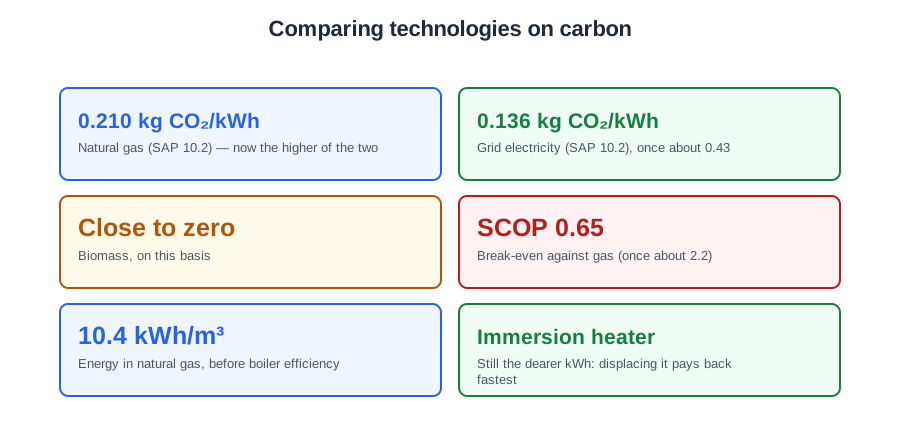
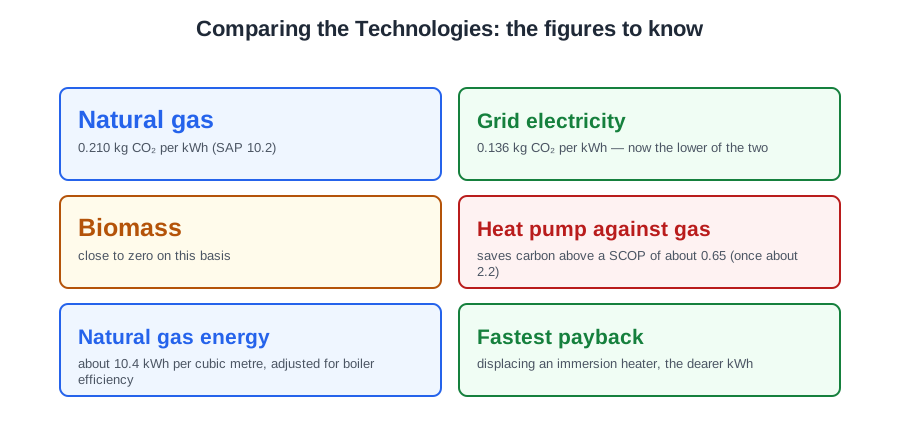
First, per kilowatt-hour of heat, displacing a gas boiler now saves more carbon than displacing an immersion heater, because gas is the dirtier kilowatt-hour and a boiler burns more than a kilowatt-hour of gas for each one it delivers. The immersion heater is still the dearer kilowatt-hour, so all-electric properties give the biggest bill saving and the shortest payback.
Second, a heat pump saves carbon against gas once its seasonal coefficient of performance beats the ratio of the two factors. On today’s factors that is 0.136 ÷ 0.210 ≈ 0.65, so practically any working heat pump now cuts carbon compared with a gas boiler. On the older factors the same sum, 0.422 ÷ 0.194, gave about 2.2, and you will still meet that figure in print: the method has not changed, the grid has.
A badly installed system, run at 60 °C on unchanged radiators, still wastes electricity and money; it just no longer loses the carbon argument.
To express a solar contribution as a fuel saving for a customer on mains gas, use around 10.4 kWh per cubic metre of natural gas, adjusted for the efficiency of the boiler doing the backup. The adjustment matters more than it looks: a boiler run in summer purely for hot water works well below its rated efficiency, so each kilowatt-hour the solar system supplies displaces more than a kilowatt-hour of fuel.
| Technology | Main benefit | Main limitation |
|---|---|---|
| Solar thermal | Around 60% of annual hot water, silent, low maintenance | Seasonal output; an auxiliary heat source stays essential |
| Ground source heat pump | Stable 8–12 °C source, so steady winter efficiency | High capital cost, large land area, complex design |
| Air source heat pump | Cheaper and easier to install than ground source | Output and efficiency both fall in cold weather; fan noise |
| Rainwater harvesting | Cuts wholesome water use; no treatment process needed | Limited by collection area and rainfall |
| Greywater re-use | Steady daily supply, larger than rainwater on many sites | Long payback, treatment and monitoring, contamination risk |
What to survey before you advise
A defensible recommendation weighs all of the following:
- The building: layout and features, plans and specifications, insulation, and where plant and components could go.
- The fuel available — mains gas, oil, electricity only — because that sets both the carbon saving and the payback.
- Occupancy and purpose: how many people, when they are in, how much hot water they draw and when.
- Suitability and availability of each technology on this particular site.
- Energy efficiency of the proposal as a system, not as a machine.
- Cost, separated honestly into capital cost and running cost.
- Legislation and statutory regulations, and the manufacturer's technical instructions.
- The customer's needs and requirements, which are the point of the exercise.
Two rules will keep you out of trouble. Explain the limitations before the customer discovers them, and use plain language — technical terms the customer does not follow are not advice, they are decoration.
🔢 The numbers worth memorising
- Natural gas
- 0.210 kg CO₂ per kWh (SAP 10.2)
- Grid electricity
- 0.136 kg CO₂ per kWh — now the lower of the two
- Biomass
- close to zero on this basis
- Heat pump against gas
- saves carbon above a SCOP of about 0.65 (once about 2.2)
- Natural gas energy
- about 10.4 kWh per cubic metre, adjusted for boiler efficiency
- Fastest payback
- displacing an immersion heater, the dearer kWh
⚠️ Where people go wrong
- Getting the emission factors the wrong way round. On today’s factors gas is the dirtier kilowatt-hour.
- Quoting the old break-even of 2.18 as current. Divide today’s factors: about 0.65.
- Ignoring the boiler efficiency adjustment when converting a solar saving into gas.
- Recommending on the technology rather than on the fuel it displaces.
- Quoting a machine’s efficiency instead of the system’s.
- Merging capital and running cost into one figure.
- Leaving the limitations for the customer to discover.
- Advising in terms the customer does not follow.
📝 5-Question Self-Test
Straight from the Level 3 course question bank. Click an option to see whether you got it right — the explanation appears instantly, and there is nothing to submit.
An inverter varies the compressor's frequency, so the unit can modulate its output down to match a partial load. Because it can throttle back rather than stopping, it runs for long continuous periods instead of cycling — which is exactly the operating pattern that gives a heat pump its best seasonal efficiency.
On a monobloc it is water, not refrigerant, that crosses the wall — and water freezes.
It is the intercept of the curve: the point where there is no temperature difference between absorber and ambient, so no losses, and the only limits are optical — how much radiation gets through the glazing and is absorbed. Every real operating point sits below it, and the heat loss coefficients describe how steeply performance falls away from it.
Note that a fully charged store and a holiday are both normal conditions, not faults.
BS 8515 4.8.1 requires the pump to be selected and arranged so that energy use and noise are minimised, cavitation is prevented and air is not introduced, and to be equipped with dry-run protection. BS 8525-1 4.11.1 makes the same point for greywater distribution. The energy is a genuine limitation and it is not cancelled anywhere: the calculation in Approved Document G 2.2 counts litres of water, not kilowatt hours.
Going further: the lessons behind this article
This article is the public answer. Unit 335 of the Level 3 course takes the same ground to the depth the exam and the synoptic assignment ask for, in 1 lessons:
- Comparing the technologies: carbon, cost and customer fit
- Environmental technology systems: the Unit 335 guide — every article on this unit in one place
- All PlumbMate articles — Level 1, 2 and 3
- The Level 3 course — the whole 8202-35 Diploma