Unit 335 is the only unit on the Diploma where the right answer is sometimes “this technology is wrong for this building”. It is assessed on judgement, and judgement needs numbers behind it.
The short answer
Unit 335 — Environmental technology systems — covers the micro-renewables a domestic plumber actually meets: heat pumps, solar thermal, biomass, rainwater harvesting and greywater recycling. For each one you have to be able to outline how it works, survey a building for it, site it legally, and then say honestly what it will and will not do.
The unit is smaller than the others — 41 lessons — and it is weighted differently. Roughly a third of it is how the technologies work; the rest is surveying, legislation and advising, which is where the marks that separate candidates actually sit.
How the unit is shaped
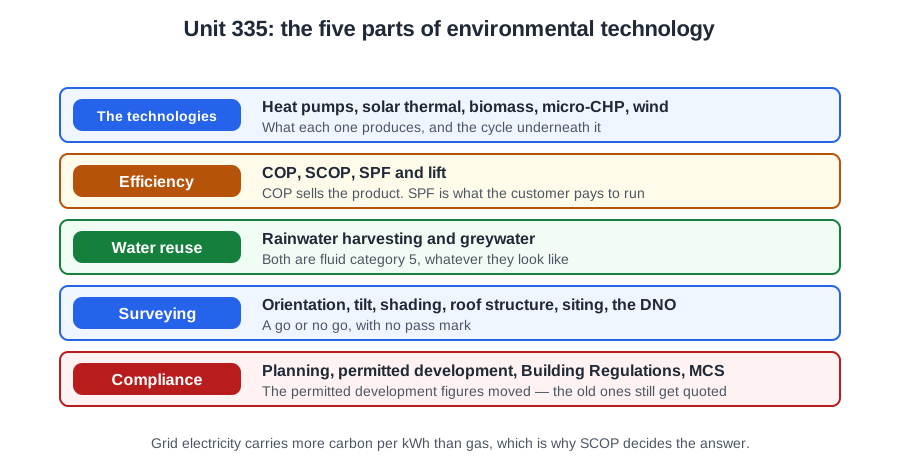
The technologies. Air source and ground source heat pumps, solar thermal, biomass, and water conservation systems. Operating principle, main components, and what each one needs from the building.
The survey. Seven lessons on it, which is the clue. Heat loss, existing emitters, existing controls, insulation, orientation, shading, available space, ground conditions, electrical supply. A heat pump specified without a survey is a complaint waiting to happen.
The law and the standards. Planning and permitted development, the Building Regulations parts that apply, MCS, and the standards each technology is installed to.
Benefit and cost. Efficiency figures — COP, SPF, SCOP — carbon savings, running cost, and the honest limitations of each technology.
Comparing and advising. The unit's last lesson, and the one the whole thing has been building towards: given this building and this customer, what do you recommend and why.
What actually makes it hard
The efficiency figures are not interchangeable. COP is a measurement at one operating point. SPF and SCOP are seasonal, averaged over a year of real conditions, and always lower. Quoting a COP as if it were an annual figure is the commonest error in the unit and it is exactly what a mis-selling complaint looks like.
Permitted development is conditional, not a blanket permission. Every one of these technologies has conditions attached — distance from a boundary, position on a roof, size, noise. In a conservation area or on a listed building the answer changes again.
Heat pumps change the whole heating design. A lower flow temperature means bigger emitters, and the survey has to establish whether the existing ones will do. This is why the unit reaches back into Unit 333 rather than standing on its own.
The advice questions have no single right answer, and they still have a mark scheme. The marks are for the reasoning: what you measured, what you weighed, and why you ruled the alternatives out.
Where it connects to the rest of the course
Solar thermal lands in Unit 332 — a solar cylinder is a hot water design problem with two heat sources. Heat pumps land in Unit 333, because they change every emitter size in the chain. Rainwater and greywater meet Unit 334's roof drainage and Unit 331's backflow protection, since neither of those waters may ever reach the wholesome supply.
Every article on Unit 335
One article per section of the unit. Each is a complete answer on its own, and each ends with a self-test drawn from the course question bank.
🔢 The numbers worth memorising
- COP
- coefficient of performance at ONE operating point — a snapshot
- SPF / SCOP
- seasonal figures, averaged over a year of real conditions — always lower than COP
- Heat pump flow temperature
- far lower than a boiler, which is why every emitter has to be re-checked
- Solar thermal
- orientation, pitch and shading decide the yield before any component is chosen
- Permitted development
- conditional — boundary distance, position, size and noise all attach
- Rainwater and greywater
- never permitted to reach the wholesome supply — Unit 331’s backflow rules apply
⚠️ Where people go wrong
- Quoting a COP as if it were an annual efficiency. SPF and SCOP are the seasonal figures and they are lower.
- Assuming permitted development means no permission needed. The conditions are the answer, and a conservation area changes it.
- Specifying a heat pump without establishing whether the existing emitters work at the new flow temperature.
- Treating biomass as zero carbon. It is low carbon — something is still burning.
- Recommending a technology without ruling the alternatives out. The reasoning is the mark, not the recommendation.
📝 10-Question Self-Test
Straight from the Level 3 course question bank. Click an option to see whether you got it right — the explanation appears instantly, and there is nothing to submit.
Electricity and heat, together, from one fuel. A micro-CHP unit runs an engine or a similar prime mover to generate electricity and captures the heat that would otherwise go up the flue, using it for the heating and hot water. Because the electricity is a by-product of running for heat, it only pays in a dwelling with a high space heating demand. It produces no hydrogen and no cooling.
Domestic micro-CHP units use a Stirling engine (the paper spells it Sterling), an external combustion engine driven by the burner's heat.
An evacuated tube collector seals the absorber inside a glass tube with the air pumped out. The vacuum removes conduction and convection losses almost entirely, so the collector holds its output in cold, windy weather and reaches higher temperatures than the other main type, the flat plate. The textbook describes a coated, double walled tube; the design guides describe a metal absorber, direct flow or heat pipe, sealed in a single tube. Finned, ribbed and ventilated tubes are not solar collectors at all.
A heat pump does not make heat, it moves it, on the same refrigeration cycle as a fridge: the evaporator absorbs, the compressor raises pressure and temperature, the condenser releases, and the expansion valve drops the pressure again. Dropping the pressure lowers the refrigerant’s boiling point below the ground temperature, which is the only way heat will flow into it. Nothing burns, so combustion is not involved.
An air source unit is a packaged outdoor box holding a fan, a heat exchanger acting as the evaporator, a compressor, an expansion valve, and a second heat exchanger that passes the heat into the system water. A ground loop collector belongs to ground source and a solar panel to solar thermal. A flue gas condenser is boiler equipment: a heat pump burns nothing, so it has no flue.
The main domestic biomass fuel is wood pellets, pressed from sawdust and shavings, with logs and wood chips as the alternatives. Biomass is called carbon neutral because growing timber absorbs the carbon dioxide that burning it releases. Kerosene and LPG are fossil fuels and smokeless ovoids are a coal product, so none of them is biological material.
Domestic micro-CHP units are gas fired and use a Stirling engine, an external combustion engine driven by gas expanding and contracting as it is alternately heated and cooled. The unit is heat led, generating only while the appliance is heating the house, typically 1 kW to 1.5 kW of electricity. Diesel, two stroke petrol and Wankel engines are internal combustion and are not used in these appliances.
A heat pump dislikes starting and stopping, and when underfloor zone valves close it can be left with almost no water to heat. A buffer vessel gives it somewhere to put surplus heat, and the volume to run a defrost cycle without robbing the house. A feed and expansion cistern is no help here, because a heat pump circuit is sealed rather than open vented.
Ground source has no combustion on site, no fuel to store, a long working life and relatively low maintenance requirements once the loop is in. Be careful with the other claims made for it. It does have moving parts, a compressor, circulators and a brine pump; it always needs ground works; and a horizontal collector needs a real area of land, so it will not fit any size of garden.
The loops in common UK use are vertical boreholes, horizontal trenches, the slinky and the pond loop, all closed loops of plastic pipe filled with water and antifreeze that pass collected heat to the evaporator. Strictly the slinky is not a fourth type but a way of configuring a horizontal trench, a coil that fits more pipe into each metre, so it saves excavation rather than area; the textbook and the trade still list it on its own. Aerial, radial, rooftop, cascade and reservoir are not collector types.
Going further: the Unit 335 lessons
These articles are the public answer. Unit 335 of the Level 3 course takes the same ground to the depth the exam and the synoptic assignment ask for, in 41 lessons across 11 sections, each with its own quizzes, flashcards, key facts, an AI-marked short answer and interactive tasks.
- Micro-renewables and heat pumps
- Solar thermal systems
- Rainwater and greywater
- Surveying the building
- Planning and permitted development
- Building Regulations and standards
- Measuring benefit and cost
- Heat pumps: benefits and limitations
- Solar thermal: benefits and limitations
- Water conservation: benefits and limitations
- Comparing and advising
- All PlumbMate articles — Level 1, 2 and 3
- The Level 3 course — the whole 8202-35 Diploma