A block of flats has almost no roof per dwelling and no garden, so rainwater harvesting will never yield much. What it does have is a great many baths and showers, running every day whatever the weather.
The short answer
A big roof argues for rainwater; a great many showers argue for greywater. Both end at the same air gap.
Rainwater is limited by collection area and by local rainfall, and is least available in a dry summer when garden demand peaks. Greywater is produced indoors, daily, and does not depend on the weather or on roof area — but it must be treated and monitored, and the retrofit is harder.
Rainwater harvesting
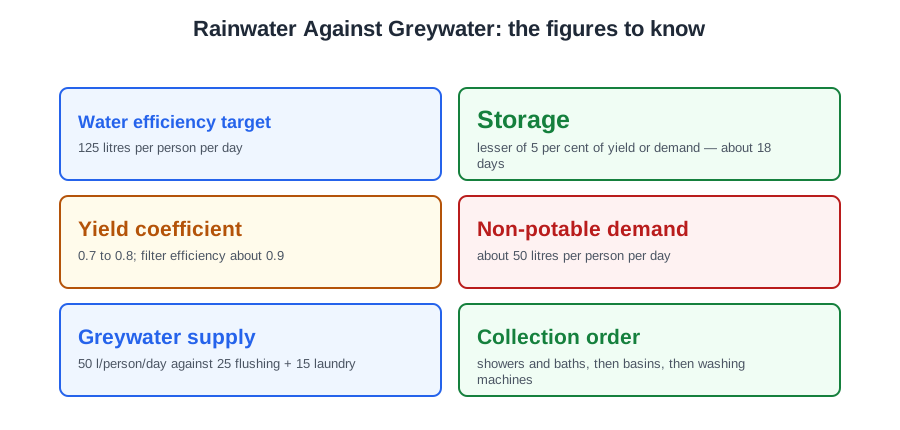
A new four-bedroom house must demonstrate that the potential consumption of wholesome water will not exceed 125 litres per person per day. Approved Document G makes the underlying point: water treated to the high standards of wholesome water is not essential for every use a building puts water to — toilet flushing and irrigation among them.
The benefits: a reduction in the use of wholesome water, which is what the Regulations target; a reduction in water bills where the property is metered; no treatment process of the kind greywater needs — rainwater is filtered and settled, not disinfected and monitored; and it is less complicated than greywater re-use, with fewer things to get wrong.
It supplies WC flushing, washing machines and garden watering. It must never supply drinking water or food preparation.
Storage capacity is the lesser of 5 per cent of the annual rainwater yield or 5 per cent of the annual non-potable water demand. Five per cent equates to about 18 days, enough to ride out normal daily variation; beyond that there are diminishing returns.
Yield is the collecting area multiplied by the depth of rainfall, reduced by a yield coefficient of 0.7 to 0.8 for a standard pitched roof and a hydraulic filter efficiency of around 0.9. Non-potable demand is usually taken as about 50 litres per person per day, covering flushing and clothes washing. Include car washing and garden watering and demand rises well above what the roof can supply.
The rest of the limitations: high initial installation costs; a water meter should be fitted for the saving to be worth anything; and the pump and controls use electricity, which offsets part of the environmental benefit.
Stored rainwater is fluid category 5. That decides everything about the mains back-up: an air gap, either a Type AA to BS EN 13076 or a Type AB to BS EN 13077. A mechanical backflow device is never acceptable, and no direct connection may bypass the air gap.
Everything must be identified. Recycled water pipework is banded green, black, green. Rainwater distribution pipes carry labels at least 100 mm long, coloured green, marked RAINWATER in black lettering at least 5 mm high, at intervals of no more than 0.5 m and at key connection points, with points of use marked Non-potable water.
The customer inherits a maintenance schedule:
- Annually: gutters and downpipes, the filter, the tank, the pump, the back-up supply and its air gaps, the control unit, the wiring, the pipework and the markings.
- Every six months: UV lamps, if fitted.
- Every ten years: drain down and clean the tank.
A log of inspections and maintenance should be kept, and human entry into tanks should be avoided wherever possible.
Greywater re-use
The benefits: a reduction in water bills and in the demand for wholesome water; a wide range of system designs, from a simple diverter to a full biological treatment unit; and the potential to provide more reusable water than rainwater harvesting, because the supply is produced indoors, daily.
The numbers show that steadiness: a relatively constant daily supply of 50 litres of bathroom greywater per person, against a demand of 25 litres per person for WC flushing and 15 litres for laundry. Supply comfortably exceeds demand, which is rarely true of a rainwater system in August.
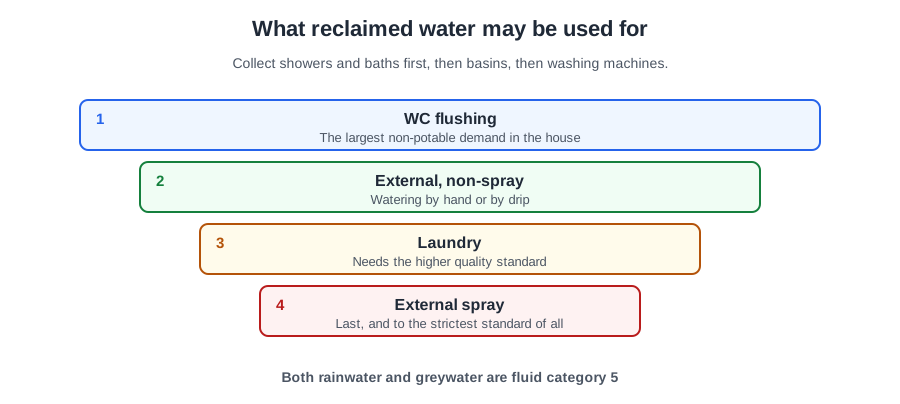
Only bathroom greywater should be collected, so the system is not burdened with treating the most heavily contaminated water. Kitchen sinks and dishwashers are excluded. The order of preference for collection is showers and baths first, then wash and hand basins, then washing machines.
The uses are ranked by risk: WC flushing, then external non-spray use, then laundry, then external spray use. Spray applications are the demanding end, because water becomes airborne.
Systems are grouped by how much treatment they apply: direct re-use with no treatment and minimal storage; basic filtration or treatment, sometimes with a chemical disinfectant; biological systems using aerobic treatment or plants; and combined biological and physical systems. Untreated greywater cannot simply be stored: it contains organic matter, it goes off, and it produces odour.
There are no statutory water quality limits for non-potable re-use, so guideline values are set instead. For spray applications and laundry, E. coli must not be detected per 100 mL, and intestinal enterococci must not be detected; for WC flushing and garden watering the guideline is 250 E. coli and 100 intestinal enterococci per 100 mL. Total coliforms are 10 per 100 mL for spray and laundry, 1000 for flushing and garden watering, and Legionella pneumophila 10 per 100 mL for spray where a risk assessment calls for it. Turbidity should be below 10 NTU.
Frequent sampling is not required, but observations for water quality should be made at every maintenance visit, with tests used to investigate a system that is not performing or any complaint of illness. Do not test immediately after commissioning: the system will have been filled with mains water for testing, so the result means nothing.
The limitations, stated fully:
- A long payback period.
- Difficult to integrate into an existing system — the collection pipework has to be separated from the soil drainage, easy in a new build and awkward in a retrofit.
- Only certain appliances can be supplied by it.
- A potential cross-contamination risk. Treated greywater is fluid category 5, so the back-up needs an air gap, and a warning mechanism that alerts the user before an overflow if the inlet valve fails.
- A water meter on the property supply.
- Filtering and pumping contribute to the property's carbon footprint, so designers are asked to minimise the energy used.
🔢 The numbers worth memorising
- Water efficiency target
- 125 litres per person per day
- Storage
- lesser of 5 per cent of yield or demand — about 18 days
- Yield coefficient
- 0.7 to 0.8; filter efficiency about 0.9
- Non-potable demand
- about 50 litres per person per day
- Greywater supply
- 50 l/person/day against 25 flushing + 15 laundry
- Collection order
- showers and baths, then basins, then washing machines
- Use order
- WC flushing, external non-spray, laundry, external spray last
- Spray and laundry quality
- E. coli and enterococci not detected per 100 mL
- Flushing and garden
- 250 E. coli, 100 enterococci per 100 mL; turbidity under 10 NTU
- Both are
- fluid category 5 — Type AA or AB air gap
- Labels
- every 0.5 m, at least 100 mm long, lettering 5 mm
- Tank clean
- every ten years; UV lamps every six months
⚠️ Where people go wrong
- Sizing a rainwater store beyond about 18 days. Diminishing returns.
- Forgetting the yield coefficient and filter efficiency.
- Including car washing and garden watering in the demand a small roof must meet.
- Fitting the system without a water meter, then claiming a saving.
- Collecting kitchen sink or dishwasher water as greywater.
- Spray-irrigating with water treated only to the flushing guideline.
- Storing untreated greywater.
- Sampling immediately after commissioning, when the system is full of mains water.
- Fitting a mechanical backflow device on a category 5 back-up.
- Omitting the overflow warning on a greywater system.
- Selling a greywater retrofit into an occupied house without pricing the drainage separation.
- Entering a storage tank when it could be avoided.
📝 10-Question Self-Test
Straight from the Level 3 course question bank. Click an option to see whether you got it right — the explanation appears instantly, and there is nothing to submit.
A hybrid pairs a heat pump with a boiler under a single intelligent controller, which decides which source to run based on outdoor conditions and the relative cost or efficiency of electricity against gas. In mild weather the heat pump does the work; in cold weather, or where the required flow temperature would make the heat pump inefficient, the boiler takes over.
A slinky overlaps a long run of pipe within a shorter trench, so more pipe — and more heat extraction — fits into a given trench length, cutting excavation cost. The trade-off is greater thermal interference between adjacent coils, so total ground area required is not much reduced and extraction per metre of pipe is lower.
The water has to be deep enough that it will not freeze around the coils, and large enough that the load does not simply chill it over a season. Around 3 m of depth and about 9 m² of surface per kW are the usual screening figures.
SPF is the figure the installer most influences. A higher flow temperature means a bigger lift and a worse seasonal result from the same machine.
Around 60% is the figure the trade and the City and Guilds textbook quote, though published guidance sits a little lower: CIBSE Guide B1 1.6.7 gives some 50% of annual dhw demand, and the Energy Saving Trust guide CE131 gives 40 to 50% at a 60 degree store. Of the four figures offered, 60% is the only one in that region. Reaching it depends on more than the collector: an efficient auxiliary regime, some management of when hot water is drawn, and outlets fed from the store rather than from an instantaneous source.
Aperture area is the part that actually admits radiation, so it is what the performance figures and the energy calculation are based on. Overall area still matters — it is what you need on the roof, and what wind loading acts on — but using it in the calculation overstates the output.
Thermal cycling to stagnation temperature breaks the fluid down. Degraded fluid loses its inhibitor package and can turn acidic, attacking the very components it circulates through — which is why condition and pH are checked at every service, not just concentration.
Stagnation is not confined to the roof. Heat and vapour reach back into the pipework, the joints, the insulation and towards the expansion vessel — which is precisely why the vessel's connecting pipework is deliberately left uninsulated as a cooling leg.
BS 8515 0.1 records the benefit for attenuation of surface water run-off, and Annex A.1 NOTE 1 warns that sizing the store for water supply alone does not provide sufficient spare stormwater control storage. Where the two jobs are combined, the extra capacity from Figure A.1 is added to the sizing from 4.1.2.2. A tank that happens to be part empty is not a designed attenuation volume.
BS 8515 3.5 defines the back-up supply as potable water that can supplement the non-potable supply in times of drought or heavy demand, and it is what keeps the WCs flushing when the store empties. The pump is protected instead by dry-run protection under BS 8515 4.8.1, not by a daily top-up, and it discharges through the air gap rather than any bypass.
Going further: the lessons behind this article
This article is the public answer. Unit 335 of the Level 3 course takes the same ground to the depth the exam and the synoptic assignment ask for, in 2 lessons:
- Rainwater harvesting: the savings and the strings attached
- Greywater re-use: a steadier supply, a heavier burden
- Environmental technology systems: the Unit 335 guide — every article on this unit in one place
- All PlumbMate articles — Level 1, 2 and 3
- The Level 3 course — the whole 8202-35 Diploma