A householder rings in August. They have been away a fortnight; the controller has been showing a collector temperature of over 180 °C and now the system will not restart. Nothing has broken.
The short answer
The system has been stagnating, which is a normal condition and the limitation that defines this technology.
And before any of that, the confusion most customers arrive with: solar thermal produces heat for stored domestic hot water, reducing the work the auxiliary heat source has to do. It does not make electricity, it does not export anything to the grid, and it is sized against the dwelling's hot water demand, not its space heating load.
What it covers, and what it cannot
Will it supply all the hot water? It will in summer, but it will contribute little in winter, so a well-controlled auxiliary heat source stays essential. An evacuated tube performs better than a flat plate in cold weather, but it does not turn a December in Manchester into July.
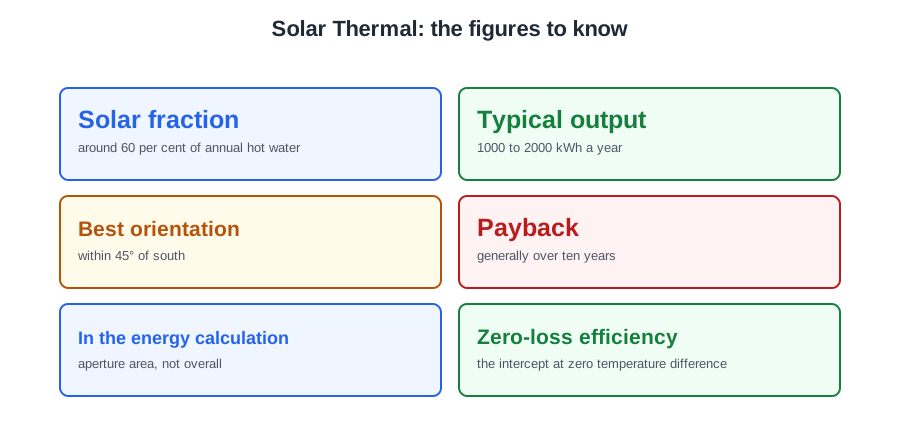
The figure to work to is around 60 per cent of a dwelling's annual hot water demand — the solar fraction — with most of that earned between spring and autumn. Independent guidance puts it as saving over 50 per cent of the energy needed to supply hot water, with a typical installation producing 1000 to 2000 kWh a year.
Promising year-round autonomy creates a complaint that no amount of commissioning will ever fix. And reaching 60 per cent depends on more than the collector: an efficient auxiliary regime, some management of when hot water is drawn, and outlets fed from the store rather than an instantaneous source.
The real constraint is that output is variable and largely unavailable on heavily overcast winter days. Set against that, three things people commonly believe are simply not true:
- The system does need maintenance. It is low-maintenance, not no-maintenance, and a neglected system degrades quietly.
- Collectors do not have to face due south. The best locations face within 45° of south, and an easterly aspect can suit a household that stores its heat.
- A combination boiler does not stop the system working — although it raises a real design problem, which is where the heat is to be stored.
Three things have to be true before an installation is viable: rights to the roof area, a largely unshaded collector location, and hot water supplied from a store the system can heat. That last one is decisive: a dwelling with an instantaneous-only supply has nowhere to put the energy.
What is not required is a due south roof of a set size, a particular pitch, mains gas, three-phase power or planning consent as a matter of course.
The other limitations belong on the quotation: high initial installation cost, possible incompatibility with the existing hot water system, and payback periods that generally exceed ten years.
Reading the data sheet
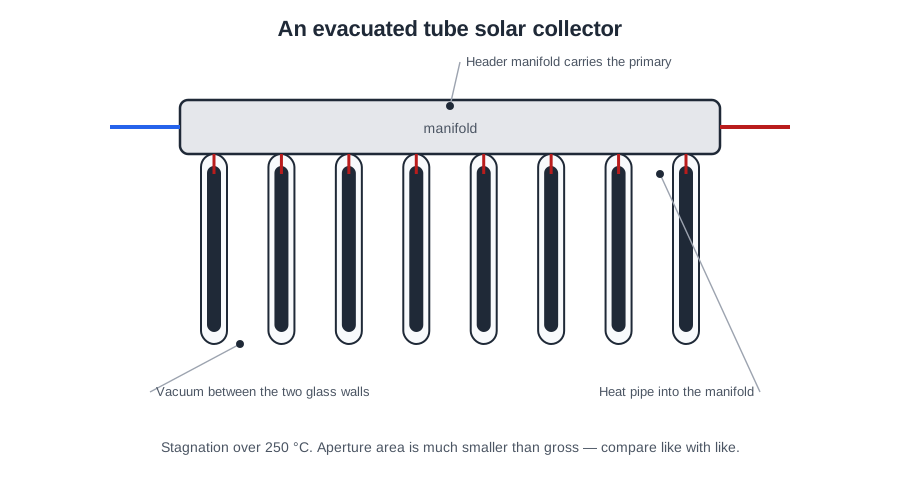
One collector quotes an overall area of 2.02 m² and an aperture area of 1.92 m². Aperture area is used in the energy calculation, because it is the area actually admitting radiation to the absorber.
Overall area is the full outside dimension. It still matters — it is what you need to find on the roof, and it is what wind loading acts on — but putting it into the energy calculation overstates the output. Nor is the answer an average of the two, or whichever figure the manufacturer prints first.
A collector's performance is published as a curve with two parts:
- The zero-loss efficiency, or optical efficiency, is the intercept: the efficiency when the absorber and the ambient air are at the same temperature, so there is no heat loss driving force. With no temperature difference the only limits are optical. Every real operating point sits below it.
- The heat loss coefficients, first and second order, describe how steeply performance falls away as the absorber runs hotter than the surrounding air.
So if two collectors have the same zero-loss efficiency but one has notably lower heat loss coefficients, they start level, and the one with lower losses holds its performance better as the difference between absorber and ambient temperature grows. Its advantage shows up in cold weather and at higher working temperatures — precisely the case for an evacuated tube against a flat plate.
Read that carefully, because it is easy to get backwards. Lower losses do not mean more energy on a bright warm day at a low working temperature — at low temperature difference the two are level. They do not mean a bigger aperture area. And they certainly do not mean a lower stagnation temperature — the opposite is true, and overheating protection matters more, not less.
| Figure on the data sheet | What it tells you |
|---|---|
| Overall area | Roof space needed and wind loading |
| Aperture area | The area admitting radiation — use this in the energy calculation |
| Zero-loss (optical) efficiency | Best case, at zero temperature difference |
| Heat loss coefficients | How fast efficiency falls as the absorber runs hotter than ambient |
Here is the point most data sheets never make: none of those four figures tells you how much energy the array will actually deliver in this house. That depends on something outside the collector entirely — the hot water consumption volume and pattern in the dwelling.
How much hot water the household uses, and when, decides how much of the collected energy is drawn off and how cool the store returns to the collector. A store that is never emptied runs hot, so the collector runs hot, efficiency falls and stagnation risk rises. A household of five who bath in the evening will get far more out of the same array than a couple who are out all week.
Stagnation
Stagnation is the condition where the pump is not running and the fluid remains in the collector, heating until it reaches the collector's stagnation temperature. Put more simply: energy arrives, but the pump is not running, so no heat is removed. It is not the pump running on with no demand, not air trapped at a high point, and not simply the store reaching its set temperature.
The classic trigger is entirely ordinary: a hot summer period with the household away, so the store is already at temperature and no hot water is drawn. A fully charged store and a holiday are normal conditions, not faults.
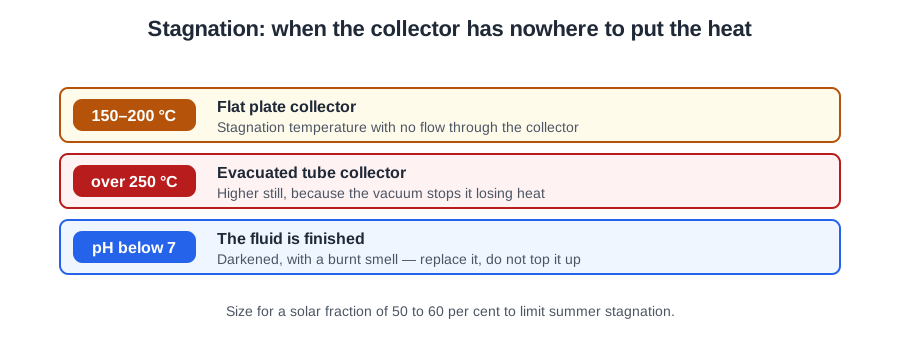
Flat plates reach roughly 150 to 200 °C at stagnation; evacuated tubes exceed 250 °C. That is why insulation, seals and jointing are specified against the stagnation temperature, not the working temperature.
And the heat does not stay on the roof. The whole circuit must be specified for high temperature, because at stagnation the hot fluid and vapour can reach components well beyond the collector. That is exactly why the pipework connecting the expansion vessel is deliberately left uninsulated, to work as a cooling leg.
Repeated stagnation degrades the heat transfer fluid, which is why fluid condition is a service check rather than a fit-and-forget item. Thermal cycling breaks the fluid down; it loses its inhibitor package and turns acidic, attacking the very components it circulates through.
Three signs tell you the fluid is finished, one of them measurable: a darkened colour, a burnt smell, and a pH below 7. Check condition and pH at every service, not just antifreeze concentration.
There are two lines of defence, and they are not the same thing:
- Correct sizing, at a solar fraction of 50 to 60 per cent. An oversized array is a liability rather than a margin, because it spends the summer with nowhere to put its heat and reaches stagnation far more often.
- A drain-back system removes the problem entirely. The fluid drains out of the collectors when the pump stops, so there is nothing in them to overheat. An empty collector cannot cook its fluid. That single behaviour gives drain-back both its freeze protection and its stagnation protection, and is why such systems can run on plain water without antifreeze or an expansion vessel.
Shading the array, raising the relief valve setting or running the pump at night are not the answers, and a bigger collector makes matters worse.
And one safety rule: a hot collector must never be drained. Cover the collectors, let the system cool, then isolate and drain into a secure container. Glycol-based fluid does not go down a drain.
🔢 The numbers worth memorising
- Solar fraction
- around 60 per cent of annual hot water
- Typical output
- 1000 to 2000 kWh a year
- Best orientation
- within 45° of south
- Payback
- generally over ten years
- In the energy calculation
- aperture area, not overall
- Zero-loss efficiency
- the intercept at zero temperature difference
- Lower heat loss coefficients
- win in cold weather and at higher working temperatures
- Stagnation temperature
- 150–200 °C flat plate, over 250 °C evacuated tube
- Fluid finished
- darkened, burnt smell, pH below 7
- Size at
- a solar fraction of 50 to 60 per cent
⚠️ Where people go wrong
- Quoting solar thermal when the customer means photovoltaics.
- Promising year-round hot water.
- Insisting on a due south roof. Within 45° is fine.
- Quoting for a dwelling with an instantaneous-only hot water supply.
- Putting overall area into the energy calculation.
- Reading lower heat loss coefficients as a lower stagnation temperature. The opposite is true.
- Sizing the array from the data sheet without asking how much hot water the household draws.
- Treating stagnation as a fault. A full store and a holiday are normal conditions.
- Specifying seals and insulation against the working temperature.
- Insulating the expansion vessel pipework. It is a cooling leg.
- Checking antifreeze concentration but not fluid condition and pH.
- Oversizing the array as a margin. It stagnates more often.
- Draining a hot collector, or putting glycol fluid down a drain.
📝 10-Question Self-Test
Straight from the Level 3 course question bank. Click an option to see whether you got it right — the explanation appears instantly, and there is nothing to submit.
An exhaust air heat pump recovers heat from warm, stale air being mechanically extracted from the dwelling before it is discharged. Available energy is limited by the ventilation rate, so output is modest — these units suit small, airtight, well-insulated properties such as flats and new-build apartments.
Monovalent means one heat source: the heat pump alone covers the design peak heat loss, with no supplementary heat at any outdoor temperature. A bivalent system pairs the heat pump with a second source — a boiler or immersion — which contributes once the outdoor temperature falls below the bivalence point.
An undersized unit runs flat out and still cannot meet the load at design conditions. Any backup — usually an immersion heater at a COP of 1 — makes up the difference, so running costs climb sharply in exactly the weather where the customer notices. Oversizing and undersizing both harm the system, in opposite ways.
Colder air holds less available heat, so the unit extracts less and its output falls. At the same time the temperature lift widens, so the compressor works harder for each kilowatt delivered and the COP falls. Both curves move the wrong way at once — and precisely when the building needs most heat.
The unit's own efficiency is only part of the picture. System efficiency draws the boundary wider, taking in circulating pumps, the brine pump on a ground source system, defrost energy, any immersion top-up, distribution losses and standing losses from storage. It is what the customer actually pays for.
Full sun, a store already up to temperature and nobody drawing off. The array collects heat with nowhere to put it, so the controller stops the pump and the collector heats to stagnation. It is why an oversized array is a liability rather than a margin — it reaches this state more often.
11 ÷ 3.4 = 3.2. That is workable but modest, which suggests a fairly wide lift.
Solar thermal heats water. It is sized against the dwelling's hot water demand, not its space heating load, and it works alongside an auxiliary heat source rather than replacing it. The confusion with PV is the single most common misunderstanding a customer arrives with.
BS 8525-1 Table 2 splits the guideline values by end use. For spray applications, E. coli and intestinal enterococci must not be detected in 100 mL, against 250 and 100 for WC flushing and garden watering, and Legionella pneumophila is added where a risk assessment under clause 8 calls for it. Turbidity below 10 NTU still applies to spray use. Water that was fit for a cistern is not automatically fit for a sprinkler.
How much hot water the household uses, and when, decides how much of the collected energy is actually drawn off and how cool the store returns to the collector. A store that is never emptied runs hot, the collector runs hot, efficiency falls and stagnation risk rises. Output is a system property, not a panel specification.
Going further: the lessons behind this article
This article is the public answer. Unit 335 of the Level 3 course takes the same ground to the depth the exam and the synoptic assignment ask for, in 3 lessons:
- Solar thermal: what it delivers and what it cannot
- Collector performance: aperture area and the efficiency curve
- Stagnation: the limitation designed into every solar system
- Environmental technology systems: the Unit 335 guide — every article on this unit in one place
- All PlumbMate articles — Level 1, 2 and 3
- The Level 3 course — the whole 8202-35 Diploma