A customer on a metered supply has a large roof and a big garden, and asks what she could do with the water that currently disappears down the drain.
The short answer
About a third of household water is flushed down WCs, and only about 3 per cent is drunk or used to prepare food — so there is a lot of wholesome water being used for jobs that do not need it. Approved Document G sets a water efficiency target of 125 litres per person per day for new dwellings.
A rainwater system follows four steps: collection, filtration, storage and reuse.
And the part an inspector will look at hardest is where the reclaimed system meets the mains. Stored rainwater and stored greywater are both fluid category 5, so the only acceptable protection is an air gap — no double check valve, no mechanical device of any kind.
Rainwater harvesting
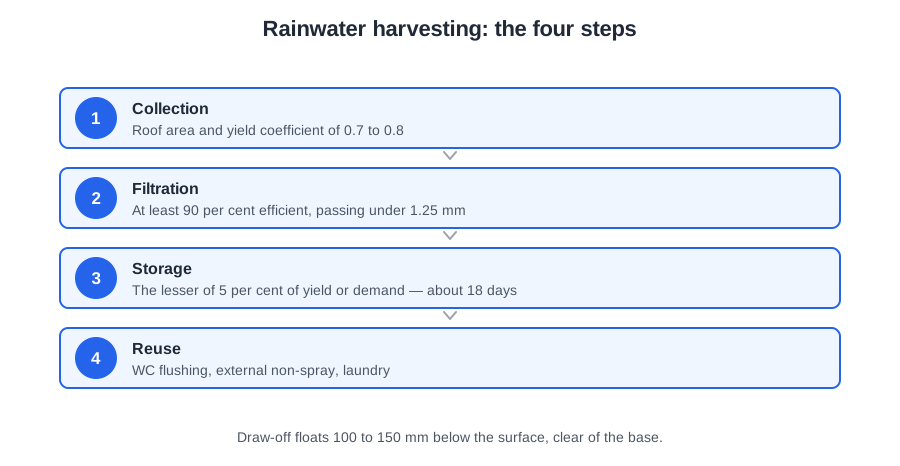
Water runs off the roof into the gutter and down the rainwater pipe towards the tank. The quantity available is governed by the area of the collection surface and the annual rainfall for the area.
The roof material matters: BS 8515 asks for surfaces subject to as little pollution as possible, and roofs of copper, lead, asbestos or bitumen may be unsuitable. Ground level and trafficked surfaces such as a driveway offer a large area but carry oil and other pollutants, so they are allowed only after a specific risk assessment, with sealed gullies. Collection pipework should be free draining, to avoid stagnation.
Filtration comes before the water reaches the main body of stored water — commonly an in-line mechanical filter that takes out leaves and debris and is flushed clean. The filter must be:
- Water and weather resistant.
- Removable and readily accessible for maintenance.
- Of an efficiency of at least 90 per cent.
- Passing a maximum particle size of less than 1.25 mm.
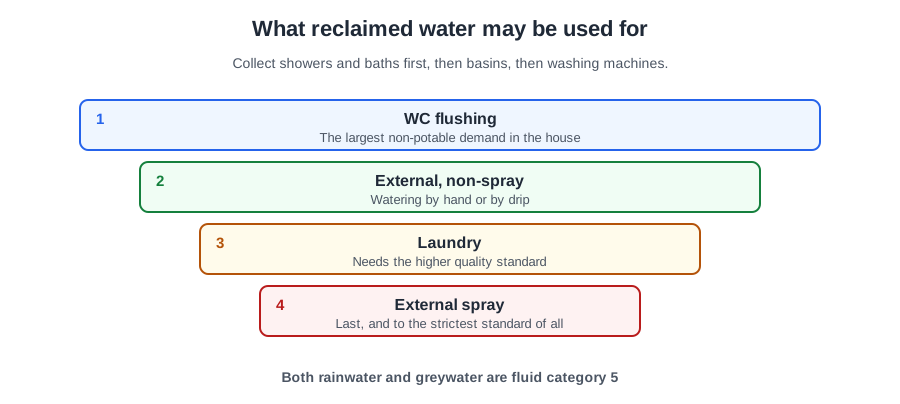
Filtered rainwater is of a quality suitable for WC flushing, laundry and garden watering. Where more exposure is expected, further treatment such as UV or chemical disinfection may be added.
The tank may be above or below ground. It must be watertight, made of materials that do not encourage microbial growth, and fitted with screened ventilation and a lid, an overflow to drainage, and a calmed inlet so incoming water does not stir up the sediment.
Draw-off is best taken from a floating extraction point about 100 to 150 mm below the surface, or from a fixed point about 150 mm above the base. Siting matters: a tank must be protected from freezing, from warming to temperatures that encourage Legionella, and from sunlight, which grows algae.
For sizing, take the lesser of 5 per cent of the annual rainwater yield or 5 per cent of the annual non-potable demand — about 18 days of supply, which covers normal variability in rainfall.
A submersible pump lifts the water to the point of use. Direct distribution pumps it straight to the outlets, with the control unit introducing wholesome water in dry spells. Indirect distribution pumps it to a cistern at high level, which feeds the outlets by gravity and takes the mains top-up. Indirect uses less energy; direct needs no roof space.
Untreated harvested rainwater is for WC flushing — of the appliances in a house, that is the one it may supply. It must never serve drinking water, food preparation, dishwashing or personal washing: no kitchen tap, no basin, no dishwasher and no shower.
Greywater
Could the shower water flush the WC as well? It can — but greywater is a much more demanding system than rainwater harvesting, and the reason is what is in the water.
Greywater is domestic wastewater excluding faecal matter and urine: in practice, water from baths, showers and wash basins, and from washing machines where a larger volume is needed. Blackwater is the wastewater that contains faecal matter and urine — the discharge from WC pans — and it goes only to the foul drain and cannot be re-used in a building.
Two near misses matter. Rainwater from the roof is not greywater; it is a separate harvesting system. Boiler condensate is acidic and goes to drain. And kitchen sink waste is technically greywater but is rarely collected, because the fats, oils, grease and food particles foul the system quickly.
Greywater arrives warm and carries skin particles, hair, soap, detergents and cosmetics, along with the possibility of intestinal bacteria and viruses. Warmth plus nutrients is ideal for bacterial growth, so untreated greywater deteriorates rapidly and cannot be stored for more than a few hours before it begins to smell.
Every system that stores greywater therefore includes some level of treatment, and the manufacturer declares a maximum storage period; when it is exceeded, the system must dump the stored water and refill.
- Direct re-use, no treatment. A diverter valve sends greywater straight to use with minimal storage. Restricted to sub-surface irrigation and non-spray applications, and not for fruit or vegetables.
- Short retention systems. Debris is skimmed off the surface and heavier particles settle out; the water above is transferred to a small tank, typically around 100 litres, enough for about 18 to 20 flushes. If it is not used within about 24 hours it is purged and the tank cleaned.
- Basic physical and chemical systems. A filter removes debris and a chemical disinfectant such as chlorine or bromine holds back bacterial growth in storage.
- Biological systems. Bacteria digest the organic matter, aerated by a pump or, on a larger site, by a reed bed. Reed beds need land and expertise.
- Bio-mechanical systems. The most advanced domestic type: filtration of hair and textiles, bio-culture chambers with settlement, then a UV filter before the final storage tank. Water from these can also be used for washing clothes.
BS 8525-2 sets quality limits by end use, tested for E. coli and intestinal enterococci, with the tightest limits on spray applications such as garden sprinklers and pressure washing. It also sets turbidity below 10 NTU and pH between 5 and 9.5. And systems must fail safe: if disinfection fails, treated water must not continue to reach the points of use.
Treated greywater may be used for flushing WCs, garden watering, car washing and, after further treatment, washing clothes. It may never be used for drinking, food preparation, washing dishes or personal washing.
Category 5, air gaps and marking
Fluid category 5 is a fluid representing a serious health hazard because of the concentration of pathogenic organisms, radioactive or very toxic substances, including any fluid containing faecal material or other human waste, animal waste, or pathogens from any other source.
Stored rainwater and stored greywater are both fluid category 5. Rainwater picks up bird and animal droppings from the roof; greywater carries the organisms that come off people. Neither is a minor risk, and both are treated the same way at the mains connection.
Every water system must contain an adequate device for preventing backflow, appropriate to the highest fluid category to which the fitting is subject. For category 5 that means an air gap, and nothing else — no double check valve, no single check valve, no mechanical device.
The acceptable arrangements for the mains back-up are:
- A type AA air gap to BS EN 13076 — an unrestricted air gap.
- A type AB air gap to BS EN 13077 — an unrestricted air gap with a non-circular overflow.
In practice the mains top-up discharges through that air gap into the header cistern or the control module, and the arrangement of the water controls and the overflow is what keeps the gap intact as the level rises and falls.
So the thing that protects the mains is a backflow protection device — not a pressure reducing valve, a strainer or a float switch, all of which do other jobs entirely.
Any fitting conveying rainwater or reclaimed water must be clearly identified so that it is easily distinguished from a pipe supplying wholesome water:
- Never blue, which is reserved for the potable supply, above or below ground.
- Reclaimed water pipework is banded green, black, green — the green basic identification colour of water with the black code band for reclaimed water.
- Pipework, fittings and outlets labelled, with the outlets marked RAINWATER or GREYWATER — NOT SUITABLE FOR DRINKING.
Regulation 5 requires the person proposing to install certain fittings to notify the water undertaker and not to start work without consent; a reclaimed water system connected to a mains-supplied property is exactly that, and the local authority should be informed before a greywater system is installed. A water meter is normally fitted on the incoming main, so the saving shows up on the bill. And no cross-connection should ever be possible, however far in the future somebody alters the plumbing.
🔢 The numbers worth memorising
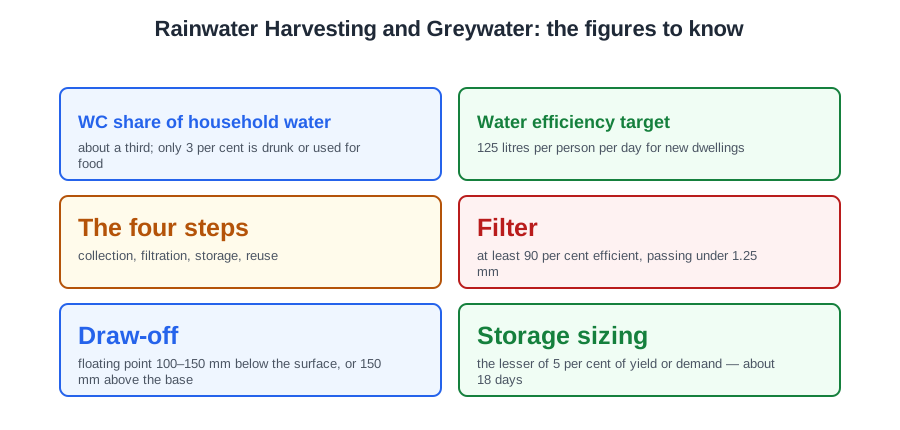
- WC share of household water
- about a third; only 3 per cent is drunk or used for food
- Water efficiency target
- 125 litres per person per day for new dwellings
- The four steps
- collection, filtration, storage, reuse
- Filter
- at least 90 per cent efficient, passing under 1.25 mm
- Draw-off
- floating point 100–150 mm below the surface, or 150 mm above the base
- Storage sizing
- the lesser of 5 per cent of yield or demand — about 18 days
- Greywater
- wastewater excluding faecal matter and urine
- Untreated storage
- no more than a few hours
- Short retention tank
- about 100 litres, 18 to 20 flushes, purged after about 24 hours
- Quality limits
- E. coli and intestinal enterococci; turbidity under 10 NTU, pH 5 to 9.5
- Fluid category
- stored rainwater and greywater are both category 5
- Only acceptable protection
- a type AA or type AB air gap
- Pipe marking
- green, black, green — never blue
⚠️ Where people go wrong
- Harvesting from a copper, lead, asbestos or bitumen roof.
- Collecting from a driveway without a specific risk assessment.
- Filtering after the water reaches the store instead of before it.
- Supplying a basin, shower or kitchen tap from untreated harvested rainwater.
- Calling roof rainwater or boiler condensate greywater.
- Collecting kitchen sink waste. The fats and food particles foul the system.
- Storing untreated greywater. It deteriorates in hours.
- Spray-irrigating with untreated greywater, or watering fruit and vegetables.
- Fitting a double check valve on a category 5 back-up supply.
- Confusing a pressure reducing valve, a strainer or a float switch with backflow protection.
- Using blue pipe for reclaimed water.
- Installing a greywater system without notifying the undertaker and the local authority.
📝 10-Question Self-Test
Straight from the Level 3 course question bank. Click an option to see whether you got it right — the explanation appears instantly, and there is nothing to submit.
Untreated rainwater off a roof carries bird and animal droppings and whatever the covering sheds, so a domestic system filters and settles it rather than disinfecting it, and BS 8515 adds UV or chemical disinfection only where exposure is greater. Of the appliances in a house, WC flushing is what it may supply, along with a washing machine and the garden. BS 8515 bars it from drinking water, food preparation, dishwashing and personal washing, which rules out the kitchen tap, the basin and the dishwasher.
Stored rainwater and greywater are fluid category 5, a serious health hazard, so the mains top-up reaches the system only through a backflow protection device: a type AA air gap to BS EN 13076, or a type AB to BS EN 13077. Schedule 2 paragraph 15 requires protection appropriate to the highest fluid category downstream. A strainer, a float switch and a pressure reducing valve stop nothing flowing back.
BS 8525-1 clause 3.17 defines greywater as domestic wastewater excluding faecal matter and urine, and clause 3.6 defines bathroom greywater, the kind the standard covers, as water from baths, wash and hand basins, showers and clothes washing machines. Blackwater is the wastewater that contains faecal matter and urine and goes only to the foul drain. Under Schedule 1 of the Water Regulations both stored greywater and blackwater are fluid category 5 (fluids containing pathogens or human waste), so both need a type AA or AB air gap from any wholesome supply. The difference is what can be done with them: greywater carries no faecal load, can be filtered and disinfected to BS 8525 and reused for WC flushing and irrigation through separately marked pipework, whereas blackwater cannot be reused in a building. Rainwater is a separate harvesting system (BS 8515, also category 5 once stored) and boiler condensate is acidic and goes to drain. Whether rainwater or greywater, the reclaimed-water pipework is identified to BS 1710 with a black band between the green base colour (green / black / green) and labelled RAINWATER or GREYWATER, so it can never be mistaken for a wholesome supply.
Filtered but untreated rainwater is fit for flushing a WC, and of these appliances that is the only one it may serve. It has been screened and settled, not disinfected, and it stays fluid category 5. A shower and a dishwasher are both barred because BS 8515 forbids personal washing and dishwashing, and a drinking water tap needs wholesome water.
BS 8515 clause 4.3 asks for a filter of at least 90 per cent efficiency passing a maximum particle size of less than 1.25 mm, and it must be water and weather resistant, removable and readily accessible. A filter finer than that belongs to a treatment stage such as a membrane, not to the debris filter ahead of the tank.
BS 8515 clause 3.7 defines a calmed inlet as a fitting on the end of the drainage pipe feeding the tank that minimises turbulence and slows the flow, so the sediment near the base of the tank is not stirred up. Leaves and grit are taken out earlier by the filter under clause 4.3, which is the tempting wrong answer.
BS 8515 clause 4.3 recommends a floating extraction point approximately 100 mm to 150 mm below the surface. Where floating extraction is not practicable, a fixed point about 150 mm above the base of the tank is used instead. Drawing off the floor pulls in the settled sediment.
BS 8515 clause 4.1.2.3 takes the lesser of the two 5 per cent figures, which works out at about 18 days of supply and covers the normal variability of UK rainfall. Taking the greater figure, or sizing on a whole year of demand, buys a far larger tank for very little extra water.
BS 8515 clause 4.9 recommends that for the majority of systems the overflow is connected to a soakaway, with floating material trapped before it gets there. The overflow outlet must be at least as large as the inlet and screened so vermin cannot enter. The foul drain takes wastewater, not roof water.
Where the manufacturer gives no schedule, BS 8515 Table 5 has the tank inspected annually but drained down and cleaned every ten years. Annually is the interval for the gutters, the filter, the pumps, the back-up supply and the markings; six months is the interval for UV lamps.
Going further: the lessons behind this article
This article is the public answer. Unit 335 of the Level 3 course takes the same ground to the depth the exam and the synoptic assignment ask for, in 3 lessons:
- Rainwater harvesting: collection, filtration and storage
- Greywater re-use: sources, treatment and storage limits
- Reclaimed water: category 5, air gaps and marking
- Environmental technology systems: the Unit 335 guide — every article on this unit in one place
- All PlumbMate articles — Level 1, 2 and 3
- The Level 3 course — the whole 8202-35 Diploma