You are surveying a 1960s semi with an ageing oil boiler and a tank in the garden the owner is glad to see the back of. Before you quote a heat pump, you owe the customer both halves of the picture.
The short answer
The benefits are real, and so are the limitations. The one that matters most on an air source unit is that it is less efficient in winter — and the reason is that output and efficiency both fall as the air gets colder. Colder air holds less available heat, so the unit extracts less; at the same moment the lift widens, so the COP falls. Both curves move the wrong way at once, and they do it exactly when the building needs most heat.
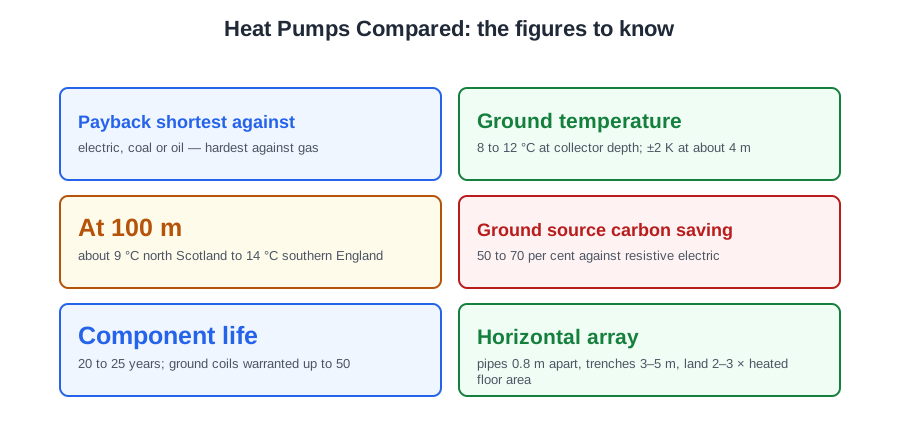
And one point worth making early: the payback period is shorter where a heat pump replaces an electric, coal or oil system rather than a gas boiler. Gas is cheap per kilowatt-hour, so the sums are hardest against a working gas boiler and easiest against expensive fuels.
Air source: benefits and limitations
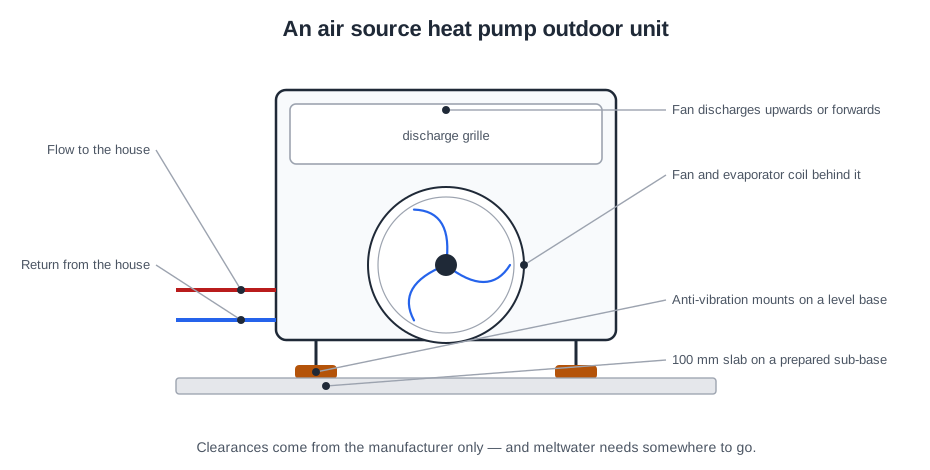
Benefits: high efficiency, reduced energy bills and carbon dioxide emissions and an improved energy rating; no combustion, so no flue gases and no products of combustion in the dwelling; low maintenance and no fuel storage — the oil tank goes and never has to be filled again; many units can be reversed to provide cooling in summer; and it is cheaper and easier to install than a ground source heat pump, because there is no excavation or drilling.
Limitations: high initial cost against a replacement boiler; less efficient with existing heating systems designed around a boiler's high flow temperature; less efficient than ground source; less efficient in winter; noisy fans, so siting relative to windows and boundaries has to be thought about; a defrost cycle that costs energy; and space around the unit for good air flow — hemmed in behind a fence, it recirculates its own cold air and performance collapses.
Undersizing is punished severely. An undersized unit runs continuously in cold weather and still fails to hold the set temperature. It does not simply short cycle — that is the oversizing fault. The shortfall is made up by back-up, usually an immersion heater running at a COP of 1, so running costs climb sharply in precisely the weather the customer will remember.
Air source units do their best work in well-insulated properties with low-temperature emitters. On a 1960s semi the honest advice is that the heat pump is viable, but the emitters and the insulation are part of the job, not an optional extra.
Ground source: the benefit is stability
The same customer asks why the ground source quotation is so much higher when the machine looks almost identical. The difference is not the machine. It is the ground.
In the UK, ground temperature at collector depth stays broadly between 8 and 12 °C all year. At about 4 m the soil sits around 10 °C and holds constant to approximately ±2 K; at 100 m, temperatures run from about 9 °C in the north of Scotland to 14 °C in southern England.
That is the whole advantage. Because the source temperature barely changes, the temperature lift barely changes, so efficiency holds steady through the winter. An air source unit meets its coldest source in the same week the building needs most heat; a ground source unit does not. It also avoids defrost losses entirely, because there is no outdoor coil to ice up.
Note carefully what is not true. The ground does not get warmer in winter, boreholes are not warmer than soil at all times of year, and ground units do not use a special refrigerant or dispense with a compressor. The advantage is stability.
The rest of the benefits: more efficient than air source; carbon savings of 50 to 70 per cent against conventional resistive electric heating; no combustion and lower maintenance costs; long life — components typically 20 to 25 years, ground coils warranted for up to 50; no fuel storage; summer cooling; and very low visual impact, with most of the plant hidden underground and no outdoor fan.
The limitations: high initial installation costs, and more expensive than air source — the extra is largely the civil engineering; potentially large land areas; design and installation are complex, involving trades a plumber does not normally engage; unlikely to work efficiently with a system designed for a boiler; and refrigerants that could be harmful if released.
| Air source | Ground source | |
|---|---|---|
| Source temperature in winter | Falls with the weather | Broadly 8–12 °C all year |
| Defrost losses | Yes | None |
| Capital cost | Lower | Higher |
| Land needed | A standing space with air flow | Trenches, boreholes or open water |
So what do you tell the customer? That the ground source system will very probably cost less to run, year after year, and will not lose its efficiency in the week they most notice it. That it will cost several thousand pounds more, and most of that money goes into the garden rather than the plant room. And that neither machine will perform on radiators sized for an oil boiler. Put like that, the decision is theirs to make on cost and disruption, which is exactly where it belongs.
The four collectors
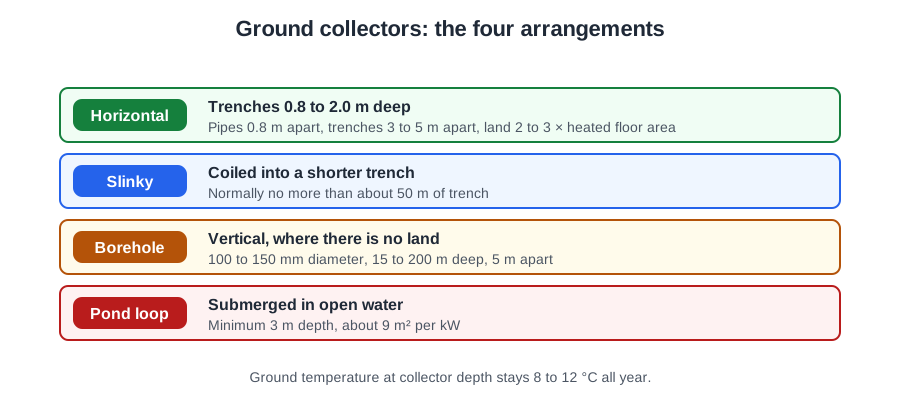
Horizontal trenches are the cheapest where land allows. A great deal of earth is moved, but laying the pipe is quick. Pipes are separated by at least 0.8 m and trenches spaced 3 to 5 m apart. The land requirement is the catch: as a rule of thumb, something in the order of two to three times the heated floor area.
A slinky extracts more heat per metre of trench, so less trench is needed and excavation costs fall. Be honest about the trade-off: the coils interfere with each other thermally, so extraction per metre of pipe is lower and the total ground area required is not much reduced. Maximum trench length for a single coil is normally about 50 m. A slinky does not remove the need for antifreeze, does not allow shallower burial above the frost line, and does not do away with the circulating pump.
Vertical boreholes deliver the same extraction from a small footprint, and are specified in preference to a horizontal collector where the available land area is insufficient. They need less pipe and less pumping energy, and reach ground that is thermally more stable still — below roughly 4 m the ground stays within about ±2 K of the annual average, so a borehole simply does not feel the season. Against that they are significantly more expensive to drill, and unsuitable in some ground such as old mine workings.
For a pond loop, two screening figures decide whether it is worth surveying: a minimum water depth of 3 m, and approximately 9 m² of water surface per kW. The depth stops the water freezing around the coils; the surface area stops the load chilling the pond over a season. Efficient and relatively cheap, but it needs a genuinely large body of water and carries a pollution risk if a loop leaks.
An open-loop system abstracts water from a borehole or watercourse, passes it through a heat exchanger and returns or discharges it. Above defined volume thresholds that requires an abstraction licence from the environmental regulator, and a discharge consent may be needed as well. These take time and must be built into the programme — not discovered the week before the plant is due.
Monobloc, split, air-to-air and exhaust air
Heat pump names follow a strict convention: source first, then what the heat is delivered into. So air-to-water takes heat from outside air into a wet heating system; air-to-air delivers it into the dwelling as warm air; ground-to-water takes heat from the ground into a wet system. Once you read the name properly, half the confusion disappears.
That settles the cheap quotation straight away. Air-to-air is unsuitable on its own, because it delivers warm air and makes no hot water at all. There is no wet circuit and no cylinder. It is a perfectly good technology in the right place; it is simply not a whole-house UK retrofit on its own.
The difference between the other two is where the refrigerant circuit lives. In a monobloc, all the refrigerant components sit in the outdoor unit, factory-charged and sealed, and only water pipes enter the building. In a split, the evaporator is outdoors and the condenser indoors, joined by refrigerant pipework run and connected on site.
That single difference decides who is allowed to make the connection. A split system's lines are brazed, pressure tested, evacuated and charged during installation, so the work requires a relevant F-Gas handling qualification. A monobloc needs none, because its circuit is sealed and factory-charged already. Not because the charge is small, not because the refrigerant is outside the scope, and nothing whatever to do with Gas Safe registration.
The monobloc buys that simplicity at a price: its principal design risk is that water-filled pipework runs outdoors, so it can freeze. On a split it is refrigerant that crosses the wall, and refrigerant does not freeze in a British winter. On a monobloc, freeze protection is a critical design point, not an afterthought.
| Monobloc | Split | |
|---|---|---|
| Refrigerant circuit | All outdoors, sealed and factory-charged | Run and connected on site |
| Crossing the wall | Water pipes | Refrigerant pipes |
| F-Gas qualification to connect | Not required | Required |
| Main design risk | Outdoor water pipework freezing | Site-made refrigerant joints |
One more type appears on small dwellings. An exhaust air heat pump recovers heat from ventilation air extracted from within the dwelling before it is discharged — not from flue gases, not from waste water, and not from outside air through a duct. Because the ventilation rate caps how much energy is available, output is modest. These suit small, airtight, well-insulated flats, and will disappoint in a draughty house.
Sizing, back-up and cycling
A monovalent system uses a single heat source sized to meet the full peak heat load — the simplest arrangement and the best carbon result, but it means buying a bigger machine to cover a handful of the coldest days.
A bivalent system pairs the heat pump with a second source. The bivalence point is the outdoor temperature below which the supplementary heat source is required — where the falling output curve crosses the rising demand curve. Set it too high and the customer pays for expensive back-up far too often; set it too low and the heat pump is undersized.
Monovalent and bivalent describe how many heat sources meet the load — nothing to do with refrigerants, the number of outdoor units, or whether hot water is served.
A hybrid puts both sources under one intelligent controller. What decides which source runs is a controller comparing the running cost or efficiency of each at the current conditions — not a timer, not the occupant, and not a simple failure changeover. On a hard-to-treat property with an existing gas supply, a hybrid is often the honest recommendation.
An inverter-driven heat pump varies the compressor's speed to match heat demand instead of running flat out or off. Because it can throttle back rather than stopping, it runs for long continuous periods — and long, steady running at a modest output is exactly the pattern that gives a heat pump its best seasonal efficiency.
A fixed-speed unit has no middle setting. In mild weather it produces far more heat than the building needs, reaches setpoint, stops, and restarts minutes later — short cycling, which wrecks seasonal efficiency and shortens compressor life. So a fixed-speed unit depends far more heavily on adequate system volume, because the surplus heat must go somewhere. Nothing to do with expansion vessel size, flow temperature or starting current.
Both errors are punished, in opposite directions. Oversizing causes short cycling in mild weather. Undersizing means the unit runs continuously in cold weather and still cannot hold temperature, with back-up heat at a COP of 1 filling the gap. Heat pumps are most efficient supplying heat continuously, so the most cost-effective size is often not the one that covers 100 per cent of the peak load on its own.
🔢 The numbers worth memorising
- Payback shortest against
- electric, coal or oil — hardest against gas
- Ground temperature
- 8 to 12 °C at collector depth; ±2 K at about 4 m
- At 100 m
- about 9 °C north Scotland to 14 °C southern England
- Ground source carbon saving
- 50 to 70 per cent against resistive electric
- Component life
- 20 to 25 years; ground coils warranted up to 50
- Horizontal array
- pipes 0.8 m apart, trenches 3–5 m, land 2–3 × heated floor area
- Slinky trench
- normally no more than about 50 m
- Pond loop
- minimum 3 m depth, about 9 m² per kW
- Open loop
- needs an abstraction licence
- Naming
- source first, then what the heat goes into
- Split system
- needs an F-Gas qualification; a monobloc does not
- Back-up heat
- an immersion heater at a COP of 1
⚠️ Where people go wrong
- Selling a heat pump against a working gas boiler on payback alone.
- Hemming an air source unit in behind a fence.
- Reading undersizing as short cycling. Undersizing runs continuously and still falls short.
- Claiming the ground gets warmer in winter. The advantage is stability.
- Proposing a slinky to save land. It saves trench.
- Surveying a pond without checking 3 m depth and 9 m² per kW.
- Discovering an abstraction licence the week before the plant arrives.
- Quoting air-to-air for a whole house. It makes no hot water.
- Connecting a split system without F-Gas.
- Forgetting freeze protection on a monobloc’s outdoor water pipes.
- Fitting an exhaust air unit to a draughty house.
- Setting the bivalence point too high, or too low.
- Expecting a fixed-speed unit to behave without system volume.
- Sizing for 100 per cent of the peak load as a matter of course.
📝 10-Question Self-Test
Straight from the Level 3 course question bank. Click an option to see whether you got it right — the explanation appears instantly, and there is nothing to submit.
Efficiency is governed largely by the gap between source temperature and flow temperature. The smaller that lift, the less work the compressor does per kW delivered. As a working rule, each 1°C reduction in flow temperature is worth roughly 2–2.5% in efficiency — which is why heat pump design favours underfloor heating or generously sized radiators.
Lift is the gap the compressor has to bridge — from the temperature at which heat is collected to the temperature at which it is delivered. A unit collecting at 2°C and delivering at 45°C has a lift of 43K. The larger the lift, the harder the compressor works and the lower the COP.
CIBSE puts the ground at about 10°C from roughly 4 m down, holding to within about 2 K all year. Nearer the surface it still follows the air, damped and some weeks behind, so even a trench is a steadier and warmer source in midwinter than the outdoor air. An air source unit meets its coldest source exactly when demand peaks, and loses output to defrost as well.
In a monobloc the entire sealed refrigerant circuit is factory-charged inside the outdoor unit. Only insulated flow and return water pipes pass into the building, so no on-site refrigerant work is needed and no F-Gas handling qualification is required for the connection. The trade-off is that water-filled pipework runs outdoors, making freeze protection a critical design point.
The naming convention is always source-to-emitter. Air-to-air collects from outside air and delivers warm air indoors, typically through wall-mounted units. Air-to-water collects from outside air and heats water for radiators, underfloor heating and a cylinder. Because air-to-air produces no hot water, it rarely suits a whole-house UK retrofit on its own.
A split system's refrigerant lines are run and connected during installation, so the operative works on a live refrigerant circuit — brazing, pressure testing, evacuating and charging. Under the F-Gas Regulations that work requires a relevant handling qualification. A monobloc arrives with its circuit sealed and charged, so the requirement does not arise.
As outdoor temperature falls, a heat pump's output falls while the building's heat demand rises. The bivalence point is where those two curves cross — the outdoor temperature below which the heat pump alone can no longer meet demand and the supplementary source must contribute. Set it too high and the customer pays for expensive backup heat; set it too low and the heat pump is undersized.
Horizontal arrays are cheaper but land-hungry. MIS 3005-D sizes one from the annual heating energy demand and the ground’s specific extraction in watts per metre, not from any multiple of floor area, and CIBSE rates a trench array at only 10 to 40 W per square metre of ground. Where the plot cannot take that, vertical boreholes get the same extraction from a small footprint, at a much higher drilling cost.
Open-loop systems take water from the environment, pass it through a heat exchanger and return or discharge it. Above defined volume thresholds this requires an abstraction licence from the environmental regulator, and a discharge consent may also be needed. These consents take time to obtain and must be built into the project programme.
A fixed-speed unit has no middle setting. In mild weather it produces far more heat than the building needs, and with nowhere to put it the unit reaches setpoint and stops — then restarts minutes later. Water content is what absorbs that surplus and lengthens the run, which is why the buffer or volumiser matters so much on these units.
Going further: the lessons behind this article
This article is the public answer. Unit 335 of the Level 3 course takes the same ground to the depth the exam and the synoptic assignment ask for, in 5 lessons:
- Air source heat pumps: the benefits and where they struggle
- Ground source heat pumps: stable source, higher cost
- Ground collectors: trenches, slinkies, boreholes and ponds
- Monobloc, split, air-to-air and exhaust air: choosing the type
- Sizing, back-up and cycling: turning efficiency into savings
- Environmental technology systems: the Unit 335 guide — every article on this unit in one place
- All PlumbMate articles — Level 1, 2 and 3
- The Level 3 course — the whole 8202-35 Diploma