A survey takes ten minutes if you know the three questions. The customer wants solar hot water — but before you look at a roof, establish whether the job is possible at all.
The short answer
The property needs roof rights, so the customer is legally entitled to fix to the structure — not automatic on a flat or a shared roof. It needs a largely unshaded location. And it needs hot water from a store.
The store is the one that stops jobs. Solar thermal produces heat when the sun shines, and the household wants hot water in the morning and evening. Only a cylinder bridges that gap. A property on a combination boiler, an instantaneous heater or an electric shower has nothing to store the heat in.
And be honest about the output: a well-designed UK system supplies around 60 per cent of the annual hot water demand, and makes no contribution to space heating.
What it delivers, and why
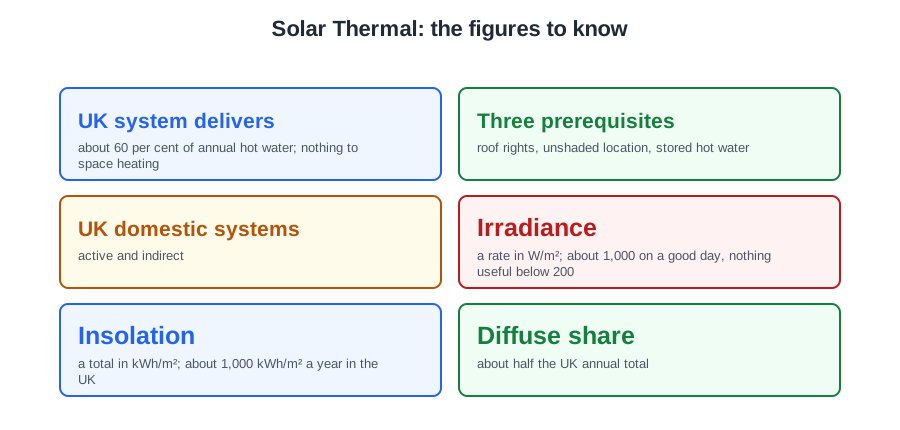
That 60 per cent figure is the whole basis of an honest conversation: the customer keeps their existing heat source, uses it far less in summer, and much as before in winter. Anyone promising all the hot water all year is selling something the British sky will not supply.
Why hot water and not heating? Because the two demand curves are almost perfectly out of phase. Hot water demand is steady all year; space heating peaks in midwinter, when solar output is at its least. There is no point sizing a system for a load that arrives when the resource has gone.
In an active system a pump circulates the heat transfer fluid; in a passive system it circulates by natural circulation alone. UK domestic work is active. The passive case is the thermosyphon: hot fluid rises and cool fluid falls under density difference, which requires the store to be mounted above the collector — awkward in a British roof space and unforgiving in a freeze.
A direct system is one in which the water that will ultimately be drawn from the hot taps passes through the collector. An indirect system is one in which some other fluid does.
Indirect is the UK domestic standard: the primary carries the heat to a coil in the cylinder and never meets the drinking water. It also lets the primary be filled with glycol antifreeze — which a direct system cannot have, because the same water is drawn off at the taps.
The circuit is: a collector; a differential temperature controller (DTC), with sensors at the collector and low down in the cylinder, running the pump only when the collector is hotter than the store; a circulating pump; a twin-coil cylinder, the lower coil for solar and the upper for the boiler; and an auxiliary heat source to make up the shortfall.
A drain-back arrangement is the alternative to a pressurised glycol primary: when the pump stops, the collector empties into a vessel, so there is nothing up there to freeze or boil.
The solar resource
A quotation says the array will "receive 8,000 kWh and deliver 1,700 kWh". Good system, faulty one, or undersized? To answer, you need to be precise about what is being measured.
Irradiance is the rate at which solar radiation arrives, in W/m². On a good sunny day in the UK it is around 1,000 W/m², dropping below 100 under heavy cloud; most systems produce nothing useful below about 200 W/m².
Insolation is the energy accumulated over a period, in kWh/m². Each square metre in the UK receives about 1,000 kWh/m² a year — 920 at Eskdalemuir and 1,045 in London on a plane facing south at 30°. A rate against a total: design guides use both terms precisely, and candidates routinely swap them.
Radiation arriving straight from the sun is direct; radiation scattered by cloud, dust and water vapour is diffuse. In the UK about half the annual total is diffuse — which is why collectors sold here are designed to absorb it, and why a bright overcast day still produces useful heat. Albedo is the share reflected back to space by cloud and the earth's surfaces.
The seasons are caused by the Earth's 23.5 degree axial tilt relative to its orbital plane. When the northern hemisphere tilts towards the sun the days are longer and the beam arrives more directly, and both pull the same way. The orbit is very nearly circular — the Earth is in fact marginally closer to the sun during the northern winter — so distance is not the cause. In practice, a horizontal surface in the UK receives in December only about 10 per cent of what it receives in June.
The reason a direct beam is worth more is the projection effect: tilt a surface away from the beam and the same energy is spread over a larger area. That one idea is the whole reason orientation and tilt matter.
A typical 40 m² south-facing UK roof receives roughly 38,000 to 45,000 kWh a year. That sounds enormous, and it is: it is the energy arriving, not the energy you can collect.
So back to the quotation. A collector that intercepts 8,000 kWh and delivers about 1,700 kWh is roughly what a real system does over a year. The gap is the collector's own efficiency, the losses in the primary and cylinder, and whether the household could use the heat at the moment it arrived. Nothing is faulty and nothing is undersized.
The figure to quote for useful output is 350 to 450 kWh per m² per year from a flat plate array in a good location — keep that firmly apart from the irradiation received, which is two to three times higher.
Orientation, tilt and shading
The only usable roof faces due west, pitches at 25°, and there is a large sycamore two gardens away. Is this a job?
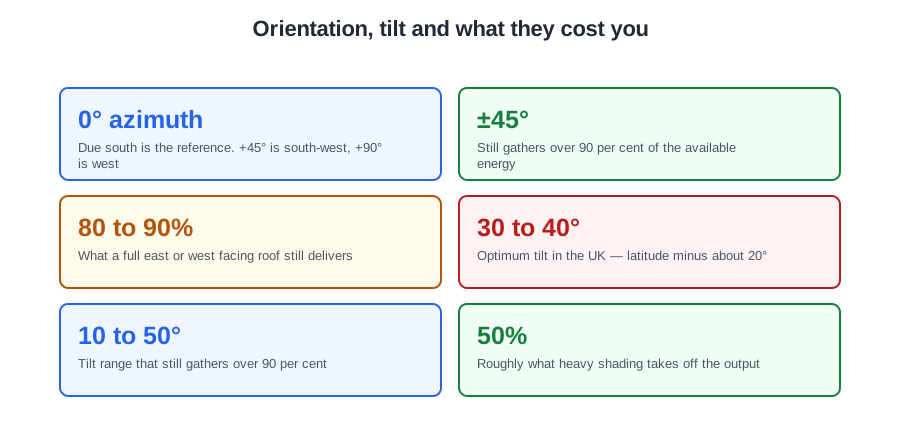
Azimuth is the compass direction the collector faces, measured from due south: due south 0°, south-west +45°, due west +90°. The angle of inclination is the tilt from the horizontal. Learn them the right way round; swapping them is a standard exam trap.
Due south is optimum, but the penalty for missing it is small. East and west facing roofs still return around 80 to 90 per cent, and anything between south-east and south-west receives over 90 per cent of the maximum annual energy. So the west-facing roof above is a job that will work. Declining it turns away good work, and turning a frame round to face south creates a wind-loading and appearance problem for a few per cent of yield.
The optimum tilt in the UK is 30 to 40 degrees, with 35 a good default, and there is a broad plateau either side: 25° to 45° is within a few per cent, and 10° to 50° still gathers over 90 per cent. Roughly, southern England wants about 30° and northern Scotland nearer 40°. A 25° roof is fine.
Shading is different in kind from imperfect orientation. Orientation reduces the yield by a predictable few per cent; shade removes the radiation outright, and it bites hardest in the shoulder seasons. The sun is high in June and an obstruction may clear the array; in March and October the sun is low, the same obstruction throws a long shadow, and those months carry a large share of the annual yield. Survey at different times of day, and aim to keep the array clear during the middle six hours.
| Shading | Sky blocked by obstacles | Reduction in output |
|---|---|---|
| Heavy | Up to 80 per cent | 50 per cent |
| Significant | 60–80 per cent | 35 per cent |
| Modest | 20–60 per cent | 20 per cent |
| Little | Up to 20 per cent | No real reduction |
Most domestic solar equipment is permitted development, with dimensional limits. In England, equipment on a pitched roof must not project more than 200 mm from the roof slope, and must not sit above the highest part of the roof excluding the chimney. On a flat roof, the highest part must be no more than 600 mm above the highest part of the roof.
The flat roof figure is the one that catches people out. A ballasted frame at a steep tilt breaches 600 mm easily, so check the finished height before committing to a tilt angle. A listed building falls outside permitted development altogether. A conservation area or world heritage site does not: only equipment on a wall, balcony or roof enclosure that fronts a highway is ruled out (the balcony and roof enclosure since 27 August 2026), so a roof slope facing the road is still permitted development within those limits. And nothing here removes the need for structural checks: the array adds dead load and, more importantly, wind uplift.
Collectors
Two quotations, one flat plate and one evacuated tube. To explain the difference you have to know what each is fighting: not collecting the heat, but keeping it.
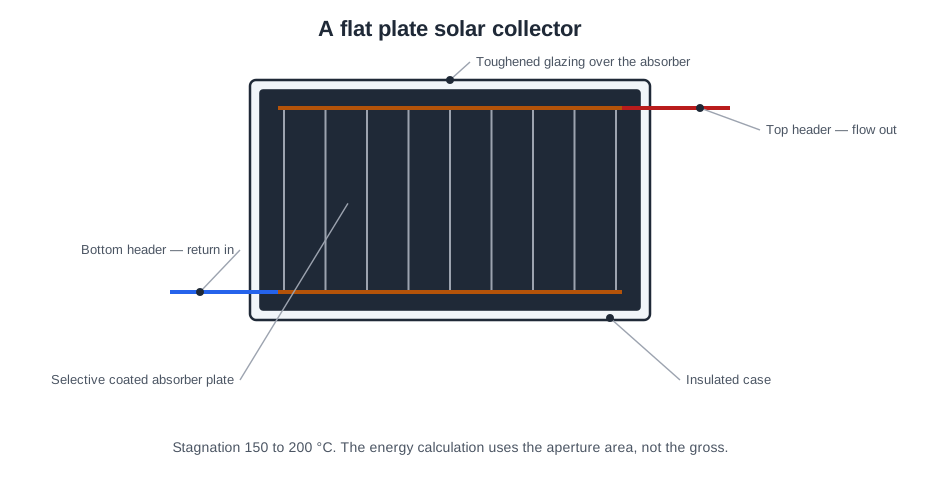
A flat plate collector is a shallow insulated box with a glazed cover. Inside is the absorber plate — copper, aluminium or stainless steel — which receives the radiation and converts it to heat. Insulation to the back and sides limits the losses, so most of what escapes goes out through the glazing.
The absorber carries a selective coating: a surface that decreases the radiative emission from the absorber plate while maintaining a high absorptance for solar radiation. In plain terms, it absorbs a high proportion of the radiation while re-radiating very little. An ordinary black surface absorbs well but also radiates well, and loses much of what it gains; the selective coating breaks that symmetry.
Two pipe configurations: the parallel grid, or harp — parallel tubes between two headers, giving a balanced flow across the plate; and the serpentine — a single continuous S-shaped path, lengthening the fluid's journey.
An evacuated tube is a coated, pressure-resistant, double-walled glass tube with the air evacuated from it. The vacuum removes conduction and convection losses almost entirely, which is why these hold their performance in cold and windy weather and reach higher temperatures.
In the common heat pipe form, the tube contains a heat-sensitive liquid that vaporises when the sun heats it. The vapour rises to the top of the tube, where a small heat exchanger is plugged into the header, gives up its heat, condenses, and runs back down. Because that cycle depends on vapour rising and condensate draining, the tubes must be mounted at a suitable angle.
An unglazed collector has no glazing and no selective coating — typically a black polymer mat, used for swimming pools and solar air heating. That is not a cheap compromise: where the target temperature is close to ambient, the losses that glazing and a selective coating exist to prevent barely arise, so the extra cost buys nothing.
A PVT collector is the hybrid: a single panel producing both heat and electricity. It is the answer to the customer who asks whether one panel can do both jobs.
| Collector | Construction | Typical use |
|---|---|---|
| Flat plate | Glazed, insulated box, selective absorber, harp or serpentine | Domestic hot water |
| Evacuated tube | Double-walled glass under vacuum, heat pipe into a header | Domestic hot water, cold or exposed sites |
| Unglazed | No glazing, no selective coating | Swimming pools |
| PVT | Hybrid panel | Heat and electricity together |
For most UK domestic hot water work either main type will do. Flat plate is cheaper, more robust underfoot and easier to integrate into a roof covering. Evacuated tubes give more output for the same area, hold up better on a cold, windy or partly shaded site, and individual tubes can be replaced — but they cost more and are more exposed to damage.
And what decides the size of either is the household's hot water demand, not the area of roof available.
🔢 The numbers worth memorising
- UK system delivers
- about 60 per cent of annual hot water; nothing to space heating
- Three prerequisites
- roof rights, unshaded location, stored hot water
- UK domestic systems
- active and indirect
- Irradiance
- a rate in W/m²; about 1,000 on a good day, nothing useful below 200
- Insolation
- a total in kWh/m²; about 1,000 kWh/m² a year in the UK
- Diffuse share
- about half the UK annual total
- Axial tilt
- 23.5 degrees; December gives about 10 per cent of June
- Useful output
- 350 to 450 kWh per m² per year from flat plate
- Azimuth
- from due south — 0° south, +45° south-west, +90° west
- East or west roof
- still 80 to 90 per cent
- Optimum tilt
- 30 to 40°; 10 to 50° still gathers over 90 per cent
- Permitted development
- 200 mm from a pitched slope, 600 mm above a flat roof
⚠️ Where people go wrong
- Quoting solar thermal for a house on a combi. There is nothing to store the heat in.
- Promising all the hot water all year. About 60 per cent, and none to heating.
- Fitting a direct system and expecting to use glycol.
- Swapping irradiance and insolation. One is a rate, one is a total.
- Blaming the seasons on orbital distance. It is the 23.5° tilt.
- Reading the irradiation a roof receives as the output. Useful yield is two to three times lower.
- Confusing azimuth with inclination.
- Declining a west-facing roof. It still returns 80 to 90 per cent.
- Turning a frame to face south on a pitched roof for a few per cent of yield.
- Surveying shading once, at midday. It bites hardest in March and October.
- Breaching the 600 mm flat roof limit with a steep ballasted frame.
- Calling an unglazed collector a cheap version of a flat plate. It is for pools.
- Sizing the array to the roof rather than to the hot water demand.
📝 10-Question Self-Test
Straight from the Level 3 course question bank. Click an option to see whether you got it right — the explanation appears instantly, and there is nothing to submit.
A heat pump dislikes starting and stopping, and when underfloor zone valves close it can be left with almost no water to heat. A buffer vessel gives it somewhere to put surplus heat, and the volume to run a defrost cycle without robbing the house. A feed and expansion cistern is no help here, because a heat pump circuit is sealed rather than open vented.
Ground source has no combustion on site, no fuel to store, a long working life and relatively low maintenance requirements once the loop is in. Be careful with the other claims made for it. It does have moving parts, a compressor, circulators and a brine pump; it always needs ground works; and a horizontal collector needs a real area of land, so it will not fit any size of garden.
The loops in common UK use are vertical boreholes, horizontal trenches, the slinky and the pond loop, all closed loops of plastic pipe filled with water and antifreeze that pass collected heat to the evaporator. Strictly the slinky is not a fourth type but a way of configuring a horizontal trench, a coil that fits more pipe into each metre, so it saves excavation rather than area; the textbook and the trade still list it on its own. Aerial, radial, rooftop, cascade and reservoir are not collector types.
Condensation is the change of state from gas (vapour) to liquid, the reverse of evaporation, and it releases latent heat, which is what a condensing boiler recovers.
Frozen soil expands and lifts the pipe — the array is the cause, not the weather.
Anything wildly outside those bands is a figure worth questioning before the digger arrives.
Equal circuits balance; a single long run costs pump duty and cannot be isolated.
The electricity moves and upgrades heat that already exists in the environment. Output is input plus collected heat, so nothing is created.
The heat pump covers the base load and the oil boiler takes the peaks, which CIBSE calls a bivalent system and MIS 3005-D calls a hybrid one. The temperature at which the second generator must cut in is the bivalence or bivalent point in course and trade wording; CIBSE calls it the valency point.
The line is drawn at the load, not the number of machines. A plant sized to cover the whole peak load itself is monovalent; it is bivalent only when a second generator is brought in to take the peaks. Two heat pumps in cascade still cover the load between them.
Going further: the lessons behind this article
This article is the public answer. Unit 335 of the Level 3 course takes the same ground to the depth the exam and the synoptic assignment ask for, in 4 lessons:
- Solar thermal: what it delivers and how the circuit works
- The solar resource: irradiance, insolation and the seasons
- Orientation, tilt, shading and permitted development
- Collectors: flat plate, evacuated tube and unglazed
- Environmental technology systems: the Unit 335 guide — every article on this unit in one place
- All PlumbMate articles — Level 1, 2 and 3
- The Level 3 course — the whole 8202-35 Diploma