A rural cottage has no mains sewer. Its foul drainage runs to a tank in the garden that a tanker empties from time to time. Which tank is it, and what does the owner have to do to keep it legal?
The short answer
The difference between the two tanks is the whole subject in one sentence:
A cesspool stores everything. A septic tank separates the solids.
The capacities follow straight from it — 18,000 litres for two users on a cesspool, 2,700 litres for four on a septic tank — because one has to hold months of sewage and the other only has to settle it.
Cesspools
A cesspool (cesspit) is a watertight underground tank for the storage of sewage. No treatment is involved. It has an inlet and no outlet; everything that goes in stays until a licensed contractor pumps it out. Modern ones are glass reinforced plastic; older ones were brick, and brick ones are the ones that leak as the fabric breaks down.
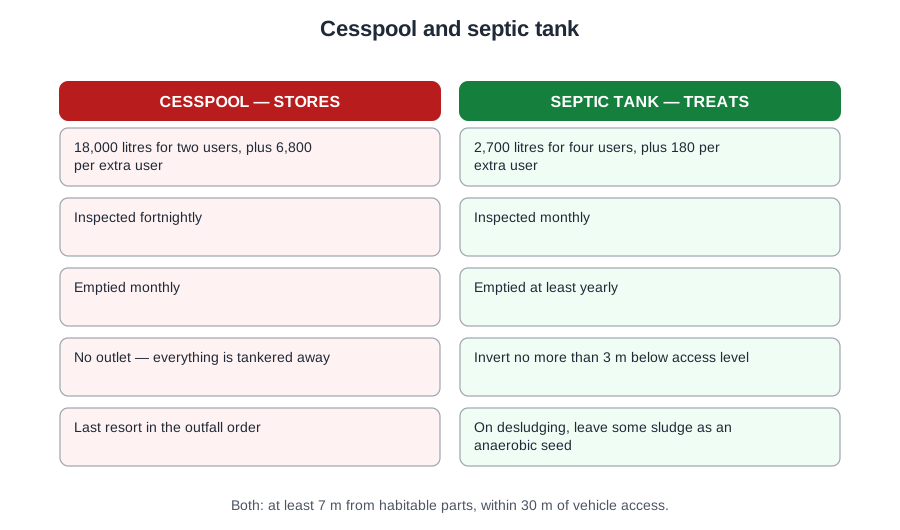
- Capacity: at least 18,000 litres (18 m³) below the inlet for two users, increased by 6,800 litres for each additional user.
- No openings except the inlet, the access for emptying, and ventilation.
- Sited at least 7 m from any habitable parts of buildings, preferably downslope, and within 30 m of a vehicle access so a tanker can reach it without the contents being carried through the building.
- Inspected fortnightly for overflow, and typically emptied monthly by a licensed contractor.
Emptying frequency is estimated at 150 litres per person per day. And there is a diagnostic in that figure: if the tank does not fill in the expected time, check it for leakage.
Septic tanks
A septic tank provides settlement, storage and partial decomposition. Sewage enters a settlement chamber; solids sink as sludge, grease and light matter form a scum on top, and the liquid in between passes out to secondary treatment — normally a drainage field, drainage mound or constructed wetland.
The discharge is still harmful, which is why a septic tank is only allowed together with secondary treatment.
- Capacity: at least 2,700 litres (2.7 m³) below the inlet for up to four users, plus 180 litres for each additional user.
- At least two chambers or compartments in series. Where the tank is no wider than 1200 mm the inlet is through a dip pipe, so the incoming flow does not disturb the scum or sludge.
- Watertight against leakage out and groundwater in, and ventilated away from buildings.
- Sited at least 7 m from habitable parts and within 30 m of vehicle access, with the invert no more than 3 m below the access level.
- Access covers durable and lockable or otherwise made to prevent anyone entering.
The detail everybody gets wrong
A septic tank is inspected monthly to check that the effluent leaving it is free-flowing and clear, and emptied at least once a year by a licensed contractor.
When it is desludged, most of the solids are removed but not all of them. Approved Document H recommends that some sludge is left in the tank as an anaerobic seed, so the bacteria that treat the next fill are already present.
Strip it out completely and the tank stops working; leave it all and solids carry over into the drainage field, blocking the pores in the soil and forcing early replacement.
A notice must be fixed inside the building describing the maintenance required, and the owner is legally responsible for making sure the system causes no pollution, health hazard or nuisance. Discharges usually need consent from the environmental regulator.
Where a better effluent is wanted, a packaged treatment plant treats to a higher standard than a septic tank and can often discharge to a watercourse, and a reed bed can polish the effluent further.
Finally, remember the ventilation link. Where the stack is the only ventilation to a septic tank or cesspool, it must be an open pipe — an air admittance valve would leave the tank unvented. And on any of this work, the significant hazard is contact between foul material and an open wound.
🔢 The numbers worth memorising
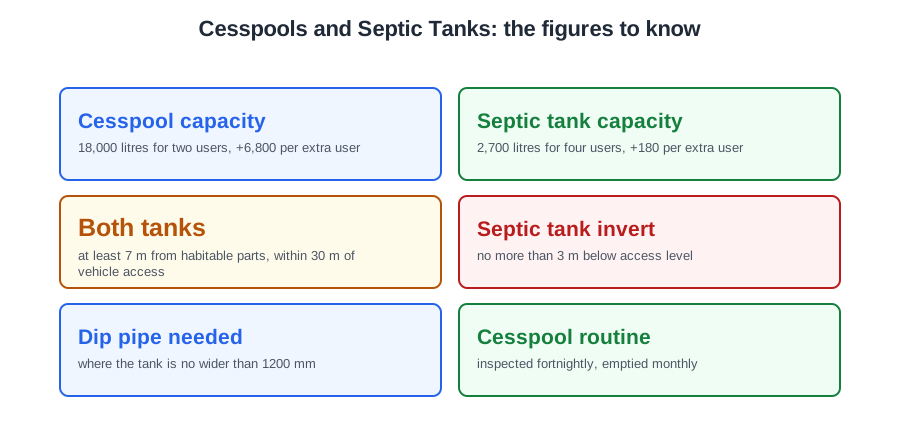
- Cesspool capacity
- 18,000 litres for two users, +6,800 per extra user
- Septic tank capacity
- 2,700 litres for four users, +180 per extra user
- Both tanks
- at least 7 m from habitable parts, within 30 m of vehicle access
- Septic tank invert
- no more than 3 m below access level
- Dip pipe needed
- where the tank is no wider than 1200 mm
- Cesspool routine
- inspected fortnightly, emptied monthly
- Septic tank routine
- inspected monthly, emptied at least yearly
- Emptying estimate
- 150 litres per person per day
- On desludging
- leave some sludge as an anaerobic seed
⚠️ Where people go wrong
- Calling a cesspool a treatment system. It stores; nothing is treated.
- Letting a septic tank discharge without secondary treatment.
- Emptying a septic tank completely. The bacteria go with the sludge.
- Leaving it all in. Solids then carry over and block the drainage field.
- Reading a cesspool that never fills as good news. Check it for leakage.
- Fitting an air admittance valve where the stack is the only ventilation to a tank.
- Siting a tank where a tanker cannot reach it within 30 m.
📝 7-Question Self-Test
Straight from the Level 3 course question bank. Click an option to see whether you got it right — the explanation appears instantly, and there is nothing to submit.
A cesspool, or cesspit, is a sealed underground tank with an inlet and no outlet. Nothing is treated and nothing leaves: it stores the foul water until a licensed contractor tankers it out, which is why Approved Document H puts it last in the order of outfalls. Separating the solids and passing the liquid on describes a septic tank, and that always needs secondary treatment after it.
The bacteria that break the sewage down live in the sludge, so stripping the tank bare leaves the next fill with nothing working in it. Approved Document H says the tank should be emptied at least once a year and recommends that not all the sludge is removed, because what stays acts as an anaerobic seed. Dosing with chlorine would kill the very bacteria the tank depends on.
A cesspool is a sealed tank that only stores the foul water until it is emptied by tanker; it treats nothing.
Cesspools should be inspected fortnightly for overflow and emptied as required.
A cesspool is a watertight holding tank with no outlet; everything that goes in stays until a licensed contractor pumps it out.
A cesspit is a sealed store; a septic tank lets solids settle and separates the liquid, which passes on to a drainage field.
Desludging removes the bulk of the settled solids while leaving a little sludge behind to seed the bacteria that treat the next fill. Removing everything or leaving all the solids both stop the tank working.
Going further: the lessons behind this article
This article is the public answer. Unit 334 of the Level 3 course takes the same ground to the depth the exam and the synoptic assignment ask for, in 1 lessons:
- Cesspools and septic tanks: how they work and what they need
- Sanitation systems: the Unit 334 guide — every article on this unit in one place
- All PlumbMate articles — Level 1, 2 and 3
- The Level 3 course — the whole 8202-35 Diploma