The system is sound. Now you find out whether it works. The first performance test is the simplest: one appliance, discharged on its own, to see whether it empties its own trap.
The short answer
Every performance test shares the same shape, and a single detail in each one decides whether it is a test at all:
- Fill the appliance to overflowing level. Half filling proves nothing.
- Repeat at least three times, recharging the trap each time — and take the maximum loss in any one test, not the average and not the last.
- At least 25 mm of seal must remain in every trap, measured with a dip stick.
Self-siphonage
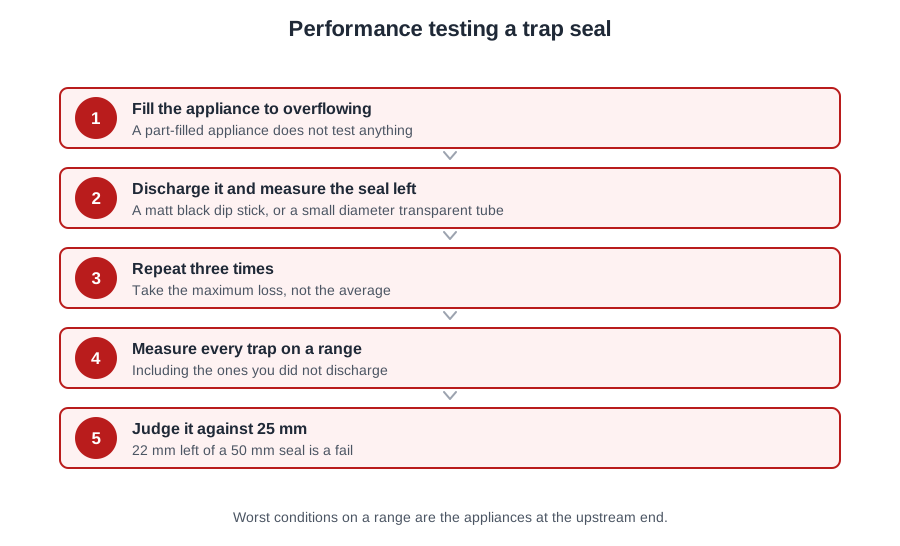
The appliance should be filled to overflowing level and discharged by removing the plug; WC pans are flushed. The seal remaining is measured when the discharge has finished.
Filling to overflowing level is not optional detail. It is the worst case: the full volume running out at full speed is what forms the plug of water that pulls the seal. Neither does discharging with the tap still running prove anything — that keeps feeding the trap — nor waiting five minutes before you look.
- Fill every trap on the branch so all seals are full.
- Measure and record the seal depth before the test.
- Fill the appliance to overflowing level.
- Pull the plug, or flush, and let it discharge completely.
- As soon as the discharge has finished, measure and record the seal remaining.
- Recharge the trap and repeat.
Three repeats exist because seal loss is not perfectly repeatable. The plug of water forms slightly differently every time, and a branch that is marginal will pass twice and fail on the third go. If you only test once you have not tested at all.
The seal is measured with a dip stick or a small diameter transparent tube. A matt black dip stick is the usual tool, because the wetted line stands out clearly against the dull finish; a shiny rule is hard to read. Lower it gently to the bottom of the trap, lift it out and read the wetted depth.
Why is the basin the classic case? It empties fast into a 32 mm pipe, so the discharge fills the bore completely and the plug of water forms easily. A bath drains more slowly into a larger pipe and rarely siphons itself. That is why the branch limits are tightest for basins: an unventilated 32 mm basin branch may run only 1.7 m, against 3 m for a 40 mm bath branch.
If the appliance fails, do not top the trap up and move on. Note the reading, finish the rest of the tests, then deal with the cause.
Induced siphonage on a range
Five basins in a row on one 32 mm branch. Each passes its own self-siphonage test. Then two students wash their hands at the same time and the trap under the fifth basin empties.
A trap on a common branch is exposed to every discharge made by every other appliance on it. When a plug of water passes the junction of a passive trap, the pressure behind it drops and the seal is pulled out. Nothing has been done to that appliance at all.
- Charge every trap on the branch and record each seal depth.
- Discharge the number of appliances Table NG.1 gives, filled to overflowing, at the same time.
- Measure the seal remaining in all the traps at the end of the discharge — not just in the ones you discharged.
- Recharge every trap and repeat, at least three times.
- Take the maximum loss in any one test, and check no trap is below 25 mm.
Measuring all the traps is the point of this test. The trap that fails is the one nobody touched.
The worst conditions usually occur when the appliances at the upstream end are discharged — the ones furthest from the stack. Their discharge has to travel past every other junction, so every trap downstream is exposed. If you have to choose which appliances to run, choose those.
Two practical points. Discharge really does mean simultaneously: get enough people on the job to pull the plugs together, or the test is not the test. And do not let anyone use another appliance elsewhere on the system during the run, or you will not know what caused the loss.
Take the readings in a fixed order, working from the upstream end towards the stack, and write them in that order every time. Two people make the test far easier: one to pull the plugs with you, one to dip the traps as soon as the discharge stops, before any resealing trap has had time to recover.
Where several basins share a branch, good practice is to increase the pipe from 32 mm to 50 mm, because a larger bore does not run full and so no plug of water forms.
The stack performance test
A nine-storey block with one WC, one basin, one sink and one bath on every floor. Which appliances do you discharge? Run too few and you prove nothing; run everything and you flood the ground floor.
A selection of appliances is discharged simultaneously, and the trap seal losses due to positive or negative pressures in the stack are noted. Those appliances should normally be close to the top of the stack and on adjacent floors, because that gives the worst pressure conditions: the discharge has the whole height of the stack to build up speed and compress the air below it.
Some appliances are left out on purpose. Baths are ignored, because bath use is spread over a long period and does not add materially to the peak flow. Flows from showers are small, and spray tap basins and urinals need not be included where the stack also serves other appliances.
| Appliances of each kind on the stack | WCs | Wash basins | Kitchen sinks |
|---|---|---|---|
| 1 to 9 | 1 | 1 | 1 |
| 10 to 24 | 1 | 1 | 2 |
| 25 to 35 | 1 | 2 | 3 |
| 36 to 50 | 2 | 2 | 3 |
| 51 to 65 | 2 | 2 | 4 |
For commercial or public use the table gives WCs and wash basins only, starting at 1 and 1 for 1 to 9 appliances of each kind and rising to 3 WCs and 5 basins at 79 to 100.
The worked example. Nine floors, one of each appliance per floor, so nine appliances of each kind — the 1 to 9 row. The test is one WC, one wash basin and one sink discharged simultaneously, on the top floor. Not every WC on the stack flushed together, not a WC and a bath on each of the top three floors, and not one of every appliance on the ground floor.
Change the building and the answer changes. Two of each appliance per floor gives 18 of each kind — the 10 to 24 row: one WC, one basin and two sinks. The WC, basin and one sink go on the top floor and the remaining sink on the floor immediately below — adjacent floors, as the clause requires.
And note what the test looks for as well as what it measures: trap seal losses due to positive or negative pressures. A seal pulled down out of the trap is siphonage from above; a seal blown up into the appliance is compression from below. Write down which way it went, because the cure depends on it.
Compression, and putting faults right
Somebody flushes the WC on the first floor and water heaves up through the ground floor basin waste. Nothing has been discharged into the basin at all. The most probable cause is compression.
The WC discharge falls down the stack and compresses the air below it. Near the foot, that positive pressure has nowhere to go except out through the nearest low-level branch. It is not self-siphonage, which would empty the basin's own trap after the basin discharged.
This is why the design keeps low branches away from the foot: no branch discharging lower than 450 mm above the invert of the tail of the bend in dwellings up to three storeys, and a bend of at least 200 mm centre-line radius.
The criterion does not bend. A bath trap with a 50 mm seal left with 22 mm after a simultaneous discharge is a fail, because less than 25 mm has been retained. It does not pass because more than 40 per cent remains, bath traps are not exempt, and it is not a fail on the grounds that the trap must keep its full 50 mm.
| What the test showed | The cure |
|---|---|
| Seal blown back into the appliance at low level (compression) | Fit a self-sealing valve in place of the water trap |
| Induced siphonage on a shared branch | A resealing trap, or increase the branch from 32 mm to 50 mm |
| Self-siphonage on a long branch | Shorten the branch, reduce the gradient within limits, or fit a branch ventilating pipe |
| Branch length or gradient outside the table | Ventilate to external air, to a ventilating stack, or with an AAV |
| Fall too steep, pulling seals | Reset the branch to the designed gradient |
A self-sealing valve is worth understanding properly, because it is the answer to a blown seal. It replaces the water seal with a flexible membrane that opens to let waste out and closes when flow stops. When back pressure is applied it is designed to remain tightly closed, so positive pressure cannot push anything back into the appliance and there is no water seal to lose. Reducing a trap seal to 38 mm, swapping a tubular trap for a bottle trap, or fitting a non-return valve on the branch do not solve it.
Whatever you change, repeat the test and record both results. A cure that has not been retested is a hope, not a fix.
Commissioning a macerator
Work is to be done on the unit, so it must not be able to operate while you are at it. Safely isolate and lock off the fused spur — not the boiler supply, not the incoming stopcock, and certainly not the flush lever.
Switching the unit off at its own switch leaves the supply live at the terminals. Turning off the cloakroom light isolates the wrong circuit. Pulling the distributor's cut-out fuse is not yours to do. Remove the fuse, lock and label the spur, keep the fuse and key with you, and prove dead — then check the fuse size against the manufacturer's figure before it goes back in.
The mechanical inspection:
- Pipework as designed, in the right material, with a fall of at least 1:40 from every appliance into the unit.
- Clipping sufficient, with no sagging or dipping in the discharge run.
- The outlet rising before it falls, with the vertical lift close to the unit.
- Filters, non-return valves and seals present, clean and correctly fitted.
- The unit accessible: not buried under a floor, and with the clips and connections reachable.
- Where the unit sits away from the pan, the extension no longer than about 150 to 200 mm.
The electrical checks belong to the electrical work, but know what they are for, because a macerator that will not run is often an electrical problem rather than a plumbing one. A test for a wiring open circuit is a continuity test and is done dead. An insulation resistance test confirms there are no low resistance paths between the circuit conductors — so where a circuit keeps operating its protective device, the instrument to find the fault is an insulation resistance tester.
Refit the fuse only when everything else is right. Restoring the supply is the last act before the commissioning run, because from that moment the unit can start on any discharge.
The commissioning run and handover
Commissioning a WC macerator includes flushing the WC and timing the pump cycle. A healthy unit starts as the discharge arrives, runs while it shreds and pumps, and stops cleanly when the chamber empties. Time it and write the figure down; it is the baseline every future service compares against.
While it runs, check every connection for leaks. That matters most where the pipework is about to disappear: a pan connector passing through a partition wall must be proved watertight now, because once the wall is made good you cannot see it.
| Symptom | First thing to check |
|---|---|
| Motor will not run at all | Power supply to the motor — not a new blade assembly or filter |
| Pump fails to operate after a flush | The pump, its motor and switch. Water is arriving, so the inlet is not the problem |
| Motor runs continuously, pan not clearing | A blockage in the outflow pipework |
| Runs on for an unusually long time | A partial blockage around the pump inside the unit |
| Pan empties slowly, pump confirmed working | A partial blockage in the pan, upstream of the pump |
| Cycles on and off when idle | A faulty non-return valve letting discharge run back in |
The logic is always the same: work out whether the restriction is before the pump, in the pump or after it, and whether the unit is getting power.
Finish the appliances — cistern levels to the line, seals neat, protective coverings off only now that the system is tested and being handed over. Where the same visit includes hot water, the cylinder thermostat is normally set to 60 °C. And if any component will not reach the figures in its own installation instructions, do not adjust it beyond its settings or double it up: contact the manufacturer.
Then hand over: the manufacturer's documents and the test and commissioning records — not a spare parts price list, and not an invitation to strip the blade assembly themselves. Show them how the unit works and what may and may not go into it, where to isolate it electrically and mechanically, and which parts are consumable — on a macerator the carbon filter. Tell them what to watch for, such as the unit running on after a flush.
🔢 The numbers worth memorising
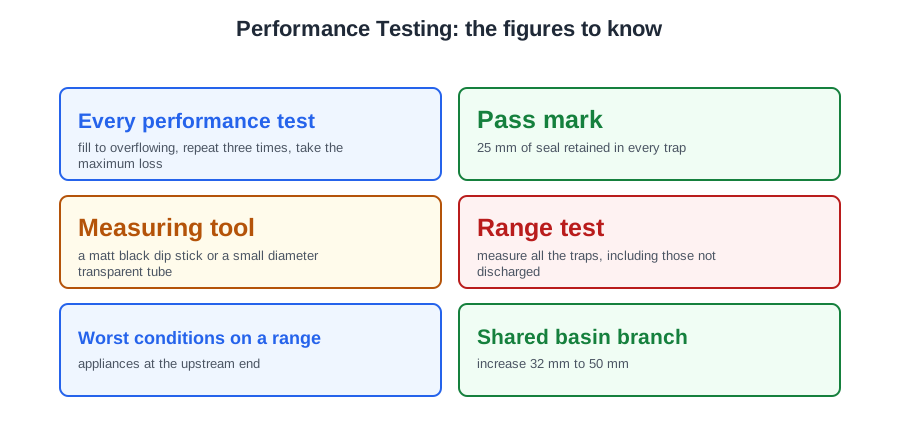
- Every performance test
- fill to overflowing, repeat three times, take the maximum loss
- Pass mark
- 25 mm of seal retained in every trap
- Measuring tool
- a matt black dip stick or a small diameter transparent tube
- Range test
- measure all the traps, including those not discharged
- Worst conditions on a range
- appliances at the upstream end
- Shared basin branch
- increase 32 mm to 50 mm
- Stack test, 1 to 9 of each kind
- 1 WC, 1 basin, 1 sink, top of the stack, adjacent floors
- Not discharged
- baths, showers, spray tap basins and urinals
- Lowest branch
- 450 mm above the invert; bend radius 200 mm
- 22 mm of a 50 mm seal
- a fail — less than 25 mm remains
- Compression cure
- a self-sealing valve, closed under back pressure
- Macerator inlet fall
- at least 1:40; extension no more than 150–200 mm
- Circuit tripping its protective device
- an insulation resistance tester
- Macerator consumable
- the carbon filter
⚠️ Where people go wrong
- Half filling the appliance, or discharging with the tap still running.
- Waiting before you dip the trap. Measure as soon as the discharge has finished.
- Testing once. A marginal branch passes twice and fails on the third.
- Averaging the three results. The maximum loss is the answer.
- Measuring only the traps you discharged on a range test.
- Pulling the plugs one after another instead of together.
- Letting somebody use another appliance during the run.
- Discharging every WC on a stack, or picking appliances at the bottom.
- Including the baths in a stack performance test.
- Passing a 22 mm reading because most of a 50 mm seal remains.
- Curing compression with a shallower seal or a bottle trap. It needs a self-sealing valve.
- Not recording which way the seal went — pulled out or blown back.
- Changing something and not retesting.
- Switching a macerator off at its own switch and calling it isolated.
- Calling an overflow-fill or a 1 bar air test a macerator commissioning step.
- Adjusting a component beyond its settings when it will not meet its figures.
📝 10-Question Self-Test
Straight from the Level 3 course question bank. Click an option to see whether you got it right — the explanation appears instantly, and there is nothing to submit.
Every trap must retain at least 25 mm of water seal after testing, because that seal is the only barrier stopping foul air reaching the room. BS EN 12056-2 NG.3.2 sets the figure and Approved Document H paragraph 1.3 repeats it. 38 mm is the tempting answer, but that is the air test pressure in paragraph 1.38, and the reduced seal Table 1 allows where an appliance discharges direct to a gully, not the seal a test must leave.
A seal blown back into the appliance is compression: positive pressure from the stack has pushed the water up out of the trap. A self-sealing valve replaces the water seal with a flexible membrane that opens to let waste out and stays shut against back pressure, so there is no seal left to blow. Reducing the trap seal to 38 mm makes it easier to blow, not harder.
After performance testing every trap must still hold at least 25 mm of water seal, measured with a dip stick as soon as the discharge finishes; the greatest loss over at least three repeats is the result. A bath trap left with 22 mm of its 50 mm seal is a fail, even though most of the seal is still in the trap.
A self-sealing valve carries a flexible membrane instead of a water seal. Flow from the appliance pushes it open; when pressure comes the other way the membrane is pressed shut, so it remains tightly closed and nothing can be forced back into the room. Venting to atmosphere is what an air admittance valve does in reverse, and it is not how this device works.
The operating instructions tell the user what can and cannot go down the unit, how to isolate it and what maintenance it needs; they stay with the appliance.
The pump has to push the discharge up before it can run away by gravity, and every lift costs head and leaves a column of waste standing in the pipe. Manufacturers therefore allow one vertical lift only, taken at the beginning of the run as close to the unit as possible, with the outlet rising at least 300 mm before any horizontal pipework.
Under working and test conditions every trap must retain a water seal of at least 25 mm.
A WC discharge falling down the stack compresses the air below it; where a ground-floor branch joins near the foot, that positive pressure blows the basin trap seal back up into the basin. Siphonage pulls seals out; compression pushes them back.
Approved Document H Table 1 gives a washing machine a 40 mm trap with a 75 mm seal; only appliances discharging direct to a gully may drop to 38 mm.
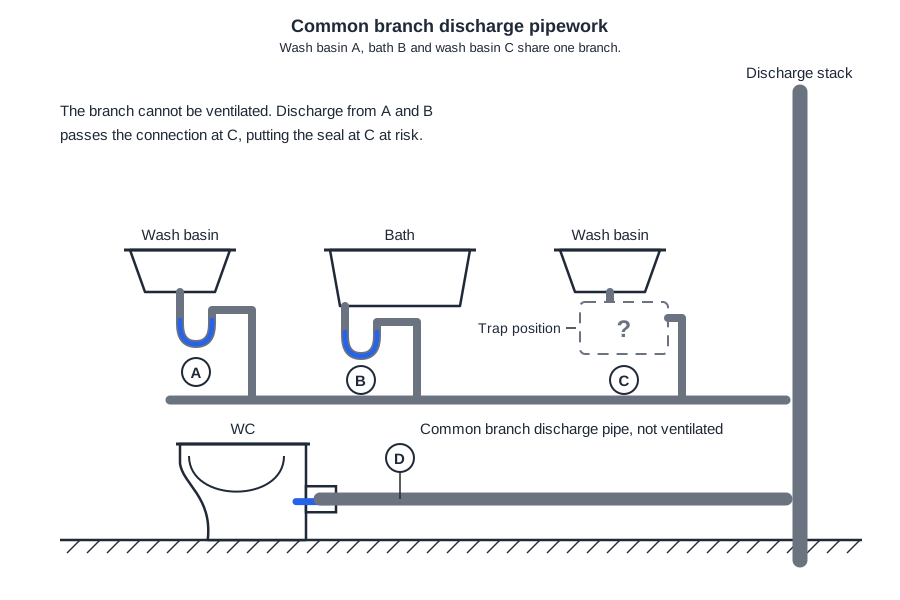
On a common branch serving several appliances a trap can lose its seal by induced siphonage when another appliance discharges. A resealing (anti-siphon) trap admits air and keeps its seal.
Going further: the lessons behind this article
This article is the public answer. Unit 334 of the Level 3 course takes the same ground to the depth the exam and the synoptic assignment ask for, in 6 lessons:
- Performance testing a branch pipe for self-siphonage
- Testing a range of appliances for induced siphonage
- The stack performance test: choosing appliances from Table NG.1
- Compression at the foot of the stack, and putting faults right
- Commissioning a WC macerator: the checks before power on
- Running the macerator: cycle, leaks, faults and handover
- Sanitation systems: the Unit 334 guide — every article on this unit in one place
- All PlumbMate articles — Level 1, 2 and 3
- The Level 3 course — the whole 8202-35 Diploma