A blockage is not one fault. There are three kinds of deposit, each with its own remedy — so reaching for the same tool every time is wrong two times in three.
The short answer
- Misuse of the system — large objects or compacted masses. Rodded, and removed at the nearest access point — not pushed further along.
- Lime scale — descaled with suitably inhibited acid-based cleaners, which should not need repeating more than three or four times a year.
- Grease and soap residues — flushed with soda crystals dissolved in hot water, 1 kg to 9 litres, released through the trap.
And the whole repair runs in one order: diagnosis, notifying the client, safely isolating, decommissioning, rectifying, re-commissioning, handing over. Skipping any of the first four is how jobs go wrong.
The three deposits
Misuse. Complete or partial blockages caused by large objects or compacted masses, such as toilet paper and sanitary towels. These can usually be loosened by rodding, and all such material should be removed from the system at the nearest access point.
Lime scale. In hard water areas scale builds inside stacks and branches. The worst is in urinal pipework, where lime precipitated by urine reacting with hard water accelerates the process, and abrasive cleaning powders make it worse. Very heavy encrustation in a urinal branch can sometimes be softened with an acid mat.
Grease and soap. Mostly in long discharge pipes from sinks and wash basins, especially in soft water areas and where the flow is too slow to be self-cleansing. Hair washed into the waste, from basins under mirrors, binds it all together. A plunger removes some of it, but the effective treatment is the soda crystal flush — soda crystals are not caustic soda, which should not be used for this purpose.
The clearing techniques, in order of severity
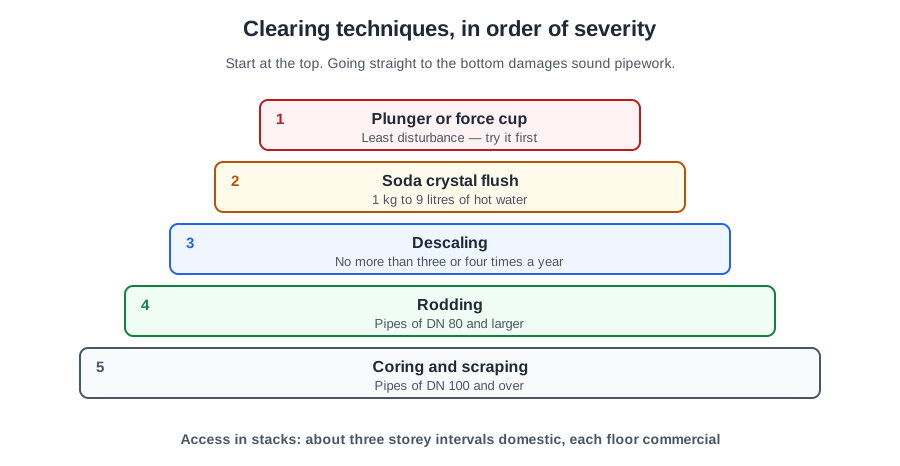
- Plunger — the simple first move on a sink or basin branch and trap, or even a WC.
- Rods — the traditional method, suitable for pipes of DN 80 and larger. Hand rods must pass through without damaging the internal surfaces, and mechanised rodding equipment should only be used by trained operators, after the pipework has been examined so the right attachment is chosen.
- Kinetic ram — compressed air driving a shock wave through a column of water. A stubborn blockage can blow the gun back and injure the operator. AAVs must be removed first, and where they are permanently fixed, ram guns should not be used. Open branches will spray waste over the decorations. Restrict it to compacted soft material — grease, soap residue and saturated paper.
- Coring and scraping — for pipes of DN 100 and over severely restricted with hard scale, using a rotating cutter on a flexible drive. Identify the pipe material first so the cutter does not destroy it.
- Chemical cleaning — last, and with the greatest care. It falls under the COSHH Regulations: gloves and eye shields, adjacent finishes protected, and the system thoroughly flushed with clean water afterwards, with particular attention to trap seals so no acid is left where a user will meet it.
Two rules are absolute. Acid-based cleaners in contact with chlorine bleach produce chlorine gas, so the system is flushed of bleach residues first and windows are opened. And the pipe material must be identified before treatment, because descaling agents are corrosive and can attack plastics fittings. Caution is also necessary when clearing obstructions with air or water at high pressures.
Getting at it: rodding points give access to lengths of pipe that cannot be reached by removing traps or appliances, and in stacks they sit above the spill-over level. Access is wanted at or near the foot of a stack with a long drain connection, at about three storey intervals in multi-storey domestic buildings and on each floor in commercial ones.
And one habit: when access covers, caps and clearing eyes are removed, damaged packing, ring seals, washers and loose fixings should be renewed before they go back.
Rainwater follows the same logic. A gutter that overflows in the rain is usually blocked at the outlet by leaves or a ball. Clear it, tell the customer what caused it, and where trees overhang, suggest regular leaf clearance or gutter guards.
Faults built in on the day
Some faults are not wear and tear — they were installed. Good workmanship follows BS 8000-13, and read as a fault list that code is a description of everything that goes wrong later.
- Stacks erected plumb, branch pipes at uniform and adequate gradients, with sufficient clearance from other services and the fabric for maintenance. A pipe boxed tight into a corner cannot be cleared at its access point.
- Pipe ends cut square, burrs and swarf removed and the bore clean before jointing, push-fit ends chamfered. A burr left inside a waste pipe catches hair and grease and starts a blockage on day one.
- Only fixings compatible with the pipe material, and the maximum spacing must not be exceeded. Under-clipped pipe sags, the sag holds water, and standing water breeds deposits.
- Jointing materials not used in excess and kept clear of the bore — excess solvent cement reduces and damages it.
- Only the ring seals supplied for that pipe system, and the recommended lubricant. Seals from different manufacturers are not interchangeable, and the wrong lubricant makes a seal deteriorate — a slow leak and a smell, two years on.
- Pipe ends pushed fully home and, for plastics push-fit ring seal joints, withdrawn about 10 mm so the pipe has room to expand.
- Plastics fittings are never fabricated on site.
Clearing access is positioned so the pipework can be cleared along the direction of flow: at connections to below ground drains; at changes in direction of stacks; at changes in direction of horizontal runs; at the ends of branches receiving multiple appliances, taken up above the spill-over level of the lowest appliance on that branch; and at other points required for testing.
Three layout faults come straight from Approved Document H: no branch may discharge so as to cause crossflow into another; no branch joins a stack lower than 450 mm above the invert of the tail of the foot bend in dwellings up to three storeys; and offsets in the wet portion should be avoided, with no branch connection within 750 mm of one in a building of not more than three storeys.
Gutters carry a design fault of their own. The published sizes are for a gutter laid level, half round, with a sharp edged outlet at one end. Where the outlet is not at the end, the gutter is sized for the larger of the two areas draining into it. So moving the outlet from the end to the centre of the run increases the gutter's capacity — it does not change the fall required, double the velocity, or alter the rainfall intensity.
Telling the client, isolating and decommissioning
Diagnosis on its own does not authorise work. The client hears what you found, what it will take, what it will cost, how long it will take and what will be disrupted.
Where a fault cannot be put right on the visit, the standard is specific: if faults are found that cannot be corrected, these shall be notified in writing to the operator, and an acknowledgement requested. So a cracked collection tank found during maintenance is not simply entered in the log and left running — it is reported in writing and the acknowledgement chased.
Before anything is opened, you need to know what feeds it: information on the location of gas, water supply, electrical power supply and other services must be made available. For a pumped unit, control boxes and alarm units are in dry, well-ventilated areas above flood level — useful, because that is where to look.
Electrical isolation follows a fixed sequence: identify the circuit, switch off, remove the fuse from the spur, then lock off and label, and prove the circuit dead with an approved voltage indicator, proved before and after. Locking off is not optional: devices for isolation must be selected and installed so as to prevent unwanted or unintentional closure. And electrical connections are carried out by a suitably qualified electrician.
Isolating the water side of a lifting plant uses the valves the standard already requires: an isolating valve on the inlet and another on the discharge after the non-return valve. Closing both takes the plant out of service without wastewater arriving from the appliances or draining back down the backflow loop. Where the plant has no such valves, the appliances it serves must be taken out of use for the duration.
Decommissioning means taking the component out of service properly rather than just switching it off:
- Drain the unit or section of pipework into a suitable container.
- Cap or plug open pipe ends so foul air, vermin and debris cannot get in.
- Protect the floor, the units and the finishes.
- Bag and remove contaminated waste, and wash down afterwards.
- Tell the occupier which appliances are out of use, and for how long.
Rectifying, re-testing and handing back
Take a confirmed case of self-siphonage: a ground-floor basin discharging through a short, near-vertical pipe into an external gully, its trap repeatedly empty while a nearby sink keeps its seal.
The standard explains both halves. Self-siphonage is less likely with baths and sinks because trail off at the end of the discharge refills the traps sufficiently, and wash basin branches may require venting or the use of a resealing or anti-vacuum trap. Venting also cures a noisy discharge.
Where a branch exceeds the limits, the three routes are the same as always: a branch ventilating pipe to external air, to a ventilating stack, or an air admittance valve. A branch vent connects within 750 mm of the trap, joins above the highest spill-over level with a continuous incline, and is 25 mm minimum or 32 mm where the branch is longer than 15 m or has more than five bends.
What not to do is just as testable. Deepening the seal to 100 mm does not stop siphonage. Replacing the gully with an open hopper is not permitted. And reducing the branch diameter makes full-bore flow more likely, not less.
The tests
A final inspection comes first — nothing left in or on the pipes and no jointing material projecting into the bore — then soundness and performance.
Soundness. Charge every trap, plug the open ends, and pump air in until the pressure reaches 38 mm water gauge. Close the inlet cock; the pressure should remain constant for not less than 3 minutes.
To find a leak, use a smoke machine, or a soap solution applied to pipes and joints under pressure so leakage shows as bubbles. Smoke testing of plastics pipework should be avoided, because naphtha attacks ABS, PVC-U and MUPVC and can damage rubber jointing components. A water test is only applied to the part below the lowest appliance, filled to that appliance's flood level, with a static head not exceeding 6 m.
Performance. All appliances should drain speedily, quietly and completely. After each test a minimum of 25 mm of water seal must remain in every trap; each test is repeated at least three times, traps recharged before each, and the maximum loss in any one test — measured with a dip stick or small-diameter transparent tube — is the significant result.
For the stack test, discharge appliances close to the top of the stack and on adjacent floors, where the pressure conditions are worst. For 1 to 9 appliances of each kind, discharge one WC, one wash basin and one sink simultaneously; baths, showers and spray-tap basins need not be discharged.
Pumped plant is recommissioned after maintenance: tested with water for a minimum of two switching sequences, with dry running avoided, checking the direction of rotation, the valves, the watertightness of plant, valves and pipes, the functional test of the non-return valve, the warning device and the motor protection switch. The result goes into the written record.
At handover, ensure that any operation, cleaning and maintenance instructions provided for the user are intact and, where applicable, attached to the installation, and that a document giving instructions for operation, maintenance and use is made available to the building owner or occupier. Update the maintenance log, show the user how to isolate the appliance, and say plainly what caused the fault and how to avoid it.
🔢 The numbers worth memorising
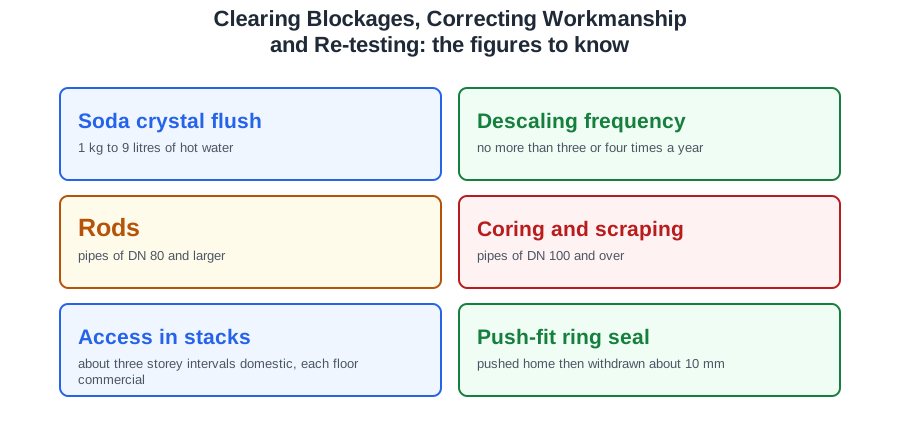
- Soda crystal flush
- 1 kg to 9 litres of hot water
- Descaling frequency
- no more than three or four times a year
- Rods
- pipes of DN 80 and larger
- Coring and scraping
- pipes of DN 100 and over
- Access in stacks
- about three storey intervals domestic, each floor commercial
- Push-fit ring seal
- pushed home then withdrawn about 10 mm
- Lowest branch
- 450 mm above the invert of the foot bend
- Offsets
- no branch within 750 mm
- Centre outlet on a gutter
- increases capacity
- Branch vent
- within 750 mm, 25 mm (32 mm over 15 m or five bends)
- Soundness test
- 38 mm water gauge, constant for 3 minutes
- Water test
- below the lowest appliance, static head not exceeding 6 m
- Performance test
- 25 mm retained, repeated three times, maximum loss counts
- Pumped plant re-commissioning
- minimum two switching sequences
⚠️ Where people go wrong
- Reaching for the same tool for every blockage. Three deposits, three remedies.
- Pushing a compacted mass further along instead of removing it at the nearest access.
- Using caustic soda where soda crystals are meant.
- Mixing an acid cleaner with bleach. That makes chlorine gas.
- Descaling without identifying the pipe material.
- Using a ram gun with an AAV still fitted, or on a permanently fixed one.
- Refitting an access cap on a damaged seal or washer.
- Leaving a burr in the bore, or excess solvent cement.
- Mixing ring seals or lubricants between systems.
- Under-clipping a run. The sag holds water and breeds deposits.
- Logging an uncorrectable fault instead of notifying it in writing and chasing the acknowledgement.
- Working on a pumped unit without locking off.
- Deepening a seal to cure siphonage, or reducing the branch diameter.
- Smoke testing plastics pipework.
- Taking an average across the three performance tests. The maximum loss is the result.
- Handing back without leaving the user instructions attached.
📝 10-Question Self-Test
Straight from the Level 3 course question bank. Click an option to see whether you got it right — the explanation appears instantly, and there is nothing to submit.
A valve that keeps blocking is in the wrong conditions: Approved Document H paragraph 1.33 says air admittance valves must not be used in dust laden atmospheres. Taking the pipe up as a stack vent open to outside air removes the moving part altogether. Fitting a second valve alongside just gives you two blocked valves.
The overload tripped because something jammed the grinder and the motor stalled. Isolating the supply first is what stops the blades spinning up under your hand; only then do you remove the unit, clear the jam, reset the overload, refit and test. Freeing the jam or resetting with the unit still connected leaves a live machine, which is the exact accident the isolation rule exists to prevent.
The unit must be electrically isolated before anything goes near the grinding chamber; then the debris is cleared. Hot water will not shift a build-up, and clearing it with the unit still connected at the spur leaves the motor able to start.
The appliance belongs to the customer and the work disturbs their premises and water; they must agree to it, and describe the fault, before anything is touched.
NC.2.1 states that loss of seal from the trap of a discharging appliance may occur by self-siphonage if the branch discharge pipe flows at full bore. A 2.5 m unvented basin branch exceeds the 1.7 m limit for 32 mm pipe in Approved Document H Table 2, so the pipe runs full and the negative pressure behind the plug of water pulls the seal out. Induced siphonage would affect a trap that was not discharging.
NC.2.1 explains that traps on appliances not discharging may suffer seal loss by induced siphonage if the branch discharge pipe to which they are connected is flowing full bore. The affected trap is fine when its own basin discharges, so self-siphonage is ruled out; it is the upstream discharge filling the common branch that draws the seal out.
ND.3.4.1 states that wash basin branches on this arrangement may require venting or the use of a resealing or anti-vacuum trap, and that venting the waste run also cures noisy discharges. Approved Document H paragraph 1.20 likewise allows a branch that exceeds Table 2 to be ventilated by a branch vent, a ventilating stack or an air admittance valve. Reducing the pipe size would make full-bore flow more likely, not less.
Clause 8.2 states that after carrying out maintenance the plant shall be recommissioned in accordance with clause 7. Clause 7 requires testing with water for a minimum of two switching sequences, avoiding dry running, with checks that include the functional test of the non-return valve, the warning device and the watertightness of plant, valves and pipes. A dry run is expressly to be avoided.
ND.5.1.2 states that pipes from appliances discharging heavy concentrations of solid matter, such as food waste disposal units, should not be connected to the head of long runs of horizontal discharge pipe or discharge to grease traps; they should connect as close as practicable to the main vertical stack or drain. ND.4.7 adds that an access point is needed at the high end of such branches because of the high risk of blockage.
Table 1 of Approved Document H lists the food waste disposal unit with the sink and urinal bowl at 40 mm trap diameter and 75 mm depth of seal. Table A3 in Appendix A raises this to 50 mm diameter with a 75 mm seal for industrial-type units. An undersized 32 mm trap restricts the ground waste and is a ready cause of slow draining and blockage.
Going further: the lessons behind this article
This article is the public answer. Unit 334 of the Level 3 course takes the same ground to the depth the exam and the synoptic assignment ask for, in 4 lessons:
- Blockages: where they form and how they are cleared
- Defective workmanship: faults built in on the day
- Telling the client, isolating safely and decommissioning
- Rectifying, re-commissioning and handing back
- Sanitation systems: the Unit 334 guide — every article on this unit in one place
- All PlumbMate articles — Level 1, 2 and 3
- The Level 3 course — the whole 8202-35 Diploma