There is one error in this subject that costs more than all the others put together, and it is a letter. Type AG looks like it belongs with AA, AB and AD — it is an air gap, it has an A, it is in the same table. It protects to category 3. Specify it where category 5 was needed and you have installed something that looks like protection, passes a visual inspection, and is not protection at all.
This article covers Module 8 of the PlumbMate Water Regulations course: what backflow is and the two modes it comes in, the paragraph 15 requirements, the air gap arrangements and their real ratings, and the mechanical devices with their category ceilings and installation conditions. There is a 10-question mock test at the end.
Backflow, and its two modes
Backflow is flow upstream — that is, contrary to the intended normal direction of flow. Two definitions worth fixing before anything else, because they are used constantly: upstream is against the flow; downstream is with it.
Backflow happens in two ways, and they need completely different thinking:
- Backpressure pushes. The pressure downstream rises above the supply pressure, and water is pushed back up the pipe. Sources: a pump, a heated vessel, an elevated tank, a compressed air line.
- Backsiphonage pulls. The supply pressure falls — a burst main, a hydrant opened for a fire, heavy demand elsewhere — and the resulting partial vacuum siphons water back out of the installation.
A device that stops one does not necessarily stop the other. Air-inlet devices are the clearest case: they break a siphon beautifully and do nothing at all against pressure pushing from below.
Paragraph 15
15(1) requires an adequate device to prevent backflow from any appliance, fitting or process.
15(3) sets the sizing rule, and it is the sentence to work from every time: the device must be suitable for the highest fluid category downstream of it, before the next device. Not the category of the appliance you are standing next to — the worst category anywhere between this device and the next one. One outside tap on a branch that also feeds a chemical dosing point sets the requirement for both.
15(2) gives two exemptions, both narrow:
- expanded water from a water heater, and
- a vented vessel fed from a cistern,
and both only up to 25 °C. Above that temperature the exemption falls away.
Whole-site and zone protection
Whole-site protection is triggered by either of two things:
- two or more separately occupied premises on one supply; or
- a 24-hour storage requirement.
And the rule that stops people saving money in the wrong place: zone and whole-site protection are in addition to point-of-use protection, never instead of it. Whole-site protection stops one occupier's contamination reaching the street. It does nothing to stop it reaching the flat next door. Point of use is what protects the building's own occupants from each other.
Prefer an arrangement to a device
Where both would satisfy the category, choose the arrangement. An air gap cannot seize, cannot be tampered with, does not need testing, and does not fail closed-looking-open. A mechanical device does all four. Everything else in this module is about what to do when an arrangement is not possible.
Air gaps
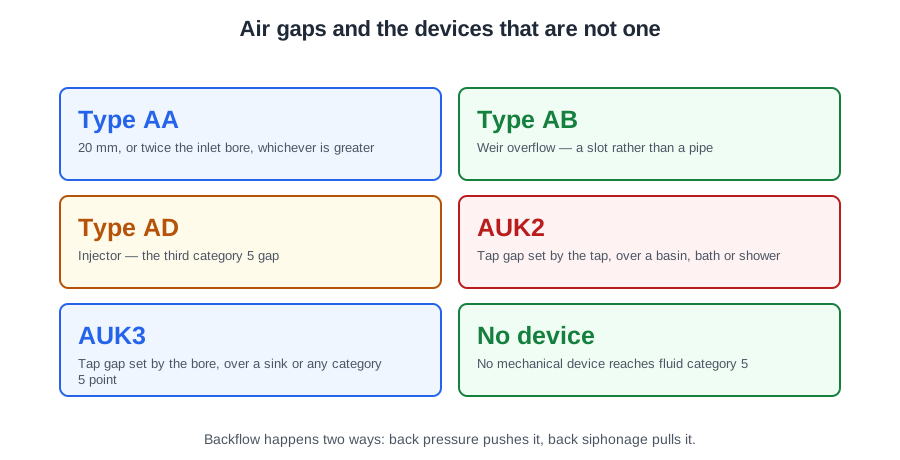
The dimension, and the datum
An air gap is not less than 20 mm, or twice the internal diameter of the supply pipe, whichever is the greater.
The datum is the spillover level — the point at which the vessel would begin to overflow if it kept filling. The overflow pipe is ignored entirely. That surprises people, and the reason is that an overflow can block, and a blocked overflow means the water keeps rising to the spillover level. The air gap has to survive the worst case, and the worst case is the overflow doing nothing.
One practical qualification: splashing or foaming that reaches the inlet compromises the air gap, and where that can happen the gap must be increased. A nominally correct 20 mm gap with detergent foam climbing into the tap is not an air gap.
The arrangements and their real ratings
The pattern to hold in your head:
- AA, AB and AD — category 5 in both modes. These are the serious ones.
- AF — category 4.
- AC and AG — category 3.
Which brings us back to the opening. Type AG is category 3, despite the letter, and mistaking it for a category 5 arrangement is the most costly single error in the subject.
A second practical point on the category 5 group: cisterns must have lids, and a type AA gap is defined to open air. So in real installations AB is the practical category 5 arrangement — a weir overflow in a covered cistern — not AA. AA appears in the tables far more often than it appears in buildings.
AUK1: the one that changes with the mode
AUK1 is category 3 against backpressure and category 5 against backsiphonage — the only arrangement whose rating differs between the two modes. It is worth learning as a named oddity rather than trying to fit it into the pattern, because it does not fit.
The AUK tap gaps
AUK2 is the tap-over-appliance gap, and it scales with the tap size:
- 20 mm for taps up to and including G½
- 25 mm for taps above G½ up to and including G¾
- 70 mm for taps above G¾
The jump to 70 mm is not a rounding error. A large tap can pass enough water to fill an appliance faster than it drains, and it can throw water further when something splashes.
AUK3 is the higher-risk version: 20 mm or twice the inlet bore, whichever is greater, and it applies to sinks anywhere, to non-domestic situations, and to healthcare premises. The three cases where AUK3 applies are exactly the three where Module 7 said the risk is elevated.
And one that is easy to forget entirely: overflows and warning pipes must terminate with a type AA air gap. An overflow discharging into a gully is a route back into the cistern if it ever surcharges.
Type DC
DC is a pipe interrupter with a permanent atmospheric vent. It is category 5, but against backsiphonage only, and it comes with strict conditions: no control valve downstream, and it must be installed vertically with the flow downwards. Any valve after it turns the interrupter into a device with pressure behind it, which is precisely what it cannot handle.
Mechanical devices
The ceiling
Two facts govern everything here:
- BA — the RPZ valve — is the only mechanical device acceptable at category 4, and it works in both modes.
- Nothing mechanical reaches category 5. Category 5 always means an air gap.
Single and double check valves
EA and EB single check valves are category 2 only. They are not health-hazard protection, and they are used as though they were more often than any other device in the list.
Two singles in series make a double check valve — but only under conditions: the flanges must be within twice their nominal bore of each other, and neither valve may interfere with the operation of the other. Two check valves a metre apart on a pipe are two single check valves, not a double check valve assembly.
Verifiable does not mean better
Verifiable means the device has test ports allowing it to be tested in situ. It is a maintenance feature, and it does not raise the rating: EC and ED are both category 3, verifiable or not. Being able to prove a device works is valuable; it does not make the device protect against something worse.
CA, and the filling loop point
CA is a disconnector with different pressure zones, rated category 3, and it has one property worth knowing well: it may be left permanently connected.
That is the contrast with a double check valve on a heating filling loop, which must be disconnected after filling. The reason is what each device does when it fails: a CA vents to atmosphere between its zones, so a failure announces itself as water on the floor. A double check valve that has failed looks exactly like a double check valve that is working.
Air-inlet devices
Air-inlet devices — DA, DB, DUK1, LA, LB — mostly give no backpressure protection. They admit air to break a siphon. Against pressure pushing from below, most of them do nothing.
Their installation conditions matter more than usual:
- DA and DUK1 need a 300 mm type A upstand and no valve on the outlet.
- DB needs to be 300 mm above the spillover level, installed with the flow downwards.
And the specific prohibition worth remembering as a rule of its own: a DB must never serve a washing machine or a dishwasher, because their inlet solenoids are control valves — and a control valve downstream is exactly what these devices cannot have.
Installation requirements
- Devices must be accessible, never buried, and not in below-ground chambers or flood-prone positions. A device sitting in a chamber that floods is submerged in the very water it exists to keep out.
- Category 4 devices need a line strainer immediately upstream, with servicing valves either side of the assembly. Grit under a seat is how these devices fail.
- An RPZ relief outlet must terminate with a type AA air gap not less than 300 mm above floor level, and the device must be tested annually by an accredited tester. An RPZ is not a fit-and-forget item; it is a piece of equipment with a maintenance regime attached, and specifying one commits the customer to that regime for the life of the building.
- HA and HUK1 are for existing house taps only. New work needs a double check valve inside the building. These two exist to deal with what is already fitted on older properties, not to be designed in.
Putting the module together
Establish the mode — is this backpressure or backsiphonage, or both? Establish the highest category downstream before the next device. Then prefer an arrangement, and if you must use a device, check its ceiling: category 2 for single check valves, 3 for most of the rest, 4 for an RPZ alone, and nothing at all for category 5.
📝 10-Question Mock Test
Click an option to see whether you got it right. Explanations appear instantly — no submitting at the end.
Push against pull, and a device that stops one does not necessarily stop the other. Air-inlet devices are the clearest case: excellent at breaking a siphon, useless against pressure pushing from below.
The worst case anywhere between this device and the next one. An outside tap on a branch that also feeds a chemical dosing point sets the requirement for both.
An overflow can block, and a blocked overflow means the water keeps rising to the spillover level. The gap has to survive the worst case, and the worst case is the overflow doing nothing. Dimension: not less than 20 mm or twice the internal diameter of the supply, whichever is greater.
The most costly single error in the subject. AG sits in the table alongside AA, AB and AD — which are category 5 — and protects two tiers below them. AF is category 4; AC and AG are category 3.
AA appears in the tables far more often than it appears in buildings. Both are category 5; AB is the one compatible with a cistern that has a lid on it, which cisterns must.
AUK1 is the only one that splits, and it is worth learning as a named oddity rather than trying to fit it into the pattern. Type DC is category 5 too, but against backsiphonage only — it has no backpressure rating at all.
The RPZ is the ceiling for mechanical protection. Nothing mechanical reaches category 5, which always means an air gap. Category 4 devices also need a line strainer immediately upstream, servicing valves either side, a type AA air gap on the relief outlet at least 300 mm above floor level, and an annual test by an accredited tester.
Being able to prove a device works is valuable; it does not make the device protect against something worse. Single check valves EA and EB are category 2 only — not health-hazard protection, though they get used as though they were.
The difference is in how each one fails. A CA puts water on the floor; a double check valve says nothing at all. Both are category 3.
A solenoid is a valve, and a valve downstream is precisely what an air-inlet device cannot have. The same reasoning gives DA and DUK1 their condition of no valve on the outlet, plus a 300 mm type A upstand.
The devices in this module fail quietly. A seized check valve, a dezincified body, an air-inlet device with a solenoid downstream — none of them look wrong, and none of them announce anything. That is the whole argument for choosing an arrangement wherever one will do the job.
The one to carry away: type AG is category 3, despite the letter. It sits in the table with AA, AB and AD and protects to two tiers below them.