Rainwater harvesting and greywater recycling arrive on jobs with an environmental halo attached, and that halo does a lot of quiet damage. It encourages people to treat the second water system as a nice-to-have bolted onto the plumbing, when the Regulations treat it as a fluid category 5 supply sharing a building with the wholesome one. Category 5 is the same tier as sewage.
This article covers Module 6 of the PlumbMate Water Regulations course: the identification requirements for anything that is not wholesome water, the cross-connection prohibition and how it was amended, what protection a harvesting system actually needs, and the point at which a “temporary” connection becomes an offence. There is a 10-question mock test at the end.
Identification
Paragraph 14(1) requires that any water fitting conveying rain water, recycled water, or any fluid that is not wholesome water is clearly identified.
Two words in that sentence do more work than they look:
- It says water fitting, not pipe. So cisterns are caught too, and so is everything else that counts as a fitting. Marking the pipework and leaving an unmarked cistern in a plant room does not satisfy it.
- The test is being easily distinguished from a supply pipe or a distributing pipe. That is a comparative test, not an absolute one. The question is not “is this labelled?” but “could somebody standing here mistake this for the wholesome supply?” A green band on a green pipe passes an absolute test and fails the comparative one.
Colour coding and labelling
Colour coding follows BS 1710. Reclaimed water is green · black · green — a black band between two green ones.
On outlets: except in a house, cold taps supplied with water that is not wholesome should be labelled “Not Drinking Water”.
There is a second convention that the course notes as equally acceptable, provided it is applied consistently: label the wholesome taps “Drinking Water” instead. On a site with three drinking points and forty other outlets that is both cheaper and clearer — the exception is the thing worth signposting. What is not acceptable is a mixture, where some non-wholesome taps are marked and some are not, because then an unmarked tap means nothing.
Where a label is not enough
A hose union tap in a washroom is likely fluid category 5, and for a tap like that a lockable or removable tap beats a label every time.
This is a general point worth holding onto. A label informs somebody who reads it, in a language they read, while paying attention. A removable head informs somebody who is not paying attention at all. Where the consequence is category 5, choose the control that does not depend on the person.
The cross-connection prohibition
The rule is that no pipe conveying rain water, recycled water or any fluid other than wholesome water may be connected to the wholesome supply.
“Can convey”, not “has conveyed”
The offence includes being connected so that it can convey. No flow needs to have happened. This is Regulation 3's “likely to cause” showing up again in a specific setting: making the connection is the offence, and nothing has to come through it.
It also disposes of the most common defence heard on site — “the valve was shut”. A closed valve is a connection with a valve in it.
The amendment worth knowing
The prohibition was originally absolute. The words “unless a device for preventing backflow is installed in accordance with paragraph 15” were added by amendment.
That history is genuinely useful, because it tells you how to read the exception. It is a narrow, deliberate relaxation bolted onto a total ban, not a general permission to interconnect systems if you put a valve in. The protection has to be in accordance with paragraph 15, which means it has to suit the fluid category — and that takes us straight to the number that governs this whole module.
Category 5, and what it forces
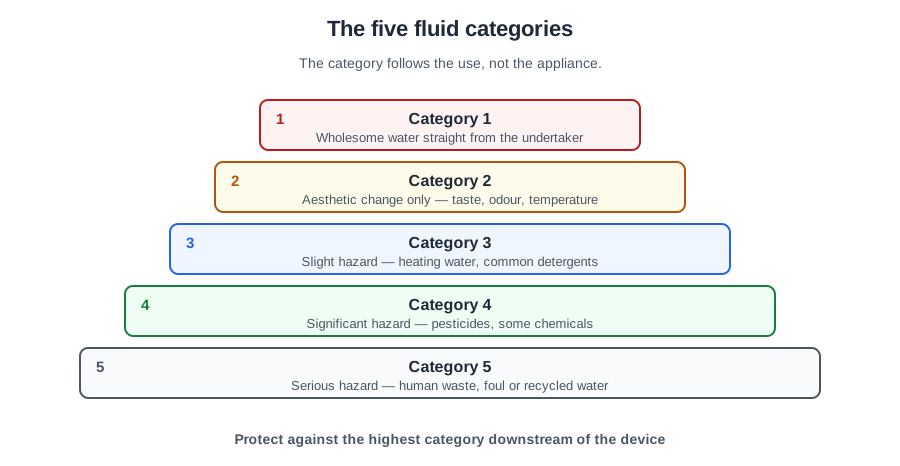
Rain water and grey water are fluid category 5.
Category 5 is the serious health hazard tier: pathogens, radioactive or very toxic substances. Rainwater collects off a roof that birds sit on. Greywater has been through a shower or a washing machine. Neither is remotely near drinking quality and neither is treated as a lesser risk because it looks clear in the tank.
What that forces is the important part:
- Category 5 requires an air gap — type AA, AB or AD.
- No mechanical device reaches category 5. An RPZ valve, the best mechanical device there is, stops at category 4.
So there is no valve, no device and no assembly you can buy that will let a harvesting system be connected to the mains. If mains back-up is needed — and it usually is, because it does not always rain — the accepted arrangement is a cistern with two inlets forming a type AB air gap: the mains discharges into the harvesting cistern through an air gap, and the harvested water and the mains top-up meet only as water in a tank, never as pipes joined together.
That arrangement is worth being able to describe from memory, because it is the answer to almost every rainwater question that starts “how do we top it up when...”.
Temporary connections
A temporary connection is still a connection. It is an offence to contaminate the supply at any time, and there is no duration below which a cross-connection becomes acceptable.
This gets tested by ordinary site pressure. The tank is empty, the customer needs water today, and a hose from the outside tap into the top of the tank will fix it in five minutes. If that hose end is below the spillover level, the arrangement is a category 5 backsiphonage risk for as long as it is there — and it will be there longer than five minutes.
Two points of perspective
Nobody has to harvest anything
There is no requirement to use rainwater or reclaimed water. It is a choice, and it is worth putting to the customer as one, because choosing it brings a package with it: separation, identification and protection, permanently, along with the maintenance that goes with a category 5 system inside their house. Some customers, hearing that clearly, decide that a water butt on the garden and a low-flush WC delivers most of what they wanted with none of the risk.
That is not discouraging the technology. It is making sure the decision is made with the whole cost visible.
The notification position differs across the UK
Scotland and Northern Ireland make harvesting systems expressly notifiable. In England and Wales there is no line on the notification list that says “rainwater harvesting” — but notification usually bites another way, because a real installation almost always includes something on the item 4 list: a pump above 12 litres per minute, a garden watering system not operated by hand, or pipework outside the depth window.
The practical answer is therefore the same in all four nations, just reached by a different route. Work through the notifiable items rather than looking for the words “rainwater harvesting”, and you will find the notification is required.
Putting the module together
Identify everything that is not wholesome, and judge the marking comparatively — could this be mistaken for the mains? Never connect a non-wholesome system to the wholesome one, remembering that being able to convey is the offence and a shut valve is no defence. Treat rain water and grey water as category 5, which means an air gap and rules out every mechanical device. And put the mains back-up through a type AB air gap into the cistern, which is the arrangement that makes the whole thing work.
📝 10-Question Mock Test
Click an option to see whether you got it right. Explanations appear instantly — no submitting at the end.
It says water fitting, not pipe. Marking the pipework and leaving an unmarked cistern in a plant room does not satisfy it.
Comparative, not absolute. The question is not whether it is labelled but whether somebody standing there could mistake it for the wholesome supply. Reclaimed water is green, black, green under BS 1710.
Both conventions are acceptable if used consistently. What is not acceptable is a mixture, because then an unmarked tap means nothing. Note the labelling requirement applies except in a house.
“Can convey” is the offence. A closed valve is a connection with a valve in it — the same idea as Regulation 3's “likely to cause”, applied to a specific case.
Knowing the prohibition was originally absolute tells you how to read the exception: a narrow deliberate relaxation, not a general permission to interconnect systems if you put a valve in.
Category 5, the same tier as sewage. Rainwater comes off a roof that birds sit on; greywater has been through a shower or a washing machine. Neither is treated as a lesser risk because it looks clear in the tank.
Nothing mechanical reaches category 5; an RPZ, the best of them, stops at category 4. Category 5 means a type AA, AB or AD air gap, and there is no device you can buy that changes that.
The accepted arrangement, and worth being able to describe from memory — it answers almost every rainwater question that begins “how do we top it up when…”. The pipes are never joined; only the water meets.
There is no duration below which a cross-connection becomes acceptable. A hose end below spillover level is a category 5 backsiphonage risk for as long as it is there — and it will be there longer than anybody intends.
Scotland and Northern Ireland name harvesting expressly; England and Wales get to the same answer by a different route. Work through the notifiable items rather than looking for the words 'rainwater harvesting'.
The environmental case for harvesting is genuine, and none of this is an argument against it. It is an argument for installing it as what it is: a category 5 supply living inside a building alongside drinking water, separated by an air gap because nothing else is permitted to do that job.
The one to carry away: no mechanical device reaches category 5. Not a double check valve, not an RPZ. If someone is proposing a valve between harvested water and the mains, the answer is a type AB air gap into the cistern instead.