The fluid categories are the pivot of the whole subject. Everything about backflow prevention — which arrangement, which device, whether a device is permissible at all — is decided by a single number between 1 and 5. Get the category right and the protection follows almost mechanically. Get it wrong and every decision after it is wrong too, in a way that no amount of careful installation can rescue.
This article covers Module 7 of the PlumbMate Water Regulations course: the five categories and what separates them, the distinction between an aesthetic problem and a health hazard, and the principle that does most of the work in practice — that the category follows the use rather than the appliance. There is a 10-question mock test at the end.
The five categories
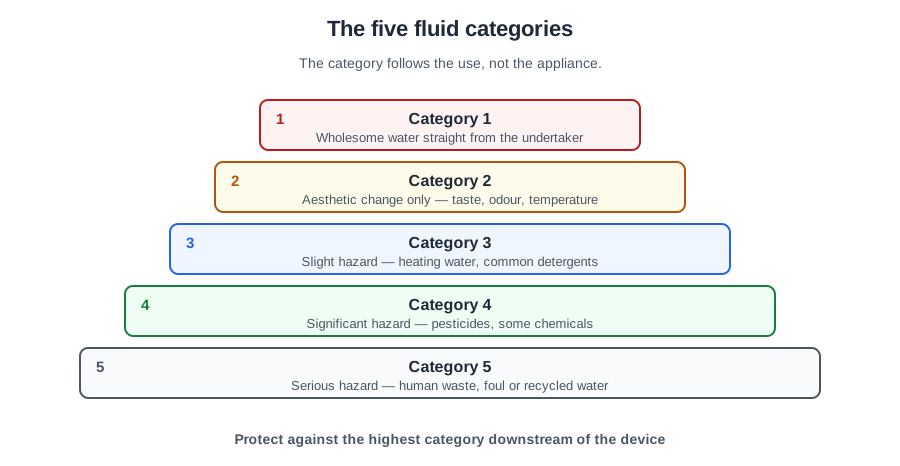
In one line each:
- Category 1 — wholesome. Water supplied by the undertaker, complying with the quality requirements.
- Category 2 — aesthetic impairment. The water's appearance, taste or smell has changed, but it is not a health hazard.
- Category 3 — slight health hazard. Substances of low toxicity.
- Category 4 — significant health hazard. Toxic substances.
- Category 5 — serious health hazard. Pathogens, radioactive material, or very toxic substances.
Where the real lines are
Two boundaries carry almost all the weight.
The 1–2 line is aesthetics, not health. This is the one people over-read. Heating alone takes water into category 2 — nothing has been added, nothing has grown, the water has simply been warmed and is no longer what a drinking outlet should deliver. The same applies to softened water, or water that has stood long enough to taste of the pipe. Category 2 is real and it needs protecting against, but it is not a health hazard and it does not deserve health-hazard protection.
The 3–4–5 progression is toxicity and biology. Low toxicity, toxic, and then a separate tier for anything living or radioactive. That is why category 5 is treated so differently from 4: a toxic chemical will disperse and dilute, while a pathogen multiplies. Dilution is not a defence against bacteria, which is why nothing mechanical is permitted at category 5 and only an air gap will do.
The category follows the use, not the appliance
This is the single most useful idea in the module, and the one that turns the categories from a list to be memorised into a system that can be reasoned with.
There is no such thing as “a washing machine is category 3”. The appliance does not carry a category around with it. What carries the category is what goes through the appliance, in that building, for that purpose.
The worked example the course uses is one washing machine in three places:
- In a house — category 3. Domestic detergents, low toxicity.
- In a launderette — category 4. Commercial chemistry, used in quantity, by staff, all day.
- In a nursing home — category 5. Soiled laundry: pathogens.
Same machine, same plumbing connection, three different categories and three different protection requirements. Once you have that example properly in mind, unfamiliar appliances stop being a problem: ask what will actually pass through it here.
The default that catches people
A primary circuit in a house is category 3. In any other premises it is category 4 by default.
“By default” is doing real work in that sentence. The non-house primary circuit is assumed to be category 4 without anybody having to demonstrate what is in it — and it stays category 4 unless it is formally reassessed. Only the water undertaker can risk assess a non-house system and downgrade it to category 3. Not the installer, not the specifier, not the manufacturer of the inhibitor.
One more, and it is a genuine trap: a vented system is deemed higher risk than a sealed one. That feels backwards to most people, who associate sealed systems with pressure and risk. But an open vented system has a cistern open to a loft, with whatever falls into it, and a route back down. A sealed system is closed to the atmosphere.
The rule with no exceptions
A sink is category 5. Anywhere. Domestic or not, kitchen or utility, house or hospital.
It is worth pausing on how unusual that is, because almost everything else in this module is conditional. A sink gets a fixed category regardless of location because of what actually happens at one: nappies, mop buckets, raw meat, pet bowls, chemicals decanted from under the cupboard. The Regulations do not attempt to distinguish a careful household from a careless one.
Compare a washbasin, which is not the same thing at all. The difference between the two is behavioural, and the Regulations reflect it.
Two more comparisons worth learning as pairs
- Fertiliser in a domestic garden is category 3; insecticide is category 5. Both come from a garden centre, both get connected to a hose, and they sit two tiers apart. Insecticide is designed to kill living things.
- A submerged inlet is category 3 in a house or domestic situation, and category 5 in premises other than a house. Same physical arrangement; the surroundings decide the risk.
What counts as “domestic”
Two classifications that need to be right, because several rules hang off them:
- A hotel counts as a domestic situation. People sleep, wash and use bathrooms there much as they would at home.
- Healthcare premises never do. Not a hospital, not a dental surgery, not a nursing home — regardless of how domestic the setting feels or how much of it is somebody's residence.
Healthcare is treated as a permanently elevated risk environment because of what is present there: pathogens, in concentration, among people whose resistance is already low.
Categorising something the guidance does not list
The guidance lists a great many applications, and sooner or later you will meet one it does not. The method is to work from first principles rather than search for the nearest-looking entry:
- What can get into the water here? Not what usually does — what can.
- Is it a health hazard at all, or only aesthetic? If aesthetic, it is category 2 and you are finished.
- Is it living, or radioactive? If yes, category 5. Stop — nothing mechanical will do.
- Is it toxic, or of low toxicity? Toxic is 4, low toxicity is 3.
- What are the surroundings? House, other premises, or healthcare — and remember healthcare is never domestic.
Then apply the paragraph 15 rule from Module 8: the protection must suit the highest fluid category downstream, before the next device. Categorise the worst thing that can happen at that point, not the average thing.
Putting the module together
Five categories, with the 1–2 line being about aesthetics and the 3–4–5 progression being about toxicity and then biology. The category follows the use, not the appliance — one washing machine is 3, 4 or 5 depending on the building it is in. A sink is category 5 everywhere. A non-house primary circuit is category 4 by default and only the undertaker can downgrade it. And healthcare premises are never domestic, whatever they look like.
📝 10-Question Mock Test
Click an option to see whether you got it right. Explanations appear instantly — no submitting at the end.
The 1–2 line is about aesthetics, not health. Heating alone takes water into category 2 — nothing added, nothing grown, simply no longer what a drinking outlet should deliver. Real, worth protecting against, but not a health hazard.
A toxic chemical disperses and dilutes; a pathogen reproduces. That is the reason category 5 always means an air gap and no mechanical device reaches it.
The same machine is category 3 in a house, 4 in a launderette and 5 in a nursing home. The appliance does not carry a category around with it; what goes through it in that building does.
Unusual in this module for having no conditions attached. A sink gets a fixed category because of what actually happens at one — nappies, mop buckets, raw meat, chemicals decanted from under the cupboard. A washbasin is a different matter entirely.
“By default” means it is assumed to be category 4 without anybody demonstrating what is in it, and it stays there unless formally reassessed. Not the installer, not the specifier, not the inhibitor manufacturer — only the undertaker. In a house the same circuit is category 3.
This one feels backwards to most people, who associate sealed systems with pressure and therefore risk. But an open vented system has a cistern open to a loft, with whatever falls into it.
Two tiers apart, from the same garden centre and the same hose. Insecticide is designed to kill living things, which is exactly what puts it in the serious hazard tier.
A hotel counts as domestic — people sleep, wash and use bathrooms much as they would at home. Healthcare premises never count as domestic, however domestic the setting feels or how much of it is somebody's residence.
Category 3 in a house or domestic situation, category 5 in premises other than a house. Same physical arrangement — the surroundings decide the risk.
Paragraph 15(3): the device must suit the highest fluid category downstream before the next device. Work from what can get into the water, whether it is living or radioactive, whether it is toxic or of low toxicity, and what the surroundings are.
Everything in the next module depends on this one being right. Choosing an RPZ valve where an air gap was needed is not a marginal error; it is the difference between protection and the appearance of protection.
The one to carry away: the category follows the use, not the appliance. One washing machine is category 3 in a house, 4 in a launderette and 5 in a nursing home — same machine, same connection, three different answers.