Everything in this module is about the pipe's surroundings rather than the pipe. Where it runs, how deep, what is above it, what can reach it, what can get through it, and what happens on the coldest night of the year when nobody is home. The fittings can all be perfect and the installation can still be a contravention because of where it was put.
This article covers Module 3 of the PlumbMate Water Regulations course: the depth window for a service pipe and the obstructions that complicate it, what counts as concealed and what may never be concealed, how frost protection actually works and why insulation alone is not a promise, and permeation through plastics in contaminated ground. There is a 10-question mock test at the end.
Depth of cover
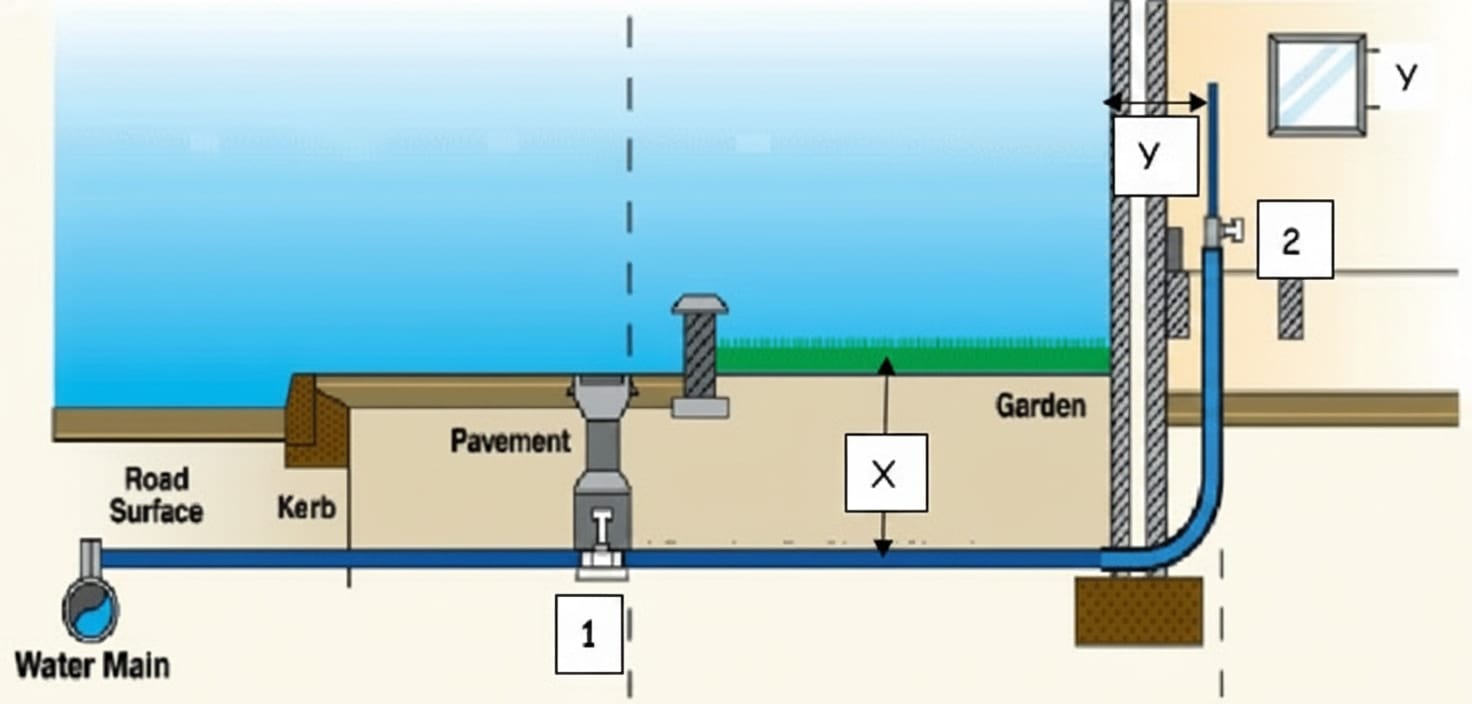
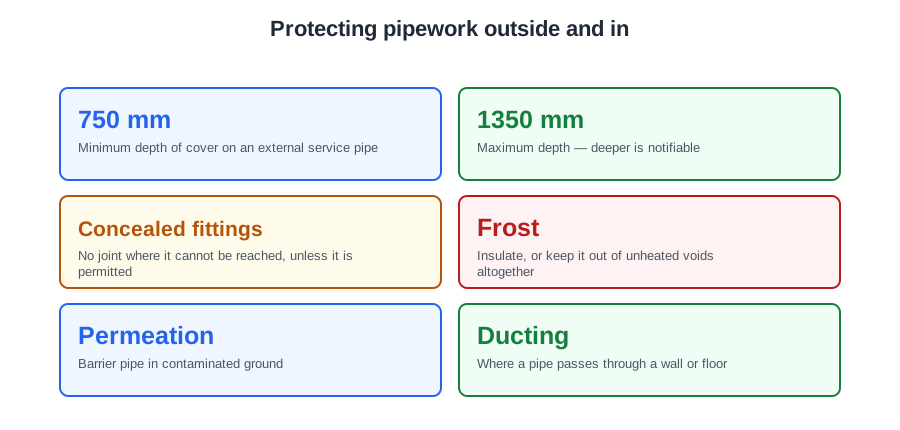
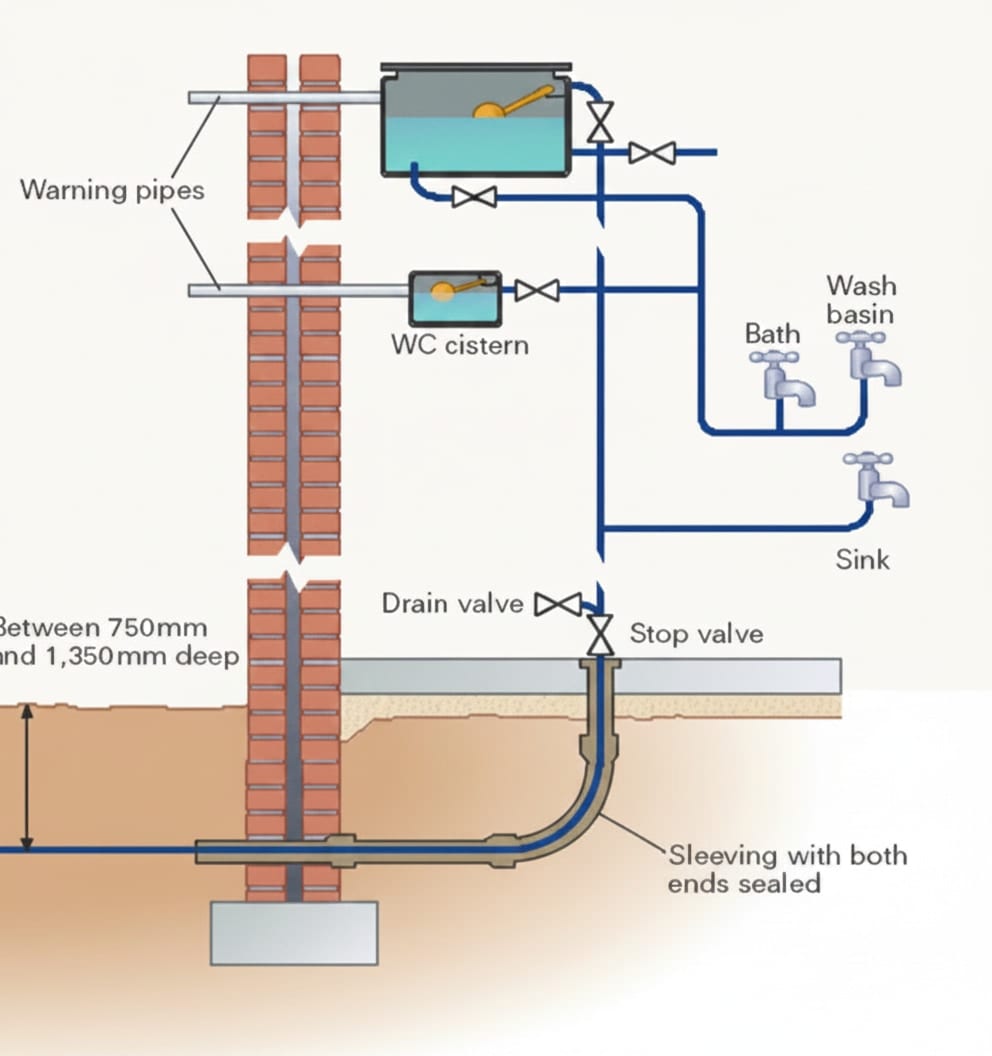
A service pipe laid outside a building must have not less than 750 mm and not more than 1350 mm of cover.
Both numbers are requirements. The shallow limit is about frost and about damage — below 750 mm the ground freezes in a hard winter, and a spade finds the pipe. The deep limit is about the people who come after you: a pipe at two metres cannot be reached safely without shoring, so a repair that should take an hour becomes an excavation. A depth window rather than a minimum is the Regulations balancing protection against maintainability, and it is why a pipe laid either too shallow or too deep is notifiable.
You may go shallower only with the water undertaker's written approval, and then only with protection against freezing and against damage. Written approval — not a conversation on site, not the meter reader's opinion.
Obstructions
Real ground has things in it, and the guidance handles three cases distinctly.
Passing under an obstruction is permitted, provided the total depth stays within 1350 mm. You are allowed to dip; you are not allowed to dip out of the window.
Passing over an obstruction is the harder case, because you are now shallower than you would like and something heavy is sitting nearby. It needs waterproof insulation and a load relieving slab extending 250 mm either side of the pipe. The slab is not there to keep the pipe warm; it is there so the load goes around the pipe rather than through it.
Passing under a watercourse gets the fullest treatment, and it is worth learning as a sequence:
- 750 mm below the bed of the watercourse;
- in a sealed duct carried into both banks;
- rising on each side to no deeper than 1350 mm;
- with a 150 mm slab for protection.
The duct into both banks is the detail people drop, and it is the one doing the most work: it means the pipe can be drawn out and replaced without anyone excavating a riverbed.
Where the pipe enters the building
Entry duct ends must be sealed — against gas and against vermin. A duct is a clear route from open ground into an occupied building, and once you have made that route you own it.
Then the insulation rules at entry, which have a shape worth getting exactly right:
- A vertical pipe less than 750 mm from the external face of the building needs insulation.
- Beyond 750 mm from the external face, it does not.
- But entry through a suspended floor with an air void needs insulation at any distance.
The third rule overrides the first two, and the reason is straightforward: a ventilated underfloor void is outside air. Distance from the wall buys you nothing when the cold is already all around the pipe.
And pipes above ground outside need insulation and mechanical protection — both. Insulation deals with the weather; mechanical protection deals with ladders, wheelbarrows, strimmers and everything else that lives in a garden.
Concealed fittings
Concealed has a definition, and it is broader than “buried in a wall”. A fitting is concealed if it is:
- below ground;
- passing through or under a wall, footing or foundation;
- in a chase or duct; or
- otherwise inaccessible.
That last phrase is the operative one, because accessibility is the test. A fitting sitting in plain sight in an accessible roof space is not concealed, however awkward the ladder. A fitting behind a screwed-down panel is a question about whether the panel counts as access. Ask whether somebody could get to it to work on it, and you have your answer.
Three prohibitions follow:
- No fitting designed to be operated or maintained may be concealed, and no joint may be. Joints are where systems leak; a joint you cannot reach is a leak you cannot fix.
- No fitting may be embedded in any wall or solid floor. Embedded is stronger than concealed — a pipe in a chase behind plasterboard is concealed; a pipe cast into a screed is embedded, and that is not permitted at all.
- A pipe may pass through a cavity wall but must not run within the cavity. Crossing is a short exposure; running along the cavity puts pipework in an unventilated, inaccessible space that is also part of the building's damp defence.
Two further requirements attach to concealed work. Concealed fittings and backflow prevention devices must be gunmetal or dezincification-resistant material — Module 2's reasoning, applied here. And underfloor voids need access at not more than 2 m intervals and at every joint, so that “under the floor” does not quietly become “inaccessible”.
One absolute: underground fittings must never be jointed using adhesives. Solvent-welded joints below ground are not permitted, and no amount of care in making them changes that.
Frost protection
Start with the sentence that reframes the whole subject: insulation delays freezing; it does not prevent it.
Insulation is a rate control, not a barrier. It slows the loss of heat from the water to the surroundings. Given a long enough cold spell and no heat input, insulated pipework freezes exactly like uninsulated pipework — just later. Every requirement below follows from accepting that.
How much, and to what
Under normal conditions, insulation should give a nominal minimum of 12 hours' protection. Under extreme conditions the thickness must be substantially increased. Twelve hours is chosen for a reason worth understanding: it covers a normal overnight cold period in an occupied building, on the assumption that the day will bring some heat back. It is not a promise about a fortnight of empty holiday cottage in February.
The specification: closed cell insulation to BS 5422, installed to BS 5970, with an external vapour barrier. Closed cell matters because open cell insulation absorbs water and wet insulation is not insulation — it is a cold wet jacket held against the pipe. The vapour barrier is what keeps it closed cell in practice.
The gaps are the failure
No gaps at bends and valves. This is where insulated systems actually freeze, and the timescale is startling: a local uninsulated pocket can freeze in under an hour while the insulated runs either side are still fine.
It makes sense once you picture it. A bare valve body is a large mass of metal with a big surface area, directly exposed, and full of still water. It is a heat sink surrounded by insulation that is doing its job everywhere except right there. And a plug of ice at a valve blocks the pipe as effectively as ice along its whole length.
Two more cases and one instruction
Pipes below ceiling insulation — in a loft, with insulation laid over the joists above them — need the full calculated thickness, or 9 mm of high emissivity material, whichever is greater. Loft insulation is doing its job when the loft is cold, which is exactly the problem for pipework left on the wrong side of it.
Trace heating to BS 6351, plus nominal insulation, is an accepted method where insulation alone will not do. Note the pairing: trace heating is not a substitute for insulation, it is an addition to it.
And the instruction that costs nothing and prevents most burst pipes: unoccupied premises in cold weather should be shut off and drained down. No water, no freeze. It is the only method on this list that works indefinitely.
The other temperature problem
Insulation on cold pipework is not only about frost. Cold water should be kept below 20 °C, and the limit at any tap is 25 °C.
Above 20 °C the legionella risk begins to rise, and 25 °C is the line the Regulations draw at the outlet. That means a cold pipe run alongside a hot one, through an airing cupboard, or above a ceiling in a warm building has a compliance problem that has nothing to do with winter. Insulation on cold pipework is doing two opposite jobs in the same year.
Permeation and contaminated ground
Plastics are permeable to hydrocarbons. Petrol, diesel, oil and solvents in the ground can pass through the wall of a polyethylene pipe without any breach, any joint failure or any visible damage, and taint the water inside.
This is the material property that catches people out on former industrial land, filling stations, garage forecourts, farms and anywhere with a history of oil storage. The pipe is intact. The water is contaminated. Pressure testing proves nothing about it.
The answer is barrier pipe — polyethylene with an integral barrier layer, specified from the start for the run through contaminated ground. And the answer that is not acceptable is worth stating explicitly because it gets tried: wrapping ordinary pipe in tape does not work. Tape is not a vapour barrier, it is not continuous over a long buried run, and it fails at exactly the joints and bends where the ground contact is closest.
Support and movement
Finally, support spacing follows the pipe material — copper, plastic, steel and multilayer pipe all have their own intervals, and plastics need considerably more support than copper because they are far less stiff and they sag between clips over time.
Support also has to allow for thermal movement. A hot pipe grows, and if it is clipped so it cannot, the movement goes somewhere: into the joints, into the fabric, or into the noise the customer rings you about. Clipping is not simply about holding the pipe up. It is about holding it up while letting it move.
Putting the module together
Three groups of ideas. Position: a depth window with both ends enforced, specific treatments for obstructions, sealed ducts at entry. Access: concealed has a definition, accessibility is the test, and nothing operable, no joint and nothing embedded may be hidden. Environment: insulation is a delay not a barrier, gaps at valves are where systems actually freeze, and the same insulation keeps cold water below 25 °C at the tap for a completely different reason.
📝 10-Question Mock Test
Click an option to see whether you got it right. Explanations appear instantly — no submitting at the end.
A window, with both ends enforced. Shallow risks frost and damage; deep makes the pipe unreachable without shoring, so a repair that should take an hour becomes an excavation. Going shallower needs the undertaker's written approval plus protection against freezing and damage.
Over an obstruction you are shallower than you would like with something heavy nearby, so it needs waterproof insulation and a load relieving slab 250 mm either side. The slab is not for warmth — it is so load goes around the pipe rather than through it. Passing under is simpler: permitted while total depth stays within 1350 mm.
The suspended floor rule overrides the 750 mm one. A ventilated underfloor void is outside air, so distance from the wall buys you nothing when the cold is already all around the pipe.
Concealed means below ground, through or under a wall, footing or foundation, in a chase or duct, or otherwise inaccessible. The operative phrase is the last one: ask whether somebody could get to it to work on it.
Passing through a cavity is permitted; running within the cavity is not. No joint and no fitting designed to be operated or maintained may be concealed, and nothing at all may be embedded in a wall or solid floor.
A rate control, not a barrier. Every other frost requirement follows from accepting that: 12 hours' nominal protection under normal conditions, substantially increased thickness in extreme conditions, and drain down for unoccupied premises — the only method that works indefinitely.
A bare valve body is a large mass of metal with a big surface area, directly exposed, full of still water — a heat sink surrounded by insulation doing its job everywhere except right there.
Above 20 °C the legionella risk begins to rise, and 25 °C is the line drawn at the outlet. It means insulation on cold pipework is doing two opposite jobs across the year — keeping heat in during winter and out in summer.
Plastics are permeable to hydrocarbons, which pass through the pipe wall with no breach, no joint failure and nothing visible. Pressure testing proves nothing about it. Tape does not work: it is not a vapour barrier, not continuous over a long buried run, and it fails at exactly the joints and bends where ground contact is closest.
Support spacing follows the pipe material — plastics need far more support than copper because they sag between clips — and it must allow the pipe to move as it heats and cools.
What ties this module together is that none of it can be fixed later at reasonable cost. A wrongly specified fitting is a morning's work to swap. A service pipe at the wrong depth, a joint cast into a floor, or ordinary polyethylene through contaminated ground is a job you do twice.
The one to carry away: insulation delays freezing, it does not prevent it — and an uninsulated valve body inside an otherwise insulated run can freeze in under an hour. The gaps are the failure, not the thickness.