A urinal cistern flushing every twenty minutes, all weekend, in an empty office is the purest example of undue consumption in the Regulations. Nothing is broken. Nothing is being misused. Water is simply being used far in excess of what the job requires, and that is an offence under Regulation 3. The controls that prevent it are a legal requirement, not an energy-saving option.
This article covers Module 12 of the PlumbMate Water Regulations course: flush volumes and the transitional dates, the replacement rules and why suite approval constrains them, flushing devices, overflow arrangements, the backflow position at a WC, and urinal flushing rates and controls. There is a 10-question mock test at the end.
Flush volumes
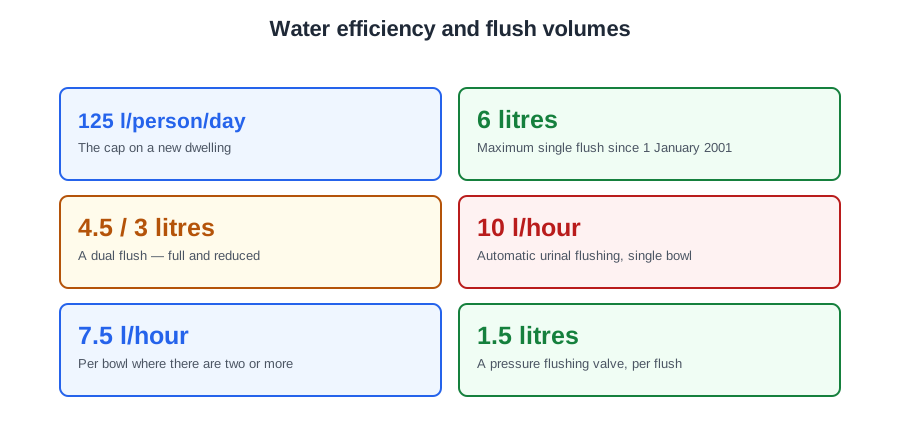
- Maximum single flush: 6 litres, from 1 January 2001.
- 1 July 1999 to 1 January 2001 was a transitional period permitting 7.5 litres.
- On a dual flush, the lesser volume must not exceed two-thirds of the largest — so 4 litres against a 6 litre flush.
Replacing an old cistern
The rule has an asymmetry that catches people out. A cistern installed before 1 July 1999 may be replaced by one of similar volume — single or dual — but a single flush may not become a dual flush.
The reason is not arbitrary, and knowing it makes the rule memorable: the pan and the flushing device are approved together as a suite. A pan designed to be cleared by a 9 litre flush may not clear on 4 litres. Fitting a dual flush cistern to an old pan produces a WC that needs flushing twice, which uses more water than the single flush it replaced — the opposite of the intention.
Two related points:
- Suite approval does not extend to urinal bowls. The pairing rule is a WC rule.
- The rules do not apply to appliances that do not solely use fluid to remove the contents — macerators and similar.
Marking
- Every flushing cistern except a pressure flushing cistern needs an indelible internal line and an indication of the volume. Indelible, and inside, so it cannot wear off or be removed.
- Dual flush devices need a readily discernible method of actuating and permanently marked instructions. A pair of identical unmarked buttons does not satisfy this, and it is extremely common.
- The performance test for a dual flush is the largest of the available flushes. The pan must clear on the full flush; the reduced flush is a bonus, not the standard the suite is judged by.
Flushing devices
Three types, each with a characteristic failure:
- A siphon is valveless, so it is inherently reliable at not leaking. Its drawback is physical effort — it needs a positive action to start the siphon, which is a genuine accessibility problem for some users.
- Drop valves and flap valves are now permitted, but they are mechanical seals, so they can leak — and waste heavily. A drop valve passing quietly into the pan can waste hundreds of litres a day with no visible symptom, because the leak goes straight down the drain. This is the single largest source of unnoticed domestic water waste in the country.
- Pressure flushing valves flush a pan with no cistern at all, direct from a supply or distributing pipe. They are banned in a house, and banned elsewhere where 1.2 l/s cannot be achieved at the appliance. A pressure flushing valve on an inadequate supply is a WC that will not clear.
Overflow arrangements
Every flushing cistern except a pressure flushing cistern or a urinal cistern needs a warning pipe, or a device no less effective.
Where a warning pipe is used, its outlet must discharge in a prominent position — the same principle as Module 10, that the pipe exists to inform somebody. Where it discharges over a tundish, the tundish itself must be visible. And a warning pipe may discharge into a WC pan, provided it does so into the air, not less than 150 mm above the top edge of the pan.
Internal overflows
Internal overflows are accepted as equally effective — the arrangement where an overfilling cistern spills into the pan rather than through a pipe to outside. But acceptance is conditional on a strainer at or upstream of the float valve.
That condition is the whole safety of the arrangement. An internal overflow gives no external signal at all; the only symptom is a WC that trickles. What causes a float valve to hang open is grit on the seat, so the strainer removes the commonest cause of the failure that the overflow would otherwise silently manage.
The course lists better alternatives, in rough order of usefulness: a visible tundish or indicator, an audible signal, a device that disables the flush, or one that closes off the supply. The last two are the only ones that stop the waste rather than reporting it.
Backflow at a WC
The contents of a WC pan or a urinal are fluid category 5. No surprise, but it sets the requirement.
Three acceptable arrangements:
- an AUK1 interposed cistern;
- a DC pipe interrupter; or
- a type AB air gap with a booster.
Why a conventional WC needs nothing extra
This is the part worth understanding rather than memorising, because it explains why a fitting nobody thinks about is compliant.
A conventional suite creates a type AG air gap at the float valve, and the cistern itself is an interposed cistern. Those two together constitute a type AUK1. So a conventional WC needs no additional backflow device — the protection is built into the ordinary arrangement. It does still need a servicing valve on the inlet.
And the reason AUK1 is acceptable here despite being only category 3 against backpressure: AUK1 is 3 against backpressure and 5 against backsiphonage, and at a WC backsiphonage is the credible risk. There is nothing in a cistern capable of generating backpressure.
One further permission worth knowing: an alternative category 3 arrangement may be accepted in place of a type AG air gap — for WC flushing cisterns only, and subject to risk assessment. Narrow, specific, and not to be generalised.
Pressure flushing valve arrangements
With no cistern there is no interposed vessel, so protection has to come from a device: a permanently vented pipe interrupter not less than 300 mm above the spillover level.
And a genuine trap: the Regulator's Specification uses 300 mm above a WC pan spillover, but 150 mm above a urinal sparge outlet. Different figure, and a different datum — the sparge outlet, not a spillover level. Two numbers that look interchangeable and are not.
DC devices carry their usual conditions: no control valve downstream, vertical pipe, flow downwards, category 5 backsiphonage only.
Distributing pipes
A single distributing pipe may flush any number of WCs and urinals — but it must not serve washbasins. The same cistern may serve washbasins, provided it does so through a separate distributing pipe.
The distinction is the pipe, not the cistern. A pipe that has served a WC sparge is not a pipe you want feeding a washbasin.
Urinals
Flushing rates
- A single urinal: 10 litres per hour.
- Two or more: 7.5 litres per hour, per bowl, per stall, or per 700 mm of slab.
The slab conversion is where the common error lives. A 2,100 mm slab is three positions — 2,100 ÷ 700 — so the rate is 3 × 7.5 = 22.5 l/h. Applying the single-urinal figure of 10 l/h to a slab because it is one physical object is the mistake, and it undersizes the flush by more than half.
Controls — the legal requirement
Unless flushed manually or electronically after use, the inlet must have a time switch and a lockable isolating valve, or an equally effective automatic device.
This is worth stating in the strongest terms: it is a legal requirement, and an uncontrolled urinal cistern contravenes the Regulations. Not a recommendation, not good practice — a contravention, on the undue consumption limb of Regulation 3.
The methods, with their honest weaknesses:
- Time switch and pet cock. Crude, and the pet cock orifice blocks — it is a deliberately tiny hole in water that carries debris.
- Hydraulic impulse. Elegant in principle: the cistern fills only when somebody draws water nearby. But it depends on the user washing their hands on the same circuit, so it fails if they do not, or if they use the hot tap. It also degrades in hard water.
- Electronic movement detection. Technically superior, and battery life is often over two years. It flushes because somebody was there, which is the thing you actually want to detect.
Cisternless urinals and other requirements
- Pressure flushing valve for urinals: not more than 1.5 litres per bowl or position. Note that this is a maximum, not a minimum — the opposite of how the cistern figures work, and easy to invert.
- Cisternless urinals: a solenoid upstream, a DC pipe interrupter for backflow, and an infrared sensor typically requiring around ten seconds of presence before it will register a use.
- Automatically operated urinal flushing cisterns are exempt from the warning pipe requirement — from Module 10, because they are fed at a controlled trickle and would be reporting a condition that is normal for them.
- And the general duty: every urinal flushing device must supply no more water than is necessary for flow over the surface and replacement of the trap fluid. That sentence is the whole module in miniature — enough to do the job, and not a litre more.
Putting the module together
6 litres since 2001, with a dual flush lesser volume no more than two-thirds of the largest, and no converting a single flush pan to dual because the suite was approved together. Warning pipes that inform, or internal overflows with a strainer to prevent the failure they would otherwise hide. A conventional WC already has its protection through an AUK1. And urinals controlled, because an uncontrolled one is a contravention rather than an inefficiency.
📝 10-Question Mock Test
Click an option to see whether you got it right. Explanations appear instantly — no submitting at the end.
Not exceeding two-thirds of the largest. The 6 litre maximum single flush has applied since 1 January 2001; the period from 1 July 1999 to then was transitional at 7.5 litres.
The pan and the flushing device are approved together as a suite. A pan designed for a 9 litre flush may not clear on 4 litres, and a WC that needs flushing twice uses more water than the single flush it replaced.
The leak goes straight down the drain, so nobody notices. A siphon is valveless and inherently reliable at not leaking; its drawback is the physical effort needed to start the siphon, which is a genuine accessibility problem.
Banned in a house outright, and banned elsewhere on an inadequate supply — a pressure flushing valve without the flow is a WC that will not clear.
The condition is the whole safety of the arrangement. An internal overflow gives no external signal — the only symptom is a WC that trickles — and grit on the seat is what makes a float valve hang open, so the strainer removes the commonest cause of the failure the overflow would otherwise silently manage.
The protection is built into the ordinary arrangement. AUK1 is category 3 against backpressure and 5 against backsiphonage, and at a WC backsiphonage is the credible risk — there is nothing in a cistern capable of generating backpressure.
Different figure and a different datum — the sparge outlet, not a spillover level. Two numbers that look interchangeable and are not.
The distinction is the pipe, not the cistern. A pipe that has served a WC sparge is not one you want feeding a washbasin.
The common error is applying the single-urinal figure of 10 l/h because a slab is one physical object. Two or more positions attract 7.5 l/h per bowl, per stall, or per 700 mm of slab.
A legal requirement, and the purest example of undue consumption under Regulation 3. Of the methods, electronic movement detection is technically superior — hydraulic impulse depends on the user washing their hands on the same circuit and degrades in hard water, and a pet cock orifice blocks.
Two things in this module waste more water than everything else on the course combined: a drop valve passing silently into the pan, and a urinal cistern flushing an empty building. Neither shows a symptom anybody notices, which is exactly why the Regulations legislate for both.
The one to carry away: an uncontrolled urinal cistern contravenes the Regulations. Time switch and lockable isolating valve, or an equally effective automatic device — it is a legal requirement, not a saving.