A customer wants a new bathroom in the loft and asks what to do about the hot water. Before you can answer you need three things: who lives in the house, how they use hot water, and what the building will physically allow.
The short answer
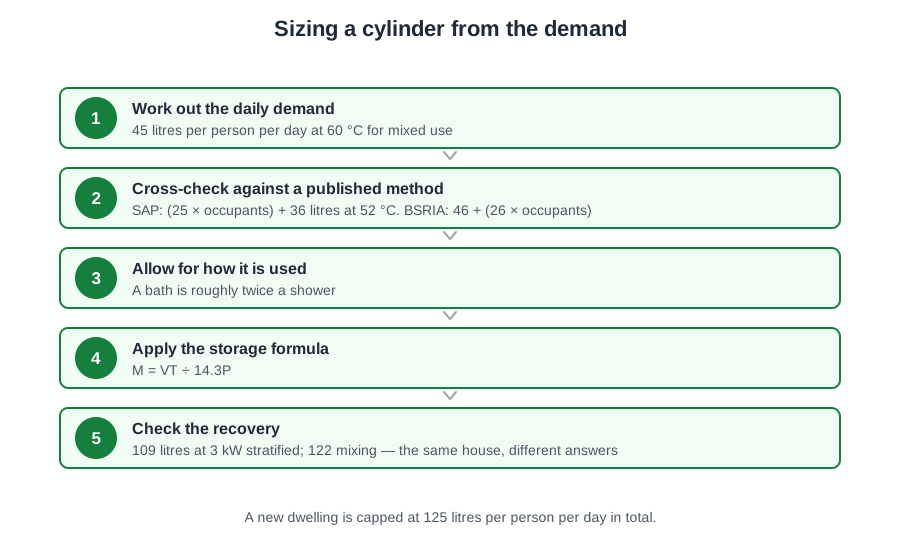
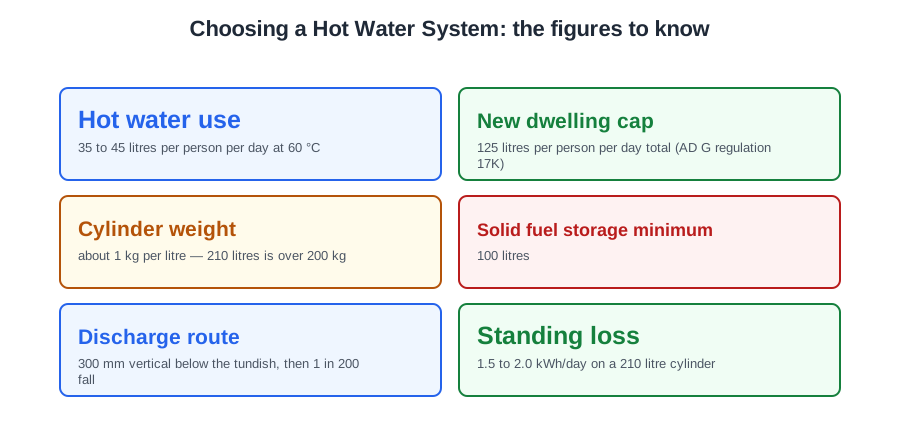
Hot water demand follows occupancy far more closely than floor area. A four-bedroom house with two people uses less hot water than a two-bedroom flat with five. Work on 35 to 45 litres per person per day at 60 °C.
But occupancy only tells you the daily total. What decides the system is finer: the number and types of sanitary appliances, and the rate and pattern of use. Three people showering inside forty minutes is a different design problem from three people spread across the day, even though the daily litres are the same.
What empties a cylinder is the peak hour, not the daily total.
Space heating comes off a heat loss calculation. Hot water comes off a conversation and then a calculation. Whether the household baths or showers, and when, is not something you can read off a drawing — and it is not a detail, because a bath uses roughly twice what a shower uses. Skip the conversation and the calculation is fiction.
What the building allows
Layout can rule systems out before cost does. The distance from the vessel to the furthest outlet matters, because the cold water in a long draw-off has to be run to waste before hot arrives; where those runs exceed the permitted lengths, only a system that can carry secondary circulation is worth considering. A downstairs cloakroom on the far side of a house may be better served by a small local heater than by a pipe run from the cylinder.
And the number of outlets likely to be open at once. A combi or instantaneous heater is a multipoint appliance, but in practice only one outlet at a time runs satisfactorily — so a house with three bathrooms and a utility room is the wrong home for one.
One combination is simply not available: an unvented cylinder must not be heated by an uncontrolled solid fuel appliance. The safety design depends on the energy cut-out being able to remove the heat source, and you cannot switch off a fire that is already burning. Where a solid fuel boiler heats water, a minimum storage capacity of 100 litres is asked for.
Three survey questions that site a cylinder
A customer points at a cupboard in the middle of the first floor landing. It is the right size and central to the bathrooms, and it may still be the wrong place.
Will the floor carry it? Reckon on roughly a kilogram per litre. A 210 litre cylinder stands at over 200 kg full, before the vessel itself, and that load sits on a small footprint — unlike a cistern in a loft, where the weight spreads across several joists. On a cupboard floor of ordinary joists and chipboard that is a real question, and sometimes an answer of no. It is cheaper to find out before you quote.
Can it be serviced? A cylinder wedged into a cupboard that only just fits will need servicing every year for twenty years. The clearance has to allow for the real jobs: recharging the expansion vessel (access to the charging point, and room for a gauge and a pump); working both relief valves by hand and seeing them reseat; removing and cleaning the in-line strainer; and withdrawing an immersion heater, which needs clear space beside or above the vessel equal to the length of the element.
Is there a safe discharge route? This is the factor that most often rules a position out. The discharge needs 300 mm of vertical drop below the tundish before any bend, then a continuous fall of at least 1 in 200 to a termination outside. A cylinder in the middle of a house with no reasonable path for a falling metal pipe to an outside wall is in the wrong position however well it fits. Because the pipe falls all the way, the route cannot rise over an obstruction, and every bend eats into its permitted length. Check it at survey and draw it on the layout.
Position also affects performance and complaints. Near the heaviest-used outlets shortens the draw-offs. Inside the heated envelope makes the standing loss at least partly useful. And a cylinder in a bedroom cupboard will be heard when an immersion, a pump or a motorised valve operates at night.
Efficiency: it is the heat source, not the cylinder
A customer wants a greener system and has been told to buy a bigger, better insulated cylinder. It will help a little. It is not where the carbon is.
The same eleven kilowatt hours of heat can come from a heat pump at a COP of three, a condensing boiler at around ninety per cent, or a direct electric immersion at a flat one to one. The carbon and the running cost differ by a factor of several. Cylinder size, recovery time and insulation change comfort and standing losses, but they move the total far less than the fuel and its efficiency do.
For scale: a typical 210 litre cylinder loses roughly 1.5 to 2.0 kWh a day just standing there, against about 11 kWh for a full reheat — about 15 per cent of one reheat, every day, whether anybody uses hot water or not. Worth insulating against; not the reason one house has twice the hot water carbon of another.
One asymmetry is worth carrying. With a boiler, raising the cylinder thermostat from 55 to 65 °C costs a little standing loss and nothing else. With a heat pump it is different in kind: every extra degree widens the temperature lift the heat pump works across, and its efficiency falls as that lift grows.
And one place where erring upwards is right: an oversized emitter costs money and wall space, an oversized boiler cycles and runs badly — but an oversized cylinder costs a little standing loss and buys time. It lets the reheat happen overnight rather than urgently at eight in the morning.
Heat pump cylinders: it is the coil that fails
A heat pump goes in and the installer leaves the old boiler cylinder in place. The customer never gets properly hot water and blames the heat pump. The cylinder is at fault, and the reason is the coil.
Heat crosses a coil in proportion to its surface area and the temperature difference across it. A boiler sends primary water round at about 75 °C into a store at 60. A heat pump can offer only about 50 °C. That is a fraction of the difference, so to pass the same power the area has to grow: a boiler cylinder gets by with roughly 1 m² of coil; a heat pump cylinder typically has about 3 m², to the heat pump and cylinder makers’ recommendations (MIS 3005-D).
Put a heat pump on a 1 m² coil and it is not simply slower. The coil cannot pass the power, the heat pump throttles back, and the store never reaches temperature at all.
Then the temperature conflict. A store held at 45 °C to keep the heat pump efficient sits squarely inside the Legionella growth band. The resolution is not to pick one temperature — it is a periodic pasteurisation cycle from a second heat source: the heat pump heats to around 45 to 52 °C day to day, and an immersion on a timer takes it to 60 periodically, typically weekly when electricity is cheap.
Two details make the cycle work. The immersion must reach low in the cylinder — a cycle that leaves 70 litres of 45 °C water at the bottom has achieved nothing — and it must run long enough to bring the whole volume up. And the customer has to be told: it is a safety control and must not be switched off. To somebody who has not been told, it looks like a wasteful timer, and a helpful relative will turn it off.
Reheat time changes the whole design. About 11 kWh heats 210 litres from cold. Through a coil passing 6 kW that is 1 hour 50; a boiler through a 1 m² coil at 15 kW does it in about 44 minutes; a 3 kW immersion takes nearly four hours. On a boiler, running a cylinder down was a twenty minute inconvenience. At two hours it is a design constraint: reheat is scheduled, and the store has to carry the whole peak.
Solar: which coil takes which source
A solar array has been on a roof for three years and the customer says it has never saved a penny. The panels work, the pump runs, the controller is happy. The two coils are connected the wrong way round — and nothing looks wrong, because the system still makes hot water. The boiler does all of it.
A solar collector works better the colder the water returning to it, because a cooler absorber loses less heat to the sky. Hot water rises, so the coldest water in a cylinder is at the bottom. Therefore the solar circuit takes the lower coil.
The second half follows: the boiler takes the upper coil, so it heats only the upper part of the store and tops up the last few degrees. If the boiler heated the whole vessel it would leave the collector nothing cold to work with, and the solar contribution would be destroyed entirely.
Sizing the solar side: design to 25 litres of dedicated storage per net square metre of collector. The solar coil should be at least 10 per cent of the collector aperture area, designing to around 0.2 to 0.25 m² of coil per m² of aperture. When a customer asks whether their existing cylinder can be reused, the answer is usually no, and the coil is what rules it out.
The division of labour to carry: solar pre-heats; the auxiliary source guarantees. Neither can do the other's job. A solar system cannot be relied on to reach a safe storage temperature, so the auxiliary must be able to raise the whole stored volume to at least 60 °C.
And what destroys the benefit: stratification is what makes a solar cylinder work, so anything that stirs the layers costs output. The commonest offender is a secondary return brought in at the bottom or into the cold feed. The return belongs in the upper part, where water back at 50 °C or more barely disturbs the layers. Height helps, a slow draw-off helps, and a diffuser on the cold feed helps.
🔢 The numbers worth memorising
- Hot water use
- 35 to 45 litres per person per day at 60 °C
- New dwelling cap
- 125 litres per person per day total (AD G regulation 17K)
- Cylinder weight
- about 1 kg per litre — 210 litres is over 200 kg
- Solid fuel storage minimum
- 100 litres
- Discharge route
- 300 mm vertical below the tundish, then 1 in 200 fall
- Standing loss
- 1.5 to 2.0 kWh/day on a 210 litre cylinder
- Full reheat
- about 11 kWh for 210 litres
- Boiler coil
- about 1 m² · heat pump coil typically about 3 m²
- Heat pump primary
- about 50 °C against a boiler’s 75
- Solar storage
- 25 litres per net m² of collector
- Solar coil
- at least 10 per cent of aperture; design to 0.2–0.25 m² per m²
⚠️ Where people go wrong
- Sizing hot water off floor area. It follows people and their pattern of use — and the peak hour, not the daily total.
- Siting a cylinder on floor area alone. Weight, servicing clearance and the discharge route all have a veto.
- Selling a bigger cylinder as the green upgrade. The carbon is in the heat source.
- Leaving an old boiler cylinder in place for a heat pump. A 1 m² coil cannot pass the power, and the store never reaches temperature.
- Switching off a pasteurisation timer because it looks wasteful. It is a safety control — tell the customer.
- Connecting the solar to the upper coil. The collector wants the coldest water, which is at the bottom.
- Bringing a secondary return in at the bottom of a solar or heat pump cylinder, or into its cold feed. It stirs the whole store and costs usable litres. The return belongs in the upper part.
📝 10-Question Self-Test
Straight from the Level 3 course question bank. Click an option to see whether you got it right — the explanation appears instantly, and there is nothing to submit.
Storage covers what a weak main cannot deliver on demand: the cylinder fills slowly through the day and gives its contents up quickly when a bath is run, so a centralised stored system suits a three-bedroom house on a low pressure supply. One hand basin in a site office, one dental chair or a single cafe sink is a job for a heater at the outlet.
The carbon of hot water is set by what heats it: a heat pump, solar or a condensing boiler against direct electric. Cylinder size and recovery time change comfort and losses far less than the fuel and its efficiency.
How many hot outlets there are, what they are and how often they run together sets the hot water demand, and that demand decides between instantaneous, stored vented or stored unvented hot water.
Solar thermal collects heat that arrives free at the collector, so in use it burns no fuel and releases no carbon dioxide. Electric immersion heating is the tempting pick because nothing burns in the house, but the electricity still has to be generated somewhere, and LPG and coal both burn fossil fuel directly at the appliance.
SEDBUK stands for Seasonal Efficiency of Domestic Boilers in the UK, and it is the database gas and oil boiler seasonal efficiencies are looked up in; the SAP calculation draws its boiler figures from it. OFTEC and HETAS register oil and solid fuel installers — they certify people, not appliance efficiency.
Demand is set by what the appliances draw and when they draw it. Three people showering inside forty minutes is a different design problem from three spread across the day, even at the same daily total, and it is the peak hour that empties a cylinder. The number of radiators belongs to the heat loss calculation, not the hot water one.
A quarter-turn tap with a lever needs a push rather than a grip and repeated turns, which is what a person with arthritic hands cannot manage. The accessibility guidance names lever operation rather than quarter turn - Approved Document M 3.34 d asks for taps that are lever operated and capable of easy operation - so it is the lever that does the work here, and a quarter turn tap with a crosshead would be no easier.
A thermal store, or water jacketed tube heater, is filled with primary water heated by the boiler; the mains cold you draw passes through a heat exchanger inside it and is heated on demand, so it is never stored. An unvented cylinder is the other way round — the domestic hot water itself is what sits in the vessel. “Both store domestic hot water” misses the whole distinction.
Mains water passes through a heat exchanger inside a body of stored primary water, giving an instantaneous output — but only if that primary is hot, which is what a low temperature source cannot provide.
The same relationship that governs the space heating flow temperature, applied to the cylinder. Standing loss rises too, but that is much the smaller effect.
Going further: the lessons behind this article
This article is the public answer. Unit 332 of the Level 3 course takes the same ground to the depth the exam and the synoptic assignment ask for, in 5 lessons:
- Choosing a hot water system: people, building and appliances
- Siting the cylinder: weight, clearance and the discharge route
- Efficiency, carbon and cost: what the heat source decides
- Heat pump cylinders: coil area, store temperature and reheat
- Solar and twin-coil cylinders: which coil takes which source
- Hot water systems: the Unit 332 guide — every article on this unit in one place
- All PlumbMate articles — Level 1, 2 and 3
- The Level 3 course — the whole 8202-35 Diploma