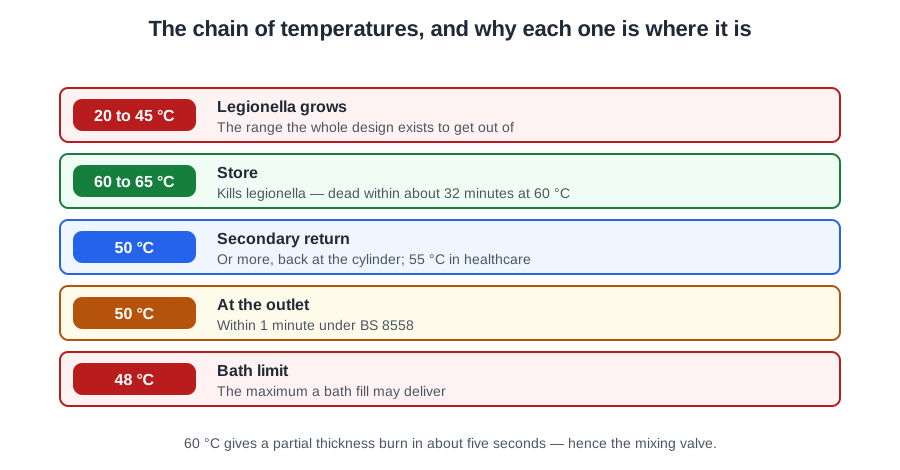
Two facts sit in opposition, and every temperature in hot water design is a compromise between them. Between 20 and 45 °C Legionella multiplies. At 60 °C water gives a partial thickness burn in about five seconds.
The short answer
Between 20 and 45 °C Legionella bacteria multiply, roughly doubling every couple of minutes. At 60 °C they are dead within about 32 minutes — but water at 60 °C will give a partial thickness burn in about five seconds.
So the system is designed to be hot in the store and the pipes, and cooled at the point of use. Every figure below is a step in that chain.
The chain of temperatures
| Point in the system | Design temperature |
|---|---|
| Storage vessel | 60 to 65 °C |
| Leaving the calorifier (secondary flow) | at least 60 °C |
| Secondary return at the cylinder | at least 50 °C (55 °C in healthcare) |
| Any outlet, within 1 minute | at least 50 °C (55 °C in healthcare high-risk areas) |
| Instantaneous heaters | about 35 to 55 °C, falling as flow rises |
| Small vented storage heaters (5–10 litres) | up to about 75 °C |
| Unvented heaters up to 15 litres | up to about 80 °C, cut-out at 85 °C |
Above all of it sits the ceiling: the Water Regulations require that water in a secondary hot water system never exceeds 100 °C (Schedule 2 paragraph 18). Below it sits the cold side: cold water should be below 20 °C after running for up to two minutes, and never warmed above 25 °C.
Large stored systems should also be capable of being raised to 70 °C for disinfection.
The outlet figure, and its three versions
You will meet three versions of this figure. Know which one you work to:
- BS 8558: at least 50 °C within 1 minute of running the water — and the supply to any thermostatic mixing valve must reach the same. In healthcare high-risk areas, 55 °C within 1 minute. HSE’s HSG274 Part 2 gives the same, and this is the figure you work to.
- BS EN 806-2: 30 seconds after fully opening a draw-off, not less than 60 °C for a central system — unless national regulations specify otherwise. BS 8558 is the UK provision that specifies otherwise.
- The 1999 Water Regulations guidance (G18.2 and G18.4) is older: it asks for distribution at 55 °C and 50 °C within 30 seconds where practicable. Whichever figure you quote, give the temperature and the time together.
On a performance test at outlets where no mixing valve is involved, the measured temperature should fall in the range 50 to 55 °C.
The 48 °C bath limit
Approved Document G 3.65 is unambiguous: the hot water supply temperature to a bath must be limited to a maximum of 48 °C, by an in-line blending valve or other appropriate device, with a maximum temperature stop and a suitable arrangement of pipework. The valve must comply with BS EN 1111 (thermostatic mixing valves) or BS EN 1287 (low pressure), fail safe, and not be easily altered by the building's users.
Note what the requirement covers: the bath, in new and refurbished dwellings. A kitchen sink is not an outlet that must have a mixing valve — which is why, if a customer says the kitchen tap runs too hot, the first move is to check the cylinder thermostat. Bear in mind the store must still be held at 60 °C or above for Legionella control, so if it genuinely is too hot at that setting, a mixing valve at the outlet becomes the answer after all.
A TMV mixes hot and cold to a set temperature and holds it, using a wax or bi-metal element to move a shuttle that opens one port as it closes the other. If the cold supply fails, the valve shuts down rather than passing hot water through.
| Appliance | Typical mixed temperature |
|---|---|
| Bath (AD G maximum 48 °C) | 41 to 44 °C |
| Shower | not more than 43 °C (41 °C in care settings) |
| Washbasin | 38 to 41 °C |
| Bidet | maximum 38 °C |
| Kitchen sink (no TMV required) | 46 to 48 °C |
TMV2 and TMV3
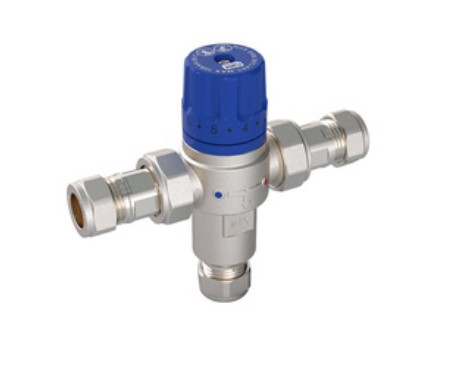
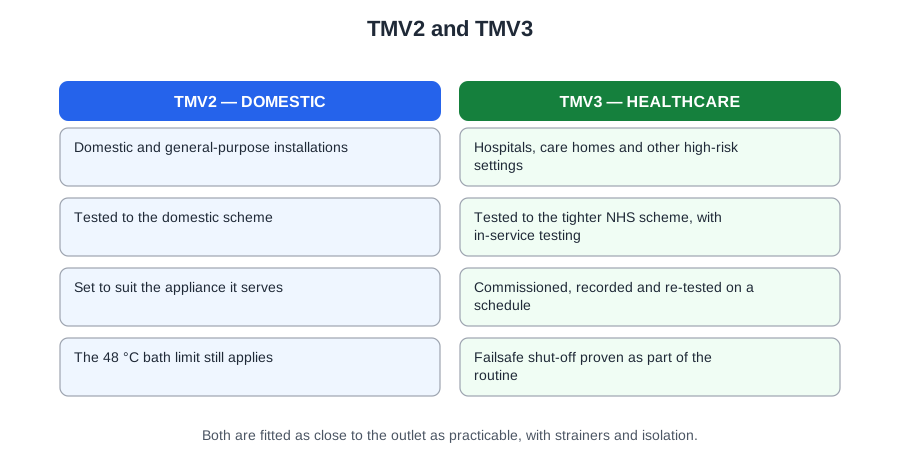
Mixing valves are certificated under a third-party scheme in two classes, and the split is by who uses the building:
- TMV2 — domestic installations, tested against BS EN 1111 and BS EN 1287. A bath, basin or shower in a private dwelling, housing association home, hotel or school (with a 43 °C maximum at school baths).
- TMV3 — healthcare and commercial, tested against NHS specification D08. NHS and private nursing homes, young persons' care homes, hospitals and schools for the severely disabled.
Getting the installation right
- Single valve: one valve, one appliance, with the pipe from valve to outlet no more than 2 m. Back-to-back appliances may share a valve if one does not affect the other.
- Group mixing: several similar appliances from one valve, with pipework short enough that mixed water reaches the furthest tap within 30 seconds. Group showers run at 38 to 40 °C and must not exceed 43. Not recommended where the occupants are high risk.
- Centralised mixing: different appliance types from one valve, with anti-Legionella precautions if the mixed water is recirculated in the growth range.
The supply to any TMV must itself be at at least 50 °C within 1 minute, or the valve has nothing hot to blend. And where a store can exceed 80 °C — heat stores, solar collectors, solid fuel boilers without intervening controls — an in-line tempering valve to BS EN 15092 holds the distribution to no more than 60 °C before the TMVs see it at all.
Two housekeeping figures follow from the same risk: shower heads and hoses, where the aerosol is made, are dismantled, cleaned and de-scaled quarterly in non-domestic premises; and when a hot water system is disinfected the chemical used is sodium hypochlorite.
🔢 The numbers worth memorising
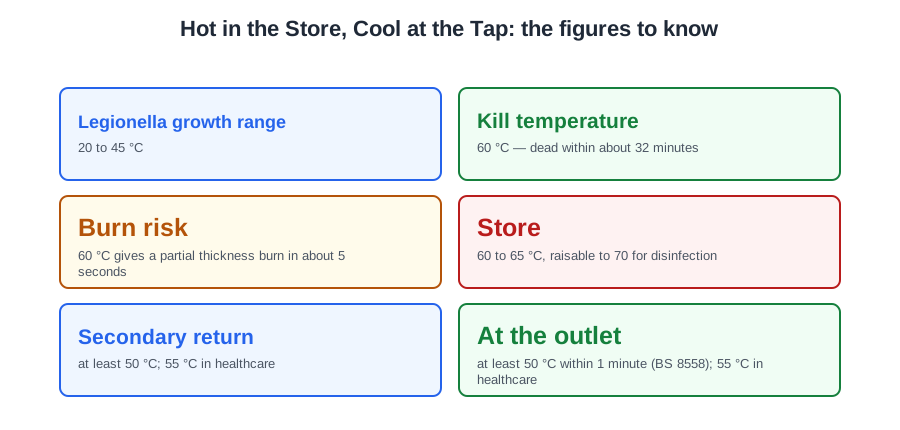
- Legionella growth range
- 20 to 45 °C
- Kill temperature
- 60 °C — dead within about 32 minutes
- Burn risk
- 60 °C gives a partial thickness burn in about 5 seconds
- Store
- 60 to 65 °C, raisable to 70 for disinfection
- Secondary return
- at least 50 °C; 55 °C in healthcare
- At the outlet
- at least 50 °C within 1 minute (BS 8558); 55 °C in healthcare
- Water Regs guidance (1999)
- 50 °C within 30 seconds; older, and you work to the minute
- Bath limit
- 48 °C (Approved Document G 3.65)
- Shower
- not more than 43 °C; 41 °C in care settings
- Single TMV to outlet
- no more than 2 m
- Group mixing
- mixed water at the furthest tap within 30 seconds
- Never exceed
- 100 °C in a secondary hot water system
⚠️ Where people go wrong
- Turning the store down because a tap is too hot. The store stays at 60 °C for Legionella — the answer is a mixing valve at the outlet.
- Fitting a TMV to a kitchen sink because it seems safer. The requirement is the bath, and a sink is expected to run at 46 to 48 °C.
- Quoting a temperature with no time. The figure is 50 °C within a minute; the older Water Regulations guidance says 30 seconds, and either way the two halves go together.
- Using a TMV2 in a nursing home. TMV3 is the healthcare class, tested against NHS D08.
- Running a single TMV more than 2 m from its outlet.
- Feeding a TMV with water that never reaches 50 °C. It has nothing hot to blend.
📝 10-Question Self-Test
Straight from the Level 3 course question bank. Click an option to see whether you got it right — the explanation appears instantly, and there is nothing to submit.
Balancing shares the circulating flow between the branches so that the far outlets are kept hot: water at the outlet should be at least 50 C within a minute of running, and the return to the cylinder at least 50 C, to control Legionella.
An accumulator is a pressurised store of cold mains water. It fills when demand in the street is low and the main is at its best, then gives that water back at pressure through the day, so a weak supply can still meet the flow an unvented cylinder needs. A larger pressure reducing valve cannot help: a reducing valve only lowers pressure, it never adds flow.
Approved Document G 3.65 limits the hot water supply temperature to a bath to a maximum of 48 °C, through an in-line blending valve with a maximum temperature stop that the occupier cannot alter. 41 °C is a comfortable blended bathing temperature, not the regulatory ceiling, and 55 °C is the healthcare figure for hot water reaching an outlet, not a bath limit.
BS 8558 clause 4.3.5.1.1 sets at least 50 C at the outlet within one minute of running, with the water leaving the cylinder at 60 C. That 60 C is the storage figure, not the delivery one. BS EN 806-2 clause 3.6 asks for not less than 60 C thirty seconds after the tap is opened, unless local or national regulations specify otherwise, and BS 8558 is the UK provision that does, so 50 C within a minute is the figure applied here.
Hot water is stored at 60 degrees C or above and should arrive at the outlets at 50 or above within a minute of opening the tap, which is the Legionella control figure. At the tap, then, the performance test is looking for the low to mid fifties.
A digital shower mixes hot and cold in an electronically controlled valve, with a processor box sited remotely and a control panel in the showering area, and that panel is most commonly a dial turned to set temperature and flow. Push-button versions exist, which is why that option tempts, but the dial is the usual arrangement. Foot pedals and pull cords belong to other appliances entirely.
Approved Document G 3.65 sets the maximum hot water supply temperature to a bath at 48 °C, achieved with a blending valve that has a maximum temperature stop and fails safe. 43 °C is the usual upper limit for a shower and for a school bath, which is why it tempts, but it is not the figure Part G gives for a bath in a dwelling.
A low pressure thermostatic mixing valve on a bath is set to deliver no more than 48 C, the ceiling Approved Document G 3.65 puts on the hot water supply to a bath. G 3.66 makes no standard compulsory: it accepts a valve conforming to BS EN 1111 or BS EN 1287 as a way of showing that 48 C cannot be exceeded and that the valve fails safe. 55 C is the healthcare figure for hot water reaching an outlet, upstream of any mixing valve, not the valve’s outlet figure.
Most hot water appliances are set to a working temperature of 60 C. BS 8558 clause 4.3.5.1.1 asks for water leaving a calorifier or hot water storage vessel at not less than 60 C, and at that temperature the City and Guilds textbook teaches that Legionella is dead within about 32 minutes, a figure no standard gives. Setting 65 C buys nothing and costs standing heat loss, scale and a higher scald risk.
Approved Document G 3.62 accepts a trapped gully with the end of the pipe below the fixed grating and above the water seal. Below the grating keeps very hot discharge away from anyone standing there; above the seal keeps the discharge visible and stops foul water being drawn back up the pipe. Ending 100 mm above the grating would spray near-boiling water at ankle height.
Going further: the lessons behind this article
This article is the public answer. Unit 332 of the Level 3 course takes the same ground to the depth the exam and the synoptic assignment ask for, in 2 lessons:
- Design temperatures: storage, flow, return and outlet
- Limiting outlet temperature: bath limits and TMV types
- Hot water systems: the Unit 332 guide — every article on this unit in one place
- All PlumbMate articles — Level 1, 2 and 3
- The Level 3 course — the whole 8202-35 Diploma