A building control officer asks why you designed a system a particular way. Answering means knowing which document you are relying on and what kind of document it is, because they do not all carry the same weight.
The short answer
Not everything you work to is law. The Building Regulations and the Water Supply (Water Fittings) Regulations 1999 are statutory; a British Standard is voluntary unless legislation calls it up. Knowing which is which is the difference between defending a design and guessing at it.
The numbers that follow are the ones the calculations actually need: 45 litres per person per day at 60 °C for typical mixed use, 4.2 kJ to raise one litre of water by one degree, and a recovery rate that falls straight out of the heat input.
Every hot water calculation on the paper is one of four: energy, storage, reheat time, or expansion. Learn the four and the arithmetic looks after itself.
Which documents are law
Two sets of rules govern domestic hot water, and both are law:
- The Building Regulations. Hot water storage is controlled by Part G, and G3 covers hot water supply and systems, vented and unvented alike. Efficiency comes under Part L.
- The Water Supply (Water Fittings) Regulations 1999. These set the requirements for the fittings themselves — and for a cold water storage cistern feeding a hot water vessel, with its lid, screened warning pipe, insulation and backflow protection, this is the legislation that applies.
Unvented systems sit under both at once. The unvented rules do not apply to a system of 15 litres or less, and G3 requires stored water never to exceed 100 °C.
A British Standard is voluntary. It has no legal force of its own unless legislation calls it up — the foreword to BS 8558 says plainly that compliance with a British Standard cannot confer immunity from legal obligations. Following it is still the normal way of showing you have complied, and departing from it needs a reason you can defend. So when a question offers the Water Regulations, the Building Regulations, an Approved Document and a British Standard and asks which is not statutory, the British Standard is the answer.
Two bodies worth knowing by name: WRAS, the Water Regulations Advisory Scheme, publishes the Water Regulations Guide and runs the approval arrangements; and the Drinking Water Inspectorate approves chemicals used in contact with drinking water — any disinfectant must be on the DWI approved list.
Which drawing answers which question
A layout drawing shows the components where they are physically located, on the plan of the building. If you want to know where the cylinder goes, this is the drawing. A schematic shows how the system connects, without regard to true position or scale — for understanding the order of components, not for measuring. A specification is the written half: materials, appliances, standards and workmanship the drawings cannot show.
And the manufacturer's instructions are not a formality. For an unvented system they are the only source of several figures you cannot get anywhere else: the minimum supply pressure and flow rate the unit needs; the minimum size of the incoming cold supply and hot distribution; the heat input and recovery time; the electrical requirements; the calculation for sizing the discharge pipework; and the fault-finding data. Working outside them can itself be a breach of the Regulations.
Working out the daily demand
Work on 45 litres per person per day at 60 °C for typical mixed use. A family of four is therefore 180 litres a day. Adjust it: a showers-only household runs at 25 to 35 litres a head; a household that baths, or uses high-flow showers, at 55 and upwards.
Two formulae are quoted constantly:
- SAP: (25 × occupants) + 36 litres per day at 52 °C. Three occupants = 111 litres.
- BSRIA: 46 + (26 × occupants). Four occupants = 150 litres.
Note that the SAP figure is at 52 °C, not 60. Comparing volumes at different temperatures without correcting them is a classic error.
| Use | Typical volume |
|---|---|
| Bath | 80 to 100 litres |
| Shower | 30 to 50 litres |
| Washing machine | 10 to 20 litres |
| Dishwashing | 10 to 15 litres |
| Hand washing | 5 to 10 litres |
A bath is roughly twice a shower. An average bath is 60 litres at 60 °C plus 40 litres of cold — or 100 litres at 40 °C. The same bath, described two ways.
Sizing the cylinder
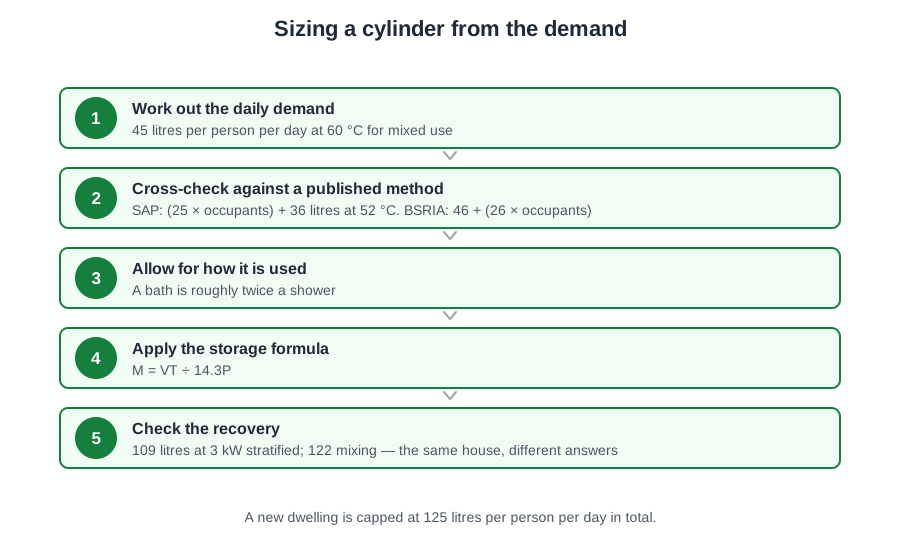
Start at 45 litres per occupant, minimum 100 on solid fuel; 100 to 150 litres is generally enough for a small dwelling with a bath. Then refine it with the storage formula:
M = VT ÷ 14.3P
where M is the time in minutes, V the volume heated in litres, T the temperature rise in °C and P the heat input in kW. Typical P values: 3 kW immersion or gas circulator, 6 kW small boiler and direct cylinder, 10 kW medium boiler and indirect, 15 kW large domestic boiler and indirect.
The worked example
One bath of 60 litres at 60 °C plus 10 litres for the kitchen, followed by a second bath of 100 litres at 40 °C after 25 minutes. Assume good stratification.
Step 1 — how long to reheat 60 litres through 50 °C at 3 kW? M = (60 × 50) ÷ (14.3 × 3) = 70 minutes. Far more than 25, so the second bath must come out of storage.
Step 2 — how much does 25 minutes of 3 kW heat? Transposing, V = M(14.3P) ÷ T = (25 × 14.3 × 3) ÷ 50 = 21 litres.
Step 3 — minimum storage: (70 + 60) − 21 = 109 litres.
Repeat with a bigger heat input and the vessel shrinks. At 6 kW the 25 minutes heats 42 litres, so storage falls to 88 litres; at 10 kW the second bath needs no storage at all.
| Heat input | One bath, stratified | One bath, mixing | Two baths, stratified |
|---|---|---|---|
| 3 kW | 109 L | 122 L | 165 L |
| 6 kW | 88 L | 88 L | 140 L |
| 10 kW | 70 L | 70 L | 130 L |
| 15 kW | 70 L | 70 L | 120 L |
Two lessons out of that table: raising the heat input buys back storage volume, and promoting stratification is worth real litres.
Reheat, recovery rate and usable volume
Water has a specific heat capacity of about 4.18 to 4.2 kJ/kg·K. Heating 210 litres from 10 to 55 °C is therefore 210 × 45 × 4.18 ÷ 3600 = about 11 kWh. (Dividing by 3600 converts kilojoules to kilowatt hours.)
Reheat time is that energy divided by the power the source can actually deliver into the water: 6 kW coil = 1 h 50; 15 kW through a 1 m² coil = about 44 minutes; 3 kW immersion = nearly four hours.
The same idea expressed as a flow is the recovery rate:
Recovery rate (l/h) = (kW × 3600) ÷ (temperature rise × 4.2)
For a 3 kW immersion raising water through 50 °C: (3 × 3600) ÷ (50 × 4.2) = about 51 litres an hour. That is why a 3 kW immersion alone is slow.
And the number on the label is the net volume. What the customer gets is the usable volume — the part that comes out hot enough to use before the temperature falls away. A well-designed cylinder gives 70 to 80 per cent; a poor one nearer 60. The difference is stratification, and anything that stirs the layers costs usable litres: a secondary return brought in at the bottom, a missing diffuser on the cold feed, a squat vessel.
Put it together: a 210 litre cylinder at 75 per cent usable holds 158 usable litres, which blends to about 263 litres at 40 °C — three baths.
Sizing pipes, pumps and vessels
Pipes are sized to provide adequate pressure and flow at every draw-off point. One loading unit = 0.1 l/s. Beginning at the last draw-off, add the loading units along each section and read the size from the tables: basin, bidet and WC cistern 1 LU; kitchen sink, washing machine, dishwasher and shower head 2 LU; urinal flush valve 3; domestic bath 4; garden tap 5.
Two things catch people out. There is no step converting loading units into a design flow rate, because the probability of simultaneous demand is already built into the pipe size tables — that is exactly what makes it the simplified method. And the method is used equally for hot and cold pipes, but it cannot size a secondary return, because a return is sized on the heat the loop has to carry, not on draw-off demand.
Fittings behave like extra pipe: effective length = actual length + equivalent length. On 15 mm copper an elbow counts as about 0.5 m, a tee 0.6, a check valve 2.5 and a stop valve 4.0. On 22 mm: 0.8, 1.0, 4.3 and 7.0.
Velocity is capped at 2.0 m/s in header, rising and floor service pipes, and 4.0 m/s in a connection pipe to a single fitting.
And a rule that runs against instinct: on hot water, oversizing a draw-off is not the safe option. A bigger pipe holds more cool water that has to run off before hot arrives — wasted water, wasted stored heat, and a failure against the 50 °C-within-a-minute figure. On hot water, the smallest pipe that carries the flow is the right one.
Pumps. A secondary circulation pump is sized from the heat the circuit loses and the flow-to-return drop: mass flow (kg/s) = kW ÷ (specific heat × the temperature difference). A booster or shower pump is sized on its duty: static head + the pressure wanted at the outlet + friction. Remember 1 bar = 10 m head = 100 kPa. For 15 l/min at 2 bar to a head 3 m above the pump, friction taken as static × 0.05: 30 + 200 + 1.5 = 231.5 kPa.
Expansion. Heated water expands by 4 per cent, and that is the figure used for sizing a feed and expansion cistern. On a sealed system it goes into an expansion vessel sized from system volume, fill pressure and relief setting. On a vented primary the open vent rises above the cistern water level by 150 mm plus 40 mm per metre of head.
Set the whole thing out on a spreadsheet: a column per pipe section, with its loading units, length, fittings and resulting size, exported to PDF for the quotation or tender. A mistake in a column is visible; a mistake in a page of longhand is not.
🔢 The numbers worth memorising
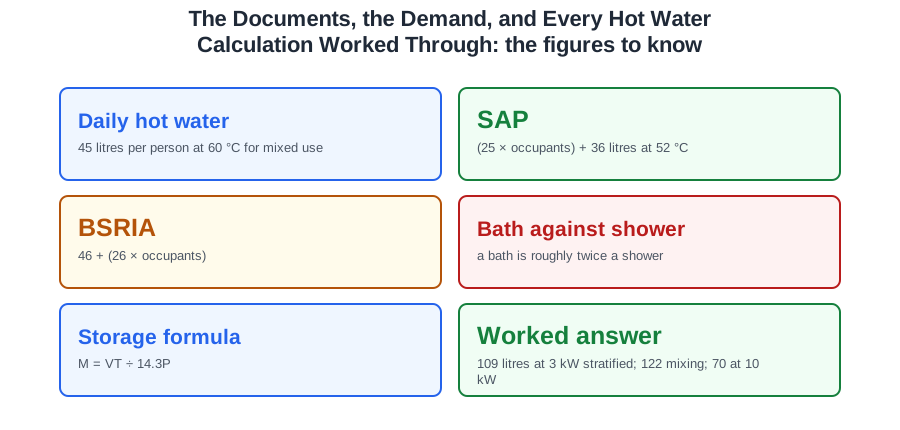
- Daily hot water
- 45 litres per person at 60 °C for mixed use
- SAP
- (25 × occupants) + 36 litres at 52 °C
- BSRIA
- 46 + (26 × occupants)
- Bath against shower
- a bath is roughly twice a shower
- Storage formula
- M = VT ÷ 14.3P
- Worked answer
- 109 litres at 3 kW stratified; 122 mixing; 70 at 10 kW
- Specific heat of water
- about 4.18–4.2 kJ/kg·K
- 210 litres, 10 to 55 °C
- about 11 kWh
- Recovery rate
- (kW × 3600) ÷ (rise × 4.2) — 3 kW through 50 °C ≈ 51 l/h
- Usable volume
- 70 to 80 per cent of net in a good cylinder
- One loading unit
- 0.1 l/s
- Velocity limit
- 2.0 m/s in service pipes, 4.0 to a single fitting
- Expansion allowance
- 4 per cent
⚠️ Where people go wrong
- Treating a British Standard as law. It is voluntary unless legislation calls it up.
- Comparing a SAP figure at 52 °C with the old BS 6700 figure at 60 °C without correcting.
- Converting loading units to a design flow in the BS EN 806-3 method. Diversity is already in the tables.
- Sizing a secondary return with the loading unit method. It carries heat, not draw-off demand.
- Oversizing a hot draw-off “to be safe”. More cool water to run off, and a failure against 50 °C in a minute.
- Quoting a net cylinder volume to a customer. Usable is 70 to 80 per cent of it.
- Ignoring stratification in the storage formula. The same case swings from 109 to 122 litres.
📝 10-Question Self-Test
Straight from the Level 3 course question bank. Click an option to see whether you got it right — the explanation appears instantly, and there is nothing to submit.
Installation detail for a particular thermostatic mixing valve - its position, strainers, check valves and commissioning settings - comes from the manufacturer's installation instructions for that valve.
Efficiency is a Building Regulations matter. Part L and the compliance guidance under it set the minimum standards for hot water storage vessels, including standing heat loss and insulation.
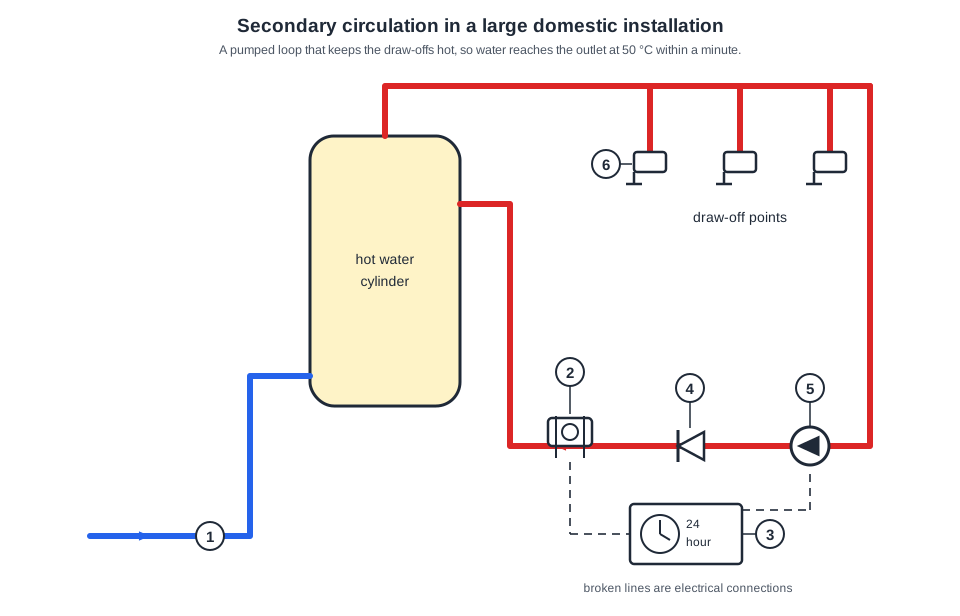
The pump at 5 sits in the secondary return, so it is circulating drinkable water drawn straight from the cylinder. That means a bronze or stainless steel body: a cast-iron circulator would rust in fresh, oxygenated water and discolour every hot tap. A “twin-impeller shower pump” boosts one outlet, it does not drive a circulating loop.
Every valve, elbow and tee resists flow, and the neatest way to account for that is to express each one as the length of straight pipe that would cause the same loss. Add those allowances to the measured run and you have the effective length used in the pressure loss calculation. On 15 mm copper an elbow counts as about 0.5 m and a stop valve about 4 m.
A spreadsheet sets the work out in columns — section, loading units, length, fittings, resulting size — so a mistake is visible, it recalculates when one figure changes, and it exports to PDF to go with a quotation or tender. Presentation slides can display a result but will not work it out, and an image editor does no arithmetic at all.
Heater output in kW multiplied by 3,600 seconds, divided by the temperature rise and the specific heat of water (4.2 kJ/kg K), gives the kilograms (litres) of water heated per hour: the recovery rate.
The pump's settings, speed selection, venting and checks are in its installation instructions.
Hot water storage is controlled by Part G of the Building Regulations (G3 for unvented and vented storage).
Current is power divided by voltage, so 6000 divided by 230 is about 26 A and the protective device has to be the next standard size above it. A 16 A device would trip on normal running load. 45 A and 50 A are far above what the appliance and its cable draw, so a fault would be allowed to run for too long before the breaker disconnected it.
Water needs 4.18 kJ to raise 1 kg by 1 K (4.186 kJ/kg K); it is the figure every heat-load and hot water calculation uses.
Going further: the lessons behind this article
This article is the public answer. Unit 332 of the Level 3 course takes the same ground to the depth the exam and the synoptic assignment ask for, in 6 lessons:
- Statutory rules, standards and guidance: which document does what
- Drawings, manufacturer instructions and the customer brief
- Working out the daily hot water demand for a dwelling
- Sizing the cylinder: 45 litres per occupant and the storage formula
- Recovery rate, reheat time and usable volume
- Sizing pipes, pumps and expansion vessels
- Hot water systems: the Unit 332 guide — every article on this unit in one place
- All PlumbMate articles — Level 1, 2 and 3
- The Level 3 course — the whole 8202-35 Diploma