Every hard question on Unit 332 is the same question wearing different clothes: what happens if this water gets too hot, and what happens if it does not get hot enough.
The short answer
Unit 332 — Hot water system planning and design — is about choosing, sizing, controlling and commissioning a hot water system, and about the two failure modes that sit either side of it.
Too hot is a safety problem, and the unit answers it with a layered set of controls: a control thermostat, then a non-self-resetting energy cut-out, then a temperature and pressure relief valve, each one catching the failure of the last. Too cold is a Legionella problem, and the unit answers it with storage temperature, distribution temperature and the elimination of dead legs.
Almost every design decision in this unit sits between those two.
How the unit is shaped
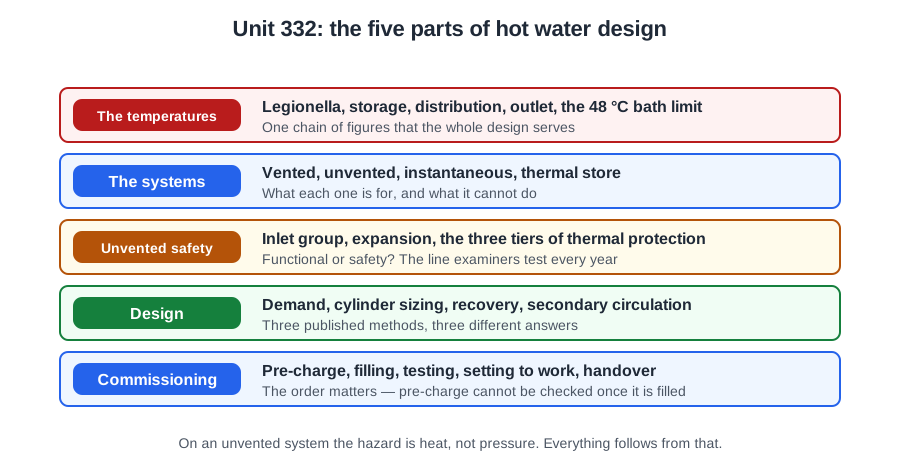
The systems. Vented and unvented, direct and indirect, instantaneous and storage, thermal stores and combination units. You are asked to choose between them for a stated building and justify it, which means knowing what each is bad at as well as what it is good at.
The controls. The unvented safety chain, expansion vessels and their pre-charge, the discharge pipe arrangement (D1, the tundish, D2, the termination), and what makes each one a legal requirement rather than good practice.
Temperature and Legionella. Storage at 60 °C, distribution reaching 50 °C within a minute, return at 50 °C or above, and the arrangements — secondary circulation, trace heating, short draw-offs — that make those achievable.
Sizing. Cylinder volume from occupancy and recovery, secondary circuit sizing, expansion vessel sizing from the volume and the temperature rise, and the information sources the calculations come from.
Installation, commissioning and fault-finding. Filling, venting, testing, flushing, setting to work, handing over, and then the diagnostic half: a symptom, a set of possible causes, and a way of separating them.
What actually makes it hard
The safety chain is a sequence, not a list. The control thermostat operates first, at the set temperature. If it fails, the energy cut-out operates and does not reset itself. If that fails, the relief valve discharges. Naming all three earns less than explaining what each catches.
The discharge pipework has more rules than any other pipe in the qualification. D1 to the tundish, no more than 600 mm of pipe from the valve, 300 mm of straight D2 below the tundish before any bend, resistance expressed in equivalent length, and a termination that is safe and visible. It is examined in detail because it is what fails in practice.
Legionella temperatures are precise and the reasons matter. 60 °C stored is not a comfort setting; it is a kill temperature. And the reason a long dead leg is a problem is not waste — it is that the water in it never reaches either the hot or the cold safe zone.
The fault-finding questions expect a method. "Check the thermostat" is not a diagnosis. The marks are for narrowing: what does this symptom rule in, what does it rule out, and what is the next test that separates the remaining two.
Where it connects to the rest of the course
The backflow thinking is Unit 331's, applied to a system where the water is also hot. The controls and wiring overlap Unit 333 — a cylinder on a Y-plan is a heating question and a hot water question at once. And Unit 335's heat pumps land squarely here, because a heat pump makes hot water at a temperature that is awkward for everything above.
Every article on Unit 332
One article per section of the unit. Each is a complete answer on its own, and each ends with a self-test drawn from the course question bank.
🔢 The numbers worth memorising
- Storage temperature
- 60 °C — a kill temperature, not a comfort setting
- Distribution
- 50 °C within one minute at the outlet; return at 50 °C or above
- Tundish position
- no more than 600 mm of pipe from the safety device (Approved Document G 3.54)
- Straight D2 below the tundish
- at least 300 mm before any bend or elbow
- Expansion vessel pre-charge
- set to the incoming mains pressure, checked with the system drained
- Unvented safety chain
- control thermostat → non-self-resetting energy cut-out → temperature and pressure relief valve
⚠️ Where people go wrong
- Calling the energy cut-out a second thermostat. It is non-self-resetting — that is the whole point of it.
- Measuring D2 in metres rather than in equivalent length. Every bend adds resistance and the resistance is what the table works in.
- Setting an expansion vessel pre-charge with the system full. It is checked and set with the water side drained.
- Treating 60 °C storage as optional in a domestic property. It is the temperature the risk assessment is written against.
- Answering a fault-finding question with a component rather than a test. The mark is for what you would do next to separate two possible causes.
📝 10-Question Self-Test
Straight from the Level 3 course question bank. Click an option to see whether you got it right — the explanation appears instantly, and there is nothing to submit.
Centralised means one source of hot water piped out to every outlet in the dwelling, which is what a stored vessel does, whether a boiler or an immersion heater does the heating. The other three heat water where it is used: an electric shower, an over-sink electric heater and a single-point gas heater over the sink are all localised, or point-of-use. A gas multipoint heater does not fit neatly on either side: it heats water instantaneously, like a point-of-use heater, but it serves several outlets from one appliance.
A localised, or point of use, system puts a small heater at the outlet it serves, so there is no distribution pipework and no dead leg — which is exactly what a single point instantaneous heater is. A thermal store heated by a boiler is tempting because it is compact and mains fed, but it is a central store feeding every outlet in the dwelling.
With no roof space there is nowhere to put a cold water storage cistern high enough to give head to a vented cylinder. An unvented cylinder works from mains pressure and needs no cistern at all.
The unvented requirements bite at 15 litres. The Water Regulations require a temperature relief valve on every unvented storage vessel with a capacity greater than 15 litres, and Approved Document G 3.19 accepts that a heater of 15 litres or less with appropriate temperature and pressure safety devices will generally satisfy G3(3). G3(3) itself applies to all hot water storage systems; it is the specific unvented provisions that a small under-sink heater escapes.
A combination unit carries its own small cold cistern mounted on top of the cylinder, so it can be installed where there is no roof space for a separate cistern.
Centralised means one store in one place piped to every hot outlet, and how the water is heated makes no difference, so an immersion heated direct cylinder is centralised. “Indirect” is the tempting pick, but that word describes a cylinder with a coil carrying primary water through it — a direct cylinder has no coil.
Balancing shares the circulating flow between the branches so that the far outlets are kept hot: water at the outlet should be at least 50 C within a minute of running, and the return to the cylinder at least 50 C, to control Legionella.
An accumulator is a pressurised store of cold mains water. It fills when demand in the street is low and the main is at its best, then gives that water back at pressure through the day, so a weak supply can still meet the flow an unvented cylinder needs. A larger pressure reducing valve cannot help: a reducing valve only lowers pressure, it never adds flow.
A weak main cannot properly supply an unvented cylinder or a mains-fed thermal store, because both depend on mains pressure and flow at the moment the tap is opened. A centralised stored system fills slowly through the day and gives its contents up quickly, so a bath can still be run. Over-sink heaters would leave the bath and basins unserved.
D1 runs from the safety valve to the tundish; D2 runs from the tundish onwards. D2 is sized at least one pipe size larger than the valve outlet so it can carry the discharge freely, and it gets larger still if the run is long or has many bends.
Going further: the Unit 332 lessons
These articles are the public answer. Unit 332 of the Level 3 course takes the same ground to the depth the exam and the synoptic assignment ask for, in 56 lessons across 13 sections, each with its own quizzes, flashcards, key facts, an AI-marked short answer and interactive tasks.
- Types of hot water system
- Design temperatures
- Long draw-offs and circulation
- Unvented controls and expansion
- Safety devices and discharge
- Taps, outlets and boosting
- Choosing a hot water system
- Information sources and design calculations
- Installation requirements
- Inspection, testing and flushing
- Setting to work and handover
- Finding out what is wrong
- Checks, repairs and handover
- All PlumbMate articles — Level 1, 2 and 3
- The Level 3 course — the whole 8202-35 Diploma