Two jobs in one morning: a three-bedroom semi on a main that takes an age to fill a bucket, and a garden workshop with one basin twenty metres from the house. They need opposite answers, and the difference has a name.
The short answer
A centralised system heats water at one place and pipes it to every hot outlet. A localised system — single point, or point of use — puts a small heater at the outlet and serves that outlet only.
The test is not how the water is heated but how far it is piped. A direct cylinder on an immersion heater is centralised. So is an unvented cylinder and so is a thermal store. A single point instantaneous heater is localised, and so is an unvented point of use heater.
Centralised divides again into storage (open vented or unvented) and instantaneous (multipoint heaters, combi boilers, thermal stores, combined primary storage units).
Choosing between them
The semi. A low pressure cold supply is the deciding factor, and it points at a centralised storage system. A store fills slowly through the day and gives its contents up quickly when the taps open, so a weak main can still run a bath. Instantaneous heaters and combis do the opposite — they only make hot water while water is flowing through them, so a weak main gives a weak, cool trickle.
The workshop. Twenty metres of hot pipe is a long dead leg: every use wastes the cold water run off, wastes the heat that has leaked out of the pipe, and leaves water sitting at bacterial growth temperature in between. A single point heater at the basin removes the dead leg entirely.
The factors that decide it: the length of the draw-off pipework; the number of occupants and their usage; the number of outlets used at once (a combi or instantaneous heater serves one outlet at a time properly); the fuel available and whether a back-up heat source is wanted; and cost, installed and running. The dominant pair are the type and number of appliances and their pattern and frequency of use. Get those from the customer and the system usually chooses itself.
The vented system: cold feed and vent
A customer rings: no hot water at any tap, the heating is fine, and the cylinder is warm. In the loft the cistern is empty and the float valve has jammed shut. That one fault explains everything, because in an open vented system the cistern is the source of every drop of hot water in the house.
The cistern sits above the highest outlet, because its height is the only thing giving pressure at the taps, and it should be at least equal in capacity to the hot store. A dedicated cold feed runs to the cylinder and discharges near the bottom, because cold water is denser and feeding at the base keeps the store layered with the hottest water at the top where the draw-off is. The cold feed serves nothing else and carries a full-way gate or lever valve.
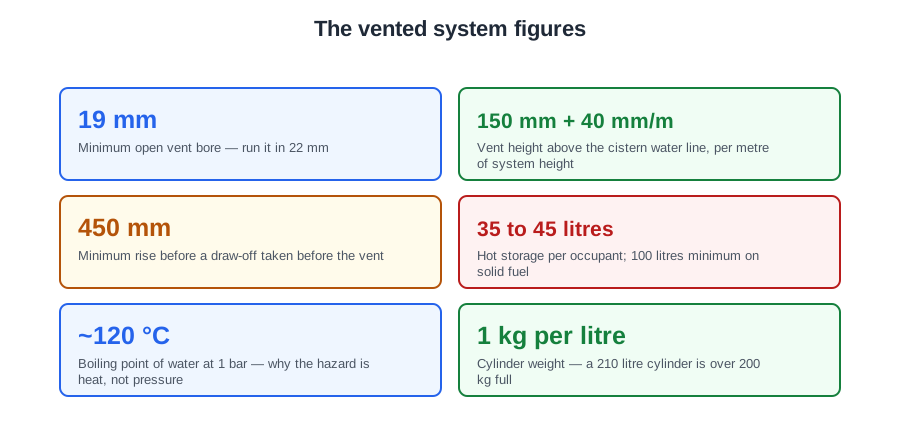
The open vent rises from the top of the vessel to a point above and over the water level in the cistern. It carries no valves of any kind and rises continuously, at not less than 19 mm bore (run in 22 mm in practice).
It is not an afterthought. On a vented system the vent is one of the two independent safety devices the Building Regulations require. It holds the store at atmospheric pressure, so the water can never exceed 100 °C, and it gives overheated water somewhere to go.
Two layout rules protect it. The vent must rise far enough above the cistern water level that a pump cannot push water out of it: 150 mm plus 40 mm for every metre of system height. For a 6 m system that is 150 + 240 = 390 mm. And the draw-off should rise slowly with at least 450 mm of pipe before the vent connects, to stop parasitic one-pipe circulation carrying heat up the vent.
Every pipe connected to the vessel, the vent included, is insulated for at least 1 metre from its connection.
The layout also reads the faults. No hot water at every outlet on a cistern-fed system points at the supply. And extremely hot water discharging from the open vent into the cistern on a directly heated system means the immersion heater's thermostat and its energy cut-out have both failed — the vent doing exactly the job it was fitted for, and saying so.
Direct, indirect and combination cylinders
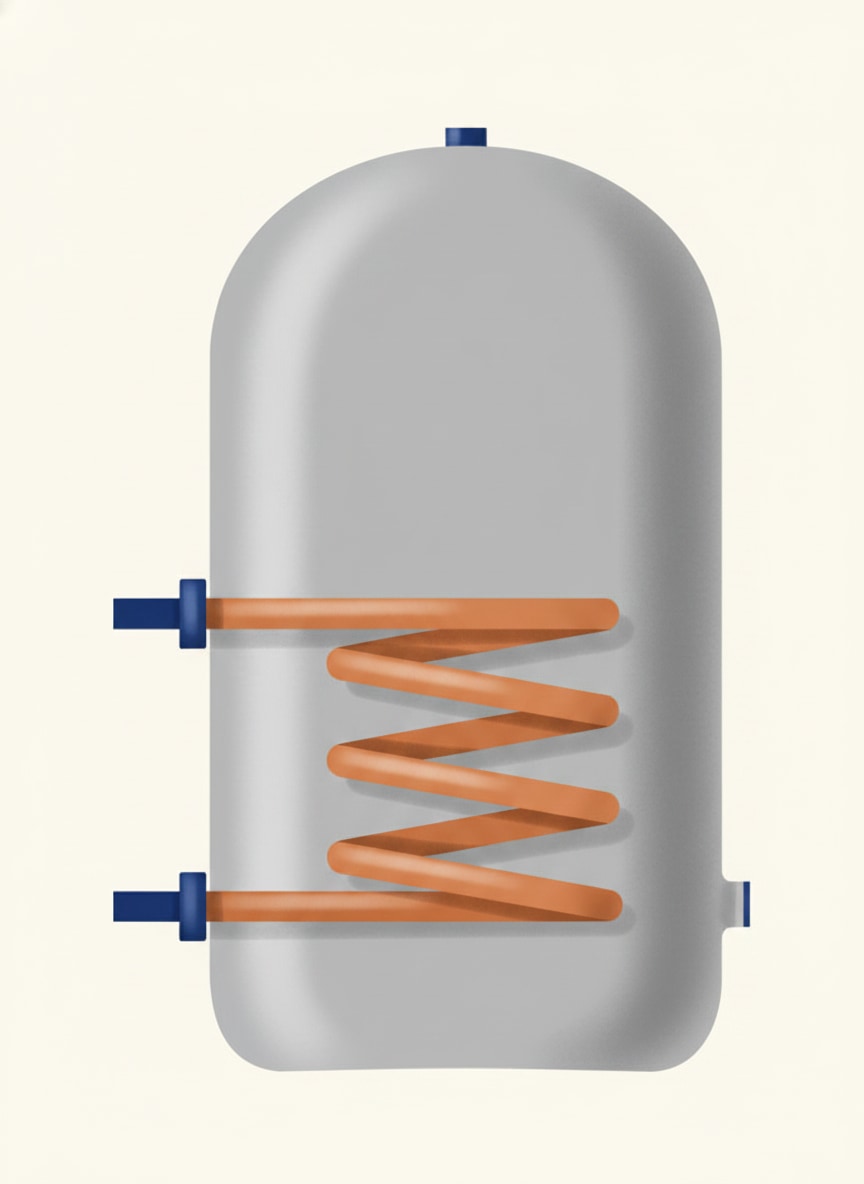
Direct means no heat exchanger. The stored water is heated directly, so any boiler circulating it must be made of a material that cannot rust — copper, stainless steel or bronze. Put a steel boiler on a direct cylinder and the customer gets rusty water at the bath.
Where two immersion heaters are fitted, the bottom one heats the whole cylinder overnight on cheap rate and the top one tops up the upper third during the day. They are independently controlled and not used at the same time.
Indirect means a heat exchanger — usually a copper coil — carrying primary water from the boiler. The waters never mix. This is what you need where the same boiler serves heating and hot water, or where the water is hard.
- Double feed indirect: two cisterns (a large one for the hot water and a small feed and expansion cistern for the primary), or a sealed primary with a filling loop and expansion vessel. Because the waters are separate, steel and aluminium are safe and inhibitor can be used.
- Single feed self-venting ("primatic"): one cistern, with an air bubble kept between primary and secondary. No inhibitor may ever be added, because a ruptured bubble would contaminate the drawn water. No longer allowed for new or replacement cylinders.
A combination cylinder (a "Fortic") carries its own cold cistern on top as one unit. It suits a flat with no roof space and keeps the loft dry. Its weakness is head: the cistern sits only inches above the draw-off, so the pressure is poor, and a shower pump must not be fitted to one — the small cistern cannot refill fast enough.
Reading an indirect cylinder's connections: the upper coil connection is the primary flow, the lower the primary return, cold feed at the base, draw-off at the top.
Storage figures: for cylinder storage at 60 to 65 °C, about 35 to 45 litres per occupant is an old rule of thumb, and the aim now is not to oversize. On a heat pump, MCS (MIS 3005-D) takes the daily demand as 45 litres × N, N being the larger of the occupants and bedrooms + 1, sizes the cylinder from that and the heat pump’s output (MGD 007), and a store charged once a day needs 300 litres. About 100 litres on solid fuel and 200 litres where off-peak electricity is the main heat source are rules of thumb. If a customer complains the hot water runs out, an undersized cylinder is the first suspect.
Unvented: why the hazard is heat, not pressure
An unvented system has no open vent pipe. It is a sealed vessel fed directly from the cold main, so the stored water sits above atmospheric pressure.
Do not confuse unvented with sealed. Unvented describes the secondary hot water; sealed describes the primary heating circuit. They are independent, so naming a system takes two words: a coil cylinder fed from the main, heated by a boiler on a pressurised circuit, is an indirect unvented system with a sealed primary.
The vent pipe used to do three jobs: hold the system at atmospheric pressure, cap the stored water at 100 °C, and take the expansion. Remove the vent and every one of those has to be engineered back with a device. That is the whole answer to a customer asking why their old cylinder never needed all this equipment.
Now the hazard. Raising the pressure raises the boiling point: about 100 °C at atmospheric, about 120 °C at 1 bar gauge, about 143 °C at 3 bar. An unvented system runs at 2.5 to 3 bar, so if the controls all failed the stored water could reach 140 °C without boiling.
It is not steam. It looks exactly like water, holding an enormous amount of energy it cannot release while the pressure is on it. Take the pressure away — the vessel splits — and that water flashes to steam, expanding about 1,600 times, in a fraction of a second, inside a building. A cylinder of cold water at the same pressure merely splits.
Pressure alone gives you a burst; heat is what makes it explosive. That single conclusion explains every control on the vessel: every unvented safety device is a temperature device.
The advantages are real: mains pressure hot water with hot and cold balanced at the outlets, no cistern to freeze or leak through a ceiling, and a cylinder that can be sited almost anywhere. The drawbacks kill jobs at survey: it needs good mains pressure and flow — the working guide is about 1 bar and 20 litres per minute, checked at peak times — and when the street main goes off the house has no water at all.
Instantaneous: why the shower is worse in winter
A customer says the combi shower is fine in summer and lukewarm in winter, and worse when somebody runs the kitchen tap. Nothing is broken.
An instantaneous heater has no storage, so no limit on quantity — but a fixed heat output. Push more litres a minute through a fixed output and each litre gets less heat, so the outlet temperature falls as the flow rate rises. In winter the incoming main is colder, so the same rise leaves a cooler tap.
Because flow sets the temperature, a water governor is fitted at the inlet to give a constant rate of flow whatever the main is doing.
A combi is a dual function appliance. When a hot tap opens, a diverter valve sends the primary water through a second heat exchanger and the entire output goes to hot water. Typical performance is about 9 litres per minute at a 35 °C rise; a combi with a small store can roughly double that to 18. But it serves one outlet at a time properly — which is why it is the wrong choice for a house with three bathrooms.
Localised heaters come in the same two kinds. Instantaneous single point heaters are inlet controlled, typically needing 1 bar minimum. Storage (displacement) heaters let incoming cold displace stored hot: over-sink types hold about 7 to 10 litres and deliver through an open spout — the spout is the vent, so a drip while it heats is expansion, not a fault. Under-sink types hold up to 15 litres and need a special tap open to atmosphere for the same reason.
One electrical point: a small 12 litre 2 kW storage heater can run from a fused connection unit, whereas instantaneous electric heaters and immersion heaters need their own dedicated circuit.
Thermal stores and solar
A thermal store is an indirect system working in reverse. The vessel is full of primary water heated by a boiler; mains cold passes through heat exchangers inside it and comes out hot, at mains pressure. Nothing that is drawn off has been stored.
The primary can reach 82 °C, so an adjustable thermostatic mixing valve on the outlet blends it down to no more than 60 °C. And one rule particular to these vessels: a temperature relief valve must not be used where the stored water is not automatically replenished. Such a vessel gets a second, independent non-self-resetting energy cut-out instead.
A solar thermal system has five parts: a collector, a differential temperature controller, a circulating pump, a storage cylinder and an auxiliary heat source. The DTC has one sensor high on the collector and one low on the cylinder, and runs the pump only when the collector is hotter than the store.
The usual cylinder is a twin coil: the lower coil is the solar circuit and the upper coil the auxiliary boiler, so the sun pre-heats the bottom of the store and the boiler tops up the top. Indirect solar circuits use water and glycol so the collector cannot freeze; a direct system circulates the drawn water itself, so no glycol may be used.
Approved Document G requires an additional heat source with any solar water heating system, so the temperature can be maintained to restrict microbial growth — and all solar primary pipework is insulated throughout its length.
🔢 The numbers worth memorising
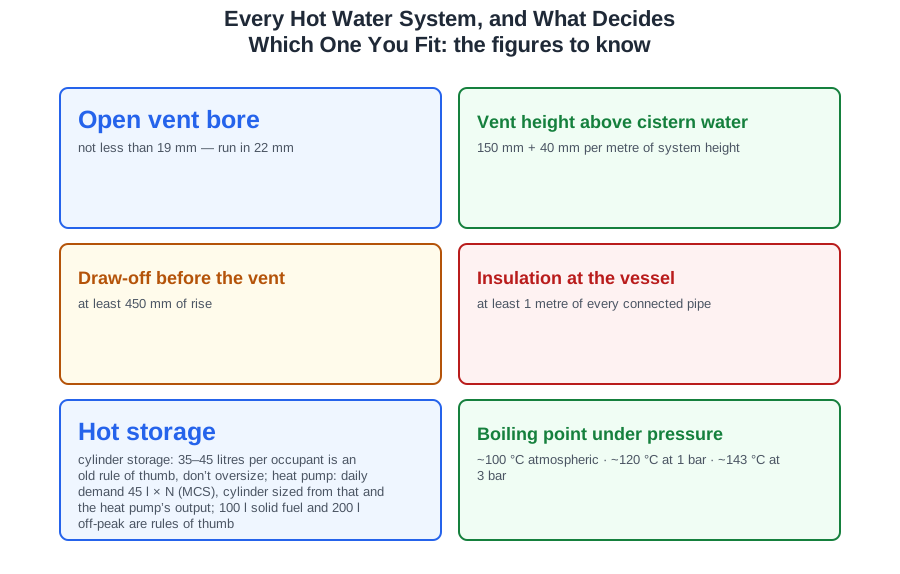
- Open vent bore
- not less than 19 mm — run in 22 mm
- Vent height above cistern water
- 150 mm + 40 mm per metre of system height
- Draw-off before the vent
- at least 450 mm of rise
- Insulation at the vessel
- at least 1 metre of every connected pipe
- Hot storage
- cylinder storage: 35–45 litres per occupant is an old rule of thumb, don’t oversize; heat pump: daily demand 45 l × N (MCS), cylinder sized from that and the heat pump’s output; 100 l solid fuel and 200 l off-peak are rules of thumb
- Boiling point under pressure
- ~100 °C atmospheric · ~120 °C at 1 bar · ~143 °C at 3 bar
- Flash to steam
- about 1,600 times the volume
- Unvented survey minimum
- about 1 bar and 20 l/min, checked at peak times
- Combi output
- about 9 l/min at a 35 °C rise — 18 with a small store
- Thermal store outlet
- blended to no more than 60 °C
⚠️ Where people go wrong
- Calling an unvented cylinder a “sealed system”. Unvented is the secondary; sealed is the primary. Naming a system takes both words.
- Fitting a steel boiler to a direct cylinder. The stored water is the boiler water — copper, stainless or bronze only.
- Adding inhibitor to a single feed self-venting cylinder. A ruptured bubble would put it in the bath water.
- Fitting a shower pump to a combination cylinder. The built-in cistern cannot refill fast enough.
- Putting a valve — any valve — on an open vent. It is a safety device.
- Blaming a lukewarm combi shower in winter on a fault. Fixed output ÷ more litres = cooler water, and the incoming main is colder.
- Treating an over-sink heater’s drip while heating as a leak. The spout is the vent.
- Specifying a combi for a three-bathroom house. It serves one outlet at a time properly.
📝 10-Question Self-Test
Straight from the Level 3 course question bank. Click an option to see whether you got it right — the explanation appears instantly, and there is nothing to submit.
Centralised means one source of hot water piped out to every outlet in the dwelling, which is what a stored vessel does, whether a boiler or an immersion heater does the heating. The other three heat water where it is used: an electric shower, an over-sink electric heater and a single-point gas heater over the sink are all localised, or point-of-use. A gas multipoint heater does not fit neatly on either side: it heats water instantaneously, like a point-of-use heater, but it serves several outlets from one appliance.
A localised, or point of use, system puts a small heater at the outlet it serves, so there is no distribution pipework and no dead leg — which is exactly what a single point instantaneous heater is. A thermal store heated by a boiler is tempting because it is compact and mains fed, but it is a central store feeding every outlet in the dwelling.
With no roof space there is nowhere to put a cold water storage cistern high enough to give head to a vented cylinder. An unvented cylinder works from mains pressure and needs no cistern at all.
The unvented requirements bite at 15 litres. The Water Regulations require a temperature relief valve on every unvented storage vessel with a capacity greater than 15 litres, and Approved Document G 3.19 accepts that a heater of 15 litres or less with appropriate temperature and pressure safety devices will generally satisfy G3(3). G3(3) itself applies to all hot water storage systems; it is the specific unvented provisions that a small under-sink heater escapes.
A combination unit carries its own small cold cistern mounted on top of the cylinder, so it can be installed where there is no roof space for a separate cistern.
Centralised means one store in one place piped to every hot outlet, and how the water is heated makes no difference, so an immersion heated direct cylinder is centralised. “Indirect” is the tempting pick, but that word describes a cylinder with a coil carrying primary water through it — a direct cylinder has no coil.
The bronze circulator goes on the secondary return, as close to the storage vessel as it can be fitted, pumping into it, with isolating valves either side so it can be changed. Fitting it on the secondary flow leaving the cylinder puts the pump in the hottest water and makes it push against the whole loop instead of drawing round it.
Every pipe connected to a hot water storage vessel is insulated for at least the first metre from the vessel, the vent pipe included, to limit standing heat loss from the store through its connections.
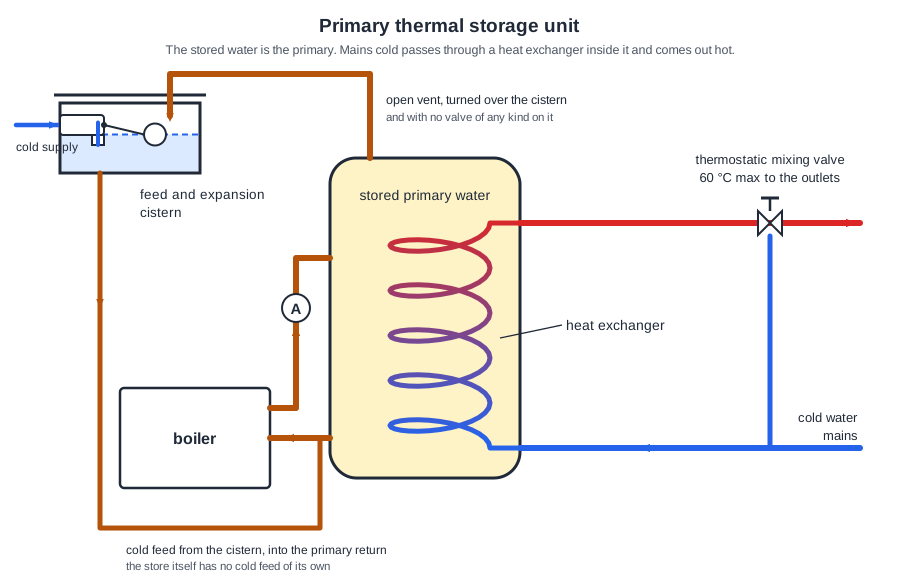
A is on the pipe leaving the top of the boiler, arrowed upwards and running across into the upper part of the store, so it carries the heated primary water in: the flow from the boiler. The cooler water returns to the boiler from lower down. The “open vent pipe” is the one that rises off the top of the store and turns over the cistern.
On an indirect system the heat comes from a boiler, so the cut-out has to stop the primary flow: the non-self-resetting cut-out is wired to shut down the boiler or close a motorised valve in the primary circuit, as Approved Document G 3.30 describes. G 3.21 does allow the energy cut-out itself to sit on the boiler, but it must still be a non-self-resetting energy cut-out to 3.29, not the boiler's own control or high limit stat standing in for one.
Going further: the lessons behind this article
This article is the public answer. Unit 332 of the Level 3 course takes the same ground to the depth the exam and the synoptic assignment ask for, in 6 lessons:
- Centralised and localised hot water: choosing between them
- Vented hot water storage: cold feed, vent and layout
- Direct, indirect and combination cylinders compared
- Unvented hot water: mains pressure and the overheating hazard
- Instantaneous heating: combi boilers and point-of-use heaters
- Thermal stores and solar thermal: their pipework layouts
- Hot water systems: the Unit 332 guide — every article on this unit in one place
- All PlumbMate articles — Level 1, 2 and 3
- The Level 3 course — the whole 8202-35 Diploma