An unvented cylinder that is working tells you nothing. A failed expansion vessel and a seized relief valve produce no symptom at all — until the day they are needed.
The short answer
That is why the service matters more on unvented than on a vented system: it is where the layered protection is actually maintained. Not because unvented cylinders scale faster, not because the warranty depends on it, and not because the losses are greater.
An annual unvented service comes down to six items: pre-charge, relief valves, strainer, discharge, pressures, record. Not flue and combustion — that is a gas service. Not anode and coil — those belong to other vessels. Six, and it is worth doing all six rather than the two that are quick.
And when something has to come out of use, one rule covers every failed safety device: isolate and take out of use — never cap, bypass, or misfit.
Checking and recharging an expansion vessel
You have read the discharge, it is cold, and it only happens on reheat. The diagnosis says expansion. Now prove it, because "probably the vessel" is not a diagnosis and a new vessel is not cheap.
An expansion vessel is a sealed shell divided by a flexible diaphragm or bladder. Water sits on one side, a charge of gas on the other. Heated water expands, pushes against the diaphragm, and compresses the gas. Water is effectively incompressible; the gas is the only thing in the system that can give.
Schedule 2 paragraph 21 requires every expansion cistern or vessel to accommodate any expansion water from that circuit during normal operation. Paragraph 17(2) then requires an expansion valve with the means of discharging water correctly in the event of a malfunction of the expansion vessel or system — which is exactly the fault you are chasing.
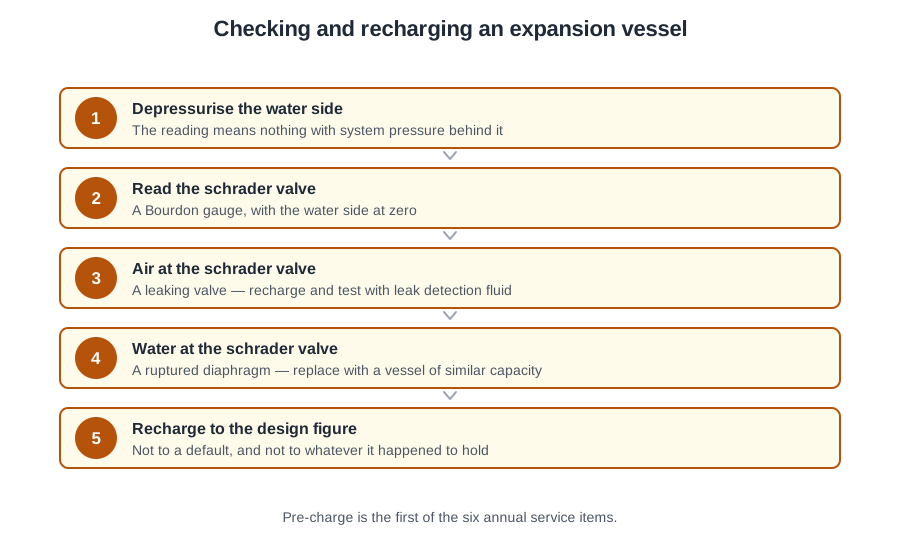
The check is made at the schrader valve with a portable Bourdon gauge — the tyre-pressure type is ideal. There is one step people skip and it makes the reading meaningless: the water side must be at zero pressure first. Isolate the cold supply and open a hot tap or the drain point. Only then does the gauge read the gas charge rather than the system pressure pushing back through the diaphragm.
Compare the reading with the manufacturer's figure. It is typically close to the operating pressure of the system, but the number belongs to that appliance.
The two ways a vessel fails
- No air charge, from a faulty schrader valve. Symptom: no pressure in the vessel, water discharging from the relief valve during heat-up. Recharge with a foot pump, then test the schrader valve with leak detection fluid and look for bubbles. If it leaks, replace the valve or the vessel as the manufacturer directs.
- Water at the schrader valve. The diaphragm has ruptured and the vessel is waterlogged. Pumping it up achieves nothing — there is no gas space left to hold the charge. Replace the membrane if that vessel allows it, otherwise replace the vessel with one of similar capacity.
So what comes out of the schrader valve is diagnostic in itself: air means a leaking valve; water means a burst diaphragm.
Some unvented cylinders have no external vessel — expansion is taken by an internal air gap at the crown. The air slowly dissolves into the stored water and the gap shrinks away. There is nothing to pump up: isolate, drain down and refill, which re-forms the bubble. On the annual service this is done as a matter of course rather than waiting for the discharge.
Where the vessel is diagnosed as faulty, the system is isolated and temporarily decommissioned until a replacement is fitted. A cylinder relieving on every heat-up is wasting water, and Regulation 3(3) is explicit that no water fitting may be used which, by reason of being damaged, worn or otherwise faulty, causes or is likely to cause waste, misuse, undue consumption or contamination.
The annual service, item by item
Testing a relief valve. Lifting the easing gear or twisting the top and holding it open for about 30 seconds is done on an expansion valve and on a temperature and pressure relief valve. It is not done on a pressure reducing valve, a line strainer or a single check valve — none of those has easing gear.
BS EN 806-5 B.16 gives the routine: check there is no discharge; check there is no spraying outside the tundish when it is operated; check there is fluid in the trap if one is present; operate the easing gear to make sure the valve is not sticking or scaled in the closed position; and check it closes automatically when the gear is released, with the water completely discharged through the tundish. If the valve is not tight afterwards, it is replaced.
That is the law as well as the standard. Schedule 2 paragraph 22(1) requires every expansion valve, temperature relief valve and combined T&P valve to close automatically after a discharge of water. A valve left dripping after a test has failed a regulation, not just a check. One caution from BS 8558 6.2.2.5: operating easing gear can itself cause a valve to leak, because it disturbs scale and debris on the seat. Carry the spare, and never leave a valve weeping.
Strainer. While the system is drained for the pre-charge check, remove the in-line strainer and clean off any debris. It is the cheapest item on the list and the one that produces the flow complaints.
Pressures. Check static and dynamic to see whether the PRV is still operating within the manufacturer's limits. BS EN 806-5 B.18 puts it as checking the outlet pressure setting at zero flow and at peak flow; on maintenance the strainer is cleaned or replaced and the internals removed, inspected and replaced if necessary. A PRV drifting upwards is what turns into a continuous cold discharge later.
Discharge arrangement. Why check it on an installation you did not fit? Because it announces nothing when it is wrong, and may never have been looked at. An undersized D2, or an ordinary plastic waste pipe used for it, produces no symptom on any day except the one that matters. Check the tundish is vertical, in the same space, within 600 mm; that D2 has 300 mm of vertical below it before any bend, then a fall of at least 1 in 200; that the material is metal or marked as rated for the discharge temperature; and that it terminates safely and visibly.
Record. BS EN 806-5 clause 5 requires maintenance to be recorded and stored so the data is auditable. Record the readings, not just a tick: the pre-charge you found and the pre-charge you set, the static and dynamic pressures, the cut-out operation, the outlet temperatures. Next year's engineer diagnoses a drifting fault from those numbers.
The underlying intervals in BS EN 806-5 Annex A: expansion valves, pressure safety valves and T&P valves inspected every 6 months; pressure reducing valves once a year; filters every 6 months; water heaters maintained once a year.
Thermostats, cut-outs and controls
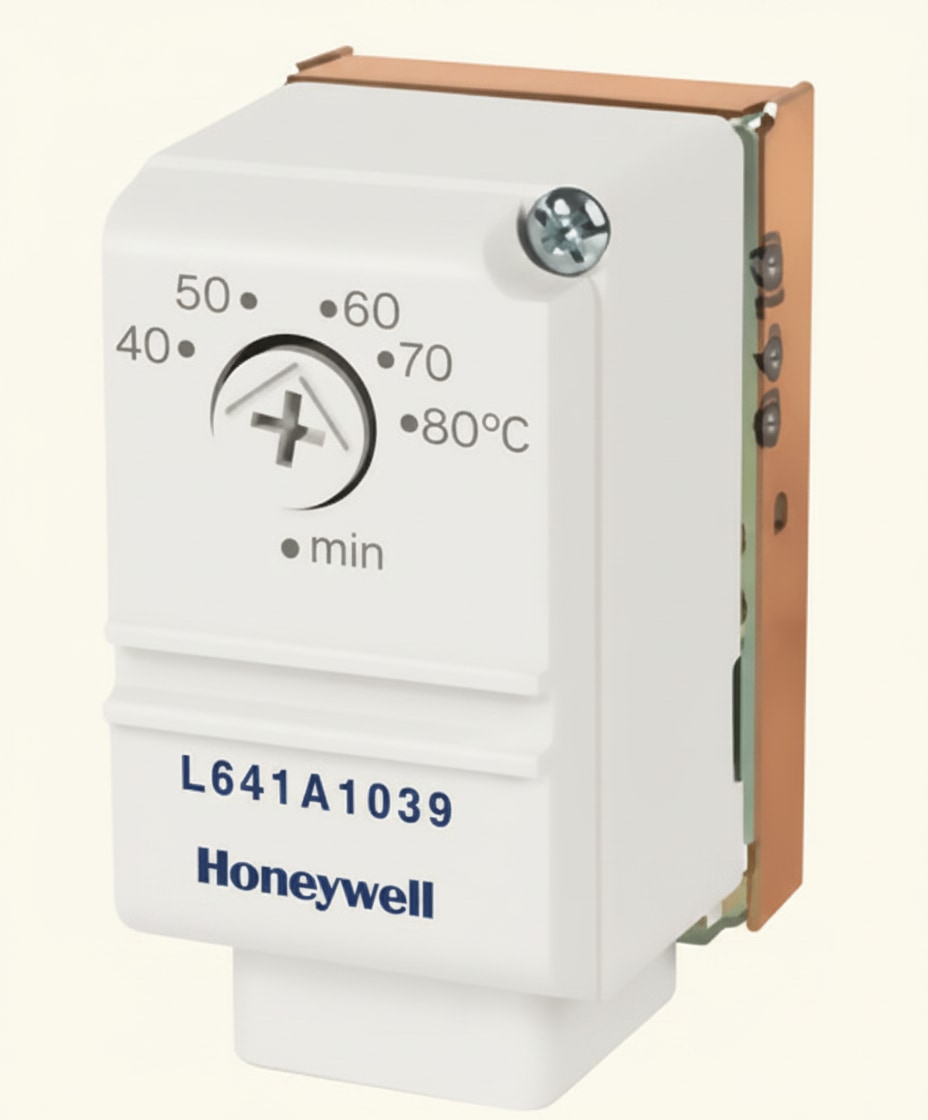
A faulty thermostat shows itself in one of two ways: excessive hot water, or no hot water. Everything hangs off which of those the customer reported.
BS 5546 6.11.2.2 sets the sequence as stored water gets hotter: thermostat, then thermal energy cut-out, then temperature relief valve. Knowing the order tells you where you are in the failure.
The energy cut-out is the middle layer, and on an indirectly heated unvented cylinder it does not act on the cylinder at all. At around 80 to 85 °C it closes the motorised valve on the primary flow, cutting the heat off before it reaches the cylinder. AD G 3.30 covers exactly this; 3.31 adds that any electrical device connected to the cut-out must interrupt the supply of energy if the electrical supply is disconnected. It does not act on the expansion vessel, the PRV or the strainer — those are pressure devices.
Non-self-resetting, and what follows
AD G 3.18 a) and BS 5546 6.11.2.1 b) both require the cut-out to be non-self-resetting: once it has operated it must be reset by hand. That is deliberate. The hand reset exists precisely so that somebody has to attend.
So the repair is: find and fix the cause, then reset it by hand, and record it. Not reset it and watch whether it trips again. Not replace the cut-out on the grounds that a tripped one cannot be reused. And not fit a self-resetting device so the customer is not left cold — that removes a layer of the protection the Building Regulations require.
Consider the engineer who resets a tripped cut-out, finds hot water restored and leaves. Three things are wrong. One layer of protection is gone, because a tripped cut-out is proof the thermostat failed and that thermostat is still fitted. There is no record, so nobody knows it has happened. And the cause is unknown, so it will happen again. The customer has hot water and one layer of safety instead of two.
Checking each control
- Cylinder thermostat, water too hot. Put a thermometer in the hot water flow once the thermostat has shut off and compare with the setting. If it does not match, it is not operating at the correct temperature — replace it.
- Cylinder thermostat, no hot water. Check with a GS38 voltage indicator for correct on and off function; replace if it is not switching.
- High limit thermostat, no hot water. Usually the system thermostat has malfunctioned and the cut-out has operated to isolate the heat source. Check the system thermostat, then reset the cut-out.
- Motorised valve not operating. On an indirect cylinder this gives cold at the hot taps, or a cylinder that never stops heating. Check the wiring, and check it is actually driving and closing at temperature.
- Programmer or time clock. Check it activates at the correct times, that boost functions work, and that the displayed time matches the real time. A great many "no hot water" calls are a programmer on the wrong time or a setting lost after a power cut.
One safety point before any of it: where hot water is running constantly from a relief valve, isolate the system from the electrical supply and let it cool before attempting any repair on the thermal controls.
Scale, blockages and airlocks
"It used to fill the bath in ten minutes and now it takes twenty, and it runs cool at the end." Nothing has failed. Something has been getting slowly worse for five years.
Heat recovery is the time taken to heat up a full cylinder of hot water — how long the heat source takes to bring a full cylinder of cold water up to its set temperature after it has been drawn off. Not the gap between the thermostat closing and the boiler firing, not the overnight heat loss, and not the time to draw the contents off.
Recovery gets worse when scale builds on the heating surface. Calcium carbonate comes out of solution on the hottest surfaces first: the immersion element, the primary coil, the plates of a combi heat exchanger. Scale is an insulator, so the same heat input takes longer to reach the water. It does a second thing too: it reduces the bore. On a vented cylinder, poor flow is often the cold feed or the hot draw-off blocked with scale — check both connections and descale.
BS EN 806-5 B.20 makes descaling part of maintaining a water heater: all deposits, anode sludge and scale shall be removed, using only agents the heater manufacturer specifies. Spray heads on taps and showers are cleaned and descaled at least annually, more often in hard water.
The prevention is not to run hotter. Store at 60 °C and blend down at the outlet; pushing the stored temperature higher to "get more hot water" makes more scale, faster.
A blockage is diagnosed from where the flow falls off. Every outlet weak → look upstream: a partly closed stop valve, a blocked strainer, a failed PRV. One outlet weak → look at that outlet: a blocked spray head, a scaled tap, a blocked shower head. On a vented system a float-operated valve stuck off starves the cistern and everything below it, so check the cistern level as well as the taps.
Airlocks and leaks
An airlock is trapped air at a high point that stops or splutters the flow. On vented systems it comes from filling in the wrong order — trickle filling encourages airlocks. Avoid one by letting the cistern fill to capacity first, then opening the gate valve, so the pipes run at full bore. Automatic air vents at high points clear the ones you cannot reach. Where a system is already air locked, the cure is to drain down the cylinder and refill.
Unvented systems get the same problem in a different form. Fill with all hot taps open, drawing from every outlet, so high-pressure air pockets are not trapped in the vessel. Close each tap only when the water runs freely without spluttering.
On leaks, Schedule 2 paragraph 4(a) requires every water fitting to be watertight, and Regulation 3(3) is blunt about faulty fittings. A known leak is not something to note and leave. For a leak you cannot see, the water meter is the instrument: close every outlet and watch it — if it is still turning, water is going somewhere. BS 8558 6.2.1.3 says the meter should be read at regular intervals and the occupier advised of any unexplained increase.
Pump faults
The hot water at the en-suite takes two minutes to arrive. It used to be instant. Nothing is leaking, nothing is discharging, and the cylinder is at temperature. The secondary circulation has stopped.
Failure is a health matter, not just a comfort one. A failed circulator leaves a long run of stagnant water at exactly the temperature ACOP L8 warns about — Legionella multiplies between 20 and 45 °C. So measure the return temperature: if it has fallen, the circulation has stopped.
| Symptom | Fault | Action |
|---|---|---|
| Motor runs, no water pumped | Worn or broken impeller | Replace the pump — no repair possible |
| Voltage at the terminals, pump does not run | Burnt-out motor | Replace the pump |
| Water leaking from the body | Cracked casing | Replace the pump |
| Pump starts slowly | Faulty capacitor | May be replaceable — check the instructions |
| Noisy running or minimal flow | Air locked | Bleed the air from the pump |
One material check goes with every secondary circulator: it must be bronze or stainless steel. A cast iron central heating circulator on a secondary circuit rusts, gives discoloured water and contamination, and must never be used. Isolating valves go either side so the pump can be changed.
Shower booster pumps
- Will not start. Power supply, fuse, breaker, loose connections. Inlet and outlet not reversed, all valves open. Sufficient gravity flow and clear inlet filters, against the manufacturer's minimum flow rates on both hot and cold. Float switch not sticking on debris.
- Reduced or intermittent flow. Blocked inlet filters, an incorrect or missing anti-aeration flange, flexible couplers bent or distorted, air in the system, a wrong-size pump, cisterns filling too slowly and starving it, or hot water above 65 °C.
- Starts with all outlets closed. A leak in the system, or an outlet left open or uncapped.
- Noisy. Air in the system, vibration on the surface (fit rubber shock absorbers), or distorted flexible connections.
- Leaking. It has seen mains pressure, chemical damage from something like flux, or excessive temperature. Keep the hot water reaching it no higher than 65 °C, fitting a TMV at the cylinder if necessary.
A motor running hot with minimal flow is either a terminal internal fault (replacement) or an air-locked pump (bleed it). And under Regulation 5, installing a pump or booster drawing more than 12 litres per minute, connected directly or indirectly to a supply pipe, is notifiable to the water undertaker — worth remembering before you fit a bigger one.
Combis, heat exchangers and mixing valves
The heating is fine, the radiators are hot, there is no hot water at any tap. On a combination boiler that single sentence points at a short chain.
The primary heat exchanger above the burner heats the primary water. When a hot tap opens, a flow switch senses the movement of mains water and activates the diverter valve, which changes the direction of the heated primary water — to the radiators in heating mode, or through the plate heat exchanger when the tap opens. That is a stack of corrugated plates carrying two separate circuits: primary water heats one side, mains cold flowing through the other is warmed instantly on its way to the tap.
So heating working with no hot water points at the end of that chain: the flow switch not sensing (often because the flow through it is too low) or the diverter valve stuck in the heating position. A low flow can itself come from a blocked inlet filter or a scaled outlet, which is why you check the flow rate at the tap before condemning anything electrical.
- A scaled plate heat exchanger gives hot water that gets weaker and cooler over months while the heating stays perfect — the primary side is unaffected.
- A pin-holed plate heat exchanger is more obvious: mains cold passes into the sealed heating side, the system pressure climbs, and the boiler's relief valve discharges. Replace the plate heat exchanger.
Rising pressure on a sealed system has two other causes worth eliminating first: a filling loop service valve left slightly open or worn, and the boiler's own expansion vessel losing its charge, checked at its schrader valve exactly as on a cylinder vessel. Three different faults, one symptom.
On an indirect cylinder the heat exchanger is the primary coil. Scaled or fouled, it gives slow recovery. Perforated, it lets primary water into the stored water, giving discoloured water and, on a vented system, a feed and expansion cistern that keeps needing to fill. A perforated coil is not repairable — the cylinder is replaced.
Thermostatic mixing valves
A stuck TMV produces two opposite complaints: no hot water at that outlet, or a scald. BS EN 806-5 B.17 gives the routine:
- Check the mixed water temperature at the outlet is within the limits for correct operation.
- Check the hot and cold inlet pressures are within limits — unbalanced pressures make a valve wander.
- Check there are no leaks from the connections.
- Check and clean the system filters, and check the check valves upstream are working.
- Carry out the thermal shut-off test: isolate the cold supply and monitor the mixed water. The outlet flow should quickly stop. Measure and record the maximum mixed temperature. Restore the cold supply and measure the outlet temperature once stabilised — it should not exceed the permitted value by more than 2 °C.
Where the valve fails it is serviced to the manufacturer's instructions and then re-commissioned. What sticks a TMV is scale and debris on the thermostatic element and in the strainers, so the filters are part of the fix, not an afterthought.
One trap: a TMV delivering cold may not be faulty at all. BS 8558 requires the supply to a TMV to reach at least 50 °C within 1 minute. Starve the valve of hot water and it will shut down correctly, and the real fault is upstream. And the answer to a scald complaint is to fix or fit the blending valve, not to turn the storage temperature down — store at 60, reach the outlets at 50 or more, deliver at 35 to 46 °C.
Isolating, decommissioning and handing back
Confirm the diagnosis before you order a part. Work the flow chart to the end rather than stopping at the first likely answer. Then tell the customer what is wrong, what it will take, what it will cost, and what they must not do in the meantime. If the system has to come out of use, they hear it from you before you turn it off.
The term for isolating a water supply during maintenance is temporary decommissioning. Do it properly:
- Place a notice at the point of isolation reading system off — do not turn on.
- Consider removing the levers from isolating valves so nobody restores the supply while the system is drained.
- Isolate only the section you need. Where there is no local isolation, a pipe freezing kit avoids shutting the whole building down.
- Cap any open ends until the new component is fitted.
- Where there is an electrical supply, follow the safe isolation procedure and lock off the fuse or supply.
- Tell the householder or responsible person which areas are isolated.
Two cases that catch people out
A cylinder is overheating and discharging. The instinct is to stop the discharge, and the apparent way is the cold supply. That is precisely backwards. Turn off the heat source, not the cold water — the cold feed is what carries the heat away and keeps the vessel replenished. Switch off the electrical power, leave the water on, and when the discharge stops, check all the thermal controls and replace as necessary.
A temperature relief valve is defective and cannot be repaired on the spot. The correct action is to shut the system down, decommission it, and arrange a convenient time for a permanent repair. Not a blanking plug in the valve tapping. Not turning the thermostat down and leaving the cylinder in use. Not isolating the cold and telling the customer to use the immersion heater. It is the last line of safety on that cylinder.
The general rule for any failed safety valve with no correct spare available: isolate and take out of use — never cap, bypass, or misfit. Not even a valve of the same pressure rating as an interim measure: Regulation 4(1) requires every fitting to be of an appropriate quality and suitable for the circumstances in which it is used, and AD G 3.37 sizes a temperature relief valve on its discharge rating against the total power input, not on pressure alone. And recording the defect on a sheet while leaving the system running is not a remedy.
Rectify, re-commission, hand back
Replace like for like, or with a part the manufacturer confirms is approved for that vessel; original spares are preferred. Regulation 4(5) requires every fitting to be installed, altered, repaired or disconnected in a workmanlike manner, which 4(6) defines as conforming to an appropriate British Standard or approved specification.
Then re-commission. Fill an unvented system with all hot taps open; on a vented one let the cistern fill before opening the gate valve. Vent, then inspect every accessible pipe, connection and appliance for leakage. Run to temperature and check the thermostat and cut-out cut points, the static and dynamic pressures, the flow rates and the outlet temperatures. Operate the relief valves and check the tundish is not passing.
Finally hand back. Record the location, the date, what was found, what was done and the tests performed — BS EN 806-5 requires maintenance to be recorded so the data is auditable. Update the service log. Show the customer the isolation points, explain the cause in plain words, and remind them when the next service is due.
🔢 The numbers worth memorising
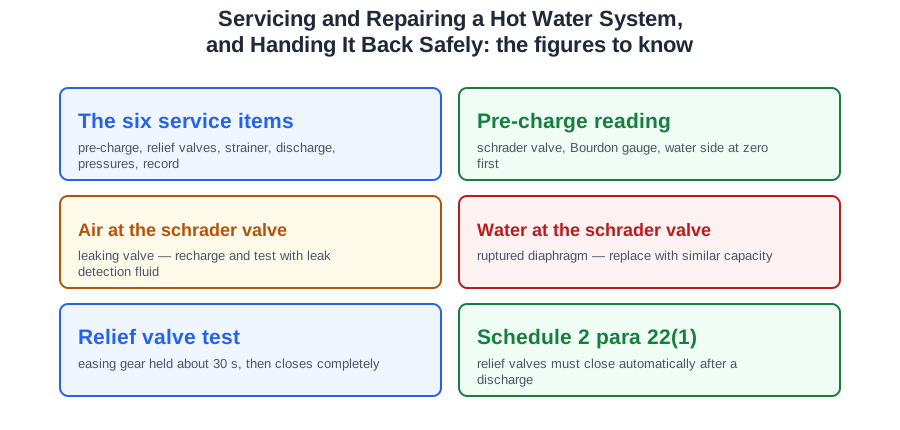
- The six service items
- pre-charge, relief valves, strainer, discharge, pressures, record
- Pre-charge reading
- schrader valve, Bourdon gauge, water side at zero first
- Air at the schrader valve
- leaking valve — recharge and test with leak detection fluid
- Water at the schrader valve
- ruptured diaphragm — replace with similar capacity
- Relief valve test
- easing gear held about 30 s, then closes completely
- Schedule 2 para 22(1)
- relief valves must close automatically after a discharge
- Inspection intervals
- relief valves and filters 6 months; PRV and water heater yearly
- Energy cut-out acts at
- 80–85 °C, on the motorised valve on the primary flow
- Cut-out repair
- fix the cause, reset by hand, record it
- Heat recovery
- time to bring a full cylinder back to its set temperature
- Descaling
- all deposits, anode sludge and scale; spray heads at least annually
- Secondary circulator
- bronze or stainless steel, never cast iron
- Booster pump hot water limit
- 65 °C
- Pump notifiable above
- 12 l/min (Regulation 5)
- TMV thermal shut-off test
- flow stops quickly; restored temperature within 2 °C
- Overheating cylinder
- turn off the heat source, not the cold water
⚠️ Where people go wrong
- Reading a pre-charge without dropping the water side to zero. The gauge then reads the system pushing back.
- Pumping up a waterlogged vessel. There is no gas space left to hold a charge.
- Trying to recharge a bubble-top cylinder. There is nothing to pump up — drain down and refill.
- Leaving a relief valve weeping after a test. Schedule 2 para 22(1) requires it to close automatically.
- Operating easing gear without a spare in the van. It can itself disturb scale and make the valve leak.
- Skipping the discharge check on a system you did not fit. A wrong D2 announces nothing until the day it matters.
- Ticking a service sheet instead of recording readings. Next year’s engineer diagnoses from the numbers.
- Resetting a tripped cut-out and leaving. One layer gone, no record, cause unknown.
- Fitting a self-resetting device so the customer is not left cold. That removes protection the Regulations require.
- Raising the stored temperature to get more hot water. More scale, faster.
- Trickle filling a vented system. Fill the cistern, then open the gate valve.
- Fitting a cast iron circulator to a secondary loop.
- Condemning a combi’s electrics before checking the flow rate at the tap.
- Replacing a TMV that delivers cold. Check the supply reaches 50 °C in a minute first — it may be shutting down correctly.
- Turning the storage temperature down to answer a scald complaint. Fix or fit the blending valve.
- Turning off the cold water on an overheating cylinder. The cold is what carries the heat away.
- Capping, bypassing or misfitting a failed safety valve — even one of the same pressure rating as an interim measure.
📝 10-Question Self-Test
Straight from the Level 3 course question bank. Click an option to see whether you got it right — the explanation appears instantly, and there is nothing to submit.
A cistern filled to the rim is a very heavy object sitting on timber, usually in a loft, so the support is the check that matters most. Approved Document G 3.15 wants the platform flat, level and rigid, carrying the whole of the base and extending beyond the cistern. A warning pipe is never smaller than the inlet, and either float valve pattern can be acceptable.
The temperature relief valve is the last line of safety on an unvented cylinder. Without it the cylinder cannot be left in use, so the system is shut down and made safe until a permanent repair is arranged.
On an indirectly heated unvented cylinder the thermal cut-out does not act on the cylinder itself; it closes the motorised valve on the primary flow to stop heat reaching the cylinder, which is the arrangement Approved Document G 3.30 describes. The 85 to 89 °C is the factory setting the City and Guilds book gives, not a figure any standard sets, and the relief valves are the next, purely mechanical, stage.
In a hard water area the expansion valve seat and spring scale up with calcium carbonate, so the valve either weeps continuously or sticks. The clue is in the question: hard water means limescale.
Steady discharge at the tundish with nothing overheating points at the expansion valve: a damaged or scaled seat lets it pass water at normal pressure.
Lifting the easing gear or twisting the head holds the valve off its seat, proving it is not scaled or seized shut and that the discharge runs freely through the tundish; BS EN 806-5 Annex B.16 sets that check and the reseat check that follows it, though the 30 seconds is the City and Guilds figure rather than a standard one. The same test is done on the temperature and pressure relief valve. A strainer, check valve or pressure reducing valve has no easing gear to lift.
An electrical overheating fault is a fire and shock risk, so the pump is isolated and the system temporarily decommissioned and labelled until the part arrives. Fitting a larger fuse defeats the protection that is meant to disconnect the fault, and asking the customer to keep showers short leaves a known dangerous appliance live in their home.
The third of the three discharge signatures, and a flow one rather than a discharge one.
Isolate at the point that feeds that appliance: the local fused spur, locked off or with the fuse withdrawn, so the immersion heater and controls are dead while you work. Isolating at the electricity meter kills the whole property for no reason, and the water undertaker’s stop tap in the street is not yours to operate.
The two requirements — same room, visible — exist for the diagnosis as much as for the hydraulics.
Going further: the lessons behind this article
This article is the public answer. Unit 332 of the Level 3 course takes the same ground to the depth the exam and the synoptic assignment ask for, in 7 lessons:
- Expansion vessels and air gaps: checking and recharging
- Relief valves, strainers and pressures: the annual service
- Thermostats, cut-outs, programmers and motorised valves
- Scale, blockages, airlocks and leaks
- Pump faults: secondary circulation and shower boosters
- Combination boilers, heat exchangers and mixing valves
- Isolating, decommissioning, rectifying and handing back
- Hot water systems: the Unit 332 guide — every article on this unit in one place
- All PlumbMate articles — Level 1, 2 and 3
- The Level 3 course — the whole 8202-35 Diploma