A water main bursts in the street. Two doors down, a garden hose lies with its end in a paddling pool. Nothing is switched on, nothing is opened, and the pool water starts travelling towards the main.
The short answer
Schedule 2 paragraph 1 defines backflow as flow upstream — in a direction contrary to the intended normal direction of flow — within or from a water fitting. Upstream means towards the undertaker's main.
It happens in two ways, and every device is rated separately for each:
- Back pressure — the pressure downstream becomes greater than the supply pressure and water is pushed back. A pump on the consumer's side, expansion in a hot water system, or a burst main with the consumer's system still full.
- Back siphonage — a negative pressure in the supply pipe sucks water back through a submerged outlet, like drinking through a straw. The paddling pool is the classic case.
The duty is paragraph 15(1): every water system shall contain an adequate device for preventing backflow. Paragraph 15(3) says how to choose it — the device must be appropriate to the highest applicable fluid category downstream, before the next such device. Look downstream, find the worst thing that could come back, protect against that.
One exemption: paragraph 15(2) lets a water heater whose expanded water flows back into a supply pipe, or a vented storage vessel fed from a cistern, go without a device where the supply pipe or cistern is at not more than 25 °C.
The five fluid categories
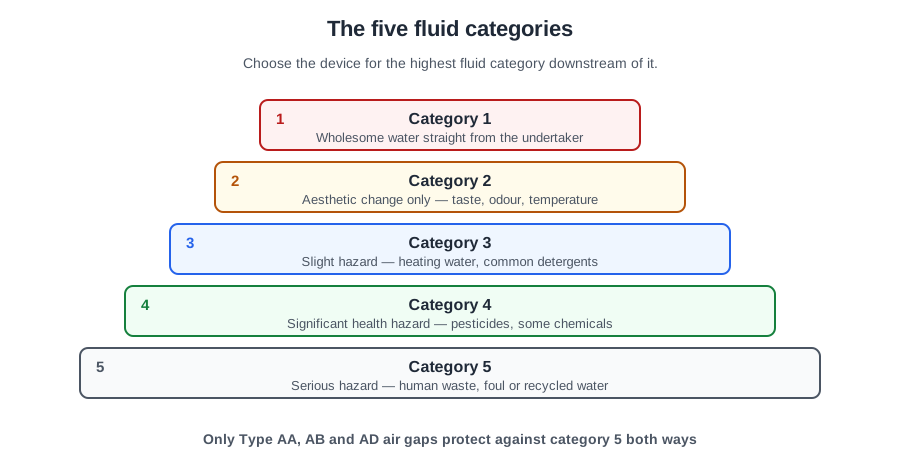
The Regulations rate not the fitting but what is in it. Schedule 1 describes five categories, and only category 1 may be supplied for drinking.
- 1 — wholesome. Water supplied by a water undertaker. Cold water straight from the main.
- 2 — aesthetic quality impaired. Category 1 water impaired by a change in temperature, or by substances or organisms changing taste, odour or appearance. Hot water; hot and cold meeting in a mixer; cold water warmed above 20 °C.
- 3 — slight health hazard. Low toxicity substances: ethylene glycol, copper sulphate, common disinfectants. Domestic basins, baths, showers, washing machines and dishwashers; heating primaries in a house; a hand-held hose with a spray.
- 4 — significant health hazard. Toxic substances: chemicals, carcinogens, pesticides, environmental organisms. Heating primaries outside a house; sprinklers with antifreeze; mini-irrigation and porous hoses; commercial dishwashers; car wash plant.
- 5 — serious health hazard. Pathogens, radioactive or very toxic substances. WC pans, urinals, bidets; kitchen sinks in any premises; hospital basins; animal troughs; non-domestic hose union taps; rainwater and greywater; laboratories.
Two lines trip people up.
Between 1 and 2 the question is aesthetics, not health. Warmed water with nothing added is category 2 — hot water in a cylinder, hot and cold meeting in a mixer, or a cold pipe warmed above 20 °C beside a heating pipe. Nobody is harmed, and it still needs a device.
Between 4 and 5 the question is what a single exposure can do. A category 4 chemical dilutes as it flows back, weaker with every litre. A category 5 pathogen multiplies — a few organisms from a WC pan become a colony. That is why no mechanical device is accepted for category 5; only an air gap will do. It is also why a kitchen sink is category 5 in a house as much as in a hospital.
Three levels of protection
A block of twelve flats is fed from one common supply pipe. Every basin has its tap gap and every mixer its check valves, so each flat is safe from itself. But if the tenant in flat 7 fits a pump for a power shower, back pressure could push flat 7's water into flat 3's cold tap. Something has to sit on the branch to each flat.
Point of use protection protects an individual fitting or outlet and sits at or close to it: a tap gap, a single check valve on each feed to a mixer, a double check valve on a garden tap branch.
Zone protection protects one part of a building from another — the branch to each flat, or to a laboratory wing.
Whole site protection sits near the incoming main and protects the undertaker's supply from everything in the building. A pumped category 5 supply inside a building is a case for it, because a pump can push against the main.
The exam uses those three words, so use them back.
Air gaps: how they are rated
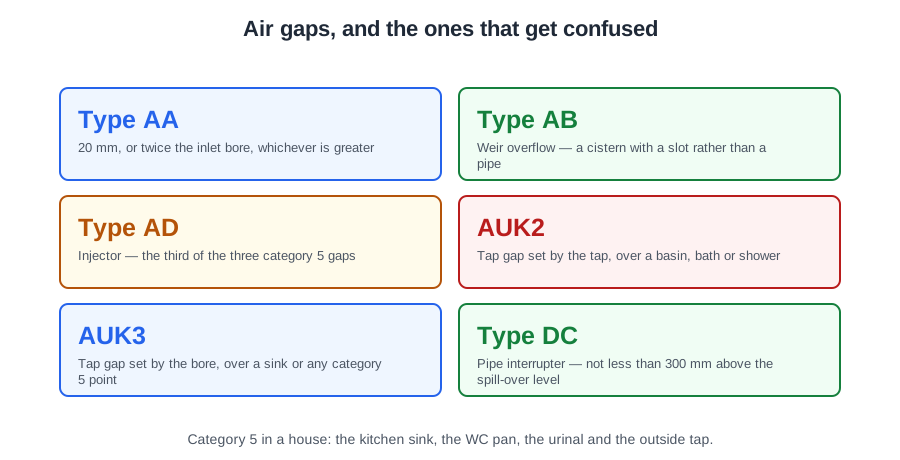
Every arrangement is measured vertically from the lowest point of the outlet to the spill-over level, and carries a rating for back pressure and one for back siphonage. Where the arrangement is open to air downstream, pressure cannot build behind it, so it is marked X for back pressure — not acceptable for any category.
| Type | Arrangement | Back pressure | Back siphonage |
|---|---|---|---|
| AA | Air gap with unrestricted discharge above spill-over level | 5 | 5 |
| AB | Air gap with weir overflow | 5 | 5 |
| AD | Air gap with injector | 5 | 5 |
| AG | Air gap with minimum size circular overflow | 3 | 3 |
| AUK1 | Air gap with interposed cistern | 3 | 5 |
| AUK2 | Tap gap over a domestic basin, bath, shower tray or over-rim bidet | X | 3 |
| AUK3 | Tap gap over a sink or higher risk appliance | X | 5 |
| DC | Pipe interrupter with permanent atmospheric vent | X | 5 |
Two others appear: AC (submerged feed with air inlet) is category 3, and AF (circular overflow) is category 4. Only AA, AB and AD satisfy category 5 in both directions.
AA, AB and AD in practice
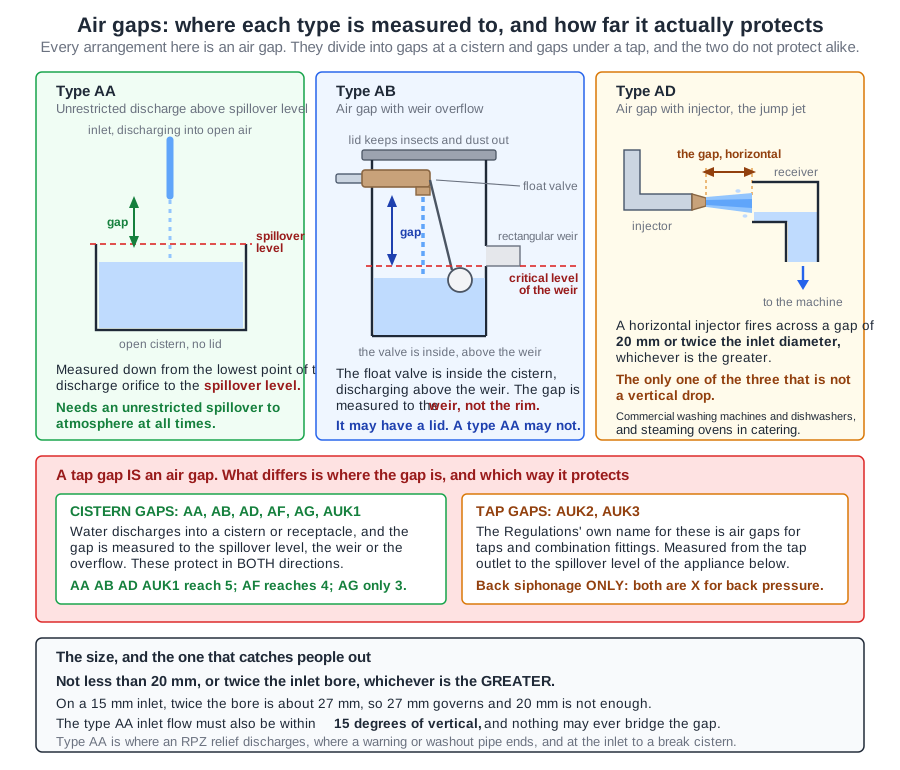
Type AA discharges through open air into a cistern or receptacle with, at all times, an unrestricted spill-over to atmosphere. The inlet flow must be within 15° of vertical and the gap not less than 20 mm or twice the inlet bore, whichever is greater. It protects against all fluid categories. Uses: a cattle trough (rigidly fixed float valve in a locked housing, water level at least 25 mm below spill-over); the inlet to a break cistern feeding a category 5 process; a warning pipe or washout pipe outlet; the relief discharge of an RPZ valve.
Type AB is the answer where the cistern needs a lid — a lidded rainwater tank has no unrestricted spill-over. As AA, but measured to the critical level of a rectangular weir overflow cut in the cistern wall and screened against insects, with a gap of twice the inlet diameter. BS 8515 clause 4.7.2 and BS 8525-1 both name type AA or AB for the mains back-up to a rainwater or greywater cistern.
Type AD is the air gap with injector — a horizontal jet throwing water across 20 mm or twice the inlet diameter. It lives inside commercial washing machines, dishwashers and steaming ovens.
The WC that protects itself
A WC pan is category 5, yet a conventional close-coupled suite gets no device at all. The cistern is the protection, in two layers.
Inside it, the float-operated valve sits above the water and discharges through air: a type AG arrangement, rated 3 and 3. The gap runs from the lowest point of the float valve outlet to the critical water level — the level reached with the valve failed fully open and the overflow running full bore, not the normal water line.
A category 3 gap cannot protect a category 5 pan. What does is that the cistern stands between the supply and the pan. A cistern with a type AG air gap and overflow, placed between the supply and a receiving vessel whose spill-over level is at least 300 mm below the overflow pipe and at least 15 mm below the lowest level of the interposed cistern, is a type AUK1 arrangement — rated 3 for back pressure and 5 for back siphonage. Back siphonage is the credible risk at a WC, since nothing in a pan can pressurise the cistern.
So: asked which gap the float valve gives, answer AG. Asked what protects the WC cistern or suite, answer AUK1. The suite needs no additional device, only a servicing valve on the inlet (Schedule 2 paragraph 16(2)).
Tap gaps: AUK2 is set by the tap, AUK3 by the bore
The gap between the underside of a tap and the rim is the commonest backflow protection in the country. Both kinds are open to air, so both protect against back siphonage only.
Type AUK2 is measured between the lowest part of a tap, combination fitting or fixed shower head and the spill-over level of a domestic wash basin, bath, shower tray or over-rim bidet, where the risk is category 2 or 3. The minimum depends on the size of the tap:
- not exceeding G½ — 20 mm
- exceeding G½ but not exceeding G¾ — 25 mm
- exceeding G¾ — 70 mm
Type AUK3 is for appliances where the risk is category 4 or 5: any sink, domestic or non-domestic, and any appliance in premises needing a higher level of protection, such as a hospital basin. The gap is not less than 20 mm or twice the bore of the tap inlet, whichever is greater.
Work a house through it. A G½ basin pillar tap: category 3, AUK2, 20 mm. A G¾ bath filler: category 3, AUK2, 25 mm. A sink mixer with a 15 mm inlet: category 5, AUK3, 20 mm or twice 15 mm, so 30 mm. The sleek low kitchen mixer that gives 20 mm and matches the basin one fails, and that is the whole point of the pairing.
The shower hose lying in the bath
A bath and shower combination mixer with a flexible hose is a submerged outlet waiting to happen: bath water is category 3, and if the main loses pressure the hose becomes a straw. The AUK2 gap the filler was designed around has vanished.
Three accepted answers:
- Double check valves on the hot and cold supplies. Category 3 both ways, and the usual exam answer. They go on both feeds, because the hose can draw from either.
- A retaining ring fixed above the rim so the head cannot drop below the spill-over level, keeping the AUK2 gap. Nothing mechanical in the pipe, which BS 8558 prefers — but it depends on the head being put back.
- A self-cancelling type HC diverter with automatic return, built into the fitting. While pressure is maintained it feeds the hose; if pressure is lost it drops back and opens the bath spout to atmosphere, so water in the hose drains into the bath. Rated X and 3. It is integral — you cannot fit an HC to an existing mixer.
The same thinking covers any submerged outlet: a basin spout below the rim or a bath inlet below the water line is fed through a double check valve. A mixer with no hose, where only hot crossing into cold is at stake, needs single check valves (category 2). The hose raises it to category 3.
🔢 The numbers worth memorising
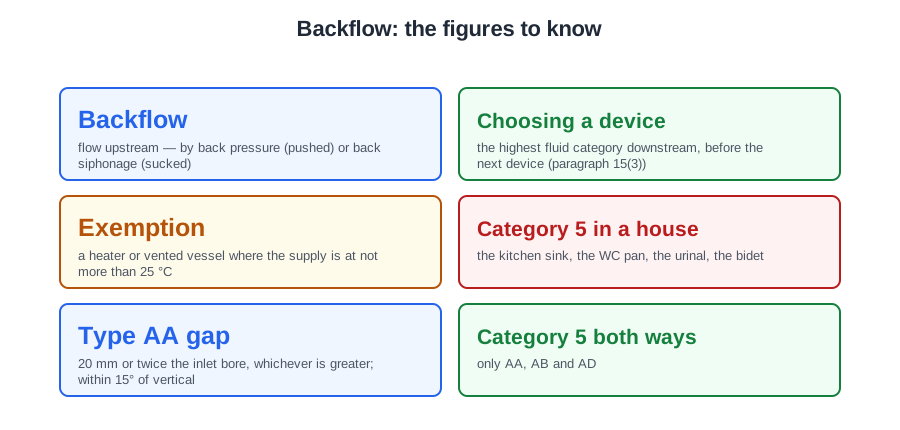
- Backflow
- flow upstream — by back pressure (pushed) or back siphonage (sucked)
- Choosing a device
- the highest fluid category downstream, before the next device (paragraph 15(3))
- Exemption
- a heater or vented vessel where the supply is at not more than 25 °C
- Category 5 in a house
- the kitchen sink, the WC pan, the urinal, the bidet
- Type AA gap
- 20 mm or twice the inlet bore, whichever is greater; within 15° of vertical
- Category 5 both ways
- only AA, AB and AD
- Type AG
- 3 and 3 — measured to the critical water level, not the working level
- Type AUK1
- 3 back pressure, 5 back siphonage; pan spill-over 300 mm below the overflow and 15 mm below the cistern
- AUK2 gaps
- 20 / 25 / 70 mm by tap size — G½, G¾, above G¾
- AUK3 gap
- 20 mm or twice the bore, whichever is greater
⚠️ Where people go wrong
- Rating a device once. Every device carries two ratings — back pressure and back siphonage — and they are often different.
- Assuming warm water is a health risk. Warmed water with nothing added is category 2, an aesthetic impairment — and it still needs a device.
- Calling a domestic kitchen sink category 3. It is category 5 in every premises, so AUK3 not AUK2.
- Sizing an AUK3 gap from the tap size. AUK2 goes on the tap; AUK3 goes on the bore.
- Measuring a type AG gap to the normal water line. It is measured to the critical level — valve failed open, overflow running full bore.
- Answering “AG” when asked what protects a WC suite. AG is what the float valve gives; AUK1 is what protects the suite.
- Reaching for a mechanical device at category 5. Nothing mechanical reaches it — only an air gap.
📝 10-Question Self-Test
Straight from the Level 3 course question bank. Click an option to see whether you got it right — the explanation appears instantly, and there is nothing to submit.
On a high risk site the danger is not one appliance but the whole installation feeding back into the undertaker’s main, so a whole-site device goes on the supply pipe where it enters. It is fitted in addition to the point-of-use protection at each appliance, which stays in place. A second point-of-use device in series still only protects that one outlet.
Water that has been in contact with a domestic wash basin, bath or shower is a slight health hazard from soap and low-toxicity substances, which is the definition of fluid category 3.
A basin in a hospital is fluid category 5 because of the pathogens present. The tap-gap that protects against category 5 is type AUK3, a gap of at least 20 mm or twice the tap bore between the outlet and spill-over level.
A bath combination tap with a shower hose is a fluid category 3 risk, because the hose outlet can be left lying in used bath water. The Water Regulations guidance gives three ways of meeting it: keep the outlet above the bath rim with a type AUK2 tap gap (G15.13, which allows other suitable backflow protection instead), fit a diverter with automatic return (type HC in Table S6.2), or fit double check valves, type EC or ED, rated for category 3, to the hot and cold supplies. Only the double check valve is offered here; its Regulators Specification letters are EC and ED, and DCV is not a type letter.
Bidet water contains human waste, so it is fluid category 5, a serious health hazard.
Paragraph 15(4) requires backflow prevention on a supply or distributing pipe where it is necessary to prevent backflow between separately occupied premises, or where the water undertaker has given notice that whole-site or part-site protection is needed. BS 8558 4.3.32.2 adds sites with buried pipework and category 5 alternative supplies as cases for whole-site protection. The WRAS Guide lists premises holding more than 24 hours' storage among those where the undertaker will usually require it; that is guidance on when notice is likely, not the legal trigger.
An over-rim bidet is filled by taps discharging above its spillover level, exactly like a wash basin, so the protection is the tap gap: type AUK2, the domestic tap gap, not less than 20 mm for a tap up to G half. AUK1 is the air gap with an interposed cistern, which is what a WC suite has, not a bidet fed over the rim.
Where a pressure flushing valve is connected to a supply or distributing pipe, the Water Supply (Water Fittings) Regulations, Schedule 2 paragraph 25(1)(c), require a permanently vented pipe interrupter (type DC) located not less than 300 mm above the spill-over level of the WC pan or urinal. The Regulations give one figure for both appliances, 300 mm; 150 mm is not it.
Where one supply pipe conveys water to two or more separately occupied premises, no occupier can control what the others connect, so the Water Regulations guidance (G15.24) has a whole-site or zone backflow prevention device fitted at the point of entry, its type chosen according to the level of risk as judged by the water undertaker. That is in addition to the protection at each point of use, not instead of it. A tap gap such as AUK2 and a pipe interrupter both work at an outlet and cannot protect an incoming main, and a pressure reducing valve is not a backflow device at all.
Fluid category 1 is wholesome water supplied by the water undertaker, the top of the five-category scale. Every other category is water whose quality has been impaired in some way - by heating (2), by a slight hazard (3), a significant hazard (4) or a serious one (5).
Going further: the lessons behind this article
This article is the public answer. Unit 331 of the Level 3 course takes the same ground to the depth the exam and the synoptic assignment ask for, in 4 lessons:
- Backflow risk: the duty and the five fluid categories
- Backflow protection levels: point of use, zone and whole site
- Air gap arrangements: types AA, AB, AD, AG and AUK1
- Tap gaps: AUK2, AUK3 and bath mixers with shower hoses
- Cold water systems: the Unit 331 guide — every article on this unit in one place
- All PlumbMate articles — Level 1, 2 and 3
- The Level 3 course — the whole 8202-35 Diploma