Nobody learns the Water Regulations by reading them in order. You learn them the day somebody with a clipboard asks why the pipe is where it is.
The short answer
The Water Supply (Water Fittings) Regulations 1999 are enforced by the water undertaker for the area, not by building control. Regulation 3 forbids five outcomes: waste, misuse, undue consumption, contamination, and erroneous measurement of the water supplied. Regulation 4 then asks two separate questions of every fitting — is it of an appropriate quality and standard, and is it suitable for the circumstances it is used in.
Almost every contravention is one of those five outcomes traced back to a fitting that failed one of those two tests.
Who is actually allowed to knock
Regulation 10 puts the duty to enforce on the water undertaker for the area it holds an appointment for — a duty itself enforceable under section 18 of the Water Industry Act 1991 by the regulator.
But the undertaker is not the only person who can be on the doorstep. Regulation 9 gives inspection powers to anyone designated in writing either by a water undertaker, under sections 74(4) or 170(3), or by a local authority, under section 84(2). Two employers, the same powers — and they are wider than people expect. A designated person may carry out inspections, measurements and tests on the premises and on fittings found there, and may take away samples of water or land, and the fittings themselves. The valve stops being part of somebody’s bathroom and becomes evidence in a bag.
The five words the whole thing hangs off
Regulation 3(2) says no fitting shall be installed, connected, arranged or used in a manner that causes or is likely to cause waste, misuse, undue consumption or contamination — or erroneous measurement. Three things there do real work.
“Or is likely to cause”. Nothing has to have gone wrong yet. A hose end left submerged in a cattle trough is a contravention on a dry day: you are judged on the arrangement, not the outcome.
“Or used”. An installation compliant the day it was signed off can be pushed into contravention by how somebody later uses it, with nobody touching a fitting.
Erroneous measurement. The odd one out, and the one people leave off, because the other four are about health or waste and this is about the meter. Letting water reach the property uncounted is a contravention on the same footing as a cross connection.
Regulation 3(3) then repeats those five outcomes for a fitting that is damaged, worn or otherwise faulty. That subsection is how old work comes back into scope.
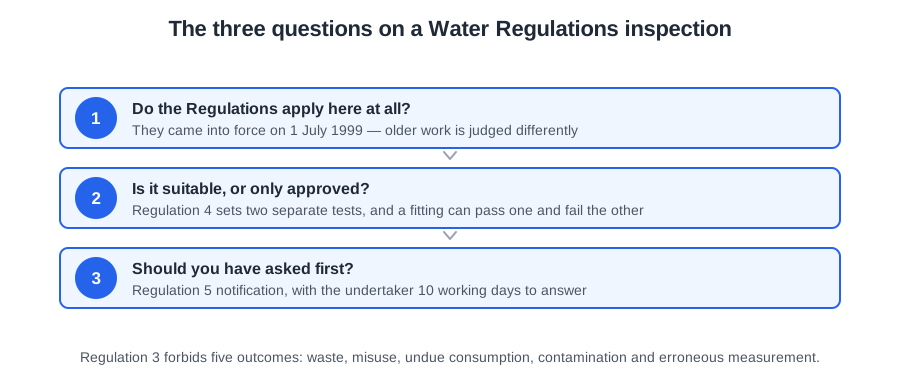
First question: do the Regulations apply here at all?
- Not connected to a public supply. Regulation 2(3) is blunt: except for paragraph 14 of Schedule 2, the Regulations do not apply to fittings not connected, or to be connected, to water supplied by an undertaker. A property on a private borehole is largely outside them. Paragraph 14 is the exception that survives, and it is the important one: it requires any pipe carrying rainwater, recycled water or anything not wholesome to be clearly identified, and forbids a supply or distributing pipe from being connected so that it could ever convey such a fluid. The one rule that follows a private system everywhere is the rule that stops it touching the mains.
- Short-term non-domestic supplies. Regulation 2(2) exempts non-domestic supplies that are metered, last no more than a month (three with written consent), and cannot return water through the meter. All three, or none.
- Work predating the Regulations. Regulation 2(4) says nothing requires anyone to remove, replace, alter, disconnect or cease to use a fitting lawfully installed or capable of being used before 1 July 1999. That is not a permanent amnesty, and here regulation 3(3) returns: old work is left alone while it is sound, but once it is damaged, worn or faulty and causing one of the five outcomes it is a live contravention regardless of age.
Second question: is it suitable, or only approved?
Regulation 4(1) sets two tests, and reading them as one is the commonest mistake here.
Every water fitting shall be of an appropriate quality and standard; and be suitable for the circumstances in which it is used.
Regulation 4(2) then defines the first test only, by four routes: an appropriate CE marking under the construction products Directive, a harmonized standard or European technical approval, an appropriate British Standard or equivalent EEA national specification, or a specification approved by the regulator.
Notice what none of those mentions: the job. Not the fluid category downstream, not the pressure, not the temperature, not whether the thing will be buried. All four are properties of the product on the shelf. That is why the second test exists and cannot be handed to a manufacturer. Suitability is decided on site, by you.
The same regulation also requires work in a workmanlike manner, and then defines it rather than leaving it to opinion: conformity to an appropriate British Standard, to a specification approved by the regulator, or to a method of installation approved by the undertaker. Workmanship is a legal test with named sources.
Third question: should you have asked first?
Regulation 5 requires notice before certain work and forbids starting without consent, which must not be unreasonably withheld. The Table, in working terms:
| Operation | What triggers it |
|---|---|
| Erecting a building or structure | Anything except a pond or swimming pool |
| Extending or altering a water system | Any premises other than a house |
| A material change of use | Any premises |
| A bath | Over 230 litres, to the centre line of the overflow |
| A bidet | With ascending spray or flexible hose |
| A pump or booster | Drawing more than 12 litres per minute |
| An RPZ valve or similar | Any device protecting against fluid category 4 or 5 |
| Buried external pipework | Less than 750mm or more than 1350mm below ground |
| A pond or swimming pool | Over 10,000 litres, replenished automatically from the supply |
The undertaker has ten working days from the day notice was given to withhold consent or attach conditions. If it says nothing, regulation 5(5) treats consent as granted unconditionally. Silence is a yes, with no strings.
The approved contractor exemption is narrower than the trade believes: regulation 5(2) disapplies notification only for item 2, the bidet and the category 4 or 5 protection device. An approved contractor is one approved by the undertaker for that area, or certified by an organisation the regulator has specified in writing.
Material change of use is two different lists
Under regulation 1(2) here, a material change of use is premises coming to be used as a dwelling, an institution, a public building, or for the storage or use of substances which if mixed with water would give a fluid in category 4 or 5. Approved Document G sets out the Building Regulations version, which adds hotels and boarding houses and says nothing about chemicals. Turning a unit into a plating shop is invisible to Approved Document G and notifiable under regulation 5 here.
Fluid categories, and why category 2 is not a health hazard
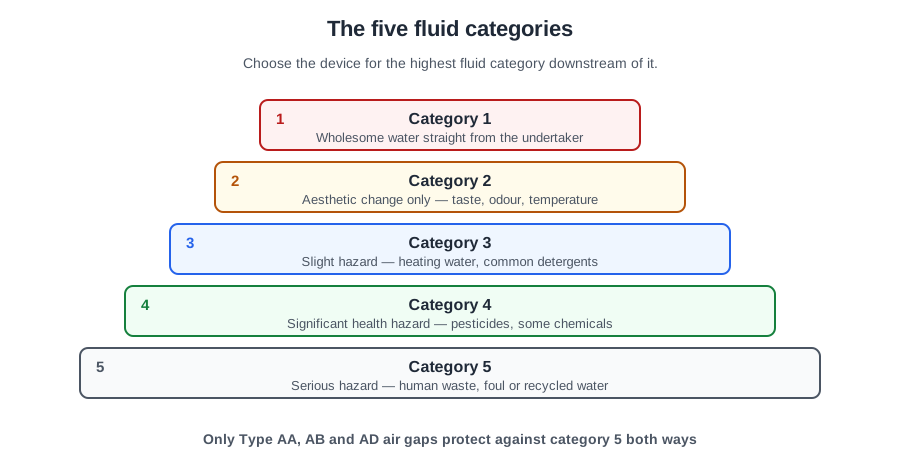
Schedule 1 defines five categories, and Schedule 2 paragraph 15(3) makes them matter: the backflow prevention device must suit the highest applicable fluid category downstream of it, before the next such device. Not the appliance you happen to be thinking about — the worst thing anywhere on that leg.
| Category | Schedule 1 | Where you meet it |
|---|---|---|
| 1 | Wholesome water as supplied | The rising main |
| 2 | Aesthetic quality impaired — temperature, taste, odour, appearance; expressly includes a hot water distribution system | Anything hot; a softener outlet |
| 3 | Slight health hazard, low toxicity — ethylene glycol, copper sulphate, sodium hypochlorite | Inhibited heating circuits; cleaners |
| 4 | Significant health hazard — toxic and carcinogenic substances, pesticides, environmental organisms | Herbicide mixing; commercial dosing |
| 5 | Serious health hazard — pathogens, radioactive or very toxic substances, human or animal waste | Any WC connection; animal troughs |
The two that get confused are 2 and 3, and the fix is in the wording. Category 2 is aesthetic: taste, smell, look, temperature. Nothing in it will hurt anybody. Hot water is category 2 for that reason and no other — Schedule 1 names the hot water distribution system inside the definition, so it is not a judgement call. Category 3 is the first category in which the word hazard appears.
Paragraph 15(2) gives the exemption that follows: backflow prevention is not required for expanded water returning to a supply pipe from a water heater, or for a vented vessel fed from a cistern, where the temperature does not exceed 25 °C. Below that, the water has not become anything else.
Who carries the can
Regulation 3(1) bites on anyone who installs, alters, disconnects or uses a fitting in contravention — and equally on anyone who causes or permits it. The householder who lets it happen is in the same sentence as the person holding the spanner.
Regulation 7(1) makes contravention an offence, liable on summary conviction to a fine not exceeding level 3 on the standard scale. It covers a breach of regulation 3(1), (2) or (3), a breach of the certificate duty in regulation 6, and three notification failures: starting a Table operation without notice, without consent, or in breach of a condition. Level 3 is a point on a scale set elsewhere in criminal law and revised periodically, so check any pound figure rather than memorising it.
Then the part that decides where liability lands. Regulation 7(2) gives a defence to an owner or occupier, and only to an owner or occupier, where two things are both true: the work was done by or under the direction of an approved contractor, and that contractor certified to the person who commissioned it that the fitting complied. Regulation 8 writes the same defence into section 73 of the Act — contaminating, wasting or misusing water — but only where the problem was caused wholly or mainly by work done on or after 1 July 1999.
Regulation 6 is the other half of that machinery: an approved contractor must, on completion, give the person who commissioned the work a signed certificate stating whether the fitting complies, and copy it to the undertaker where the job needed notice. The certificate is not paperwork. It moves exposure off the customer and onto the contractor, and it does not move back.
The failures that only show up years later
Everything above is the day of the visit. These three are the visit five years later.
Dezincification
Schedule 2 paragraph 7 governs anything you are about to hide. No fitting may be embedded in a wall or solid floor; nothing designed to be operated or maintained, and no joint, may be concealed. And where a fitting is concealed, or is a mechanical backflow prevention device other than a terminal fitting, paragraph 7(3) requires gunmetal, or another material resistant to dezincification. “Concealed” is defined broadly in 7(5): below ground, in a chase or duct, or anywhere access is difficult. A boxed-in duct qualifies.
BS 8558:2015 supplies the metallurgy: copper cannot dezincify, having no zinc in it; gunmetal is likewise immune; brasses can be inhibited to resist it, tested to BS EN ISO 6509, with grade A fittings marked CR or DRA. Ordinary brass in the wrong water leaves a fitting still the right shape with no strength left in it.
Galvanic corrosion
Schedule 2 paragraph 3(a) requires every fitting to be immune to, or protected from, corrosion by galvanic action. It is a requirement about combinations, so it cannot be met by choosing good components one at a time. BS 8558 gives the practical version: avoid incompatible materials in one installation, particularly dissimilar metals in contact. Metallic fittings should not be connected to existing lead pipework without protection against electrolytic action — and where a non-metallic insert achieves that, the earth bonding continuity must be maintained, a job forgotten precisely because it is not plumbing. Where copper meets stainless, avoid jointing a small copper area to a large stainless one: the ratio of the areas drives the attack, not merely the fact that two metals have met.
Flux
Flux fails under regulation 3, by way of Schedule 2 paragraph 2: no substance likely to cause contamination may be used in the construction, installation, renewal, repair or replacement of a fitting conveying water for domestic or food production purposes. Aggressive flux sitting in the bore is that substance.
BS 8558 gives the method. Clean the mating faces abrasively with nylon pads or emery strip — explicitly not steel wool, which leaves iron behind in a copper joint. Apply flux sparingly, and to the spigot. Leave the joint until the solder has cooled, then carefully remove any surplus. Excessive flux is a fault in its own right, not untidiness. The same standard records that the Water Fittings Regulations permit lead-free solder only.
What to take away
Hold onto the chain: five prohibited outcomes in regulation 3, two tests for the fitting in regulation 4, notification in regulation 5, a certificate in regulation 6, and an offence in regulation 7 with a defence that protects the customer rather than you.
Every detail in Schedule 2 — the gunmetal, the 25 °C, the flush volumes — hangs off one of those five outcomes. When you meet a Schedule 2 requirement you have not seen before, ask which of the five it prevents.
🔢 The numbers worth memorising
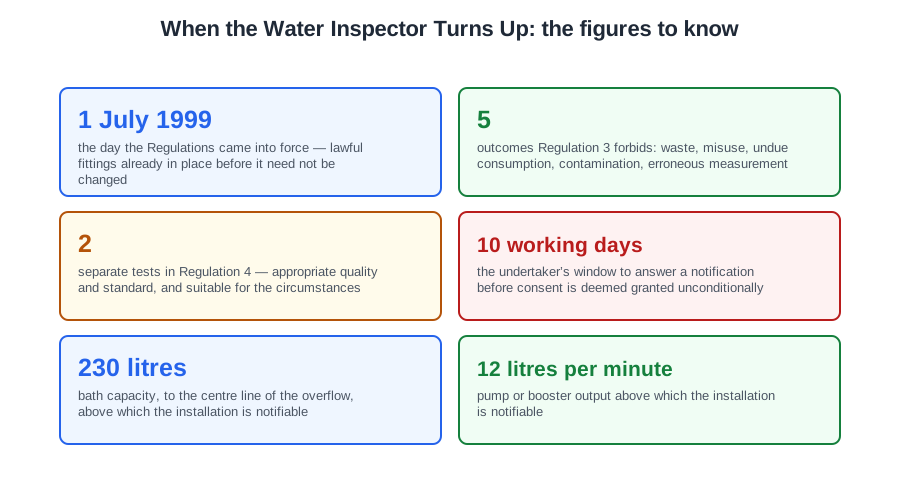
- 1 July 1999
- the day the Regulations came into force — lawful fittings already in place before it need not be changed
- 5
- outcomes Regulation 3 forbids: waste, misuse, undue consumption, contamination, erroneous measurement
- 2
- separate tests in Regulation 4 — appropriate quality and standard, and suitable for the circumstances
- 10 working days
- the undertaker’s window to answer a notification before consent is deemed granted unconditionally
- 230 litres
- bath capacity, to the centre line of the overflow, above which the installation is notifiable
- 12 litres per minute
- pump or booster output above which the installation is notifiable
- 750mm to 1350mm
- the depth band for buried external pipework; outside it, the job is notifiable
- 25 °C
- the temperature below which expanded water is exempt from backflow prevention under Schedule 2
- level 3
- the point on the standard scale capping the fine for a contravention
⚠️ Where people go wrong
- Reading Regulation 4 as one test. It is two. A fitting can carry every approval going and still fail the second, because suitability depends on where it is being installed and is decided by you, not by the manufacturer.
- Leaving erroneous measurement off the Regulation 3 list. Four of the five are about health or waste, so the meter one gets forgotten — but interfering with measurement is a contravention on exactly the same footing as a cross connection.
- Assuming the Regulations follow the water everywhere. Regulation 2(3) puts fittings not connected to a public supply outside them, with one exception: the cross-connection rule in Schedule 2 paragraph 14 still applies.
- Calling hot water category 3. Schedule 1 names the hot water distribution system inside the category 2 definition. Category 2 is aesthetic only; category 3 is the first category that mentions a health hazard.
- Thinking the contractor’s certificate protects the contractor. Regulation 7(2) is a defence for the owner or occupier. It moves exposure onto the person who signed it, which is the whole point of it.
- Treating the approved contractor notification exemption as general. Regulation 5(2) covers only three items in the Table — extension or alteration other than a house, the bidet, and the category 4 or 5 protection device.
- Using one definition of material change of use for both regimes. The Water Regulations list adds the storage or use of substances that would create a category 4 or 5 fluid, and omits hotels and boarding houses, which the Building Regulations list includes.
📝 10-Question Self-Test
Straight from the Level 3 course question bank. Click an option to see whether you got it right — the explanation appears instantly, and there is nothing to submit.
Regulation 3 forbids installing, connecting, arranging or using a fitting so that it causes or is likely to cause waste, misuse, undue consumption or contamination of the water supplied, or its erroneous measurement.
The question asks for the item of LEGISLATION. The Water Supply (Water Fittings) Regulations 1999 require every water system to be tested for water-tightness before it is brought into use.
Regulation 2(2) takes fittings out of scope where the water is supplied for a purpose other than domestic or food production, is metered, runs for no more than a month (three with the undertaker’s written consent) and cannot flow back through the meter. An outside tap on a private house is domestic use and stays in scope, whatever pipework feeds it.
Every fitting that conveys or receives water supplied by an undertaker falls under the Water Supply (Water Fittings) Regulations 1999; Regulation 2 applies them to any water fitting installed or used in premises the undertaker supplies. Building Regulations Part H covers drainage and waste, not the incoming water supply, so it is not what governs the fitting.
Regulation 3(2)(ii) adds the erroneous measurement of water supplied by the undertaker, and regulation 3(3)(ii) repeats it for fittings that are damaged, worn or faulty, which is why fittings must not bypass or disturb the meter. Regulation 3(1) itself is only the general prohibition on installing, altering, disconnecting or using a fitting in contravention of the Regulations.
Regulation 3(3) forbids any fitting being installed, connected, arranged or used which, by reason of being damaged, worn or otherwise faulty, causes or is likely to cause waste, misuse, undue consumption, contamination or erroneous measurement.
The Water Supply (Water Fittings) Regulations 1999 came into force on 1st July 1999 and replaced the water bye-laws that each undertaker had made until then, giving one national set of rules. The bye-laws went entirely; nothing was left in force for industrial buildings. BS EN 806 is a standard, not law, and a standard cannot replace regulations.
Lead pipe is soft and rarely round, so the connection is made with a proprietary fitting designed for it, such as a lead lock, which seals onto the lead by compressing a rubber ring against it. A standard compression fitting with a copper olive is the tempting answer, but the olive bites into soft lead instead of sealing on it and the joint leaks.
Schedule 2 paragraph 25 allows no flushing device fitted to a WC pan to give a single flush greater than 6 litres; 7.5 litres was the limit only until 1st January 2001. Send it back. Lowering the float valve does not rescue it either, because the cistern is marked internally with its intended flush volume and is still a 7.5 litre device.
Schedule 2 paragraph 25 caps any single flush at 6 litres, and says a device giving flushes of different volumes must have a lesser flush no greater than two-thirds of the largest, which is 4 litres. So the permitted maximum is 6 and 4. The 7.5 litre figure applied only until 1st January 2001 and is long dead.
Going further: the lessons behind this article
This article is the public answer. Unit 331 of the Level 3 course takes the same ground to the depth the exam and the synoptic assignment ask for, in 5 lessons:
- The Water Regulations: origin, enforcement and the five harms
- Scope of the Regulations: mains supplies in, private supplies out
- Fluid categories: grading water and regrading a building
- Regulations 3 and 4: installer tests and user duties
- Materials and standards: dezincification, galvanic corrosion and flux
- Cold water systems: the Unit 331 guide — every article on this unit in one place
- All PlumbMate articles — Level 1, 2 and 3
- The Level 3 course — the whole 8202-35 Diploma