A customer complains that her new kitchen tap tastes metallic and leaves a green tinge in the kettle. The pipework passed its pressure test a week ago. What it never had was a proper flush.
The short answer
Schedule 2 paragraph 13 is one sentence, and the order in it is the requirement.
One sentence of law
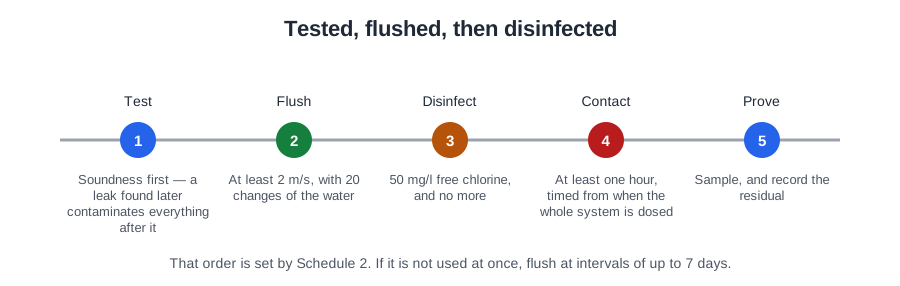
Schedule 2 paragraph 13 is one sentence: every water system shall be tested, flushed and where necessary disinfected before it is first used.
The order is the requirement. Flushing before testing would wash the evidence of leaks into the drain. Disinfecting before flushing would waste the disinfectant on debris. Testing after disinfection risks recontaminating a clean system. Each step assumes the state the previous one left the system in.
Flushing is not housekeeping
Flushing is required on every installation, whatever its size or premises. It removes swarf, jointing compound and excess flux — and flux is an acid that will corrode copper from the inside and can push the copper content over the drinking-water limit. That is the metallic taste and the green kettle.
Building debris also promotes bacterial growth, so a poorly flushed system is a contamination risk as well as a corrosion one.
The only liquid used for flushing is drinking water. And simply filling and draining is not flushing — that moves debris from one place to another. A flush has to move water fast enough to carry the debris out, through every outlet, until it runs clear.
The method
The site foreman says the system has been flushed because someone ran the ground-floor sink for ten minutes. The top-floor bathroom has never had water through it at speed.
- Protect sensitive valves and equipment — WC flushing valves, thermostatic mixers. Remove aerators, strainers and shower heads to increase flow, and backwash or renew filters afterwards.
- Open all servicing valves fully; float-operated valves must be induced fully open or removed so they do not restrict the flow.
- Flush storey by storey from the lowest floor upwards; on each floor open the draw-offs fully starting with the most remote from the riser, closing them in order afterwards.
- Achieve a velocity of at least 2 m/s and change the water in the system at least 20 times.
- Run every outlet until the water runs completely clear. Every length of pipe must be flushed — the nearest tap is not enough.
- Make a complete record of the flushing and hand it to the building owner.
An alternative flush uses a water/air mixture pulsed under pressure at a minimum velocity of 0.5 m/s, in sections of no more than 100 m. On a boosted system, water from the main is first introduced into the break cistern and then pumped to every point.
If a system has been flushed several times and the water is still cloudy, the trouble is upstream: report it to the water supplier. And if the system will not be used at once, flush at intervals of up to 7 days.
Cold and hot pipes are flushed separately, cold first, so clean water reaches the hot water storage. It may be necessary to flush with warm water to remove flux residues properly, because flux softens with heat.
Flushing is not only for new pipework: a cleansing flush is needed after refurbishment, after fitting new components, after a prolonged period of non-use (as little as two or three weeks), and after any work that might have introduced contamination. The school reopening in September and the holiday let opening at Easter both need one.
Which jobs need disinfecting
Three jobs land on the same morning: a new bathroom in a family house, a new cold water system for a nursing home, and a tee cut into an existing main for an outside tap. One needs disinfecting, one does not, and one gets a fitting dipped in a bucket.
Disinfection is not universal. For single dwellings, and for minor extensions or alterations in any premises, flushing is sufficient. So the family bathroom is flushed and left.
What does trigger disinfection:
- New installations, except a private dwelling occupied by a single family.
- Major extensions or alterations to an existing system — treat as a new system.
- Underground pipework forming part of a new installation.
- Where contamination is suspected — fouling by drainage, sewage or animals, entry by operatives during repair, or sampling showing microbiological contamination.
- A system not in regular use and not regularly flushed — a school after the summer holiday is the classic case.
How far the exception reaches. The single-family exception covers new installations and major extensions only. It does not exempt a house where contamination is suspected: a flooded cellar with the stop valve under sewage is disinfected whoever lives there. And it does nothing for a house in multiple occupation, a communal system in a block of flats, or anything commercial. The test is who the system serves, not how big it is.
The exception in the other direction is localised repairs. Inserting a junction or fitting into an existing pipe is not a new installation: the fitting is immersed in disinfectant before it goes in. Chlorinating a whole house for one fitting is not required and would inconvenience everyone in it for nothing.
The three numbers
Flush through all outlets first. Then:
| Step | Figure |
|---|---|
| Initial concentration of free chlorine | 50 mg/l — not more, because higher levels corrode copper and damage non-metallic materials |
| Contact time | at least one hour, starting only when the whole system, including the cistern up to overflow level, is full at 50 mg/l |
| Residual at the end | not less than 30 mg/l of free chlorine, measured at the furthest outlet |
| If the residual is below 30 | drain and repeat the disinfection |
| If it is 30 or more | pass — drain immediately and flush until the residual matches the incoming supply |
| pH above 7.6 | longer contact time (pH 8 needs 2.5 hours); chlorine is not used above pH 8.5 |
The residual is the whole point. Chlorine is used up as it kills what it finds, so a system that starts at 50 and ends at 20 has told you it was dirtier than an hour of chlorine could deal with. It goes round again.
The sequence is service pipes, supply pipes, cisterns, then distributing pipes. On a cistern-fed system the calculated dose is added as the cistern fills, then each draw-off is opened in turn working away from the cistern until chlorinated water discharges, topping the cistern up with dosed water as it falls.
The people side
A cleaner arrives at seven in the evening, fills a bucket from the nearest tap and starts on the floors. The system is full of water at 50 mg/l of chlorine. Nobody told her, because nobody thought about who uses the building after five.
- Nobody may draw water during disinfection, and an alternative supply is provided in an occupied building.
- The people affected are told first, and notices reading "DISINFECTION IN PROGRESS, DO NOT USE" go on every outlet — with out-of-hours users such as cleaners and security staff informed too.
- No other chemicals such as toilet cleaners may be added, because they can react with chlorine to give toxic fumes.
- Where the disinfectant could reach the point of delivery, the water supplier is informed and the supply pipe isolated.
- Spent disinfectant discharged to a sewer needs the sewerage undertaker's approval before discharge, and may need neutralising.
- Wear the PPE the safety data sheet requires. Hypochlorite burns skin and eyes.
Samples for bacteriological analysis are taken after flushing, ideally two to seven days after treatment. If the results are unsatisfactory the system is flushed, re-disinfected and re-sampled.
One distinction worth holding: where contamination is in the installed system, the answer is to disinfect. Where the problem is in the incoming supply — a private borehole, say — the answer is water treatment such as UV. Chlorinating a system does nothing for contaminated water that keeps arriving, and treating the supply does nothing for a biofilm already in the pipes.
Proving it works
A system that holds pressure and has been flushed is sound and clean, but not yet proved to work. A block of flats can pass every test so far and still leave the top-floor tenant with a basin tap that dribbles.
A performance test covers pressure and flow rate at every outlet, not the kitchen sink only. Flow is measured with a weir gauge and compared with the specification or the design flow rates the system was sized on: basin 0.1 l/s, sink and shower 0.2 (minimum 0.15), bath 0.4 (minimum 0.3), garden tap 0.5 (minimum 0.4).
Static pressure is read with a gauge on an open end with no appliances running. Dynamic pressure is read while water flows and is always lower, because of friction — and it is the one the outlets actually feel.
A diagnostic worth remembering: a customer reports her loft cistern overflows, but only at night. Static pressure rises at night as demand on the main falls, so a float valve with a split washer holds at daytime pressure and lets by under the higher off-peak pressure. The commissioning lesson is to check the shut-off under the highest pressure it will see, not the pressure that happens to be there at eleven in the morning.
And take a thermometer. Cold water sitting between 20 and 45 °C is in the range where bacteria multiply, and a cold pipe run alongside a heating flow can put it there without any fault in the plumbing.
Balancing: a valve, not a bigger pump
The readings are on paper: a top-floor basin at 0.06 l/s against a design minimum of 0.1, and the ground-floor sink at 0.35 against a design of 0.2. The pump is fine and the pipe sizes are what the drawing says. The system is unbalanced, and the fix is a valve.
Water takes the easy route. Balancing means setting the floor isolating or regulating valves, or the pressure reducing valves BS 8558 recommends where pressure has to be controlled floor by floor, so that the lower floors are throttled to the design pressure and the top floor still meets its minimum.
Work from the furthest outlet back, and re-read the outlets you have already set — every adjustment moves the others. Throttling the ground floor pushes more water up the riser, which raises the top floor and may lift the middle floors above their design figure too.
In the block of flats: the ground-floor regulating valve is throttled until the sink reads 0.2 l/s, and the top basin rises to 0.11. Both readings, the pump cut-in and cut-out and the accumulator pre-charge go on the record.
Had the top floor still failed, the drawings go back to the designer — because an undersized riser cannot be balanced out. A valve can only move flow from one outlet to another; if the riser cannot carry the design total, no throttling will find it.
Setting the controls, then proving them
Setting a control puts the right number on it. Functional testing proves the system responds to that number. They are two separate checks and the exam separates them.
Set: float valve shut-off below the warning pipe with no let-by under static pressure; servicing and stop valves proved to isolate what their labels say; PRVs set with a gauge; backflow devices fitted the right way and holding; pump cut-in and cut-out, accumulator pre-charge, low-level float switch, and the pump duty against the data.
Then run it through its cycle: draw water until the pressure switch starts the pump and confirm it stops at cut-out; lower the break cistern level and confirm the low-level switch stops the pumps; on a duplicate set confirm duty and standby change over and the alarm works. Listen for cavitation and vibration, check the rotation, check for leaks at the pump.
And one rule: a pressure switch that reads far above the true system pressure on a calibrated gauge is defective and is replaced, not adjusted. Adjusting a faulty switch until its number looks right leaves a faulty switch on the system.
🔢 The numbers worth memorising
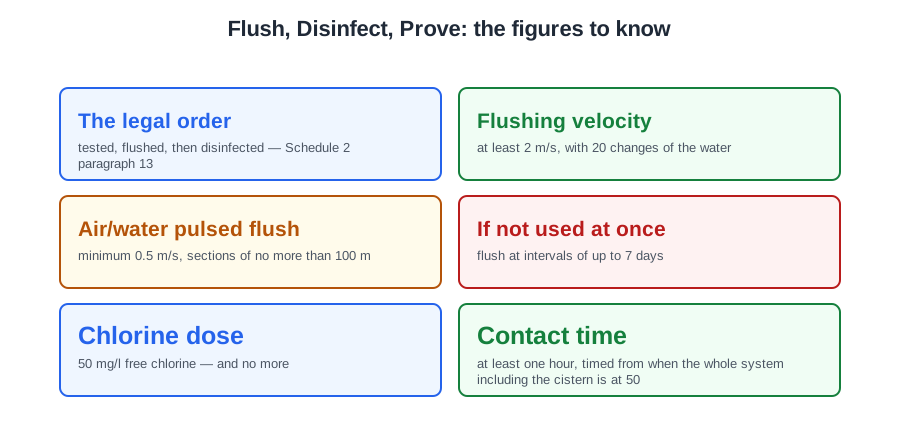
- The legal order
- tested, flushed, then disinfected — Schedule 2 paragraph 13
- Flushing velocity
- at least 2 m/s, with 20 changes of the water
- Air/water pulsed flush
- minimum 0.5 m/s, sections of no more than 100 m
- If not used at once
- flush at intervals of up to 7 days
- Chlorine dose
- 50 mg/l free chlorine — and no more
- Contact time
- at least one hour, timed from when the whole system including the cistern is at 50
- Residual
- not less than 30 mg/l at the furthest outlet
- pH above 7.6
- longer contact — pH 8 needs 2.5 hours; not used above pH 8.5
- Sampling
- two to seven days after treatment
- Cold water temperature
- avoid 20 to 45 °C anywhere in the system
⚠️ Where people go wrong
- Flushing before testing, or disinfecting before flushing. The order is the legal requirement.
- Calling a fill-and-drain a flush. It moves debris rather than removing it.
- Flushing only the nearest outlet. Every length of pipe, most remote first, lowest floor upwards.
- Disinfecting a single-family house for a new bathroom. Flushing is sufficient — but the exception does not cover suspected contamination.
- Chlorinating a whole house to fit one tee. A localised repair gets the fitting immersed.
- Timing the contact hour from when dosing began. It starts when the whole system, cistern included, is at 50 mg/l.
- Passing a disinfection with a residual of 20. Below 30 means drain and repeat.
- Fitting a bigger pump for a starving top floor. That is a balancing job — unless the riser is undersized, which no valve can fix.
- Adjusting a pressure switch that disagrees with a calibrated gauge. It is defective; replace it.
📝 10-Question Self-Test
Straight from the Level 3 course question bank. Click an option to see whether you got it right — the explanation appears instantly, and there is nothing to submit.
Microbiological contamination is dealt with by chemical or thermal disinfection of the whole system followed by flushing and sampling.
Disinfection is required where the system is contaminated or suspected to be; flushing alone precedes testing and deals with debris.
BS EN 806-5 clause 8 covers resumption of supply: a system that has been temporarily shut off and drained is thoroughly flushed before it goes back into operation, and after a short interruption without draining it is usually enough to open each draw-off fitting fully for about five minutes to run off the stagnant water. Where planned maintenance on a boosted set has involved draining down, the whole installation, booster set, pipework and storage vessels, is flushed with drinking water, not only the parts that were opened, because any part that has been drained or worked on can hold debris and stagnant water.
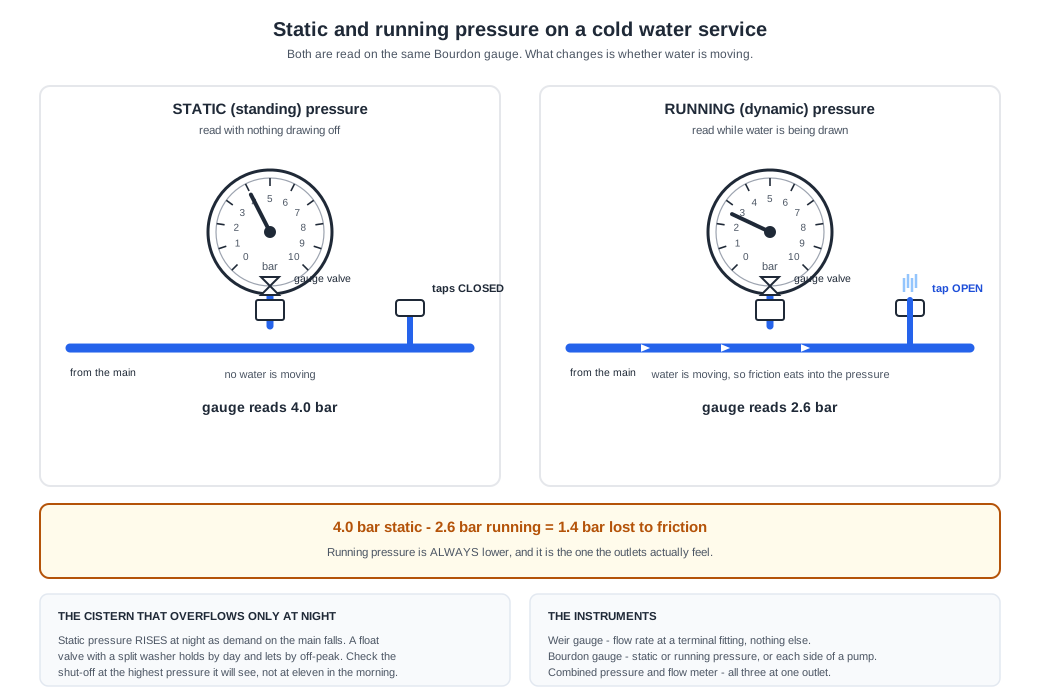
The stop valve towards the draw-off points is closed and nothing is being drawn, so the water in the pipe is standing still and the gauge is reading the pressure of water at rest. That is static pressure. “Dynamic” pressure is what you read with an outlet open and water flowing, and it always comes out lower because friction in the pipe uses some of it up.
BS 8000-15 clause 4.5 has each draw-off tap, shower fitting and float-operated valve checked for rate of flow against the specified requirements, performance tests carried out on any connected specialist items, and defects remedied and the tests repeated until a satisfactory result is obtained. Reading the pressure at the outlets alongside the flow is how the result is compared with the design figures, though the clause itself names only flow. Checking the flow at the kitchen sink alone proves nothing about the top-floor basin, which is the outlet most likely to be starved.
The installation shall be flushed with drinking water; disinfectant is a separate later step and recycled water would contaminate the system.
Disinfection is dosed at 50 mg/l (50 ppm) of free chlorine and held for at least one hour. At the end of the contact period the free residual must be not less than 30 mg/l (30 ppm); if it has fallen below 30 the disinfection is repeated. PD 855468 clause 8.5.1.1, supporting BS EN 806-4 clause 6.3; the withdrawn BS 6700 (6.1.10.4.2) gave the same figures.
PD 855468 clause 4.10 says that only biocides and materials appearing in the List of Approved Products for use in Public Water Supply in the United Kingdom, published by the Drinking Water Inspectorate, should be used in contact with water; the withdrawn BS 6700 carried the same note under its disinfection clause 6.1.10.2. The WRAS Water Fittings and Materials Directory records fittings and materials tested to BS 6920, not disinfectant chemicals.
The gauge reads how much water an outlet actually delivers, from the height the water reaches against a slot in its side, so flow rate is what gets compared with the design figure. Head loss and residual pressure are pressure measurements needing a gauge, not a weir cup; if the flow spills over the top, use a flow meter instead.
Nothing is moving: the stop valve towards the draw-off points is shut, so the gauge shows the pressure of water at rest, the static pressure. To read “dynamic” pressure you open an outlet and take the reading while the water is flowing, and it will be lower because friction in the pipe eats into the head.
Going further: the lessons behind this article
This article is the public answer. Unit 331 of the Level 3 course takes the same ground to the depth the exam and the synoptic assignment ask for, in 5 lessons:
- Flushing: the legal order and the BS EN 806-4 method
- Disinfection: which jobs need it and what disinfectant is used
- Chlorine disinfection: the figures, the people and the samples
- Performance tests: measuring flow and pressure at every outlet
- Balancing, mechanical controls and functional testing
- Cold water systems: the Unit 331 guide — every article on this unit in one place
- All PlumbMate articles — Level 1, 2 and 3
- The Level 3 course — the whole 8202-35 Diploma