A farmhouse at the end of a lane has never had a water bill. Its water comes up a borehole in the yard, and it works under a completely different rule book from a town supply — including the one you spent this unit learning.
The short answer
A private water supply is any supply not provided by a water undertaker: a well, borehole, spring, stream, river or lake. The owner or user is responsible for it. It is governed by the Private Water Supplies Regulations 2016, enforced by the local authority, which risk-assesses the supply, samples it and serves notices.
And the part that catches people: the Water Supply (Water Fittings) Regulations 1999 do not apply to water from a private supply. Everything you learned about Schedule 2 stops at the point the water is not the undertaker's.
Where a mains supply also serves the building, the private supply stays entirely separate and identified, with no connection between the two.
One source that does not count at all: rain water is not a source of wholesome water. It is harvested for WCs and gardens, never for drinking.
Ground water: wells and boreholes
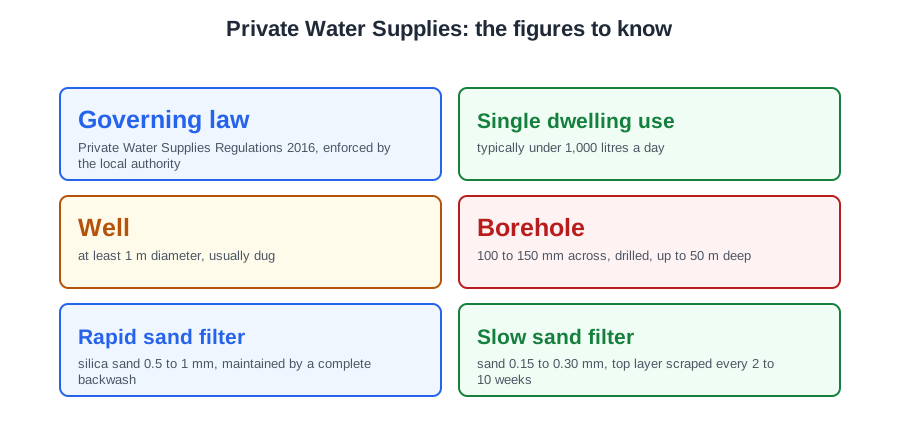
Ground water sits in an aquifer, rock that holds water like a sponge. A well is at least 1 m in diameter and usually dug. A borehole is 100 to 150 mm across, drilled, and can reach 50 m.
A perched aquifer — a pocket of water above the main water table — is the least reliable and dries up after a long dry spell. Deep water filtered through sand and gravel is generally clean; limestone water travels through fissures and is less so, and some aquifers carry iron, manganese or nitrates that treatment has to deal with.
Water is lifted either by a submersible pump, a sealed centrifugal pump hung below the water that pushes the water up with no suction-lift limit, or by a surface pump at the top that has to pull it up, which limits how deep it can draw from. That push-versus-pull distinction is the reason boreholes of any depth use submersibles.
Surface water: springs and streams
Surface water is drawn from streams and rivers. Rivers give bigger yields than boreholes but vary with catchment, season and weather. Peaty ground gives acidic water that can carry lead, and microbiological contamination peaks after heavy rain.
A surface source is used only where no ground water exists, and it always needs filtration and disinfection designed for the worst case. A shallow stream or spring carries the greatest risk of microbiological contamination, being open to run-off, animals and vegetation — so a sample from one is the one most likely to contain microbiological matter, and a house on such a supply should expect supply problems in the summer months.
A stream intake gets its first protection from a coarse strainer or screen against fish, weed, silt and debris, sited away from turbulent water and feeding a settlement tank with a raised, screened outlet so the silt drops out.
A spring forms where the water table meets the surface. It is protected by a chamber built over it, water entering from the base or side, a lockable watertight cover above ground, an overflow sized for the full flow, a screened raised outlet, fencing to keep animals off, and a cut-off ditch upslope to carry surface run-off round the chamber rather than into it.
The multiple barrier principle
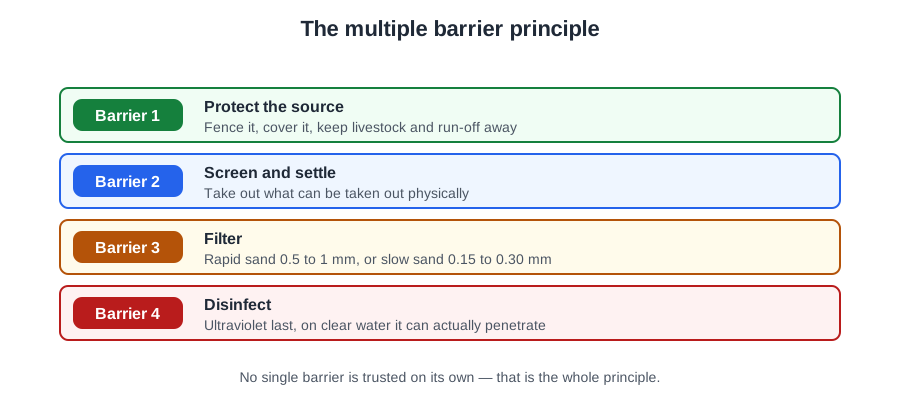
All private water is treated before it is drunk, and it is treated in stages so no single one carries the whole load: settling, coarse pre-filtration, sand filtration, then disinfection. Water from a spring or well is filtered before the final treatment stage, because disinfection only works on clear water.
- Rapid sand filter — coarse silica sand, 0.5 to 1 mm; a physical filter removing turbidity, algae, iron and manganese. The preferred sediment removal before disinfection on a small supply. Maintained by a complete backwash.
- Slow sand filter — fine sand, 0.15 to 0.30 mm; a biological layer (the schmutzdecke) removes micro-organisms. Top layer scraped every 2 to 10 weeks; units in tandem.
- Pressure filter — a sand bed in a sealed cylinder, so the supply keeps its pressure.
- Activated carbon — absorbs chlorine, pesticides, taste and colour. Can breed bacteria, so not for water of unknown quality.
- Reverse osmosis — removes salts, nitrates and pesticides, wastes about 3 litres per litre made, and is notifiable under Regulation 5 where the property is also on the mains.
Ultraviolet: the last cylinder on the wall
Ultraviolet irradiation is the preferred disinfection for a single dwelling. A low-pressure mercury lamp in a quartz sleeve inside a stainless steel chamber emits UV at 254 nm, which changes the cellular structure of micro-organisms so they cannot reproduce.
Three consequences follow, and all three are examined. UV needs clear water, so pre-filtration is essential. The lamp is replaced every 12 months whether or not it is still glowing. And it leaves no residual, so it sits after the filters and the pump, as close to the taps as it can be.
Chlorination (0.2 to 0.5 mg/l residual after 30 minutes contact) and ozone serve larger supplies. A base-exchange softener may follow, checked with pH indicator strips on raw and softened samples — and because a softener swaps calcium and magnesium for sodium, a hard-water tap is usually taken off before it.
Three ways into the house
Gravity, where the source is higher than the house. Water flows from a catchment tank at the spring or stream with no pump at all, feeding a conventional indirect system or a direct one. Filtration and disinfection are needed either way.
Pressure control, from a well or borehole. A submersible or surface pump delivers through the filters and UV into an accumulator; a transducer or pressure switch starts the pump when the pressure falls and stops it when the vessel is charged, typically between 1.5 and 3 bar. The kitchen sink is fed directly from the accumulator at pressure, other outlets from a roof cistern, and a non-return valve goes upstream of the accumulator so stored water cannot run back through the pump. This is the preferred layout where treatment is fitted.
Level control. A float switch in the roof cistern runs a surface pump until the cistern is full. Every outlet is then cistern-fed at low pressure, and a pressurised sink is not possible. That is the difference between two neighbouring cottages on the same hillside: one has a kitchen tap that fires like a mains tap, the other has a gentle trickle everywhere.
Where the source is below the house, or unreliable, water is collected in a catchment tank and passed to a low-level break cistern, and a surface pump lifts it from there. The break cistern gives settlement time and a reserve, and a float switch in it protects the pump from running dry.
Storing it
External break cisterns and roof cisterns are protected against contamination, insulated against freezing and undue warming, and given a lockable, close-fitting but not airtight lid with screened overflows and warning pipes. A new cistern is disinfected with 20 mg/l chlorine left overnight, and storage is inspected every six months.
🔢 The numbers worth memorising
- Governing law
- Private Water Supplies Regulations 2016, enforced by the local authority
- Single dwelling use
- typically under 1,000 litres a day
- Well
- at least 1 m diameter, usually dug
- Borehole
- 100 to 150 mm across, drilled, up to 50 m deep
- Rapid sand filter
- silica sand 0.5 to 1 mm, maintained by a complete backwash
- Slow sand filter
- sand 0.15 to 0.30 mm, top layer scraped every 2 to 10 weeks
- UV
- 254 nm from a low-pressure mercury lamp; lamp replaced every 12 months
- Chlorination
- 0.2 to 0.5 mg/l residual after 30 minutes contact
- Accumulator pressure
- typically 1.5 to 3 bar
- New cistern disinfection
- 20 mg/l chlorine overnight; storage inspected every six months
⚠️ Where people go wrong
- Applying the Water Fittings Regulations to a private supply. They do not reach it — the Private Water Supplies Regulations 2016 do.
- Treating harvested rainwater as a drinking source. It is never a source of wholesome water.
- Putting the UV unit before the filters. Disinfection only works on clear water, and UV leaves no residual, so it goes last and close to the taps.
- Leaving a UV lamp in because it still glows. It is replaced every 12 months on time, not on appearance.
- Fitting the non-return valve downstream of the accumulator. It goes upstream, so stored water cannot run back through the pump.
- Specifying a surface pump for a deep borehole. A surface pump pulls and is suction-limited; a submersible pushes and is not.
- Making a private-supply cistern lid airtight. Close-fitting and lockable, yes — airtight, no.
📝 10-Question Self-Test
Straight from the Level 3 course question bank. Click an option to see whether you got it right — the explanation appears instantly, and there is nothing to submit.
Surface water and shallow springs are open to run-off, animals and vegetation, so they carry the highest microbiological load. A deep well is filtered by the strata; a treated main and a covered cistern hold wholesome water.
A submersible pump sits below the water level in the borehole and pushes water up, avoiding the suction-lift limit a surface pump would face.
A check valve on the inlet stops the stored water in the accumulator flowing back into the supply pipe when the mains pressure drops.
Surface water is water that has not soaked into the ground: streams, rivers and lakes. Boreholes, artesian wells, chalk aquifers and deep springs all yield ground water, drawn from rock below the surface. The distinction matters because surface water changes with the season and the weather, so it always needs filtration and disinfection designed for its worst condition.
The intake pipe in a stream is protected first by a coarse strainer or screen, which keeps leaves, weed, silt, fish and debris out of the pipe before the water reaches any storage or treatment. Finer filtration and disinfection come later in the chain. A filter cartridge would block in hours on raw stream water; a double check valve and a pressure reducing valve deal with backflow and pressure, not with what enters the pipe.
210 litres of usable water at 14 litres per minute lasts 210 / 14 = 15 minutes before the accumulator is spent and the supply falls back to mains flow. The usable volume is less than the vessel's nominal size, because the air pre-charge and the diaphragm take part of it, which is why the stem gives the usable figure.
An indirect system feeds only the drinking water tap from the incoming main and takes everything else from a cold water storage cistern, so a cistern in the roof space is what tells you the system is indirect. A stop valve where the supply enters, and a drain-off above it, are fitted to every system, direct or indirect, so neither tells you anything.
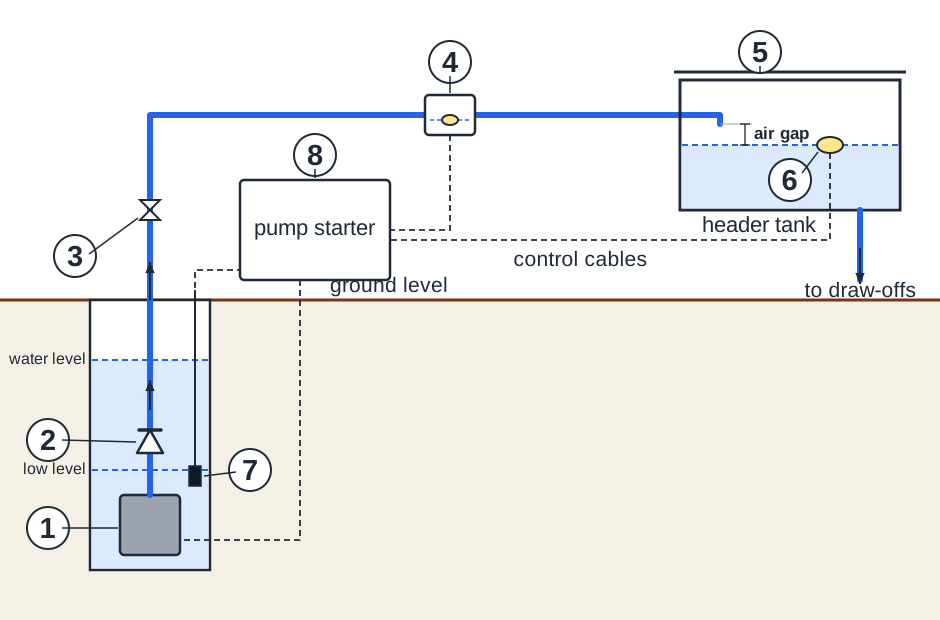
1 is the unit sitting in the water at the bottom of the well. A submersible pump carries its motor and impellor together under the water and pushes water up the rising main, so it is not limited by suction lift the way a surface pump is. “A break cistern” is wrong: the only cistern here is the header tank at high level, which this pump fills.
The pre-charge is the air pressure in the empty vessel, set to suit the system pressure, which in practice means a little below the pump cut-in pressure (manufacturers give the figure; BS 8558 sets no percentage). Set it wrong and there is hardly any usable water between cut-out and cut-in, so one small draw-off empties the vessel and the pump restarts seconds later. A wide pressure switch differential does the opposite, giving longer runs and fewer starts.
A rapid sand filter traps turbidity, algae, iron and manganese in a bed of coarse silica sand, and the way to clear it is a complete backwash, reversing the flow to lift the bed and wash the trapped material out. BS EN 806-2 (B.4.4) has a control device to judge the level of fouling and start the backwash, so it is done whenever the head loss across the bed rises, at the interval the manufacturer gives. The sand itself is not used up, so it is not replaced monthly.
Going further: the lessons behind this article
This article is the public answer. Unit 331 of the Level 3 course takes the same ground to the depth the exam and the synoptic assignment ask for, in 3 lessons:
- Private water supplies: sources and responsibilities
- Private supply treatment: filtration, ultraviolet and house layouts
- Borehole pumps: packaged sets, controls and the accumulator
- Cold water systems: the Unit 331 guide — every article on this unit in one place
- All PlumbMate articles — Level 1, 2 and 3
- The Level 3 course — the whole 8202-35 Diploma