Three years after handover the top-floor tenant complains of poor pressure. Was it always like that? The only honest answer is on the commissioning record.
The short answer
The commissioning record is the proof that the system does what the design said it would. It is kept for reference during maintenance, it is the baseline a fault is measured against years later, and in a non-domestic building it feeds the Legionella records that HSE ACOP L8 requires.
BS EN 806-4 requires a complete record of the pressure test, of the flushing, and of the disinfection and its results, each handed to the building owner. BS EN 806-5 makes the commissioning report part of the documentation kept for the life of the installation.
What goes on it
| Section | Information |
|---|---|
| Identification | Date and time, name of the commissioning engineer and company, location |
| The system | Type of system, cold water storage volume, types and manufacturers of equipment, backflow devices fitted and where |
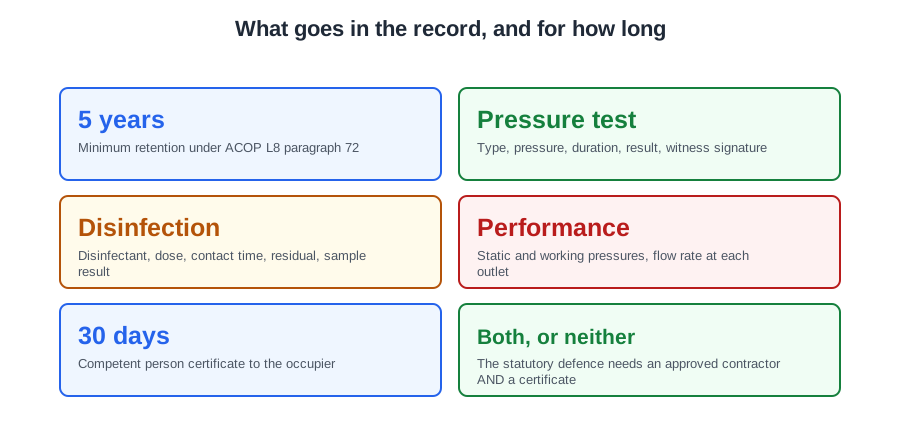
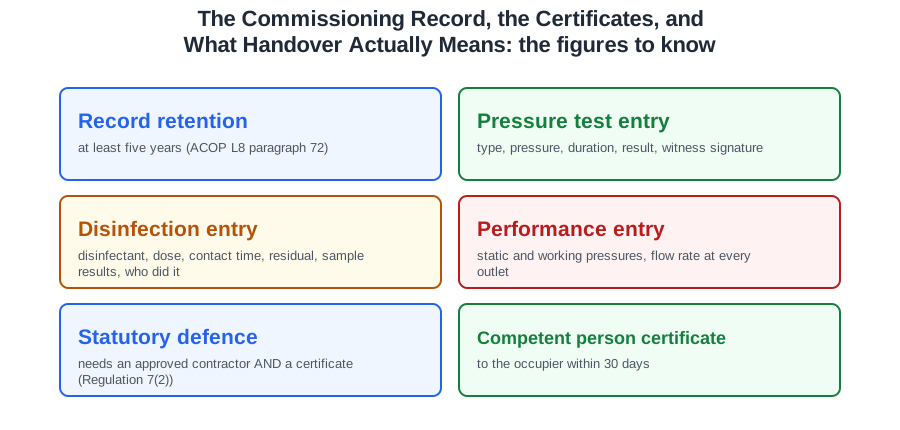
| Pressure test | Type of test (metal one-hour, Test A or Test B), test pressure, duration, result, witness signature |
| Flushing | Flush time and flow rate, sections flushed, date |
| Disinfection | Disinfectant used, dose in mg/l, contact time, residual at the end of contact, residual after flushing, neutralising agent if any, sampling results, date, and who carried it out |
| Performance | Static and working pressures, flow rates at every outlet, pump suction and discharge pressures, pump cut-in and cut-out, accumulator pre-charge, PRV settings |
| Defects | Anything found, what was done about it, and the retest |
What does not
Payment terms belong to the contract and the invoice. Delivery dates of plant, the supplier of the copper tube, the brand of flux or solder, the weather, the vehicle registration and the time you arrived on site are none of them commissioning results.
The names and qualifications of the installers, and the method statements and permits used during installation, belong in the health and safety file and the water management logbook — though the record does name the person or company who carried out the disinfection.
Under ACOP L8 paragraph 72, records of monitoring, inspection, tests and checks are kept for at least five years.
When commissioning finds a fault
Commissioning is the first time the system runs, so it is when problems appear — and finding them is what commissioning is for. The rule is: correct items failing any test immediately and re-test them before further work proceeds. A defect is never carried forward or left for the maintenance contractor to find.
What you do next depends on the kind of defect, and the split between "yours to fix" and "somebody else's decision" is examined:
- A leak or pressure drop on test — locate and repair, then repeat the whole test.
- A component that does not match the specification — report it to your manager. Accepting a substitution is not your decision.
- Flow or pressure below specification — if pipe sizes are too small the shortfall appears immediately downstream of the mistake. Check the drawings and confirm the sizes with the design engineer before acting. If the pump set or accumulator is wrongly set up, follow the manufacturer's set-up procedure and, if it still fails, contact technical support.
- A defective component — do not attempt a repair, which can void the warranty. Contact the manufacturer and supplier, who may wish to inspect before replacement.
- Noise or vibration — usually missing or wrongly spaced clips. Add supports.
- Cold water warming above 20 °C — pipework run too close to hot pipes. Insulate or re-route.
- Microbiological contamination — disinfect, resample, take specialist advice.
Every defect and its remedy goes on the record, with the retest that proved it fixed, and nothing is handed over until the retest passes.
Notification, seen from the other end
Two jobs, same week. A new bathroom in a private house, and a new-build house waiting for its service connection. The customer on the first asks whether the water company has to be told. The site agent on the second assumes it does not. Both have it the wrong way round.
Work in a private house that is only an extension or alteration is not notifiable, because item 2 of the Regulation 5 Table says "premises other than a house". So the new bathroom needs no notice. But before a new house is connected the undertaker must have been notified, because erecting a building is item 1, and consent is needed before the fittings are installed and connected.
Both traps cut against instinct: a big job in a house can be done without a word to the water company; a modest new build cannot. The test is which line of the Table the work sits on, not its size.
And the last step, easily forgotten: when all tests have passed, the water supplier is told the system is ready for permanent connection.
The certificates
Whether you can write a certificate of compliance depends on one thing: whether you are an approved contractor — approved by the undertaker for the area, or certified by an organisation specified in writing by the regulator.
Under Regulation 6, an approved contractor must on completion give a signed certificate of compliance to the person who commissioned the work, and where the work was notifiable, send a copy to the undertaker.
The reason it matters is Regulation 7(2): the owner or occupier has a statutory defence only where the work was done by an approved contractor and the contractor certified it. Approval without a certificate fails. A certificate from somebody not approved fails too.
Separately, Building Control wants its own paperwork — a completion notice on a building notice or full plans route, or a competent person's certificate within 30 days.
What handover actually means
Handover is not dropping an envelope through the door. The customer gets three things: the documents, a demonstration, and the knowledge to act in an emergency.
The handover file holds the undertaker's acceptance, the compliance certificates, the commissioning records, the as-fitted drawings and every manufacturer's instruction book. Where the building has a water management regime, it also holds the schematic diagrams and the log the next engineer will write in.
The demonstration is the part people skip and the part customers remember. Walk them round and explain the working principles of the controls — what the booster set does and what its alarm means, what the softener needs, how the WC servicing valves work. Show them the isolation points, and make them turn the stop valve themselves once, so they know it moves and where it is at two in the morning.
Then the record goes in the logbook, and the system stops being your job and starts being theirs — with a written baseline so that in three years, when the top-floor tenant complains, there is an honest answer to "was it always like that".
🔢 The numbers worth memorising
- Record retention
- at least five years (ACOP L8 paragraph 72)
- Pressure test entry
- type, pressure, duration, result, witness signature
- Disinfection entry
- disinfectant, dose, contact time, residual, sample results, who did it
- Performance entry
- static and working pressures, flow rate at every outlet
- Statutory defence
- needs an approved contractor AND a certificate (Regulation 7(2))
- Competent person certificate
- to the occupier within 30 days
- Extension in a house
- not notifiable — item 2 says "premises other than a house"
- Erecting a building
- is notifiable — item 1, consent before fittings are connected
⚠️ Where people go wrong
- Putting payment terms, delivery dates or the flux brand on a commissioning record. It holds technical results.
- Leaving a defect for the maintenance contractor. It is corrected and re-tested before further work proceeds.
- Accepting a component that does not match the specification. That goes to your manager, not into the system.
- Repairing a defective new component yourself. It goes back to the manufacturer and supplier — a repair can void the warranty.
- Assuming a big job in a house needs notifying and a small new build does not. It is the Table line, not the size.
- Writing a certificate of compliance without being an approved contractor. It gives the customer no defence at all.
- Handing over an envelope. The demonstration and the isolation points are part of handover, not an extra.
📝 10-Question Self-Test
Straight from the Level 3 course question bank. Click an option to see whether you got it right — the explanation appears instantly, and there is nothing to submit.
The commissioning record holds the technical results: the disinfection concentrations and contact time, the measured flow rates at outlets and the pressure test and how long it was held. Prices, invoices and maintenance contracts are commercial documents.
Regulation 5 requires notice to the water undertaker for the extension or alteration of a water system on any premises other than a house (Table item 2), so a plain extension or alteration in a house is not notifiable. That is not a general exemption for houses: the fittings in Table item 4, such as a bath holding more than 230 litres, a bidet with an ascending spray or flexible hose, a pump or booster drawing more than 12 litres per minute, a reverse osmosis unit, a reduced pressure zone valve or an automatic garden watering system, are notifiable wherever they are installed, and Regulation 5(2) lifts the notice only for items 2, 4(b) and 4(g) when an approved contractor does the work. Whatever the notification position, an approved contractor must on completion give the person who commissioned the work a signed certificate under Regulation 6 stating whether the fittings comply. The ten working days in Regulation 5(4) is the undertaker's period for withholding or conditioning consent, not a notice period, and neither the local authority nor WRAS has any part in Water Regulations notice.
At handover the user has to be able to run the system, so you explain how the controls work, show them the isolation points and let them operate the stop valve. Insurance details, component prices and the flux safety data sheet are your own paperwork; none of them helps the customer operate the installation.
The commissioning certificate and the test results are evidence that the installation was tested and performs as designed; an invoice or a verbal account proves nothing.
The commissioning record proves the system does what the design said: pump duty, pressures and flows measured against the specification.
A disinfection record is a required part of the commissioning documentation for a large system: the method, concentrations, contact time and the sampling results.
A water softener is a working appliance the customer has to keep going: it takes salt, it regenerates on a cycle and it has a bypass, so it is handed over with operating instructions and a demonstration. Bath taps, a drain-off valve and pipe insulation have nothing for the user to set or run, so no operating instructions are needed for them.
Show the customer where the stop valve is, how to close it, and then let them operate it themselves, so that when a pipe bursts they can stop the water before it does damage. Adjusting the pressure reducing valve is a commissioned setting and not theirs to move, and draining down is skilled work that can collapse a cylinder if air cannot get in behind the water.
Unsatisfactory samples mean the system is still contaminated, so the disinfection is repeated in full and fresh samples taken afterwards. Flushing with fresh water and handing over tempts because flushing does come first in the procedure, but it clears debris and stagnant water; it does not kill what the sample found.
Flow rates measured at each outlet are the evidence that the installation performs to specification, so they are recorded in detail alongside the test pressure and duration, the static and working pressures and any disinfection figures. Operatives’ names belong in the health and safety file, and flux brands and insulation colours belong nowhere on a commissioning record.
Going further: the lessons behind this article
This article is the public answer. Unit 331 of the Level 3 course takes the same ground to the depth the exam and the synoptic assignment ask for, in 4 lessons:
- The commissioning record and the defects that go on it
- Regulation 5 notification and the certificates of compliance
- Handover: the file and the demonstration
- After handover: signing off and the routine user checks
- Cold water systems: the Unit 331 guide — every article on this unit in one place
- All PlumbMate articles — Level 1, 2 and 3
- The Level 3 course — the whole 8202-35 Diploma