A customer wants a 260 litre bath, a booster pump and a timed garden watering system in an ordinary private house. She assumes nobody needs telling. Two of the three are notifiable, and starting them without notice is a criminal offence.
The short answer
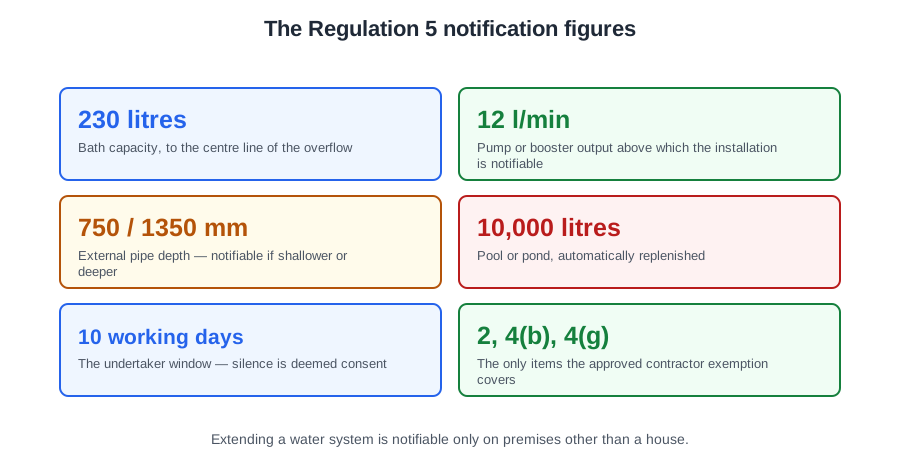
Regulation 5 of the Water Supply (Water Fittings) Regulations 1999 lists the operations you must notify the water undertaker about before work starts. You then wait for consent, and comply with any conditions attached to it. If you hear nothing within ten working days, Regulation 5(5) deems consent granted unconditionally.
Separately — and this is the part people miss — the Building Regulations 2010 are different law with a different enforcer, and satisfying one does nothing for the other. Every job has to be run through both columns.
The Regulation 5 table, and the three traps in it
Five items, with item 4 sub-divided. In outline:
- 1 — erection of a building or other structure (not a pond or pool).
- 2 — extension or alteration of a water system on any premises other than a house.
- 3 — a material change of use of any premises.
- 4(a) a bath over 230 litres, measured to the centre line of the overflow; 4(b) a bidet with an ascending spray or flexible hose; 4(c) a single shower unit of a type specified by the regulator (none currently is); 4(d) a pump or booster drawing more than 12 litres per minute from a supply pipe; 4(e) reverse osmosis; 4(f) a water treatment unit producing a waste discharge or needing water to regenerate; 4(g) an RPZ valve or other mechanical device protecting against fluid category 4 or 5; 4(h) a garden watering system unless designed to be operated by hand; 4(i) any water system laid outside a building less than 750 mm or more than 1350 mm below ground.
- 5 — a pond or swimming pool over 10,000 litres automatically replenished from the undertaker's supply.
Trap one: the house exception is item 2 only. A new bathroom in an office or a toilet block at a small industrial unit is notifiable. Item 4 fittings are notifiable anywhere, including a house — which is why the 260 litre bath and the timed garden system both need notice even though the property is a private home.
Trap two: thresholds cut both ways. A 180 litre bath, a pump drawing 10 litres a minute, a double check valve against category 3, or a hand-operated garden system are all outside the table. The threshold is the answer, not the type of fitting.
Trap three: the depth rule catches both ends. Too shallow and it freezes; too deep and it cannot be reached for repair. BS 8558 clause 4.3.12.8 adds that domestic cisterns installed below ground are notifiable.
What the notice has to say, and what happens next
Regulation 5(3) sets the contents: the name and address of the person giving notice (and of the person to be served if different), a description of the work or change of use, and the location of the premises and their use or intended use. A plan of the premises and a diagram of the pipework are required except for items 4(a), 4(c), 4(h) and 5 — the large bath, the specified shower, the garden system and the pond — where the fitting itself is the notifiable thing and its position on a drawing tells the undertaker nothing.
The undertaker then has ten working days and four lawful responses: consent unconditionally, consent with conditions, refuse, or do nothing. Silence is consent, unconditionally.
Be clear about what deemed consent is and is not. It is permission to start. It is not approval of whatever you go on to build — your duty to comply with the Regulations is unchanged, and the undertaker can still inspect afterwards.
If consent is refused and you think that unreasonable, the route is arbitration. It is not starting anyway.
The approved contractor exemption is narrower than people think
An approved contractor (Regulation 1) is approved by the undertaker for the area, or certified by an organisation specified in writing by the regulator — the first such scheme being WIAPS.
Regulation 5(2) exempts an approved contractor from notifying items 2, 4(b) and 4(g) only: extensions and alterations outside a house, ascending-spray bidets, and RPZ valves or other category 4 or 5 devices. That is why a WIAPS plumber can start an RPZ at a dental surgery on Monday while somebody else waits.
Everything else on the list still needs notifying, card or no card. A 260 litre bath in a private house is not exempt.
The certificate is what actually protects the customer
Under Regulation 6 an approved contractor must, on completion, give a signed certificate of compliance to the person who commissioned the work, and where the work was notifiable send a copy to the undertaker.
That certificate matters more than the approval, because Regulation 7(2) gives the owner or occupier a statutory defence only when both halves are present: the work was done by an approved contractor and the contractor certified it. Approval without a certificate fails. A certificate from somebody not approved fails too.
Building Control is a different question with a different clock
The Building Regulations 2010 are enforced by the local authority. Part G covers cold water: G1 requires wholesome water for drinking, food preparation and washing; G2 and Regulation 17K require water efficiency, with new dwellings designed to no more than 125 litres per person per day.
The building control body must normally be notified before work starts (Regulation 12), by full plans or a building notice. Two exceptions:
Schedule 2B is minor work that needs no notice at all — replacing part of, or adding a control to, an existing cold water supply; or replacing a WC, basin, sink, bath or shower with one using no more water. The requirements still apply; only the duty to notify is removed.
Schedule 2A is self-certifiable work. Under Regulation 12(5), a person registered with a government-recognised competent person scheme need not notify in advance. For a wholesome cold water supply, Annex 2 of Approved Document G lists APHC, BESCA, CORGI, NAPIT and NICEIC. The installer then gives the occupier a certificate within 30 days and the building control body a notice or copy in the same 30 days (Regulation 16A).
Watch the completion clocks: on a building notice or full plans, notice that commissioning is complete goes to the BCB within 5 days; for a competent person, within 30. For a new dwelling the water efficiency calculation is notified within 5 days (Regulation 20E), and a completion certificate is unlikely until it arrives.
Two more waters, two more people to tell
Where a mains-fed building also has rainwater or greywater, BS 8515 and BS 8525-2 both require notification to the water supplier before work starts, with a plan, schematic and details, because the undertaker must see the backflow protection between the two waters. Schedule 2 paragraph 14 requires every non-wholesome pipe to be clearly identified, to BS 1710 — green base with an auxiliary blue band for drinking water — and forbids any cross-connection.
And two more, on an ordinary job: tell the water supplier before disinfecting where the disinfectant could reach the point of delivery, and the sewerage undertaker before discharging used disinfectant to a drain (BS EN 806-4).
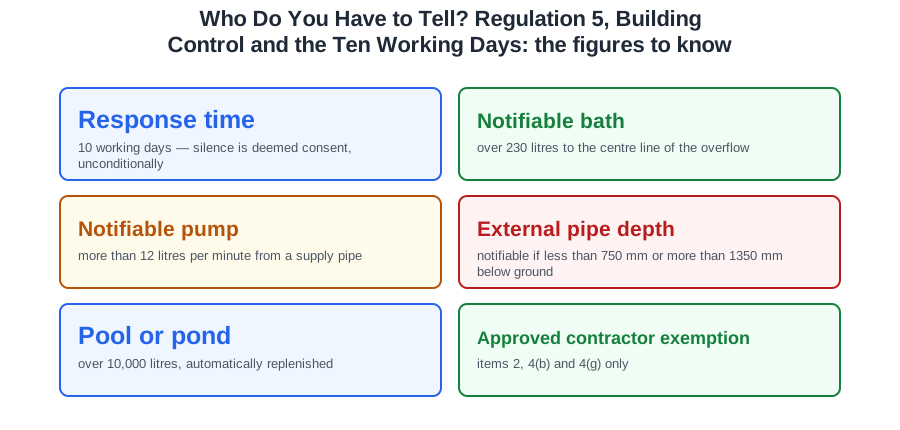
🔢 The numbers worth memorising
- Response time
- 10 working days — silence is deemed consent, unconditionally
- Notifiable bath
- over 230 litres to the centre line of the overflow
- Notifiable pump
- more than 12 litres per minute from a supply pipe
- External pipe depth
- notifiable if less than 750 mm or more than 1350 mm below ground
- Pool or pond
- over 10,000 litres, automatically replenished
- Approved contractor exemption
- items 2, 4(b) and 4(g) only
- Competent person certificate
- to the occupier within 30 days; BCB notified in the same 30
- Completion notice (building notice / full plans)
- within 5 days
- New dwelling water efficiency
- no more than 125 litres per person per day
- Penalty
- a fine not exceeding level 3 on the standard scale (Regulation 7)
⚠️ Where people go wrong
- Reading the house exception as covering everything. It is item 2 only — item 4 fittings are notifiable anywhere, a private house included.
- Believing a WIAPS card removes the duty to notify. The exemption is items 2, 4(b) and 4(g); a big bath or a big pump still needs notice.
- Treating deemed consent as approval of the finished work. It is permission to start, nothing more.
- Starting anyway when consent is refused. The route is arbitration, and starting is a Regulation 7 offence.
- Assuming that notifying the water undertaker satisfies Building Control. Two systems, two enforcers — run every job through both.
- Giving the certificate of compliance to the undertaker and forgetting the customer. Regulation 7(2) needs the customer to hold it for the statutory defence to exist.
📝 10-Question Self-Test
Straight from the Level 3 course question bank. Click an option to see whether you got it right — the explanation appears instantly, and there is nothing to submit.
Notifiable building work needs a building notice or full plans deposited with Building Control before work starts; the officer cannot inspect what is already covered up.
Item 4(a) of the Regulation 5 table makes a bath of more than 230 litres, measured to the centre line of the overflow, notifiable anywhere, a house included, because of the demand it puts on the supply. A bidet is only notifiable where it has an ascending spray or flexible hose, and an RPZ valve only where it protects against fluid category 4 or 5.
Item 4(d) of the Regulation 5 table makes a pump or booster drawing more than 12 litres a minute notifiable. A bidet is notifiable only with an ascending spray or hose, a bath only over 230 litres, and an RPZ only when it protects against category 4 or 5.
Regulation 5(2) exempts an approved contractor from notifying three items in the table: item 2, the extension or alteration of a water system on premises other than a house, and items 4(b) and 4(g). Erecting any building still needs notice.
Regulation 6 makes the approved contractor give a signed certificate, stating whether the fitting complies with the Regulations, to the person who commissioned the work — the customer — and send a copy to the undertaker where the job was notifiable. Building control has its own separate notification route under the Building Regulations; it is not told under Regulation 6.
Regulation 12(5) of the Building Regulations removes the need to notify a building control body in advance where the work is done by someone registered with a government-recognised competent person scheme, and that person then certifies compliance to the occupier within 30 days. A boiler maker’s own installer scheme or a trade union card carries no such statutory standing.
Regulation 5, item 4(d) of the table, sets the threshold at more than 12 litres a minute for a pump or booster connected directly or indirectly to a supply pipe, and the notice must reach the undertaker before work starts. The figure is 12, not 10 or 15, and there is no exemption for a house.
A bidet with an ascending spray or flexible hose is item 4(b) in the table of notifiable work; the water undertaker must be given notice and consent before it is installed.
Item 2 of the Regulation 5 table makes the extension or alteration of a water system notifiable on any premises other than a house, and item 1 catches erecting the building itself, so the toilet block needs notice and consent before work starts. Replacing a bath like for like, a tap, or a float valve in a house is none of those things.
Regulation 5(4) gives the undertaker ten working days, counted from the day the notice was given, to refuse consent or grant it subject to conditions. Regulation 5(5) then says that if nothing is heard in that period, consent is deemed to have been granted unconditionally. No shorter period appears anywhere in the Regulations, so do not start on day three.
Going further: the lessons behind this article
This article is the public answer. Unit 331 of the Level 3 course takes the same ground to the depth the exam and the synoptic assignment ask for, in 3 lessons:
- Regulation 5 notification: the list and the ten working days
- Approved contractors: certificates of compliance and other notices
- Building Regulations Part G: notices and competent person self-certification
- Cold water systems: the Unit 331 guide — every article on this unit in one place
- All PlumbMate articles — Level 1, 2 and 3
- The Level 3 course — the whole 8202-35 Diploma