Unit 331 is where cold water stops being pipework and starts being law. Almost every question on it comes back to one of two things: what the Regulations forbid, and what happens to water that stands still.
The short answer
Unit 331 — Cold water system planning and design — is the biggest unit on the 8202-35 Diploma and the one most of the rest leans on. It runs from the legal framework, through backflow protection and boosted systems, into sizing, then into fault-finding, commissioning and handover.
Two ideas run through all of it. The first is that the Water Supply (Water Fittings) Regulations 1999 are criminal law, not guidance, and everything you design has to survive them. The second is that stored water is a liability — every design decision about cisterns, boosting and pipe sizing is a compromise between having enough water and not letting it sit.
How the unit is shaped
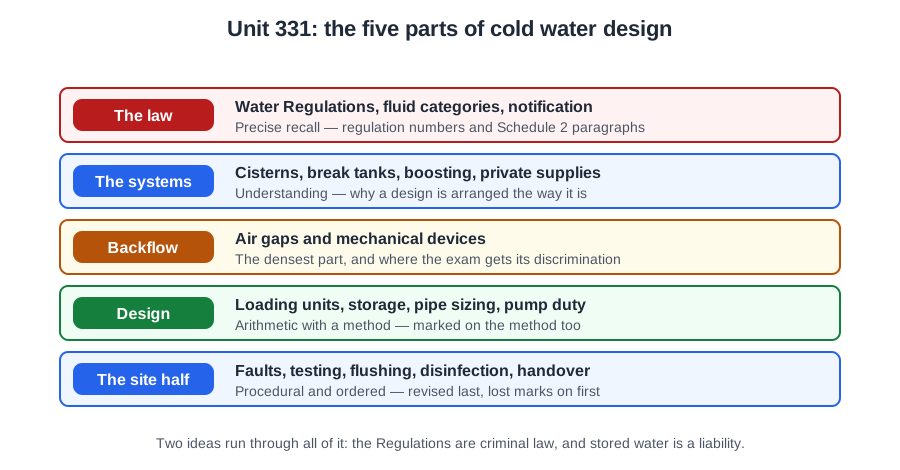
It is not one topic. It is five, and they are assessed differently.
The law. The Regulations themselves, the fluid categories, notification, and who certifies what. This is recall, and it is precise: regulation numbers, Schedule 2 paragraph numbers, the ten working days, level 3 on the standard scale. It is also the part that appears in the synoptic assignment as a justification rather than as a fact.
The systems. Cisterns in tall buildings, break tanks, boosted and pressurised systems, private supplies, and the specialist valves and pumps that go with them. Understanding, not recall — you are asked why a design is arranged the way it is.
Backflow. Air gaps, mechanical devices, and the matching of device to fluid category. This is the single densest part of the unit and the one that produces most of the exam's discrimination, because the tables look learnable and the applications are not.
Design. Loading units, demand, storage volumes, pipe sizing, pump duty. Arithmetic with a method behind it. You are marked on the method as much as the number.
The site half. Diagnosing faults, repairing, filling, pressure testing, flushing, disinfection, and the paperwork that closes a job. Procedural, ordered, and the part people revise last and lose marks on first.
What actually makes it hard
The Regulations reward precision and punish paraphrase. "You have to protect against backflow" earns nothing. "Schedule 2 paragraph 15(3) requires the device to match the highest fluid category downstream of it" earns the mark. Learn the numbers with the rules attached.
The fluid categories are about what could happen, not what did. Category 5 is not "dirty water" — it is a defined list, and a hose end lying in a cattle trough on a dry day is already a contravention, because the test is the arrangement.
Sizing has a direction of travel. Appliances give you loading units; loading units give you a simultaneous demand; demand plus available head gives you a pipe size. Learners who memorise a table without the sequence cannot answer a question that changes one input.
Commissioning is a sequence, and the order carries the marks. Fill, vent, test, flush, disinfect, sample, record. Doing them in a different order is not a matter of taste — disinfecting before flushing wastes the disinfectant on the debris rather than the pipe.
Where it connects to the rest of the course
Unit 332 takes the same backflow thinking into hot water and adds temperature. Unit 334 takes the same commissioning discipline into drainage. Unit 336 is where the notification and certification in this unit stop being a legal topic and become part of a programme of work with a cost attached.
If you are choosing where to start on Level 3, start here. Nothing else on the qualification makes as much sense on its own.
Every article on Unit 331
One article per section of the unit. Each is a complete answer on its own, and each ends with a self-test drawn from the course question bank.
🔢 The numbers worth memorising
- Water Supply (Water Fittings) Regulations 1999
- in force 1 July 1999, made under s.74 Water Industry Act 1991
- Penalty for a contravention
- a fine not exceeding level 3 on the standard scale (Regulation 7)
- Notification
- before work starts; the undertaker has 10 working days to respond
- Notifiable bath
- over 230 litres, measured to the centre line of the overflow
- Notifiable pump
- more than 12 litres per minute drawn from a supply pipe
- Typical mains pressure
- 3 to 7 bar, about 30 to 70 m head — roughly eight storeys, less friction
- Fluid categories
- 5 of them, from wholesome mains water to a serious health hazard
⚠️ Where people go wrong
- Treating the WRAS guide as the law. The Regulations are the law; where Schedule 2 and the Guidance Document differ, Schedule 2 governs.
- Assuming a WIAPS card removes the duty to notify. The Regulation 5(2) exemption covers items 2, 4(b) and 4(g) only — a 260 litre bath in a private house still needs notifying.
- Thinking a private borehole supply is outside everything. The Water Regulations do not reach it; the Private Water Supplies Regulations do.
- Reading “aesthetic quality impaired” as contamination. Softened water, changed in taste but not in safety, is fluid category 2, not 3.
- Sizing a booster set for peak demand with no allowance for one pump being out. Duplicate pumps are sized so peak demand is still met if one fails.
📝 10-Question Self-Test
Straight from the Level 3 course question bank. Click an option to see whether you got it right — the explanation appears instantly, and there is nothing to submit.
Regulation 3 forbids installing, connecting, arranging or using a fitting so that it causes or is likely to cause waste, misuse, undue consumption or contamination of the water supplied, or its erroneous measurement.
The question asks for the item of LEGISLATION. The Water Supply (Water Fittings) Regulations 1999 require every water system to be tested for water-tightness before it is brought into use.
Regulation 2(2) takes fittings out of scope where the water is supplied for a purpose other than domestic or food production, is metered, runs for no more than a month (three with the undertaker’s written consent) and cannot flow back through the meter. An outside tap on a private house is domestic use and stays in scope, whatever pipework feeds it.
Every fitting that conveys or receives water supplied by an undertaker falls under the Water Supply (Water Fittings) Regulations 1999; Regulation 2 applies them to any water fitting installed or used in premises the undertaker supplies. Building Regulations Part H covers drainage and waste, not the incoming water supply, so it is not what governs the fitting.
Regulation 3(2)(ii) adds the erroneous measurement of water supplied by the undertaker, and regulation 3(3)(ii) repeats it for fittings that are damaged, worn or faulty, which is why fittings must not bypass or disturb the meter. Regulation 3(1) itself is only the general prohibition on installing, altering, disconnecting or using a fitting in contravention of the Regulations.
Notifiable building work needs a building notice or full plans deposited with Building Control before work starts; the officer cannot inspect what is already covered up.
Item 4(a) of the Regulation 5 table makes a bath of more than 230 litres, measured to the centre line of the overflow, notifiable anywhere, a house included, because of the demand it puts on the supply. A bidet is only notifiable where it has an ascending spray or flexible hose, and an RPZ valve only where it protects against fluid category 4 or 5.
Item 4(d) of the Regulation 5 table makes a pump or booster drawing more than 12 litres a minute notifiable. A bidet is notifiable only with an ascending spray or hose, a bath only over 230 litres, and an RPZ only when it protects against category 4 or 5.
The Regulations require a servicing valve on the outlet pipe of every storage cistern, the one exception being a cistern feeding the primary circuit of a heating system.
A servicing valve must be fitted upstream of, and as close as practicable to, every float-operated valve so it can be isolated for maintenance without draining the system.
Going further: the Unit 331 lessons
These articles are the public answer. Unit 331 of the Level 3 course takes the same ground to the depth the exam and the synoptic assignment ask for, in 57 lessons across 15 sections, each with its own quizzes, flashcards, key facts, an AI-marked short answer and interactive tasks.
- The Water Regulations
- Notification and certificates
- Cisterns in multi-storey buildings
- Boosted cold water systems
- Private water supplies
- Specialist taps, valves and pumps
- Backflow risk and air gaps
- Mechanical devices and cross connections
- Design information and measurement
- Sizing cisterns, pipes and pumps
- Diagnosing and isolating the fault
- Repairing and re-commissioning the system
- Inspecting, filling and pressure testing
- Flushing, disinfection and performance checks
- Records, certificates and handover
- All PlumbMate articles — Level 1, 2 and 3
- The Level 3 course — the whole 8202-35 Diploma