A tenant rings to say the heating has been switching itself off for a fortnight, but never at the same time of day. You arrive, run the system, and it behaves perfectly.
The short answer
On a fault like that, the most useful piece of test equipment you own is a conversation. The person who lives with the system has watched it fail a dozen times; your instruments have watched it work once.
Then the order is fixed: gather information, verify the symptom, consult, then test. And one rule sits over all of it — a fault code names a symptom, not a part.
Gathering information first
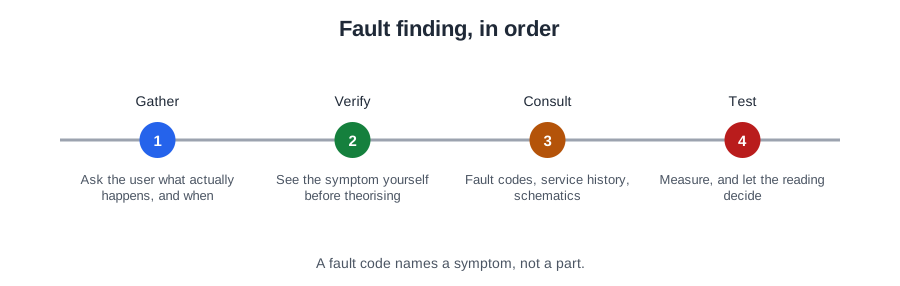
Talking it through with the customer is the best way of gathering information about an intermittent fault. A boiler data plate, a pump rating label or an analyser printout tells you what the equipment is; none of them tells you what it has been doing. In a rented dwelling, the tenant is the most reliable source — the agent holds the paperwork and the helpline knows the product, but the tenant sets the programmer and hears the noise at six in the morning.
The questions worth asking:
- When did it first happen, and how did you notice it?
- What exactly does it do — every radiator, one radiator, heating but no hot water, or the reverse?
- Have you seen water anywhere it should not be — around the cylinder, under the boiler, from the discharge pipe outside?
- Has the pressure or the flow rate changed? A falling pressure or weakening flow points at a leak, a blocked strainer or scale.
- Has anyone worked on it, or tried to put it right themselves? Repairs already attempted may have to be undone before the real fault will show.
- What was the result — did it lock out, did you reset it, did it come back on its own?
Separate what the customer observed from what they concluded. Somebody who says the pump has gone has given you an opinion; somebody who says the radiators were cold but the boiler was hot and rumbling has given you evidence — and that particular piece of evidence is worth a great deal.
Two shortcuts get people into trouble. The first is replacing whatever component the fault code names: a low pressure code on a heat pump does not mean the pressure switch has failed. The second is isolating the appliance, stripping the casing and inspecting everything — that is a search, not a diagnosis, and it usually ends with a working system reassembled badly.
Reason from what is working as well as from what is not. If the hot water is fine and the radiators are cold, the heat source and the circulator are both proved good, so the fault lies in what happens to the heat after that.
Fault codes, flow charts and the service history
A fault code means nothing without the documentation of the manufacturer that wrote it. The same three digits mean a flow sensor on one make and a high pressure trip on another, so the diagram to refer to is the maker's schematics for that particular unit.
Manufacturer literature gives three things: known problems and their symptoms; a fault diagnosis flow chart (found in the servicing literature, not a parts diagram or a merchant's catalogue); and the replacement technique. Order parts by the model number of the appliance and the part number from the list.
British Standards give you the figures the system was designed around and are used together with the maker's literature. Where the two differ on a particular product, the manufacturer's instructions take precedence — the appliance was tested and approved as the maker specified it.
A flow chart only works if you answer each step honestly and in order. Skipping to the step that matches your hunch is how a good chart produces a wrong answer. If a step asks for a measured value, measure it; if it asks whether a supply is present, prove it with a voltage indicator, not by looking at a neon.
Suppose the chart for a no-heating fault begins: is there a call for heat at the appliance terminal? You measure, and there is not. The chart sends you back through the controls rather than into the boiler, and you have eliminated the whole appliance in one step. A good chart is written to eliminate the largest number of possibilities with the earliest checks — which is exactly why the order matters.
And know when to stop. A fault is escalated to the manufacturer or a specialist where it is beyond your competence or authorisation. That is the test — not whether the fault is difficult, and not whether the customer wants a second opinion. Escalating early is professional; guessing on somebody else's equipment is not.
The commissioning record as your baseline
You measure a flow temperature of 52 °C and a difference of 8 K across a heat pump. Is that good or bad? On its own it is neither. Against a record showing 45 °C and 5 K on the day it was set to work, the same reading says something has changed.
A service needs four documents: the manufacturer's service schedule, the commissioning record, the previous service records and the schematic. Without them you are guessing at what normal looks like on this system.
The commissioning record says what the system achieved and was set to when it worked correctly. Not a warranty document, not a notification, not the maker's rated figures — the measured behaviour of this system, in this house.
That makes it the answer to one of the commonest complaints. A customer says the house has never felt as warm since somebody adjusted the controls after a power cut. You do not start looking for a failed part: you check the current settings against those recorded at commissioning and restore what was recorded. The repair often involves no parts at all.
Where there is no record, take a full set of readings before you alter anything, so at least today becomes next year's baseline. And write numbers, not verdicts: a difference creeping from 5 K to 6 K to 8 K over three visits describes a circuit slowly restricting. Caught then, it is a filter clean; noticed only when the appliance locks out, it is a callout and possibly a damaged component.
Emitter cold spots
One radiator hot along the top and down both ends but cold across the middle and bottom; another hot underneath and cold along the top. Two completely different faults, and you can tell them apart with the palm of your hand.
| Pattern | Cause | Action |
|---|---|---|
| Cold at the top, hot at the bottom | Gas trapped in the top | Vent it; find out where the gas is coming from |
| Hot at the top and sides, cold in the middle and bottom | Black oxide sludge in the slow-moving water | Remove and flush the emitter, then clean the system |
| Cold all over, pipes hot | A closed or stuck valve, or an air lock in that branch | Check both valves before condemning anything |
| Whole system slow, boiler banging | Scale or sludge in the heat exchanger | Clean and flush, then treat the water |
Venting a radiator once is routine. Venting the same one or two every few weeks is a fault. That gas may not be air at all — it is often hydrogen produced by electrolytic corrosion, which is why it collects repeatedly in the same emitters. Hydrogen is highly flammable, so never vent near a naked flame.
Magnetite settles wherever the water moves slowly. BS 7593 clause 5.2 names sludge as the most common cause of failure of water-carrying components — heat exchangers, pumps, radiators and controls — and notes it restricts flow badly in small-bore and microbore circuits. Because it is magnetic, it also gathers on anything producing a magnetic field.
Taking one radiator off and hosing it through in the garden works for that radiator, and only until next winter. The problem is system deep, and powerflushing is the process used to put right blocked heat emitters.
In hard water areas, calcium carbonate comes out of solution in the hottest part — the heat exchanger — and scale and sludge cause the boiler noise known as kettling. Where mains total water hardness exceeds 200 parts per million, provision is made to treat the feed water.
Afterwards, clean the in-line magnetic filter at every service: captured magnetite accumulates and eventually restricts flow through the filter itself, and a full filter gets misdiagnosed as a flow fault. Check the inhibitor concentration annually, re-dose at five-year intervals, and never assume the inhibitor is still there — it depletes over time, and after any draining or topping up.
Pumping over and persistent venting
Radiators need bleeding every fortnight. Up in the loft the feed and expansion cistern is warm, and when the boiler fires you can watch water arching out of the open vent pipe. Nobody has a leak. The system is beating itself up.
Pumping over is the pump pushing system water up the open vent so it discharges into the cistern — the pump, vent and cold feed arranged wrongly, putting that part of the circuit under positive pressure. The mirror image is just as damaging: the other way round, the pump puts that point under negative pressure and sucks air down the vent.
Either way the water is aerated. Oxygen drives corrosion, corrosion produces hydrogen and magnetite, and the customer vents fortnightly. Persistent venting is a symptom, not a job — something is putting gas into the water and it will not stop until the arrangement is corrected.
The cure is the neutral point: vent, cold feed, then pump working away from the boiler, both connections on the suction side and no more than 150 mm apart. Where the pipework will not allow it, an air separator makes close coupling of the cold feed and vent possible, giving both a single point on the flow and releasing entrained air at the same time.
The rest of the open vented faults:
- Water from the cistern overflow on heat-up — the cold level is too high to accommodate expansion. Reset the float valve to shut off lower.
- Float valve stuck shut — no make-up water, so the level drops and the system draws air.
- Blocked cold feed or air separator — the system will not refill after a drain down.
- Combined feed and vent, common on older systems — air locks every time the system is drained. They must be separated or it recurs.
BS EN 12828 requires the cistern at the highest point, with an overflow one size larger than the filling pipe, and the open vent safety pipe connected to the heat generator at not less than 19 mm internal diameter.
The check on site takes ten seconds. Look into the cistern cold, then start the pump and watch the vent. Water discharging from it is pumping over; a dimple or whirlpool over the cold feed is the system pulling down instead. Either observation settles a fault that could otherwise be blamed on the boiler.
Poor circulation
An open vented, fully pumped system: the hot water is lukewarm, the upstairs radiators are lukewarm, and the downstairs radiators are stone cold. The boiler is firing.
The circulating pump has failed. With no pump, a little heat still drifts upwards by gravity, so the cylinder and the upstairs emitters get lukewarm — but nothing at all reaches the radiators below the boiler, because gravity will not push heat downwards. A locked-out overheat stat would give no heat anywhere; a satisfied cylinder stat would not stop the radiators; a stuck float valve does not choose between floors.
The first sign of pump failure is usually cold radiators or an unusual noise, and often the boiler shuts down on its high-limit energy cut-out, because the heat it is making is not being carried away.
- Check the rest of the system is working — stats calling, motorised valves opening.
- Switch off at the switched fused spur.
- Remove the centre bleed screw and check with a screwdriver that the shaft rotates freely. A pump seized by sludge often runs afterwards.
- With the supply restored, check for 230 V at the pump terminals with an approved voltage indicator — not a multimeter. If 230 V is present and it does not run, the pump is faulty and must be replaced.
| Symptom | Fault | Repair |
|---|---|---|
| Motor running, water not moving | Worn or broken impeller | Replace the pump |
| 230 V at the terminals, nothing happens | Burnt out motor | Replace the pump |
| Water weeping from the body | Cracked casing | Replace the pump |
| Slow to start | Faulty capacitor | Replace the capacitor if the maker allows |
Not every pump complaint is a failure. A pump left on its lowest speed after someone chased a noise complaint will warm the near radiators and starve the far ones, and a pump fitted the wrong way round moves almost nothing. Check the speed setting against the commissioning record before condemning a pump that is plainly running.
One circuit cold while the other zones are warm is an air lock in that circuit — not a boiler fault, because the others are working. Vent it with the other circuits isolated, which forces the whole flow round the affected one and drives the pocket out. Blockages behave differently: gradual rather than sudden, showing as a wide temperature difference with poor output.
Valves, and heat with no demand
A stuck TRV gives a cold radiator with hot pipework right up to the valve — a failing valve or debris holding the pin down, and valves that sat untouched all summer are the usual offenders. Take the head off and work the pin gently up and down; if it frees, the valve lives. Advise the customer to open the heads fully at the end of the season. And when a radiator comes off for decorating, the TRV is shut off with the proprietary cap supplied with the valve, not by relying on the head.
When a motorised valve does not move on a call for heat, the fault is in the actuator or motor, and the repair is to replace the valve head. A valve that will not shut off is diagnosed with the manual lever, because most close under a spring when the supply is removed:
- Lever moves freely, valve stays open → the spring is broken; replace the head.
- Lever will not move → the valve is seized; the body must be replaced.
- Water weeping below the head → the spindle seal has worn; replace the valve.
Prove the signal before you condemn the valve. If the actuator is receiving its supply and still does not drive, the head has failed. If no supply arrives, the valve is innocent and the fault lies back through the wiring centre, the room thermostat or the programmer. Two minutes with a voltage indicator saves fitting a new head to cure a thermostat.
A boiler and pump running with nothing calling for heat means one of three things: a zone valve stuck open, so its auxiliary switch stays made; a wiring fault backfeeding a live through the wiring centre; or gravity circulation through a valve that is not closing. Behind all three sits the boiler interlock — and on an S-plan the classic culprit is a zone valve whose orange wire stays live after the thermostats are satisfied.
Pressure loss on a sealed system
Topped up three times in six months, and a pale streak of lime on the brickwork under the discharge pipe. That streak is the whole diagnosis.
The correct response to repeated topping up is to find the cause, because every refill brings fresh, oxygenated mains water into a system designed to exclude it and dilutes the inhibitor. Advising the customer to watch the gauge, raising the cold fill pressure so it happens less often, or fitting a bigger vessel to hide it, are all ways of turning a repair into a slow failure.
The water goes to one of three places: a weeping joint or leaking component, a discharging safety valve, or a failed expansion vessel pushing water out through that valve.
- Discharging intermittently as the system heats → the expansion has nowhere to go. The vessel has lost its charge or is the wrong size.
- Dripping continuously → dirt under the seat or damaged seating. Replace the valve.
- Pressure rising steadily when cold → a passing filling loop service valve or double check valve.
A safety valve is checked by twisting the top, holding it open for about 30 seconds, and confirming it reseats with no drips at all.
| Finding at the schrader valve | Cause | Action |
|---|---|---|
| No air charge | Faulty schrader valve | Recharge, test with leak detection fluid, replace if it leaks |
| Water | Ruptured diaphragm; waterlogged | Replace with a vessel of similar capacity |
| Correct charge, valve still lifting | Vessel too small for the system volume | Fit a vessel sized to the system |
Check the charge with the system depressurised, against the maker's pre-charge figure. And the filling loop carries a double check valve and must be disconnected after filling — a loop left in place is a cross connection between category 1 and category 3 water.
Electrical faults on the controls
No heating, no hot water, a blank programmer. Before anybody suggests a new boiler: check the supply, the switch, the fuses, the overloads and the wiring. Controls are fed through a switched fused spur with a 3 A fuse, and that fuse is where a surprising number of no-heat calls end. Never replace a fuse with one of a higher rating — a bigger one simply moves the failure somewhere more expensive.
Before a panel comes off: identify, isolate, check, test, prove, confirm — and the re-prove is the step that catches an indicator that failed during the test. Where residual energy may be present there must be means of discharging it and a label giving the discharge time, which is why you wait as the manufacturer instructs before touching the inside of an inverter-driven unit.
First, check the system is wired correctly. Only start suspecting components once you are sure of the wiring. And during testing, disconnect the terminals that could backfeed a voltage through another control, or you will chase a reading that is not real.
- Cylinder thermostat — with C, 1 and 2 correctly wired and 1 and 2 disconnected, it is faulty if terminal 1 does not become live when calling, or terminal 2 when satisfied, C being live in both cases.
- Room thermostat — remove the wire from terminal 3, confirm terminal 1 is live, then turn the stat up. No live at 3 means it is faulty. Dust on the sensor, a lost radio link, flat batteries or a lost internet connection all give the same complaint of cold radiators.
- Programmer — suspect it only after checking any required links are fitted, that it has power at the correct terminals and that the timing is set correctly.
Heat pump patterns
Two systems, the same complaint. On one the temperature difference reads 11 K where the design was 5 K, and it keeps locking out. On the other the difference is exactly 5 K and the house is still cold. They are opposite faults, and two readings tell them apart.
The pair to take is the temperature difference across the heat pump, and the brine or air conditions at the source. A wide difference points at the water side; a normal difference with poor output points at the source.
- Wide difference with high pressure lockouts → lost water flow: a blocked filter, a valve, or a failing pump. Check the in-line filter first — commonest cause and quickest to eliminate.
- Low pressure lockout on a ground source unit, with brine below the commissioning figure → a leak in the collector circuit. Exactly why the brine pressure is recorded at commissioning.
- Cycling after another trade fits TRVs throughout → as the valves close, the volume in circulation and the flow through the unit fall below what it needs. The remedy is an open, stable circuit: the reference room should not have a TRV.
- Electricity consumption jumped and the immersion running often → the heat pump is failing to meet the hot water demand and the immersion is making up the difference at a COP of 1. Look at a cylinder setpoint above what the unit can reach, an undersized or fouled coil, a pasteurisation cycle set too frequently, or a diverter fault.
- One room never reaching temperature → that circuit, not the system: its design flow, or an emitter too small for the room at a low flow temperature. Common on retrofits.
- A whining outdoor fan with no fault codes → no fault code means the controls see nothing abnormal, so the answer is mechanical: clearances, obstructions and fan defects.
Notice how often the answer came from a comparison rather than a component. Eleven kelvin means nothing until you know the design was five. Take the readings, write them beside the commissioned figures, and the pattern usually names the fault before you have opened anything.
On the annual service, the two things that degrade between visits on an air source unit are airflow into the coil and drainage away from it. Isolate first, then clean gently so the fins are not bent — a pressure washer at close range, a wire brush or cleaning with the unit running all make it worse. Clear the drainage route before winter: blocked, the meltwater pools, freezes, obstructs the coil and makes the ground beside the unit a hazard.
So heavy ice means an air-side or defrost-control fault — restricted airflow, meltwater refreezing, or a cycle not initiating or terminating correctly. Inhibitor concentration is the least likely cause of icing: that is a water-side matter and the ice is on the air side.
Two findings are never simply corrected and left: repeated top-ups, and a refrigerant charge that has fallen again. Both mean something is leaking, so both are recorded as well as repaired.
Underfloor faults
Everything before the blending valve is the primary; everything after it is the floor. That line decides where you look.
- Cool water arriving at the manifold before the mixer → the fault is upstream and there is no point touching the loops. Is the boiler firing, is the primary pump working, are the primary pipe sizes adequate? Lockshield settings, actuator travel and floor coverings are all downstream and cannot explain a cool supply.
- One room that never gets there → a circuit problem. Check that loop's flow rate against the design figure at the flow meter, then ask whether the floor covering actually laid matches the one the design assumed — a thick carpet over a screed designed for tiles will lose several degrees and no amount of rebalancing will get it back. Check the actuator too: a failed one gives the same symptom in five minutes of checking.
- A floor that is far too hot, typically a hallway → circuits crossing it that were never insulated. Every loop passes through the hall on its way somewhere else. It is neither a thin screed, nor the blend temperature, nor that loop's own balancing.
- One cold loop among warm ones → almost always an air lock. Isolate the other loops so the whole flow is forced round the affected one, and vent at the manifold.
One warning before diagnosing anything by hand: a heated floor is slow. A floor that feels cool an hour after switching on may be behaving perfectly. Judge it by the flow meters, the manifold temperatures and the room temperatures reached, not by how the tiles feel to a palm in the first hour.
And this is where the record matters most of all: underfloor heating hides everything it does under a floor, so the paperwork is the only view you get. Without it, today's readings compare with nothing.
🔢 The numbers worth memorising
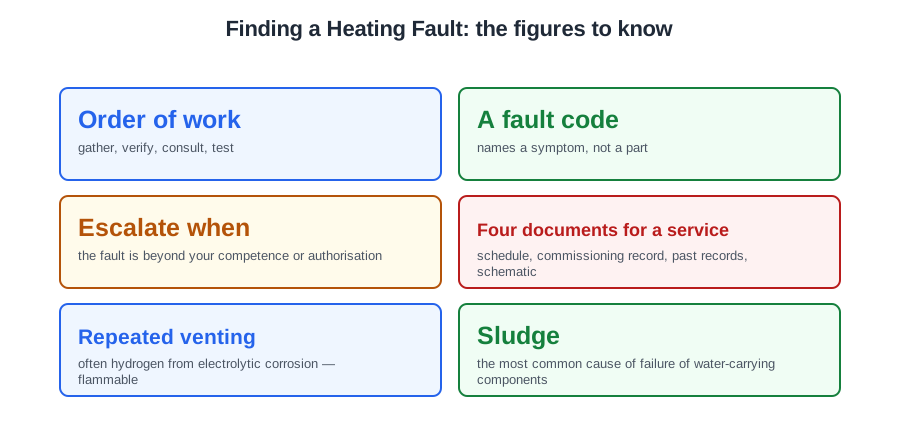
- Order of work
- gather, verify, consult, test
- A fault code
- names a symptom, not a part
- Escalate when
- the fault is beyond your competence or authorisation
- Four documents for a service
- schedule, commissioning record, past records, schematic
- Repeated venting
- often hydrogen from electrolytic corrosion — flammable
- Sludge
- the most common cause of failure of water-carrying components
- Hard water threshold
- 200 ppm total hardness
- Neutral point
- vent, cold feed, pump — within 150 mm, suction side
- Open vent pipe
- not less than 19 mm internal diameter
- Cistern overflow
- one size larger than the filling pipe
- Pump failed
- upstairs lukewarm, downstairs stone cold — gravity only lifts
- Controls fuse
- 3 A, never uprated
- Safety valve test
- held open 30 seconds, reseats with no drips
- Water at the schrader valve
- ruptured diaphragm
- Heat pump 11 K on a 5 K design
- a water-side restriction
- Low brine pressure
- a collector leak
- Immersion running often
- hot water demand unmet — backup at a COP of 1
⚠️ Where people go wrong
- Testing before talking. On an intermittent fault the customer has seen what your instruments cannot.
- Taking the customer’s conclusion as evidence. Ask for the observation behind it.
- Replacing the component a fault code names.
- Stripping an appliance to look. That is a search, not a diagnosis.
- Decoding a code from a generic wiring diagram. It needs that maker’s schematics.
- Jumping to the step of a flow chart that matches your hunch.
- Reading 8 K as good or bad without the commissioning figure.
- Bleeding the same radiator every fortnight and calling it maintenance.
- Hosing one radiator out in the garden. The problem is system deep.
- Venting hydrogen near a naked flame.
- Leaving a magnetic filter uncleaned, then diagnosing the restriction as a flow fault.
- Assuming the inhibitor is still there after a drain down.
- Blaming the boiler for pumping over. Watch the vent for ten seconds.
- Condemning a running pump without checking its speed against the record.
- Using a multimeter to prove 230 V at a pump.
- Replacing a valve head before proving whether the signal reaches it.
- Relying on a TRV head to shut a radiator off for decorating.
- Treating repeated topping up as a habit rather than a fault.
- Raising the cold fill pressure, or fitting a bigger vessel, to hide a discharge.
- Suspecting components before proving the wiring.
- Uprating a 3 A fuse.
- Cleaning an evaporator coil with a pressure washer, a wire brush, or the unit running.
- Blaming inhibitor for icing. The ice is on the air side.
- Rebalancing an underfloor loop to fix a floor covering the design never assumed.
- Judging a screed floor by hand an hour after switch-on.
📝 10-Question Self-Test
Straight from the Level 3 course question bank. Click an option to see whether you got it right — the explanation appears instantly, and there is nothing to submit.
Fault-finding flow charts are written by whoever knows the appliance. The manufacturer publishes them in the installation and servicing literature supplied with the boiler, keyed to that model’s components, sensors and lockout codes. The Benchmark checklist is the tempting answer, but it only records commissioning and service history; it diagnoses nothing.
Talk it through with the customer. An intermittent fault is not present when you arrive, so the only record of it is what somebody in the house has seen: when it happens, what the weather was doing, whether hot water is affected too. A data plate or a pump rating label tells you what the equipment is, never what it has been doing.
The tenant. They set the programmer, feel the cold radiator and hear the noise at six in the morning, so they are the only person with first-hand evidence of the symptom. The letting agent holds the paperwork and the manufacturer’s helpline knows the product inside out, but neither of them has been in the room while the fault was happening.
The relief valve of an RPZ opens whenever the pressure in the middle zone rises to within 0.14 bar of the inlet pressure. That happens when the first check valve no longer holds, so inlet pressure leaks into the zone and the relief port runs continuously.
If both connections are at design temperature but the body stays cold, water is passing across the top of the radiator instead of through it — magnetite sludge has silted up the waterways. Drain, remove and flush it. Air trapped in the pump would stop circulation everywhere, and the flow and return would not be hot at all.
With the pump dead the boiler still fires and the hot water still moves, but only by gravity: it rises into the upstairs circuit and never reaches the downstairs radiators, which sit at or below boiler level. A room thermostat set too high is the tempting answer, but that would make the system run more, not leave half of it stone cold.
Replace the valve head. When the system calls for heat and the valve does not move, the fault is in the actuator or its motor, and the head is a replaceable unit that comes off the valve body without draining the system. Fitting a larger expansion vessel answers a pressure problem, not a valve that will not drive, and bleeding radiators answers air.
The circulating pump has failed. With no pump a little heat still drifts upwards by gravity, so the cylinder and the upstairs radiators go lukewarm, but nothing reaches the radiators below the boiler because gravity will not push heat downwards. A locked-out overheat thermostat would leave the whole system cold, and a satisfied cylinder thermostat would not stop the radiators.
An expansion vessel of the wrong size, or one that has lost its air charge. The vessel has to swallow the extra volume as the water heats; if it cannot, the pressure climbs past the safety valve setting every time the boiler runs and the valve dumps the difference. A zone valve stuck open only changes where the water goes, and an undersized gas pipe starves the burner rather than raising system pressure.
Airflow in and water away are the two things that degrade between visits.
Going further: the lessons behind this article
This article is the public answer. Unit 333 of the Level 3 course takes the same ground to the depth the exam and the synoptic assignment ask for, in 12 lessons:
- Gathering information from the end user before you test
- Manufacturer instructions, fault codes and flow charts
- Service histories and the commissioning record as your baseline
- Emitter cold spots: air at the top, sludge at the bottom
- Pumping over and persistent venting on open vented systems
- Poor circulation: air locks, blockages and pump faults
- Stuck TRVs, motorised valves and heat with no demand
- Pressure loss, a discharging safety valve and the expansion vessel
- Electrical faults on the controls: supply, fuses and wiring
- Servicing a heat pump: coil, defrost and the water side
- Heat pump fault patterns: temperature difference and pressures
- Underfloor heating faults: the manifold, the loops and a hot floor
- Central heating systems: the Unit 333 guide — every article on this unit in one place
- All PlumbMate articles — Level 1, 2 and 3
- The Level 3 course — the whole 8202-35 Diploma