You have proved a ruptured expansion vessel diaphragm on a February afternoon. The replacement is not on the van. The system has to come out of service, and there are three people in the house who will notice.
The short answer
From here on, every repair follows the same seven steps in the same order:
diagnosis → notifying the client → safely isolating → decommissioning → rectifying → re-commissioning → handing over
The diagnosis is only the first of them, and the last three are the ones most often rushed. A repair is not finished until the readings prove it.
Tell the client first
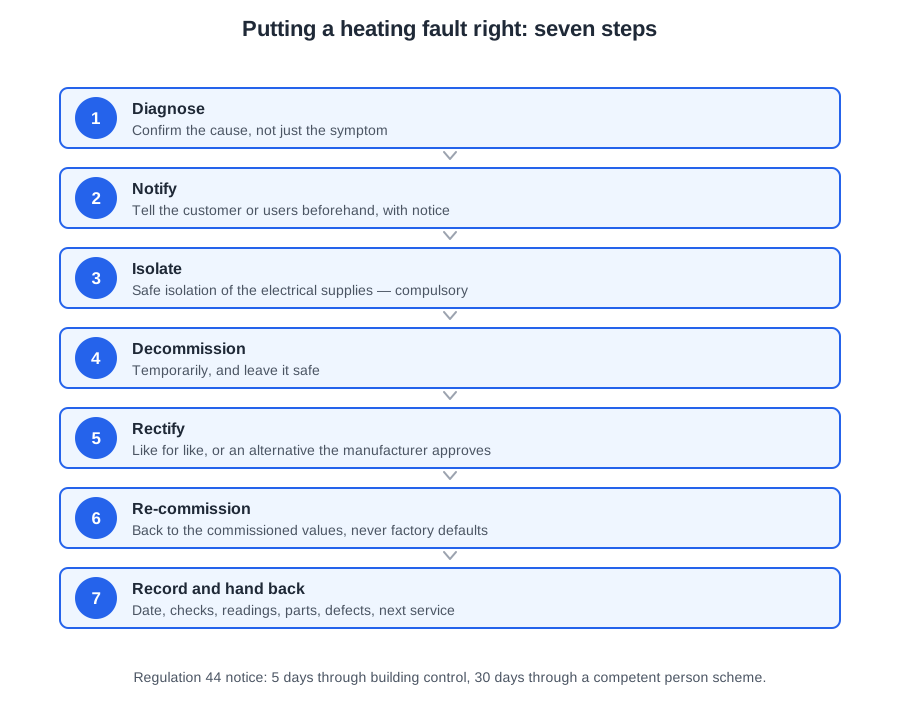
Before a boiler or a system is shut down, tell the customer or the system users beforehand and put warning notices at the isolation point. You do not notify the fuel supplier, you do not inform the local authority, and you certainly do not switch off the electrical supply to the whole property.
Keep the householder or the responsible person informed of which areas are being isolated and for how long. Ask who is in the building — a young family or an elderly occupant in winter changes the job. Agree what happens overnight, offer temporary heating where it is needed, and say clearly when you expect to be back with the part.
Temporary decommissioning
Temporary decommissioning is the term for isolating a system while maintenance is carried out. It comes in two forms: planned preventative maintenance, arranged in advance, and unplanned or emergency maintenance, which is not.
Where a key component — the expansion vessel, the safety valve, a motorised valve, a thermostat — is found to be faulty, the system is isolated and temporarily decommissioned until the replacement part is obtained and fitted.
The step that is not optional is that the electrical supplies to the controls are safely isolated. Turning the boiler thermostat to maximum, dosing fresh inhibitor or setting the pump to full speed have nothing to do with taking a system out of service safely.
Isolate using the full procedure: identify, isolate and lock off retaining the key, check the indicator, test dead, prove the indicator again, confirm. Then post the notice at the point of isolation reading system off — do not turn on, so nobody restores the supply while you are inside the wiring centre.
On the water side, close the isolating valves either side of the pump, or the service valves around the component, so you drain the least water possible. Cap off any open ends until the new component is installed — open pipework attracts debris, and debris is the thing you have spent the day removing. Shut off a TRV with the proprietary cap that came with the valve. And remember every litre drained is a litre of inhibitor lost, so plan the drain-down to save what you can.
Write it down as you go. Repairs and maintenance are recorded on the maintenance schedule at the time of completion, with their location, the date and the tests performed. That record is what makes the next visit start from something rather than nothing, and it is your evidence of the state you left the system in.
Know the limits of your own ticket as well. Work on a gas appliance belongs to a Gas Safe registered engineer, and the sealed refrigerant circuit of a heat pump belongs to somebody qualified to open it. Isolating a system and making it safe is always within your remit; working inside somebody else's sealed equipment is not. Where the repair belongs to a specialist, decommission the system, tell the customer plainly why, and arrange the visit rather than improvising.
Rectifying
Components are replaced like for like. Where an identical part is not available, check with the manufacturer that the alternative is approved for use with that system. Follow the maker's servicing instructions for the order of dismantling and reassembly, and order parts by model number and part number so what arrives is what fits.
Re-commissioning
The new vessel is on and the system holds pressure. It would be very easy to pack up now, and the job would still be half finished.
Re-commissioning means putting the system back to the state the commissioning record describes:
- Refill and vent, working from the low points upwards, and restore the cold fill pressure recorded for that system.
- Remove and disconnect the filling loop once the pressure is right.
- Restore every control setting to its commissioned value — not to factory defaults, which are somebody else's house.
- Re-balance where anything affecting flow has been changed, and prove the affected circuits get hot.
- Where the water has been drained or diluted, check the inhibitor protection meets the manufacturer's concentration. BS 7593:2019 requires it after work that significantly dilutes or replaces the protection.
- Re-check the readings the fault affected, and record what was found and done.
Where the work counts as providing or extending a fixed building service, regulation 44 requires a notice confirming the system has been commissioned to be given to the local authority. Where a building notice or full plans went to building control, it is due by the time of the completion notice, no more than 5 days after completion. Under a competent person scheme such as Gas Safe, OFTEC or MCS, the work is notified through the scheme within 30 days and the customer receives a compliance certificate.
The record, and handing back
After routine inspection, service or maintenance, record the date, the checks made, the readings taken, any parts fitted, the defects found and the next service due. Six items — and the readings are what makes the record worth keeping, because they are what the next engineer compares against.
On a full installation the customer receives a file containing the manufacturers' installation, operation and servicing manuals, the commissioning records and certificates, the Building Regulations compliance certificate, and an as-fitted drawing showing isolation valves, drain-off points, strainers and the electrical controls. After a repair the file is smaller, but the shape is the same.
Then walk the customer round it: show them the controls and how to set them, point out the emergency isolation points and demonstrate isolating the system, explain what went wrong and what you did about it, and give them the readings you have just taken. Tell them what to watch between visits — the pressure, the unit clear of debris and snow, the drainage — and when the next service is due. Leave emergency contact numbers.
Ask whether they have any questions, use words they will understand, and look for the signs that they have actually followed you; if not, go through it again.
And be honest about what you have not fixed. A rust spot weeping on a radiator, a valve that will not be worth touching next time, an inhibitor level only just acceptable — say so and write it down as a defect found. A customer who has been told is a customer who can plan; a customer who finds out through a burst radiator remembers who was there last.
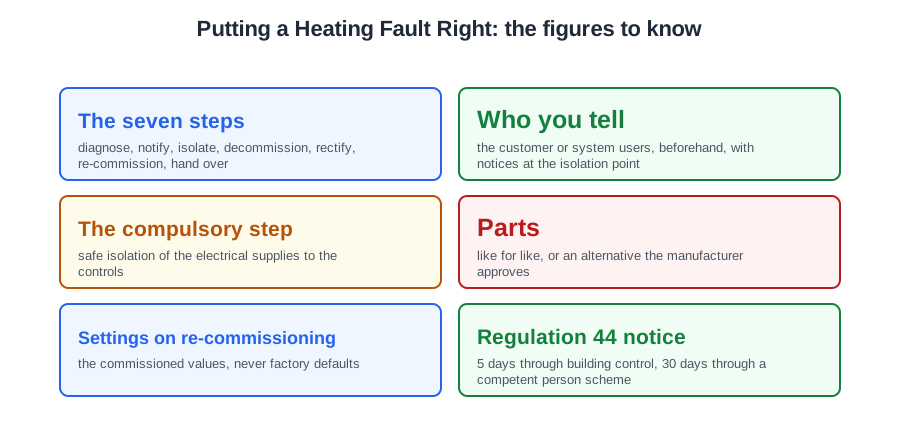
🔢 The numbers worth memorising
- The seven steps
- diagnose, notify, isolate, decommission, rectify, re-commission, hand over
- Who you tell
- the customer or system users, beforehand, with notices at the isolation point
- The compulsory step
- safe isolation of the electrical supplies to the controls
- Parts
- like for like, or an alternative the manufacturer approves
- Settings on re-commissioning
- the commissioned values, never factory defaults
- Regulation 44 notice
- 5 days through building control, 30 days through a competent person scheme
- The six record items
- date, checks, readings, parts, defects, next service due
⚠️ Where people go wrong
- Shutting a system down before telling the people who live with it.
- Notifying the fuel supplier or the local authority instead of the customer.
- Switching off the whole property’s electrical supply.
- Skipping the electrical isolation because “only the water side” is being worked on.
- Draining the whole system when service valves would have saved most of it — and the inhibitor with it.
- Leaving pipe ends open while you wait for a part.
- Improvising on a gas appliance or a sealed refrigerant circuit.
- Fitting a non-identical part without asking the manufacturer.
- Restoring factory defaults instead of the commissioned settings.
- Leaving the filling loop connected after re-filling.
- Skipping the inhibitor check after a drain down.
- Packing up once the system holds pressure. Re-check the readings the fault affected.
- Recording a verdict instead of the readings.
- Saying nothing about the defects you noticed but did not fix.
📝 10-Question Self-Test
Straight from the Level 3 course question bank. Click an option to see whether you got it right — the explanation appears instantly, and there is nothing to submit.
Isolating valves, on the inlet and on the outlet. With one each side you close them both, undo the unions, and only the water in the pump body comes out, so a pump change takes minutes instead of a full drain-down, refill, vent and re-dose. Automatic air vents are fitted at high points to clear air; they do nothing to let you remove a pump.
Blocked heat emitters. Magnetite sludge settles in the bottom of radiators, so the top warms and the bottom stays cold, and it is system-wide rather than one radiator’s problem. Powerflushing circulates a cleaner at high velocity through the whole system and through each radiator in turn, with the flow reversed, to lift it out. It does nothing for low pressure, which is a leak or an expansion vessel fault.
Safely isolating the electrical supplies to the controls. Until the boiler, pump, valves and wiring centre are dead and locked off, anything can be energised while you have it apart, and the pump can run dry once the water is out. It is the one step that is not optional. Dosing inhibitor into a system being taken out of service achieves nothing.
Tell the customer or the system users first, and hang warning notices at the point of isolation. They need to know they will have no heating and for how long, and anyone who finds the switch off has to see why and who to ask. Switching off the whole property’s electrical supply is far more than the job needs and takes out the lights, the freezer and everything else.
Bent fins block the airflow you were cleaning the coil to restore.
The re-prove is the step that catches an indicator that failed during the test.
A repair is not finished until the readings prove it and the record captures it.
Six items, and the readings are the ones that make the record worth keeping.
Escalate when the work is beyond your competence or your authorisation — a sealed refrigerant circuit, a warranty-restricted repair, gas work outside your registration. That is the test, and it is about what you are qualified and permitted to do. “A fault code you have not encountered before” is not the test: you look that one up in the manufacturer’s literature or ring the technical helpline and get on with it.
Three things a customer can see without tools, and all three matter.
Going further: the lessons behind this article
This article is the public answer. Unit 333 of the Level 3 course takes the same ground to the depth the exam and the synoptic assignment ask for, in 2 lessons:
- Notifying the client, safe isolation and temporary decommissioning
- Rectifying, re-commissioning and handing back
- Central heating systems: the Unit 333 guide — every article on this unit in one place
- All PlumbMate articles — Level 1, 2 and 3
- The Level 3 course — the whole 8202-35 Diploma